


14
Aug, 2026
10
Aug, 2026
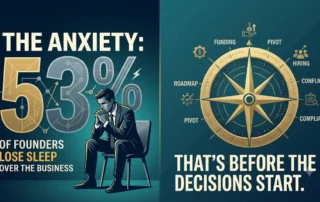
53% of Founders Lose Sleep Over the Business. That’s Before the Decisions Start.
Samantha Lankford2026-08-31T12:37:10-04:0053.5% of founders lose sleep, 47.7% skip their own paycheck, 85% face decision distress. The founder overwhelm trap, in six charts of 2026 data.
7
Aug, 2026
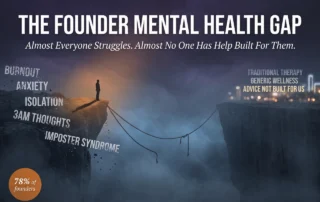
The Founder Mental Health Gap: Almost Everyone Struggles, Almost No One Has Help
Samantha Lankford2026-08-31T12:37:20-04:00The founder mental health gap — almost every founder struggles, almost none get help. The data on burnout, isolation, and why support never reaches the people building companies. In 6 charts.
4
Aug, 2026
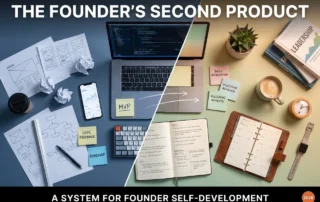
The Founder’s Second Product: A System for Founder Self-Development (2026)
Samantha Lankford2026-08-31T12:37:31-04:00Founder self-development is the second product every founder builds in parallel with the company — and usually neglects. The capability stack, the compounding math, and a repeatable sprint to ship a better you.
4
Aug, 2026

The Founder Identity Crisis: When You Become Your Company (2026)
Samantha Lankford2026-08-31T12:37:36-04:00The founder identity crisis is when your self-worth fuses with your company — 76% of founders feel it. How identity fuses, and the 5-domain protocol to rebuild a self outside the business.
30
Jul, 2026
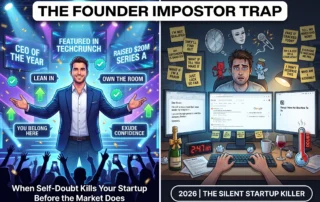
Founder Impostor Syndrome: Why Success Makes It Worse
Michael Dermer2026-08-31T12:38:14-04:00
The Founder Impostor Trap: Why Success Makes It Worse, Not Better
Most founders assume the fraud feeling will fade once they win — once the round closes, the revenue lands, the press calls. It doesn't. For a huge share of founders, the voice that whispers "you'll be found out" gets louder as the stakes rise. In 2026, roughly 70% of people feel it at some point, and 20% of senior leaders feel it constantly. Here's why success amplifies it, and how founders quiet it, in six charts.
Here's the paradox almost nobody warns you about. You'd think impostor syndrome is a beginner's affliction — a first-time-founder wobble that experience cures. The data says the opposite. Among all employees, about 13% feel like a fraud constantly. Among senior managers, that figure climbs to 20%. Success doesn't dissolve the feeling; it raises the height of the fall. The more you achieve, the more there is to be "exposed" about, and the more convinced you become that it was luck, timing, or a con that finally worked.
We've written about founders who check out emotionally, the isolation epidemic at the top, and the identity crisis after exit. The impostor trap is the quiet engine underneath all of them: the belief that you don't actually deserve the seat you're sitting in. It's one of the most common things founders confess once they finally trust the room — and one of the least discussed out loud.
Impostor syndrome doesn't target the incompetent. It targets the conscientious, the ambitious, and the high-performing.
The feeling climbs with the title.
If impostor syndrome were a beginner's problem, this line would fall as seniority rose. Instead, it rises. Hover any point.
Chart 1 — The rising-stakes curve
Why the fraud feeling gets louder as you win
Share who "always or very frequently" feel like a fraud, by level. Hover a point.
Sources: Workplace Insight / national workforce survey (13% all employees, 20% senior managers); Strategy People Culture (45% of leaders aged 24–44 report frequent impostor thoughts, vs 23% aged 55–74). The stakes of being "found out" feel highest exactly where you'd expect confidence.
Look closely at that climb, because it breaks the intuition every founder starts with. The assumption is that impostor syndrome is a rite of passage you outgrow — a rookie tax you pay until you've earned enough proof to feel legitimate. The evidence dismantles that story. One in five senior managers reports feeling like a fraud always or very frequently, a higher rate than the general workforce. Among leaders aged 24 to 44, a striking 45% report frequent impostor thoughts, and even in the 55-to-74 bracket — people with decades of demonstrated success — nearly a quarter still carry it. Experience narrows the gap. It never closes it. That's the trap in one sentence: the thing you're waiting to earn your way out of is the thing your success keeps feeding.
Who carries it most.
Impostor feelings aren't evenly distributed. Two patterns stand out sharply — by gender and by generation. Tap any bar.
Chart 2 — The uneven load
Who feels it "very frequently or always"
Paired comparisons across two dimensions. Tap a bar.
Higher-load group Comparison group
Sources: Workplace Insight (women 21% vs men 12%; Millennials 27% vs workers 65+ at 3%); KPMG survey of 750 female executives (75% have experienced it). Structural scrutiny, comparison culture, and shifting benchmarks all feed the gap.
The load falls unevenly, and the patterns are worth naming plainly. Women report feeling like a fraud very frequently or always at roughly 21%, nearly double the 12% rate among men — a gap that persists even after controlling for job level, industry, and performance. It isn't a story about ability; it's a story about scrutiny, about operating as the minority in the room and absorbing more questioning of your competence. Generationally, the divide is even sharper: 27% of Millennials regularly experience impostor syndrome versus just 3% of workers aged 65 and older — a sevenfold difference shaped by economic uncertainty, relentless social-media comparison, and benchmarks for success that keep moving. And at the executive tier, KPMG found 75% of female leaders had experienced it, with 85% saying it's commonplace among women in corporate life. The people who've objectively made it are far from immune.
75% of female executives have felt like frauds. Success alone does not resolve self-doubt — it raises the stakes of exposure.
The scale of the quiet epidemic.
This isn't a fringe feeling. It's near-universal, largely invisible, and expensive. The numbers count up as you scroll.
Chart 3 — By the numbers
The impostor economy
Selected indicators
Sources: Clance & Imes / Asana (70% lifetime prevalence); Workplace Insight (62% of knowledge workers currently); The Hub Events UK study (85% feel inadequate; only 25% aware impostor syndrome exists); Training Industry (up to 10 lost workdays/yr; 45% avoid promotions; 31% leave projects unfinished).
The scale is the part that surprises people most. Roughly 70% of people experience impostor syndrome at some point — a figure first observed by psychologists Clance and Imes and replicated across populations ever since. It isn't a lifetime-only number, either: about 62% of knowledge workers worldwide are actively feeling it right now. A UK study found 85% admit to feeling inadequate or incompetent at work, yet only 25% are even aware impostor syndrome is a named, common phenomenon — which is precisely why so many suffer convinced they're the only one. And the costs are concrete, not abstract. Impostor syndrome drains up to ten full workdays a year through over-preparing and obsessive double-checking, drives 45% of workers to avoid promotions and stretch roles, and leads 31% to leave important projects unfinished for fear the output will "expose" them. Multiply that across a company, and self-doubt becomes a line item.
Where the hours actually go.
The impostor tax isn't paid in one lump. It leaks out across a founder's week, behavior by behavior. Hover any stage to see the drain.
Chart 4 — The hidden-cost waterfall
How impostor syndrome eats a productive week
Each drop is time and momentum lost to self-doubt, not to lack of skill. Hover a bar.
Illustrative model grounded in Training Industry findings (over-preparation, perfectionism, avoidance, unfinished work). The work is usually high quality — it just costs far more to produce than it should.
What makes the impostor tax so insidious is that you never get a single bill for it. It leaks out in fragments across the week, each one individually defensible. You over-prepare for the board call, rehearsing answers to questions no one will ask, because being caught flat-footed feels like exposure. You re-check work you already know is right, unable to trust your own output without obsessive verification. You delay the risky decision, hedging with more consensus than the moment requires, so no single call can be pinned on you. You quietly decline the podcast, the panel, the stretch assignment — the visibility that might reveal the fraud. And sometimes you abandon a real project outright, not because it's too hard, but because finishing it means being judged. None of these feel like self-sabotage in the moment. Stacked across a year, they're roughly ten lost workdays and a leadership pipeline that never fills.
Workers with impostor syndrome usually produce excellent work. They just pay double for it — in hours, and in nerve.
The cruel twist: the confident ones often aren't.
Impostor syndrome and its mirror image live on the same curve. The more you truly know, the more you see how much you don't. Hover the curve.
Chart 5 — Confidence vs. competence
Why real experts doubt — and beginners don't
The impostor curve (blue) meets the Dunning-Kruger curve (orange). Hover a zone.
Framework: the Dunning-Kruger effect and impostor syndrome as two sides of the self-assessment gap (Feel the Boot / Lance Cottrell, 2026). The greater your knowledge, the more clearly you see the ocean of what you don't know.
Here's the twist that reframes the whole thing: the people who feel most like frauds are frequently the ones most qualified to be in the room. There's a mirror image to impostor syndrome — a set of people with no doubt whatsoever about their own ability, who consistently overestimate it. That's the Dunning-Kruger effect, the odd inverse relationship where self-assessed competence runs opposite to actual competence. The mechanism is knowing what you don't know. The deeper your expertise in something, the more vividly you can see the vast territory of your own ignorance; every gain in skill reveals an even larger set of unknowns. Beginners, by contrast, know so little that they mistake it for everything there is to know, and feel serenely confident. Founders sit in a particularly brutal version of this, because they benchmark against the most successful CEOs alive and surround themselves with exceptional people — a reference class engineered to make anyone feel like they fall short.
If Neil Armstrong quietly wondered what he was doing in the room, maybe there are no grown-ups — only people working hard, slightly out of their depth.
The founder's antidote.
You don't cure the impostor voice — you learn to work while it talks. Five moves that shrink it. Tap each step.
Chart 6 — The five-step antidote
How founders quiet the fraud feeling
Not a cure — a practice. Tap each step to expand it.
Tap any step to see what it means in practice. The pattern The Lonely Entrepreneur keeps returning to: the feeling shrinks fastest the moment it's said out loud to someone who gets it.
Synthesized from Feel the Boot's "vaccine against impostor syndrome," KPMG's findings on supportive management, and the founder-community model. Naming it is step one; sharing it is the whole game.
The good news is that impostor syndrome responds to practice, even if it never fully disappears. The first move is simply recognizing how nearly universal it is — knowing that Neil Armstrong reportedly wondered what he was doing among "real" achievers can carry a founder through a genuine crisis of confidence. The second is taking a hard, honest inventory: because we tend to undervalue our true strengths, name where you're objectively strong and hire deliberately for where you're weak, rather than pretending to be everything. The third is deceptively hard — start taking compliments seriously; if you repeatedly hear specific praise for your work, the rational move is to believe the data. The fourth is to expect the voice to spike at exactly the visible moments, the launches and the pitches, and to keep going anyway rather than reading the spike as truth. And the fifth, the one that moves the needle most, is to say it out loud to other founders. The research is blunt here: 47% of people cite supportive relationships as the single biggest antidote. The feeling thrives in silence and comparison. It withers the instant someone you respect says, "Yeah — me too."
You will not out-achieve the impostor voice. But you can stop believing it — usually with help.
What founders should actually do
If the fraud feeling is running your decisions, start by separating the feeling from the facts — write down what you've actually built, and read it back as if it belonged to someone else. Notice that the voice gets loudest right before your highest-leverage moments, and treat that spike as a signal you're growing, not a verdict that you're faking. Refuse to let self-doubt make your career decisions for you: the promotion you're avoiding, the raise you're not asking for, the stage you're declining are exactly the moves the impostor voice is designed to block. Build a small circle of founders where the fraud feeling can be said out loud, because the single most effective intervention isn't a mindset hack — it's another person who's felt the same thing and can tell you so. And when someone gives you specific, credible praise, practice the radical act of believing them instead of explaining it away.
The bottom line
The impostor trap is one of the loneliest experiences in entrepreneurship precisely because it's so common and so hidden — 70% feel it, almost nobody says it. Every founder is quietly convinced they're the exception who really is faking it, while sitting in a room full of people convinced of exactly the same thing about themselves. You are not the fraud in the room. You're one of the conscientious, self-aware people who cares enough to doubt — which is, ironically, the opposite of what a real impostor would do. The goal was never to feel bulletproof. It's to keep building while the voice talks, and to do it alongside people who'll remind you, when you can't see it yourself, that you earned the seat you're sitting in.
You are not the fraud in the room. You're the one honest enough to wonder — and that's the tell.
The fraud feeling shrinks the moment you say it out loud.
Impostor syndrome thrives in silence and comparison. The antidote is a room full of founders who feel the exact same thing — and a place to finally admit it. That's what The Lonely Entrepreneur is for.
Join the Learning Community
250,000+ builders who've felt like frauds too — real humans who remind you that you earned the seat you're sitting in.
Find your people →Work with Sidekick
A partner to help you separate the impostor voice from the facts, and make the brave call instead of the safe one — clear-headed, not alone.
Get a Sidekick →Keep reading
Frequently asked questions
'+d.lab+'
'+r.t+'
'+r.d+'
';}).join(''); root.querySelector('#tFaq').innerHTML=[ ['What is founder impostor syndrome?','Founder impostor syndrome is the persistent feeling that your success is undeserved and that you\u2019ll eventually be "found out" as a fraud \u2014 despite objective evidence of competence. Founders are especially prone to it because they benchmark themselves against the most successful CEOs alive and surround themselves with exceptional people, a reference class engineered to make anyone feel like they fall short.'], ['Does impostor syndrome go away with success?','Usually not \u2014 and often the opposite. About 13% of all employees feel like frauds constantly, but that rises to 20% among senior managers, and 45% of leaders aged 24\u201344 report frequent impostor thoughts. Success raises the stakes of being "exposed," so the feeling can grow louder as you achieve more, not quieter.'], ['How common is impostor syndrome?','Very. Roughly 70% of people experience it at some point, and about 62% of knowledge workers are feeling it right now. A UK study found 85% admit feeling inadequate at work \u2014 yet only 25% are even aware impostor syndrome is a named, common phenomenon, which is why so many suffer believing they\u2019re the only one.'], ['What does impostor syndrome cost?','It\u2019s expensive and concrete: up to 10 lost workdays per year from over-preparing and obsessive double-checking, 45% of workers avoiding promotions or stretch roles, and 31% leaving important projects unfinished for fear of exposure. The work is usually high quality \u2014 it just costs far more time and nerve to produce.'], ['How do founders overcome impostor syndrome?','You manage it rather than cure it: recognize how near-universal it is, take an honest inventory of real strengths (and hire for weaknesses), start believing specific compliments, expect the voice to spike before high-visibility moments and act anyway, and \u2014 most effective of all \u2014 say it out loud to other founders. 47% cite supportive relationships as the single biggest antidote.'] ].map(function(f){return ''+f[0]+'
'+f[1]+'
29
Jul, 2026

The Founder Identity Crisis After Exit: Why It Hurts
Michael Dermer2026-08-31T12:38:20-04:00
The Founder Identity Crisis After Exit: Why the Win Feels Like Grief
The wire hits the account. The congratulations flood in. And somewhere in the quiet after, there's an absence where the feeling of success was supposed to be. Nobody warns founders that selling the company — the thing you spent a decade chasing — can trigger one of the loneliest experiences in business. Here's why the win feels like grief, and how founders rebuild, in six charts.
Markus "Notch" Persson sold Minecraft to Microsoft for $2.5 billion in 2014. He outbid Jay-Z for a $70 million mansion and threw legendary parties. Less than a year later he wrote: "Hanging out in Ibiza with a bunch of friends and partying with famous people, able to do whatever I want, and I've never felt more isolated." He wasn't fishing for sympathy — he was naming something founder culture refuses to talk about: the identity vacuum that opens when the thing you built for years suddenly isn't yours anymore.
We've written about founders who check out emotionally, founders trapped in companies that won't die, and the loneliness at the top. This is the flip side nobody prepares you for: the loneliness of winning. Vinay Hiremath, co-founder of Loom, sold to Atlassian for $975 million in 2023, left $60 million in retention bonuses on the table, and titled his next blog post "I am rich and have no idea what to do with my life." The exit was supposed to be the victory lap. For many founders, it's the starting line of an existential crisis.
On paper, what you've lost is a company. In practice, you've lost a central organizing structure for your entire life. The money stays. The identity doesn't.
Why the win feels hollow.
Selling doesn't cost you one thing — it costs you five at once, and only one of them is the company. Hover any loss.
Chart 1 — What you actually lose
The five things that leave with the company
Relative weight of each post-exit loss. Hover a slice.
Framework synthesizing Diana Chu Therapy's 2026 analysis of founder identity after exit. A relative map of what's grieved, not survey percentages.
On paper you sold a company. In practice you handed over the reason you woke up with urgency, the container for your ambitions, and your sense of being needed and useful and important. When ownership transfers — even on excellent terms — all of it goes with the wire. There's the daily mission, the sense that something important depended on today's effort. There's the team, often the closest relationships of a founder's life, forged under shared adversity and now reporting to someone else. There's the status and role — you become a "former founder," the present tense gone. There's the urgency itself, which was never just stress but aliveness; without it, life feels muted, a low-grade boredom that's embarrassing to admit when you're supposed to be grateful. And there's the future self you'd been building toward, replaced by a better financial outcome but an emptier calendar. The startup world systematically fails to prepare founders for a single one of these.
Identity fusion: the trap that made you great.
The deeper your self merged with the company, the harder the exit hits. It's not a weakness — it's exactly what made you effective. Tap either side.
Chart 2 — The fusion curve
Why your greatest strength becomes the wound
Identity fused with the company vs. disruption at exit. Tap a side.
Tap the low or high end of the curve. The founders who fuse most completely with the mission build the best companies — and face the hardest reckoning when it's no longer theirs.
Sources: Diana Chu Therapy (identity fusion, 2026); A Smart Bear / neuroscience research showing entrepreneurs' brains respond to their company brand like parents to images of their children.
Psychologists call it identity fusion — the process by which your sense of self merges so completely with a role or cause that "I" and "the company" stop being separable. In startups this is nearly inevitable, and it's not a flaw. That total identification is a large part of what drives the extraordinary investment of time and self that building something requires. The catch is structural: what makes you a compelling founder is exactly what makes the exit so destabilizing. Researchers have found that entrepreneurs show brain activity when viewing their company's brand similar to what parents show when viewing images of their children. The company literally becomes part of how your brain defines you. Removing it doesn't just change your schedule — it rewires your sense of self. The more completely your identity was organized around the company, the more complete the disruption when the company is no longer yours.
What makes you a compelling founder is exactly what makes the exit so destabilizing. You can't fuse with something and lose it painlessly.
The athletes who understand it best.
The people who get post-exit grief aren't other founders — they're elite athletes. The numbers behind their crash map almost exactly onto the founder's. They count up as you scroll.
Chart 3 — The post-peak parallel
Post-Olympic depression, founder edition
Selected indicators
Sources: Michael Phelps / IOC data (via Healthline, The Conversation); PMC longitudinal study of 36 Olympic athletes; UC Berkeley/UCSF (Michael Freeman) study of 242 entrepreneurs; Notch / Vinay Hiremath public accounts.
Michael Phelps — 23 gold medals, most decorated Olympian ever — has spoken openly about the "post-Olympic depression" that hit after every Games. After London 2012 it got dark: days alone, barely eating, not wanting to be alive. He estimates 80%+ of Olympians go through some version of it, and the IOC's own data backs him: roughly a third of elite athletes experience anxiety and depression during their careers, and over a quarter face severe mental-health problems when the career ends. The parallel to founders is almost exact — years of intense focus on a single goal, an identity completely wrapped up in performance, then an abrupt transition nobody prepared them for. The difference? Athletes at least expect retirement. Founders don't see the crash coming, because exit is sold as the victory lap. One longitudinal study of 36 Olympians found well-being drops immediately after retirement, starts recovering around month five, stabilizes near month eight, and improves meaningfully only after a year. The first year is rough. Then it gets better — but only if you understand what's happening.
The four dangerous patterns of year one.
The same behaviors repeat across post-exit founders — and none is wrong until it's unconscious, a way to escape thinking about what just ended. Hover any pattern.
Chart 4 — The escape routes
How founders run from the vacuum
Four traps that repeat in the first year. Hover a quadrant.
Source: Capital Founders' 2026 analysis of post-exit founders, with Notch and Vinay Hiremath as documented cases. Each pattern is a way of avoiding the harder question of who you are without a company.
Trace the first year and four traps recur, usually in some combination. There's the immediate pivot — raising a fund or launching something within weeks, which looks productive but is often using the familiar structure of building to dodge the harder work. Hiremath met over 70 investors and founders in robotics in two weeks, then admitted he wasn't passionate about robotics at all; he just "wanted to look like Elon," which he called "incredibly cringe." There's the lifestyle explosion — Notch bought the mansion, the parties, the travel, and still found himself "watching my reflection in the monitor," because consumption doesn't fill an identity void, it just makes the void more expensive. There's the disappearing act, vanishing from meetings and texts because solitude feels safer, even though isolation deepens the depression. And there's the placeholder identity — "I'm an angel investor now" — socially acceptable, status-preserving, and a holding pattern that delays the real question rather than answering it. None of these is inherently wrong. The danger is when they're unconscious.
None of the escape routes is wrong. The danger is running toward something new mainly to avoid thinking about what just ended.
The recovery timeline.
Post-exit disorientation isn't a problem to solve in a weekend — it's a transition with phases. Here's the shape the research and lived accounts trace. Hover any phase.
Chart 5 — The identity rebuild
Well-being over the first two years
The dip, the turn, and the slow reconstruction. Hover a phase.
Directional model synthesizing the PMC Olympic-transition study (well-being dips, recovers ~month 5, stabilizes ~month 8, improves after a year) with Capital Founders' observed post-exit founder timeline.
Based on the research and observed patterns, the rebuild moves in phases. Months 0–3 are turbulence — the hardest stretch, and the founders who handle it well resist the urge to make major commitments during this window; the disorientation is expected, not pathological. Months 3–6 are for experimenting without commitment: take meetings, explore interests, but don't sign onto anything that locks you in before you understand what you actually want. Months 6–12 are for construction, once some clarity emerges about what genuinely energizes you versus what's just the most legible next step in the same identity script. Year two and beyond is refinement — identity reconstruction isn't a one-time event, and what feels right at month 12 may need revision by month 24. The founders who describe themselves as satisfied rarely got there in a straight line. The critical distinction: if the flatness shifts at all when something engages you — a new project, close friends, physical effort — you're in a transition crisis, not a clinical depression. If nothing moves the needle at all, that's worth a proper evaluation.
How founders actually rebuild.
Retirement almost never works for builders — freedom without purpose feels like floating, not flying. Five moves that actually help, drawn from the people who came through it. Tap any one.
Chart 6 — The way through
Rebuilding identity on purpose
Five research-backed moves that beat "just be grateful." Tap a move.
Tap any move to see how it works. The through-line: don't redeploy immediately. Grieve what ended, then build the next chapter from clarity instead of avoidance.
Synthesized from Diana Chu Therapy and Capital Founders (2026) and athlete-transition research. What builders need isn't rest — it's a new arena that demands the same intensity, chosen honestly.
The traits that made you good at building — high energy, obsessive focus, the need for achievement — don't vanish when the company does. They just have nowhere to go, which is why golf and travel almost never satisfy a founder. What helps instead is deliberate. First, name it as grief, not ingratitude — you lost your structure, your anchor, your relationships, and a version of yourself; grief isn't only for death. Second, resist the immediate redeployment; the founders who avoid regret don't commit to anything binding in the first months. Third, separate what you care about from what you should care about — what would you build if status weren't a factor, if nobody was watching? Hiremath's robotics stint failed because it was inauthentic; studying physics in Hawaii stuck because it genuinely interested him. Fourth, find a new arena that demands real intensity — Hiremath climbed a 6,800-metre Himalayan peak with no training and got "reacquainted with how important doing hard things is to me." And fifth, build the relationships and interests before you exit, not after, because the social infrastructure you'll need can't be assembled in the fog.
"Just be grateful" is useless advice. Gratitude doesn't resolve identity confusion — reconstruction does.
The bottom line
Notch never really figured it out publicly; his presence turned erratic, and Microsoft eventually erased his name from Minecraft — the creator scrubbed from his own creation. Hiremath is still working through it, openly and messily, studying physics and trying to understand who he wants to become. Phelps found his footing in mental-health advocacy and has probably helped more people than his gold medals ever did. There's no single right answer, because the post-exit identity crisis isn't a problem with a solution — it's a transition with phases. What matters is recognizing it for what it is: a predictable phenomenon that hits high achievers when their primary source of identity disappears. Not a personal failing. Not ingratitude. Not weakness. The company you built was remarkable — and so is the person who built it. The hardest question, the one that can't be rushed, is who that person is without the company. And the loneliest part was always believing you had to sit with it alone. You don't.
The company you built was remarkable. So is the person who built it — and that person is still here.
The exit is the beginning of a question, not the end of one.
Post-exit grief thrives in silence, because you can't mourn a win to the people celebrating it with you. The antidote is a room full of founders who've stood exactly where you are. That's what The Lonely Entrepreneur is for.
Join the Learning Community
250,000+ builders who understand that the loneliest moment in business is sometimes the one everyone's congratulating you for. Real people, real perspective.
Find your people →Work with Sidekick
A partner to help you separate what genuinely energizes you from the most legible next step — so you build the next chapter on purpose, not on autopilot.
Get a Sidekick →Keep reading
Frequently asked questions
'+d.lab+'
'+r.t+'
'+r.d+'
';}).join(''); root.querySelector('#tFaq').innerHTML=[ ['Why do founders feel empty after a successful exit?','On paper you lost a company. In practice you lost a central organizing structure for your entire life \u2014 the reason you woke up with urgency, the container for your ambitions, your sense of being needed and useful. When ownership transfers, even on excellent terms, all of that goes with it. The money stays; the identity doesn\u2019t. Feeling hollow isn\u2019t ingratitude \u2014 it\u2019s a normal response to a major identity loss.'], ['What is identity fusion in founders?','Identity fusion is when a person\u2019s sense of self merges deeply with a role or cause. In startups it\u2019s nearly inevitable and it\u2019s not a weakness \u2014 total identification with the mission is much of what drives the extraordinary investment building requires. Neuroscience shows founders\u2019 brains respond to their company\u2019s brand like parents\u2019 to images of their children. The problem is structural: the more completely you fused, the more complete the disruption at exit.'], ['When does post-exit disorientation hit hardest?','Often two or three months after the transaction, once the close, the transition period and any media attention fade. That\u2019s when the question arrives with real weight: who am I now? It\u2019s destabilizing not because founders are fragile, but because many never built an identity that didn\u2019t have the company at its center.'], ['Is post-exit grief the same as clinical depression?','Usually not. Post-exit disorientation is a normative response to an identity and role transition \u2014 sadness, flatness, reduced motivation, lost structure. It responds to meaning-making and identity reconstruction, not necessarily clinical treatment. The practical test: if the flatness lifts at all when something engages you (a project, close friends, physical activity), it\u2019s likely a transition crisis. If nothing moves the needle across all of life, it\u2019s worth a thorough clinical evaluation.'], ['How do founders rebuild identity after an exit?','Name it as grief rather than ingratitude; resist immediate redeployment into a new company; separate what genuinely energizes you from the most legible next step; find a new arena that demands real intensity (not passive retirement, which rarely satisfies builders); and build relationships and outside interests before the exit, not after. Research on athlete transitions shows well-being typically dips, recovers around month five, and improves meaningfully after a year \u2014 but only when the person understands what\u2019s happening.'] ].map(function(f){return ''+f[0]+'
'+f[1]+'
29
Jul, 2026
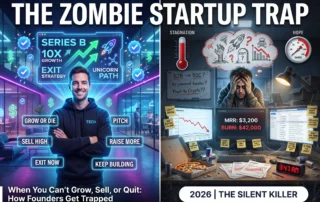
The Zombie Startup Trap: When You Can’t Grow, Sell, or Quit
Michael Dermer2026-08-31T12:38:26-04:00
The Zombie Startup Trap: When You Can't Grow, Sell, or Quit
Failure has a funeral. The zombie startup doesn't. It just keeps breathing — payroll runs, customers renew, the dashboard blinks green — while the founder quietly realizes the company will never grow enough to win or sell for enough to matter. In 2026, an estimated 30–40% of VC-backed startups live in this trap. Here's how it forms, and the four ways out, in six charts.
Here's the story the pitch decks never mention. Two years in, the company has $3M in recurring revenue, growth has slowed to 18% a year, and the last round valued it at $40M post-money — a number no acquirer will ever pay. The founder can't raise at those terms. The investors can't write down the position without triggering awkward questions from their own backers. Nobody wants to pull the plug. So it just… continues. This is a zombie startup, and there are thousands of them right now.
We've written about founders who check out emotionally, founders trapped by their own calendars, and the isolation epidemic at the top. The zombie startup is where all three collide with cold financial math. It's the trap nobody warns you about, because it doesn't look like failure. It looks like survival — and that's exactly what makes it so lonely.
A zombie startup neither fails cleanly nor exits successfully. It survives indefinitely — and that's the problem.
What actually makes a startup a zombie.
It's not about struggling — plenty of struggling companies recover. It's about five markers that, stacked together, lock every exit door at once. Hover any marker.
Chart 1 — The five markers
How close a company sits to zombie territory
Each bar shows how firmly a marker is locked in. Hover a bar.
Framework synthesizing Value Add VC / Trace Cohen's 2026 zombie-startup analysis. The tragedy: each marker looks defensible alone. It's only when you stack them that the cage appears.
The classic zombie profile is oddly unremarkable, which is what makes it so hard to name from the inside. Annual recurring revenue sits somewhere between $1M and $10M — real money, real customers. Growth has slipped below the 20% year-over-year line that any credible next round demands. The prior-round valuation is so inflated that any realistic acquisition price would register as a write-down for later investors. Cash flow is roughly neutral: enough to survive indefinitely, nowhere near enough to reach venture scale. And in the fund's books, the position is still marked at or near cost, even though a real market sale would clear 50–80% lower. Notice what's absent from that list: crisis. There's no cliff, no missed payroll, no lawsuit. Every individual metric looks defensible. It's only when you stack them that you see the founder is caged.
How the trap got built: the 2021 vintage.
The same company, priced in two different eras. The business didn't get worse — the number attached to it did. Tap either column.
Chart 2 — The valuation scissors
A $5M-ARR company, then and now
Same revenue, two multiples, a trap in the gap. Tap a column.
Tap either column. The left is what the company raised at. The right is what it's honestly worth today. Investors won't approve a sale at a 50–60% discount to cost unless forced to — so the company drifts.
Sources: KPMG Venture Pulse ($600B+ deployed at inflated 2020–22 multiples); Value Add VC. SaaS multiples compressed from 15–20x ARR to 4–6x between 2021 and 2026.
The zombie problem isn't random bad luck — it's the direct mathematical hangover of a specific era. Between 2020 and 2022, when interest rates sat near zero and SaaS multiples ran 15–20x ARR, a company with $5M in revenue could raise at a $50–75M post-money valuation. Over $600B in global venture capital was deployed at those historically elevated multiples, according to KPMG's Venture Pulse. Then multiples compressed to 4–6x in 2022–2023, and that same $5M-ARR company became worth $20–30M on any honest read. Here's the mechanism that manufactures zombies: investors will not approve a sale at a 50–60% discount to their cost basis unless they absolutely have to. So they don't. The company drifts. The clock runs. And a business that could have had a clean, modest ending instead becomes structurally unacquirable at any price the cap table will accept.
The company didn't get worse. The number attached to it did — and that gap is the cage.
The scale of the problem.
This isn't a niche footnote. It's an estimated $50B+ pool of trapped capital and thousands of stuck founders. They count up as you scroll.
Chart 3 — The zombie economy
The numbers behind the trap
Selected indicators
Sources: Carta / Dealroom / CB Insights (30–40% of VC-backed startups become zombies); PitchBook 2025 (5,000+ US startups 2019–22 with no exit, follow-on, or shutdown); KPMG Venture Pulse ($600B+); Value Add VC ($50B+ trapped capital); Harvard/Shikhar Ghosh (75% never return cash).
This is not a niche problem. Estimates from Carta, Dealroom, and CB Insights converge on the same uncomfortable range: roughly 30–40% of all VC-backed startups eventually become zombies — companies that neither fail cleanly nor exit successfully. PitchBook counted more than 5,000 US startups from the 2019–2022 window with no follow-on round, no exit, and no confirmed shutdown. They're simply still there. Set that against the broader backdrop and it sharpens: Harvard's Shikhar Ghosh found 75% of venture-backed startups never return cash to investors, and CB Insights pins running out of cash as the cause in 29% of shutdowns, second to "no market need" at 42%. The zombie is the strange third category the headline stats miss — the company that doesn't run out of cash and doesn't die, but never wins either.
The four real exits.
Recovery-to-unicorn isn't on the list for 99% of zombies. But four outcomes actually happen, over and over — and each is a legitimate ending. Hover any path.
Chart 4 — The way out
The four exits that actually happen
Relative frequency and what each returns. Hover a path.
Source: Value Add VC / Trace Cohen, 2026. Each door clears something. None is a highlight-reel exit — but each preserves reputation and lets everyone move on.
Here's the good news, and it's more than most trapped founders believe: there are real doors out. They're just not the doors anyone pitched at the seed stage. The acqui-hire is often first — the team is valuable even when the product isn't, and big tech regularly pays $1–3M per engineer, enough that a 20-person team clears $20–60M. A strategic acquisition for the customer base lets a larger vertical player buy the contracts at roughly 1–2x ARR, giving founders a soft landing with earnouts. A secondary sale of VC positions on platforms like Forge or Carta Secondary clears investors at 50–90% below the last round — brutal, but it frees everyone. And the quiet wind-down, far more common than anyone admits, is a managed soft landing: a few months of runway, IP placed on a shelf, customers transitioned, a mutually agreed narrative. Unglamorous, but frequently the cleanest ending of all.
Recovery-to-unicorn isn't on the list for 99% of zombies. Pretending otherwise is what keeps founders stuck.
How one zombie drains a fund.
To understand why the ecosystem resists clean endings, follow the money as it drains through a fund. Each stage feeds the next. Hover any stage.
Chart 5 — The capital drain
Why the incentives favor delay
The compounding cost of one unresolved position. Hover a stage.
Source: Value Add VC, 2026. The trapped-capital problem is estimated at $50B+ across the ecosystem — and the math only gets worse with time.
This is why founders often feel their investors are stalling even when everyone privately knows the company is stuck — the incentives genuinely favor delay over resolution. A single zombie position doesn't just sit there; it degrades the fund quarter after quarter. It's held at cost with no markdown, so LPs distrust the carrying value and start asking for write-downs. It consumes GP attention, showing up on every board agenda with bridge discussions and pivots that go nowhere. Follow-on capital gets deployed poorly into small bridges that only postpone the reckoning. The fund's life stretches from ten years to twelve or thirteen. And low DPI — actual distributions back to LPs — makes the next fund far harder to raise. Some GPs even roll zombie positions into a continuation vehicle, a workaround that functions exactly once before it erodes LP trust for good.
The warning signs you're turning into one.
The zombie stage is usually visible eighteen months before anyone says it out loud — and the signals are behavioral before they're financial. Tap any sign.
Chart 6 — Early warning signs
Six signals you're drifting into the trap
If several feel familiar, it's worth an honest look at the numbers. Tap a sign.
Tap any sign to see what it really means. The pattern The Lonely Entrepreneur keeps returning to: the earliest signals aren't on the P&L. They're in how the room feels.
Synthesized from Value Add VC's 2026 analysis and the founder-community model. Behavioral drift precedes financial drift by a year or more.
The tragedy of the zombie startup is that it's usually visible long before anyone names it, and the signals are behavioral first. Growth stalls under 20% and every plan to reaccelerate quietly resets to next quarter. The "bridge" round becomes a habit — small raises to extend runway rather than to fund a genuine change in thesis. The valuation turns undiscussable, because nobody will name a realistic price out loud when it's a write-down. Board meetings feel circular, the same pivots proposed and none acted on. The vision curdles into obligation: you keep going for payroll and pride, not because you still believe. And your top talent — the people with options — quietly take them. None of these show up on the P&L first. They show up in how the room feels.
Failure lets you grieve and move on. A zombie startup keeps you exactly where you are.
What founders should actually do
If you're running a zombie company and you know it, the single most valuable thing you can do is stop pretending otherwise. Have the honest board conversation early — before another year of bridge rounds that accomplish nothing. Explore acqui-hire options while the team is still intact, motivated, and the talent market still recognizes your name; that window closes faster than founders expect. Negotiate your own liquidity into any deal structure, because you've spent years on this and you deserve something for it. Don't raise more primary capital to extend the status quo unless there's a real change in the business model behind it. Talk to secondary buyers early, even just to learn what your investors' positions would actually clear at — that single data point forces the realistic conversation everyone's been avoiding. And protect your reputation above all, because how you handle the ending will define how fast your next round comes together.
The bottom line
The venture ecosystem doesn't have a good mechanism for zombie exits. It's not glamorous, it doesn't make the highlight reel, and the incentives quietly favor delay. But you are not your company's valuation, and a stuck company is not a moral failing — it's a market condition that happened to thousands of good founders at the same time, for reasons that had nothing to do with how hard they worked. The bravest thing you can do in the zombie stage isn't to grind another year. It's to choose an ending — cleanly, with your reputation and your relationships intact — and to do it alongside people who understand exactly what it costs. Because the loneliest part of the trap was never the balance sheet. It was believing you had to sit in it alone.
Clean endings preserve reputation, return something to investors, and let everyone move on. The founders who handle it well raise their next round faster.
Choose the ending — don't sit in the trap.
Zombie economics thrive in silence and isolation. The antidote is a room full of founders who've faced the same impossible math — and a place to say it out loud. That's what The Lonely Entrepreneur is for.
Join the Learning Community
250,000+ builders navigating the same stuck-company decisions — real humans who help you see the doors you can't see from inside the trap.
Find your people →Work with Sidekick
A partner to help you pressure-test the numbers, weigh the four exits, and make the hard call with a clear head instead of alone at 2am.
Get a Sidekick →Keep reading
Frequently asked questions
'+d.lab+'
'+r.t+'
'+r.d+'
';}).join(''); root.querySelector('#tFaq').innerHTML=[ ['What is a zombie startup?','A zombie startup is a venture-backed company with roughly $1M–$10M ARR, growth below 20% year-over-year, an inflated prior-round valuation, and no credible path to a new round, IPO, or acquisition at that price. It survives \u2014 often cash-flow neutral \u2014 but can\u2019t grow toward venture-scale returns or exit cleanly. It neither fails nor wins.'], ['How many startups become zombies?','Estimates from Carta, Dealroom, and CB Insights suggest roughly 30–40% of all VC-backed startups eventually become zombies. PitchBook counted more than 5,000 US startups from 2019–2022 with no follow-on round, exit, or confirmed shutdown \u2014 companies simply drifting in place.'], ['Why did so many zombie startups appear after 2021?','Between 2020 and 2022, over $600B in global VC was deployed at 15–30x ARR multiples. When multiples compressed to 4–6x in 2022–2023, those companies became structurally unacquirable at their last-round price. Investors won\u2019t approve a sale at a 50–60% discount to their cost basis unless forced to \u2014 so the companies drift instead.'], ['What are the exit options for a zombie startup?','There are four realistic paths: an acqui-hire (big tech pays $1–3M per engineer), a strategic acquisition for the customer base (typically 1–2x ARR), a secondary sale of VC positions (often 15–30 cents on the dollar for 2021-vintage companies), or a quiet wind-down with a managed soft landing. Recovery to unicorn is not on the list for 99% of zombies.'], ['How does a founder escape the zombie trap?','Have the honest board conversation early, explore acqui-hires while the team is still intact, negotiate your own liquidity into any deal, avoid raising more primary capital just to extend the status quo, talk to secondary buyers to learn real clearing prices, and protect your reputation above all \u2014 clean endings raise your next round faster than a drawn-out one.'] ].map(function(f){return ''+f[0]+'
'+f[1]+'
27
Jul, 2026
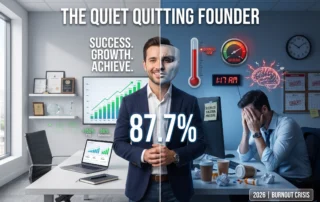
The Quiet Quitting Founder: Checking Out Before You Fail
Michael Dermer2026-08-31T12:38:41-04:00
The Quiet Quitting Founder: When You Check Out Before Your Company Does
Everyone talks about employees quiet quitting. Almost nobody talks about the founder who stops caring while still showing up. It's the most dangerous disengagement of all — because there's no manager above you to notice. Only 20% of workers worldwide are engaged, manager engagement has fallen to 22%, and 87.7% of entrepreneurs report at least one mental-health struggle. Here's how founder disengagement really works, in six charts.
Every founder knows the phrase "quiet quitting" — the employee who stays on payroll but stops giving discretionary effort. What almost nobody names is the version that happens at the top of the org chart: the founder who is still in every meeting, still answering Slack, still "running" the company, yet who checked out emotionally months ago. There's no HR file for it. No exit interview. No manager to flag the drop in energy, because you are the manager.
That's what makes it the most lethal disengagement in the whole company. A quiet-quitting employee costs some productivity. A quiet-quitting founder costs the company its heartbeat — because culture, urgency, standards, and vision are all calibrated to how much the person at the top actually cares. When that number quietly falls to zero, the organism starts dying long before the bank account confirms it. And it's common: Gallup's State of the Global Workplace 2026 found only 20% of workers worldwide are engaged, with the steepest recent declines coming from managers, whose engagement fell to 22%. Detachment climbs the ladder. Founders sit at the very top of it, carrying the heaviest emotional load with the least permission to admit they're running on empty.
A quiet-quitting employee stops giving extra. A quiet-quitting founder stops giving a damn — and hopes no one notices.
How motivation actually decays.
Disengagement is never a cliff. It's a slope — each phase feels like a normal bad week, until you realize you've been coasting for six months. Hover any point.
Chart 1 — The drift curve
How founder motivation quietly decays
A directional map of the drift arc, from all-in to checked out. Hover a phase.
Directional model synthesizing founder mental-health research (Founder Reports) and workforce-disengagement patterns (Gallup 2026). The phases are consistent; the timeline varies by founder.
The drift curve is remarkably consistent. It starts all-in — every problem feels like yours to solve, and you'd work through the night and call it fun. Then the grind sets in: still committed, but the joy has curdled into duty, and you start counting the hours. Next comes resentment, where you feel trapped by the very thing you built and small decisions start feeling heavy. Then coasting, where you do the minimum to keep the lights on — present but gone. And finally checked out, where you're quietly managing your own exit in your head while pretending nothing has changed. The mistake is treating this as a character flaw. It isn't. It's an adaptive response to prolonged strain without recovery: when effort stops producing the results or the meaning it used to, the brain protects you by dialing down investment. That's not weakness. It's biology doing triage.
The drift is rarely a decision. It's your own mind quietly protecting you from a fire you never let yourself put out.
The signals everyone misses.
Founder disengagement broadcasts itself — but the signals are so quiet, and so easy to rationalize, that they go unnamed for months. Tap any sign.
Chart 2 — The signals
Five signs a founder has quietly quit
The observable signals of emotional withdrawal at the top. Tap a sign.
Tap any signal to see what it really means — and why it's so easy to explain away as "just a rough patch."
Signals synthesized from founder mental-health research and Gallup's 2026 "not engaged" behavioral profile (does the minimum, mentally detached).
The signals are almost embarrassingly consistent once you know to look. The first is deferred decisions — you used to decide in minutes, now everything is "let me think about it," because caring enough to choose costs energy you no longer have. The second is a dropped standard: work ships that you'd once have sent back, and you see it, shrug, and let it go, so the bar falls silently because the person who held it stopped holding it. The third is a calendar that fills with busywork — inbox, admin, meetings, anything that feels like motion without forcing you to face the hard, ownership-level questions. The fourth is exit fantasies, where acquisition or shutdown or "someone else running it" starts feeling less like strategy and more like relief. And the fifth, the most contagious, is flat mission talk — you still say the words at all-hands, but there's no charge behind them, and your team feels the absence before you'll admit it. Every one of these is easy to rationalize in isolation. Together, they're a founder quietly leaving the building.
The "still showing up but gone" funnel.
Not every disengaged founder ends up quitting — but the slide from fully engaged to quietly gone is steeper than most people think, and it mirrors the whole workforce. Hover any stage.
Chart 3 — The drift funnel
From fully engaged to quietly gone
The narrowing path of founder engagement. Hover a stage.
Illustrative founder funnel; band shares reflect Gallup State of the Global Workplace 2026 engagement distribution (20% engaged / 64% not engaged / 16% actively disengaged) applied to the founder journey.
Gallup splits every workforce into three groups: engaged (20% globally), not engaged (64% — the quiet-quitting middle), and actively disengaged (16%). Founders aren't immune to that gravity. In fact, carrying the whole company's weight makes the slide faster once recovery stops happening. The funnel starts at fully engaged and energized — deciding fast, defending the standard, mission alive. It narrows to grinding but committed, then to coasting, then to actively disengaged, and finally to the true quiet-quitting founder: still in the chair, quietly planning the exit. What's striking is how little of this is visible from the outside. An employee who coasts eventually gets a performance review. A founder can coast for a year, propped up by title, autonomy, and a team too polite — or too scared — to say "you don't seem to be here anymore." The absence of accountability that makes founding so freeing is exactly what lets the drift go undetected.
Where the energy actually leaks.
Drift almost never has one dramatic cause. It's the accumulation of unaddressed drains — and when you map them, four dominate. Hover any block.
Chart 4 — The causes
The four causes of founder drift
Relative share of what quietly drains founder engagement. Hover a block.
Directional weighting synthesizing founder mental-health survey data (Founder Reports, n=227: 34.4% burnout, 26.9% loneliness) and disengagement research. A relative map, not survey percentages.
When you map where the energy actually leaks, four causes dominate. The biggest is identity mismatch — the role outgrew the reason you started, and the person who wanted to build now spends their days managing, hiring, and administrating. Close behind is chronic burnout without recovery: relentless load with no reset, which is why burnout isn't the end state of quiet quitting but often its beginning. The data backs this up — 34.4% of entrepreneurs report outright burnout, and 87.7% report at least one mental-health struggle. Third is isolation, the quiet engine behind so much of it; 26.9% of entrepreneurs report loneliness, with no peer to process the weight alongside. And fourth is effort disconnected from results or meaning — when the work stops moving the needle, investment self-protects downward. Notice that only the last cause is really about the business. The other three are about the human. That's the core insight: the company can be doing fine on paper while the founder is quietly dying inside it. Revenue up, founder gone. It happens more than anyone admits, because the metrics we watch don't measure the one thing that drives everything.
The company can be winning on every dashboard while the one person it depends on has already left the building.
Reengage — or plan a clean exit?
The real question isn't "should I push harder" — pushing harder is what got you here. It's whether this is a recovery problem or a reengagement problem. They have opposite solutions. Tap either side.
Chart 5 — The fork
Reengage, or plan a clean handoff
The signals that point toward staying — versus leaving well. Tap a side.
Tap either branch to see the specific signals — and why "I'm fine, just tired" is the most dangerous sentence a drifting founder tells themselves.
Decision framework for founder disengagement. The honest answer often takes an outside voice — a coach, peer, or therapist — to surface. Both paths are legitimate; staying checked out is the only losing one.
The most dangerous sentence a drifting founder tells themselves is "I'm fine, just tired." Tired is recoverable — a weekend, a vacation, a lighter month, and it lifts. Quiet quitting doesn't respond to rest, because the problem was never sleep; the emotional contract between you and the company has quietly changed, and rest doesn't renegotiate contracts. So the test is simple. Take a real break. If the flat feeling lifts, it was a recovery problem — the fuel was just low, and the fix is to redesign the role that drained you and rebuild the peer network that isolation stole. But if you come back and still feel nothing — if you feel relief imagining the company without you in it at all, if you're keeping standards low on purpose because caring costs too much, if the identity mismatch is structural — then it's a reengagement problem, and no amount of rest will solve it. That's when the kindest, most responsible move can be to plan a clean handoff to a co-founder, a hired CEO, or an acquirer. A company led by someone who's checked out is being quietly starved. Your team deserves a leader who's actually there.
If you come back from a real break and still feel nothing, it wasn't tired. It was a decision you hadn't let yourself make yet.
The quiet quitting founder, in numbers.
Put it all on one wall. These are the figures that turn "take care of yourself" from a platitude into a real, buildable discipline. They count up as you scroll.
Chart 6 — The bottom line
Founder disengagement by the numbers
Selected indicators
Sources: Gallup State of the Global Workplace 2026 (20% engaged; 22% manager engagement); Founder Reports entrepreneur mental-health survey (n=227, 46 countries): 87.7% one+ struggle, 34.4% burnout, 26.9% loneliness, 18.5% aware of founder-specific resources.
Only twenty percent of workers worldwide are engaged, and the sharpest recent declines came from managers, whose engagement fell to twenty-two percent — a reminder that detachment climbs the ladder toward the people carrying the most. Among entrepreneurs specifically, 87.7% report at least one mental-health struggle, 34.4% have faced outright burnout, and 26.9% report loneliness or isolation, one of the strongest drivers of drift. Perhaps most telling: only 18.5% even know that mental-health resources exist for founders like them. Read together, these numbers make one argument — founder engagement is the most important, least-measured asset in the entire company, and the founders who treat it as something to actively protect, rather than assume will hold, are the ones who don't wake up one day to find they left years ago and never told anyone.
What to do if you recognized yourself
If you saw yourself in the drift curve, that recognition is the whole game — you can't reverse a decline you won't name. Three moves account for most of the recovery. First, run the recovery test honestly: take a genuine break and watch whether the flatness lifts or survives it, because that single signal tells you whether you need less or need change. Second, if it's a recovery problem, redesign the role with the same rigor you'd bring to a product — offload the drains, rebuild a peer network to end the isolation, and reconnect to the original problem instead of the operational sludge that buried it. Given that fewer than one in five founders even know support exists for people like them, the first step is often just admitting the problem has a name and isn't a personal failing. Third, if it's a reengagement problem, have the courage to plan a clean handoff rather than fake it for another two years. The through-line is the one The Lonely Entrepreneur was built on: you don't have to carry the heaviest weight in your company alone, and the founders who stop trying to are the ones who either fall back in love with the work — or leave it well, on their own terms.
You can't afford to keep sitting in the chair, present but absent, hoping no one notices. They already have.
You don't have to run on empty alone.
Isolation is the quiet engine behind founder drift. Building a peer network — and having people who've been checked out and found their way back in your corner — is exactly what The Lonely Entrepreneur exists to do.
Join the Learning Community
250,000+ builders who've hit the flat patch, named it, and either reengaged or exited well — the support that ends the isolation before it hollows you out.
Find your people →Work with Sidekick
An always-on AI partner to help you run the recovery test, redesign the role that's draining you, and surface the honest answer you've been avoiding.
Get a Sidekick →Keep reading
Frequently asked questions
'+d.lab+'
'+r.t+'
'+r.d+'
';}).join(''); root.querySelector('#tFaq').innerHTML=[ ['What is a "quiet quitting founder"?','A quiet-quitting founder has emotionally checked out of their own company while still physically showing up \u2014 attending meetings and holding the title, but no longer investing real energy, defending standards, or feeling connected to the mission. Unlike a quiet-quitting employee, there\u2019s no manager above them to notice, so the drift can go undetected for years while it quietly starves the company of its most important driver.'], ['How do I know if I\u2019m just tired or actually disengaged?','The test is recovery. Tiredness responds to rest \u2014 take a real break and the flat feeling lifts. Quiet quitting doesn\u2019t; you come back from the vacation feeling exactly the same, because the problem was never sleep. If genuine time off changes nothing, it\u2019s likely a reengagement problem, not a recovery one, and it needs a structural change rather than more rest.'], ['Why do founders lose motivation even when the company is doing fine?','Founder engagement is driven mostly by human factors, not business metrics. The most common causes of drift are identity mismatch, chronic burnout without recovery, isolation, and effort disconnected from meaning. A company can post strong numbers while the founder is quietly dying inside it \u2014 revenue up, founder gone. Founder data supports this: 87.7% of entrepreneurs report at least one mental-health struggle and 34.4% face outright burnout.'], ['Is quiet quitting really common among founders?','Disengagement is widespread and climbs the ladder. Gallup\u2019s State of the Global Workplace 2026 found only 20% of workers worldwide are engaged, with the steepest recent declines among managers, whose engagement fell to 22%. Founders sit atop that hierarchy, carrying the heaviest load with the least accountability, which makes them highly exposed \u2014 often faster, since recovery is optional and no one is watching.'], ['What should a founder do if they\u2019ve quietly quit?','First, name it \u2014 you can\u2019t reverse a decline you won\u2019t admit. Then test whether it\u2019s a recovery problem (take a real break; if the feeling lifts, redesign the draining role and rebuild a peer network) or a reengagement problem (if rest changes nothing and you feel relief imagining the company without you, plan a clean handoff to a co-founder, hired CEO, or acquirer). The only losing move is staying checked out for years. If it\u2019s affecting your mental health, talking to a therapist or coach can help surface the honest answer.'] ].map(function(f){return ''+f[0]+'
'+f[1]+'
25
Jul, 2026
The Resilience Advantage: Why Founders Succeed After Failure
Michael Dermer2026-08-31T12:38:56-04:00
The Resilience Advantage: Why Surviving Failure Is a Founder's Real Edge
Everyone celebrates the comeback story. But what does the data actually say? It's more honest — and more useful — than the myth. Previously successful founders hit a 30% success rate vs. 21% for first-timers, second-time founders raise faster and hire better, and the real advantage isn't luck twice — it's scar tissue, pattern recognition, and pacing. Here's the resilience advantage, in six charts.
The startup world loves a comeback story. The founder who failed, dusted themselves off, and built something extraordinary the second time. It's inspiring — and it's also more complicated than the highlight reel suggests. Because when you actually dig into the data, the picture that emerges isn't "failure guarantees future success." It's something subtler and far more useful: experience compounds, but only when it's interpreted correctly. The founders who win the second time aren't the ones who got lucky twice. They're the ones who turned scar tissue into judgment.
This matters enormously for how founders treat their own setbacks. If failure were purely destructive, the rational response would be to avoid risk at all costs. But if resilience is a trainable, compounding asset — if surviving the fire genuinely changes how well you build next time — then the way you handle a hard season becomes one of the most important skills you'll ever develop. We pulled from the deepest research available: Harvard Business School's founder-performance studies (Gompers, Kovner, Lerner, Scharfstein), the New York Fed's performance-persistence data, NFX's second-time-founder analysis, entrepreneurial-resilience re-entry research, and Bureau of Labor Statistics survival data. Some of it complicates the comeback myth. All of it points to the same conclusion: how you survive failure is a bigger predictor of your next outcome than the failure itself.
The comeback edge isn't luck striking twice. It's what you learn to unlearn — scar tissue turned into judgment.
What the success rates actually show.
Start with the honest numbers — because they're more nuanced than the myth. Prior experience helps, but the size of the edge depends entirely on what kind of experience it was. Hover each bar.
Chart 1 — The real edge
Next-venture success rate by founder history
% of ventures succeeding, by the founder's prior track record. Hover a bar.
Source: Harvard Business School / NY Fed performance-persistence research (Gompers et al.). First-timers ~21%, previously failed ~22%, previously successful ~30%.
Here's the uncomfortable honesty the data demands: previously failed founders succeed at about 22% on their next venture — only a hair above the 21% first-timer rate. It's the previously successful founders who jump to 30%. That's the finding that made the HBS research famous, and it's often misquoted as "failure makes you better." It doesn't, on its own. What the data really shows is that experience is raw material, not a guarantee — and the founders who convert a past failure into a real edge are the ones who did the hard work of learning from it rather than just surviving it. The resilience advantage is earned in how you process the failure, not merely in having had one.
The comeback timeline.
Resilience isn't a moment — it's a curve. Recovery from a serious setback follows a recognizable arc, and knowing the shape of it is half the battle when you're in the trough. Hover any stage.
Chart 2 — The recovery arc
How founders climb back after failure
A directional map of the emotional-and-operational comeback curve. Hover a stage.
Directional model synthesizing entrepreneurial-resilience re-entry research (Sachdev 2023; Bayes Business School restart framework). The stages are consistent; the timeline varies by founder.
The comeback curve is remarkably consistent across founder stories. It starts with the drop — the failure itself and the grief that follows, which research is clear about: entrepreneurial failure produces genuine loss that has to be processed, not skipped. Then comes reflection, where the honest post-mortem happens and lessons get extracted. Then re-entry, tentative at first, and finally the rebuild, where the accumulated judgment starts to pay off. The founders who recover fastest aren't the ones who deny the trough; they're the ones who move through it deliberately. Bayes Business School's restart research found that founders who explicitly frame failure as data — rather than identity — re-enter faster and build more internationally ambitious next ventures. The trough is unavoidable. Getting stuck in it is not.
The founders who recover fastest don't deny the trough. They move through it deliberately — treating failure as data, not identity.
What actually builds resilience.
Resilience isn't a personality trait you're born with — it's a set of sources you can deliberately strengthen. Some matter far more than founders expect. Hover any spoke.
Chart 3 — The sources
The pillars of founder resilience
Relative contribution of each source to bounce-back capacity. Hover a spoke.
The strongest single predictor of founder recovery isn't grit in isolation — it's support: having people who understand the weight and can hold it with you.
Directional weighting synthesizing resilience research (Sachdev 2023) and support-network studies. A relative map, not survey percentages.
When researchers examine what actually lets founders bounce back, a few sources dominate. Peer support and mentorship consistently rank at or near the top — the isolation that makes failure so devastating is exactly what a genuine support network dissolves. Purpose comes next: founders anchored to a problem they care about (rather than to a specific company) recover faster because their identity survives the venture's death. A financial buffer buys the runway to grieve and reflect instead of scrambling. Physical and mental health provide the baseline capacity to think clearly. Self-compassion — treating a failure as a data point rather than a character verdict — turns out to be one of the most protective factors research has identified. And pattern recognition, the accumulated judgment of having seen the movie before, is what converts all of it into a second-venture edge. The through-line is that most of these are buildable. You are not stuck with the resilience you were born with.
How the second time is different.
Repeat founders don't just try harder — they operate differently. The behavioral shifts are specific, and every one of them is learnable before you've failed even once. Tap any shift.
Chart 4 — The behavioral shifts
What repeat founders do differently
The mindset changes that create the second-time edge. Tap a shift.
Tap any shift to see how repeat founders think differently — and how first-timers can adopt the same mindset early.
Source: NFX second-time-founder analysis; First Round Review founder case studies; practitioner interviews.
The second-time edge isn't mystical — it's a set of concrete behavioral shifts. Repeat founders replace the need for certainty with a bias for speed, moving on informed instinct and validating later rather than drowning in advice. They fall in love with distribution instead of product, baking go-to-market into week one. They hire for slope and ownership rather than enthusiasm, building infrastructure instead of just adding teammates. They operate with emotional distance — not detachment, but perspective — so a flopped feature reads as data instead of catastrophe. And they set kill criteria in advance, deciding when to walk before the sunk-cost fog rolls in. The encouraging part, backed by every practitioner who's studied this: you don't need a past company to think this way. You can install the second-time operating system before you've earned the scars — which is precisely what a strong founder community lets you do, by lending you other people's scar tissue.
The trap on the other side.
But experience cuts both ways. The same scar tissue that sharpens judgment can calcify into blind spots. Resilience without adaptation becomes its own failure mode. Hover any risk.
Chart 5 — The overconfidence trap
Where the second-time edge backfires
Risk level of each experience-driven trap. Hover a bar.
Source: NFX second-time-founder analysis; practitioner post-mortems. Relative risk framing, directional.
Here's why resilience alone isn't enough — and why the "failed founders only match first-timers" data makes sense. Experience becomes a trap the moment it's misapplied. Founders fight the last war, replaying a playbook built for a different market. They over-correct: burned by tech debt once, they over-engineer everything next time; starved of sales before, they overhire go-to-market prematurely. They play it too safe, unwilling to risk failing publicly after a win. They assume culture and chemistry carry over just because they do. Each of these is scar tissue calcifying into rigidity. The best repeat founders gut-check their instincts constantly, asking not "what worked last time" but "what does this venture actually need." The resilience advantage is real — but only for founders humble enough to keep learning. Experience is leverage; humility is the multiplier.
Experience is leverage. Humility is the multiplier — the second time works only if you keep questioning what you think you know.
The resilience advantage, in numbers.
Put it all on one wall. These are the figures that turn "bounce back" from a platitude into a real, buildable edge — and make the case for treating how you survive failure as a core founder skill. They count up as you scroll.
Chart 6 — The bottom line
The resilience advantage by the numbers
Selected indicators
Sources: HBS / NY Fed (30% vs 21%; ~9-pt edge); BLS (~50% 5-yr survival); NFX (>50% of startup CxOs are repeat founders); Bayes / Sachdev resilience research.
Thirty percent success for proven founders versus twenty-one for first-timers. A nine-point edge that compounds across a career. Half of all startups gone within five years — which means resilience isn't optional, it's statistically required. More than half of venture-backed startup CxOs are repeat founders, because experience is the single trait investors and teams reward most. Read together, these numbers make one argument: failure is nearly universal in building, but it is not the end of the story — and the founders who treat resilience as a trainable skill, not a fixed trait, are the ones who turn a setback into their sharpest advantage.
How to build the resilience advantage on purpose
The research converges on the same answer, and it isn't "hope you don't fail" — it's "build the capacity to recover before you need it." Three moves account for most of it. First, separate your identity from your venture: found on a problem you care about, not a company you're attached to, so that if the company dies, you don't. This single reframe is what lets founders treat failure as data instead of a verdict. Second, build your support structure in advance — peers who've carried the same weight, mentors who've survived the same fires, and honest relationships that don't depend on the business succeeding. The resilience research is unambiguous that support is the strongest external predictor of recovery, and it's the hardest thing to assemble in the middle of a crisis. Third, install the second-time operating system early: set kill criteria, bias toward speed, obsess over distribution, and gut-check your instincts against the current context rather than the last war. The common thread is the same one The Lonely Entrepreneur was built on: you don't have to fail alone, recover alone, or figure out the lessons alone. Borrow other people's scar tissue, build your resilience deliberately, and the comeback stops being a matter of luck.
You don't have to fail alone or figure out the lessons alone. Borrow other people's scar tissue — and build your resilience before you need it.
Failure is common. Recovering well is a skill.
The data is clear: resilience is trainable, and support is its single strongest source. Building that support before the hard season hits is exactly what The Lonely Entrepreneur exists to do.
Join the Learning Community
250,000+ builders who\u2019ve survived the fire \u2014 the scar tissue and pattern recognition you can borrow before you need it.
Find your people →Work with Sidekick
An always-on AI partner to run your post-mortems, pressure-test your instincts, and help you recover with clarity.
Get a Sidekick →Keep reading
Frequently asked questions
'+d.lab+'
'+r.t+'
'+r.d+'
';}).join(''); root.querySelector('#tFaq').innerHTML=[ ['Do second-time founders really succeed more often?','It depends on the first outcome. Harvard Business School research found previously successful founders succeed about 30% of the time on their next venture, versus about 21% for first-timers. Founders who previously failed sit around 22% \u2014 only slightly above the baseline. So prior success clearly helps; prior failure only helps if the founder genuinely learned from it.'], ['Does failure make you a better founder?','Not automatically. The data shows failure alone barely moves the success rate. What creates the resilience advantage is how you process the failure \u2014 running an honest post-mortem, extracting real lessons, and separating your identity from the venture. Failure is raw material; judgment is what you build from it.'], ['What actually builds founder resilience?','Research points to a handful of sources: peer support and mentorship (the strongest external predictor), a sense of purpose beyond any single company, a financial buffer, physical and mental health, self-compassion, and accumulated pattern recognition. Most of these are buildable \u2014 resilience is a trainable skill, not a fixed trait.'], ['Why do experienced founders sometimes fail again?','Because experience can calcify into blind spots. Common traps include fighting the last war (using an outdated playbook), over-correcting from past pain, playing it too safe after a public win, and assuming culture carries over. The best repeat founders stay humble and re-interpret their lessons for the current context.'], ['How can a first-time founder build resilience early?','Separate your identity from your venture by founding on a problem you care about; build a genuine support network of peers and mentors before you need it; and adopt the second-time operating system now \u2014 set kill criteria, bias toward speed, obsess over distribution, and gut-check your instincts against the present situation rather than assumptions.'] ].map(function(f){return ''+f[0]+'
'+f[1]+'
22
Jul, 2026
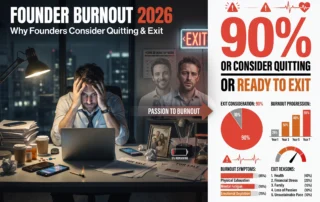
Founder Burnout 2026: Why 90% Consider Quitting & Exit
Michael Dermer2026-08-31T12:39:31-04:00
The Great Founder Burnout & Exit: Why Founders Quit, Sell, or Walk Away in 2026
Ninety percent of founders have been burned out enough to consider quitting. Most exits aren't triumphant IPOs — they're $71M acquisitions after a 9-year grind. And only a third feel more fulfilled after selling. Here's the data, in six charts, and what it means for how you build.
There are two stories about founders, and only one of them makes the headlines. The first is the exit: the acquisition announcement, the IPO bell, the life-changing check. The second is the part that comes before it and often after it — the burnout, the loneliness, the quiet question of whether any of it was worth it. In 2026, the data on that second story got impossible to ignore.
We pulled from two of the most rigorous recent sources: a February 2026 survey of 200 U.S. tech founders by Wilbur Labs, and an exit report covering 1,947 venture-backed companies across North America and Europe. Together they draw a clear arc — building is brutal, exiting is slow and rarely glamorous, and the finish line isn't where most founders think it is. Understanding that arc before you run it changes how you run it.
The exit is romanticized as the reward. The data says it's a coin flip on happiness — and the real work is building a life that doesn't depend on it.
How founders actually exit.
Forget the IPO fantasy. Nearly 7 in 10 exits are acquisitions, IPOs are under 10% of deals, and a fast-growing share are secondary sales and acqui-hires. This is what the exit door really looks like. Tap any segment.
Chart 1 — Exit pathways
Where startup exits actually go
Share of venture-backed exit deals, Q1 2026. Tap a segment.
Tap any segment to see what that exit path really means for a founder.
Source: Zabella Startup Exit Statistics 2026 (1,947 venture-backed companies). Deal-count share.
The median M&A exit in 2026 sits at just $71 million — and 86% of acquisitions had undisclosed valuations, which usually signals a markdown, not a windfall. The billion-dollar exits that dominate the news are real, but they're the tail, not the trend. Most founders who "make it" do so through a modest acquisition after years of grinding. Which raises the harder question: what does that grind actually cost?
How close founders come to quitting.
This is the number that stops people cold: 90% of founders have felt stress or burnout severe enough to make them consider quitting. For 15%, that feeling is constant. Only 10% have never been there. Hover any band.
Chart 2 — The quitting gradient
How often burnout made founders consider quitting
Share of founders, by frequency. Hover a band.
Source: Wilbur Labs 2026 Founder Survey (200 U.S. tech founders, Feb 2026).
Ninety percent isn't a fringe of fragile founders. It's the overwhelming majority — the confident ones, the successful ones, the ones you'd never guess. Burnout severe enough to consider walking away is the baseline experience of building a company, not the exception. And it rarely stays contained to work; it leaks into every part of a founder's life, which the next chart maps out.
Ninety percent of founders have wanted to quit. If you've felt it, you're not weak or unusual — you're in the majority.
The founder's tax: what building really costs.
Burnout doesn't bill you once. It taxes every corner of your life at the same time — social, mental, physical, relational, and the isolation nobody warns you about. Here's the full footprint. Hover any axis.
Chart 3 — The founder's tax
Where the strain shows up
% of founders reporting each impact. Hover a point.
Source: Wilbur Labs 2026 Founder Survey (200 U.S. tech founders).
The single loneliest data point: 87% of founders said building a company was lonelier than they expected — and 56% started solo, so the entire emotional load falls on one person. This is exactly the gap this publication exists to close. The isolation isn't a personality flaw or a phase; it's structural, baked into a role where you can't fully share the pressure with employees, investors, or even family.
The exit takes far longer than anyone plans for.
If you're building toward an exit, know the clock. Median time to exit now stretches from 8 years at seed stage to over 15 years for late-stage companies — and success rates climb the longer you survive. Hover any stage.
Chart 4 — Years to exit
Median years to exit, by stage
Years from founding to exit, with success rate. Hover a point.
Source: Zabella Startup Exit Statistics 2026 (median years to exit, 2021–2026).
Companies are staying private far longer than a decade ago, when a comparable late-stage exit took around 12 years versus 15.4 today. That means the burnout curve and the exit curve overlap for the better part of a decade — you're most likely to want to quit during the exact years you're furthest from any payoff. Endurance, not intensity, is the actual skill. And even reaching the finish line doesn't guarantee what founders expect from it.
The exit paradox: the finish line moves.
Here's the part almost nobody prepares for. After all the sacrifice, only 33% of business owners report more satisfaction in life after selling than before. The other two-thirds feel the same or worse. Tap either side.
Chart 5 — Life after exit
Satisfaction after selling the business
Founders reporting more vs. same-or-less fulfillment post-exit. Tap a bar.
Tap either bar to see why the exit so often fails to deliver what founders hoped.
Source: Post-exit founder satisfaction research (EO Network; 2026 owner surveys).
The exit paradox is real: the thing founders sacrifice everything for often fails to deliver the fulfillment they attached to it. Identity was fused to the company; when it's gone, so is a chunk of self. The founders who navigate it best treat the exit as a transition to plan for — a next chapter, a new purpose, a support system — not a finish line that fixes everything. That reframe is the difference between a triumphant exit and a hollow one.
Only 1 in 3 founders feel more fulfilled after selling. The exit is a door, not a destination — and what's on the other side has to be built too.
The resilience that keeps founders coming back.
For all the cost, here's the redemptive twist in the data: failure rarely ends a founder's career. It reloads it. These are the numbers that show why entrepreneurs keep going. They count up as you scroll.
Chart 6 — The comeback
Why founders don't actually stop
Selected 2026 founder-resilience indicators
Source: Wilbur Labs 2026 Founder Survey (200 U.S. tech founders).
Not a single founder in the Wilbur Labs survey said a failure would stop them from starting another company. That's the paradox of the whole arc: the work is lonelier, harder, and slower than anyone expects, the exit rarely delivers the promised catharsis — and founders keep doing it anyway. Because for most, it was never purely about the exit. It was about the building.
What this means if you're building
Detach your identity from the exit before you need to, because the finish line moves and only a third find more fulfillment on the other side; build a life and a sense of self that the company can't take with it when it goes. Plan for a decade, not a sprint, since the median exit now takes 8 to 15 years and the burnout peaks in the middle years when the payoff is furthest away — pace is the actual competitive advantage. Treat loneliness as a solvable operating problem rather than a personal failing, given that 87% found it lonelier than expected and 56% went solo; a peer group, a mentor, and honest relationships are infrastructure, not luxuries. And redefine what winning means, because if 90% consider quitting and most exits are modest acquisitions, the founders who thrive are the ones who found meaning in the daily building itself, not just the imagined ending.
Not one founder said failure would stop them from building again. The exit was never really the point. The building was.
Build for the long game — with people who get it.
The burnout, the loneliness, the decade-long grind — none of it has to be carried alone. 250,000+ builders use The Lonely Entrepreneur to go the distance without going through it by themselves.
Join the Learning Community
A room of 250,000+ builders who close the loneliness gap the data exposes — so the decade-long grind never falls on you alone.
Find your people →Work with Sidekick
Your AI-powered partner to think through the hard calls, protect your energy, and pace the long build — so you last long enough to win.
Get a Sidekick →Keep reading
Frequently asked questions
0'+d.suf+'
'+d.lab+'
'+r.t+'
'+r.d+'
';}).join(''); root.querySelector('#tFaq').innerHTML=[ ['How many founders experience burnout?','In a February 2026 survey of 200 U.S. tech founders, 90% said they experienced stress or burnout severe enough to make them consider quitting, and for 15% that feeling is constant. Separately, around 54% of startup founders report burnout in a given 12-month period and 75% experience anxiety.'], ['How do most startups actually exit?','Acquisitions dominate: about 68% of venture-backed exits in Q1 2026 were M&A deals, versus roughly 19% secondary sales, under 10% IPOs, and about 3% acqui-hires. The median M&A exit was around $71 million \u2014 far below unicorn territory.'], ['How long does it take a startup to exit?','Median time to exit now ranges from about 8 years at seed stage to over 15 years for late-stage companies \u2014 significantly longer than a decade ago, as companies stay private longer.'], ['Are founders happier after selling their business?','Often not. Research finds only about 33% of business owners report more life satisfaction after selling than before; the other two-thirds feel the same or worse, a phenomenon sometimes called the "exit paradox."'], ['Does startup failure end a founder\u2019s career?','Rarely. About 81% of founders who experienced a failure remain motivated to start another company, and 31% wanted to do so immediately \u2014 failure tends to reload a founder\u2019s career rather than end it.'] ].map(function(f){return ''+f[0]+'
'+f[1]+'
6
Jul, 2026

Founder Burnout: Why Never Stopping Makes You Lose
Michael Dermer2026-08-31T12:41:56-04:00
The Rest Myth: Why Founders Who Never Stop Are Quietly Losing
You've been told rest is a reward you earn after the work is done. But the work is never done — so you never rest, and slowly your best thinking, your judgment, and your fire all dim without you noticing. Rest isn't the reward. It's the strategy. Here's the math nobody showed you.
0% of founders feel guilty taking a break
0% agree that excessive stress leads to bad decisions
0% carry hidden "shadow burnout" behind a functioning face
The founder who never stops falls behind the one who does
Here's the counterintuitive math at the heart of the rest myth. Grinding without recovery doesn't produce a flat line of steady output — it produces a curve that climbs, plateaus, and then quietly declines as fatigue erodes decision quality. The founder who builds in recovery dips a little in raw hours but sustains far higher quality over time. Watch the two paths diverge.
Output over time: grind vs. recovery
A model of effective output (decision quality × energy) across months. The "never stop" path burns bright then fades; the "recovery" path compounds. Based on burnout / decision-degradation research (Future Ventures; WHO; 2026).
Never stop — climbs, plateaus, then declines as burnout sets in Build in recovery — lower peak hours, higher sustained quality
You've heard the myth so many times it doesn't even register as a claim anymore — it just feels like reality. The myth is this: rest is what you get to do after the work is finished. Push through now, recover later. Sleep when you're dead. Outwork everyone and you win. It sounds like discipline, like the mindset of people who make it, and so founders wear their exhaustion like a badge and feel a low, gnawing guilt any time they stop. The data confirms just how deep the guilt runs: 57% of founders admit they feel guilty taking a break. More than half of the people building our economy feel bad for resting.
But here's the problem with the myth: for a founder, the work is never finished. There is always another fire, another decision, another thing that could be done. So "rest after the work is done" translates, in practice, to "never rest," and never resting doesn't make you a machine — it makes you a slowly degrading one. The research is blunt about the cost. 76% of founders report burnout symptoms. 88% agree that excessive stress leads to bad decisions — meaning the very grind you think is driving the business forward is, past a certain point, actively steering it wrong. And founders are 50% more likely to experience mental stress than the general workforce, often operating at 110–130% of capacity for months on end.
The cruelest part is how invisible it is. 73% of founders experience what researchers call "shadow burnout" — persistent exhaustion, cynicism, and reduced effectiveness hiding behind a face that still shows up, still ships, still performs. You don't collapse dramatically. You just get a little worse at everything, a little slower to decide, a little flatter emotionally, a little more likely to snap or avoid or default — and because you're still functioning, you tell yourself you're fine. Shadow burnout is the founder version of a frog in slowly heating water. By the time it's obvious, a lot of damage is already done.
This article is going to make an argument that will feel wrong at first and then, I hope, feel obvious: rest is not the reward for the work. Rest is part of the work. It's not the thing you do instead of building — it's one of the things that makes the building good. The founders who last aren't the ones who could endure the most punishment. They're the ones who learned to recover fast enough to keep their judgment sharp, their fire lit, and their best decisions available when it counted. Let's look at how they actually do it.
The three years I mistook exhaustion for commitment
I lived the rest myth about as hard as a person can. When IncentOne nearly collapsed in the 2008 crisis and I was fighting to rebuild it, I did twenty-hour days for three years straight. I wore it as proof — proof of how much I cared, proof that I'd do whatever it took, proof that I was the kind of founder who doesn't quit. And some of that grind was genuinely necessary; there are seasons where you simply have to summon everything you've got. But I made a critical error that cost me more than I understood at the time: I treated recovery as the enemy of commitment, as if any hour spent resting was an hour of betrayal to the company I was trying to save.
What I couldn't see, in the middle of it, was that my exhaustion was quietly making me worse at the exact job I was destroying myself to do. My decisions got slower and more defensive. My emotional responses flattened — I stopped feeling the wins and just braced for the next blow. I'd sit with a decision I could have made cleanly at full strength and find myself unable to think, wanting only for the discomfort to end. I was pouring more and more hours into the business while the quality of what those hours produced kept dropping. On paper I was maximally committed. In reality I was a degraded system making degraded decisions, and calling it dedication.
The thing that eventually kept me functional wasn't more grit — it was, strangely, structure around recovery. The daily workout I refused to skip. The cold shower that reset my nervous system when the panic rose. The small, non-negotiable practices that had nothing to do with the company and everything to do with keeping the person running the company operational. I didn't understand it then in the language I'd use now, but those weren't indulgences stolen from the work. They were the infrastructure that made the work possible. They were the reason I could sit in that Starbucks at the lowest point and still, eventually, think clearly enough to fight back.
I spent three years believing rest was the enemy of commitment. The truth was the reverse: my exhaustion was the enemy, and recovery was the only thing keeping my commitment worth anything.
The four stages of the slow burn
Burnout almost never announces itself. It arrives in stages, each one feeling like a slightly worse version of normal \u2014 which is exactly why founders miss it until they're deep in. Here's the trajectory, so you can spot where you actually are.
01
Honeymoon
Energy is high, motivation is easy, the grind feels good. You're running hot and it's working, so you assume it always will. The seeds of the problem are planted here \u2014 you build no recovery habits because you don't feel like you need any.
02
Chronic stress
The easy energy is gone; now you're pushing. Sleep gets choppy, the days blur, the to-do list never shrinks. You tell yourself it's just a busy stretch \u2014 but the "busy stretch" has quietly become your baseline, and you're spending down reserves you're not replacing.
03
Shadow burnout
You're still functioning \u2014 shipping, deciding, showing up \u2014 but everything costs more and returns less. Emotional flatness, cynicism, decisions that used to be easy now feel heavy. 73% of founders live here, hidden, telling everyone (including themselves) that they're fine.
04
The crash
Eventually the system fails \u2014 a health scare, a blowup, a decision you can't make, a morning you can't start. Founders with low resilience are more than twice as likely to consider quitting, and the crash always costs more to recover from than the rest you skipped would have.
Map your early warning signals
Recovery works best when it's triggered by data, not by hitting a wall. Tap every signal you've felt in the last two weeks. Your live risk gauge will show where you actually are \u2014 and what to do about it now, not after the crash.
Behavioral
Cognitive
Physical / emotional
Tap the signals you've felt →
How to make recovery a strategy, not an accident
Build the protocol before you need it. The single most important principle of recovery is that a depleted founder cannot design their own way out \u2014 the system that needs repair can't repair itself. So you build your recovery infrastructure while you're still regulated: decide in advance what your rest actually looks like, what your non-negotiables are, and what you'll do when the warning signs appear. Waiting until you're already crashing is like trying to install a smoke detector during the fire.
Treat rest as input, not reward. Reframe recovery from "the thing I earn after the work" to "one of the inputs that makes the work good." Sleep, movement, real time off, and genuine disconnection aren't stolen from the business \u2014 they're what keeps the decision-maker sharp enough to run it. Once you see rest as infrastructure rather than indulgence, the guilt starts to dissolve, because you understand you're not choosing between the company and yourself. Your recovery is an investment in the company.
Use signals, not feelings, to trigger recovery. Founders are terrible at self-diagnosing burnout because the same exhaustion that requires rest also convinces you that you can't afford it. So don't rely on feelings \u2014 rely on your early warning map. When you hit two or three of your named signals, that's the trigger to act, the same way a warning light on a dashboard triggers a check regardless of how the car "feels." Predefined signals cut through the denial.
Activate support early. The research is clear that a support system \u2014 peers, a mentor, a community of other founders \u2014 only works if you activate it before full depletion, not after. Make the ask in advance: know who your first call is when the first signal appears, and have already told them "when I reach out about this, I need you to do X." Loneliness accelerates burnout; connection buffers it. The founders who recover fastest are almost never the ones doing it alone.
Define what "recovered" actually means. Don't guess when you're ready to go full-throttle again \u2014 measure it. Recovery is real when your decision speed returns to baseline, when you've slept well for several nights running, when feedback doesn't send you spiraling, and when you feel genuine interest in the work rather than grim obligation. Without a finish line, founders re-enter too early, half-recovered, and dig the hole deeper. Name the standard, then honor it.
Consistency beats intensity every single time
There's a statistic that reframes this whole conversation: the failure rate everyone quotes for entrepreneurs looks a lot like the dropout rate for people who join a gym in January and quit by February. Extend the timeline, and the ratio flips \u2014 the people who simply keep showing up, sustainably, over years, end up massively overrepresented among those who succeed. Entrepreneurship isn't won by the founder who burns hottest for six months. It's won by the founder who's still standing, still sharp, and still building in year five. And you cannot be sharp in year five if you incinerated yourself in year one.
That's the real case against the rest myth. It's not soft, and it's not about balance for its own sake \u2014 it's about winning the long game, which is the only game entrepreneurship actually is. Intensity without recovery is a sprint you run until you collapse; consistency built on recovery is a pace you can hold long enough to get somewhere. The founders who never stop aren't more committed than the ones who rest. They're just optimizing for a race that ends far sooner than they realize \u2014 and quietly falling behind the ones who understood that the point was never to work the hardest. The point was to still be here, at full strength, when it mattered most.
Rest is not the reward. It's the strategy.
You are going to be tempted, over and over, to believe that stopping is quitting and that exhaustion is proof of your devotion. It isn't. Your exhaustion doesn't love your company \u2014 it's slowly making you worse at running it, dimming the exact judgment and fire and clarity your business needs most. The founders who win aren't the ones who proved they could suffer the longest. They're the ones who figured out that recovery is part of the work, not a break from it, and who protected their own capacity the way they'd protect any other critical asset \u2014 because they understood they are the critical asset.
So build the protocol before you need it. Map your warning signals and treat them as data, not weakness. Reframe rest as an input that sharpens everything else, not a reward you never let yourself collect. Activate your people early, before the crash instead of after. And hold onto the truth the myth works so hard to bury: the goal was never to work the most. The goal was to still be standing, still sharp, and still building when it counted \u2014 and that's a race you win with recovery, not against it. You don't have to grind yourself down to prove you care. And you were never meant to do the recovering, any more than the building, entirely alone.
You can't recover alone \u2014 and you don't have to.
Whether you want a community of founders who understand the guilt of stopping alongside 250k+ others, or a trusted thinking partner to help you protect your capacity \u2014 there's a door for where you are now.
Join the Learning Community
The full survival framework in depth \u2014 500+ modules, tools, and a community of founders who make recovery normal instead of something to feel guilty about.
Find your people →Work with Sidekick
1:1 guidance from Michael Dermer \u2014 someone who did the 20-hour days for three years and learned, the hard way, that recovery is the strategy.
Get a Sidekick →Frequently asked questions
14
Apr, 2026

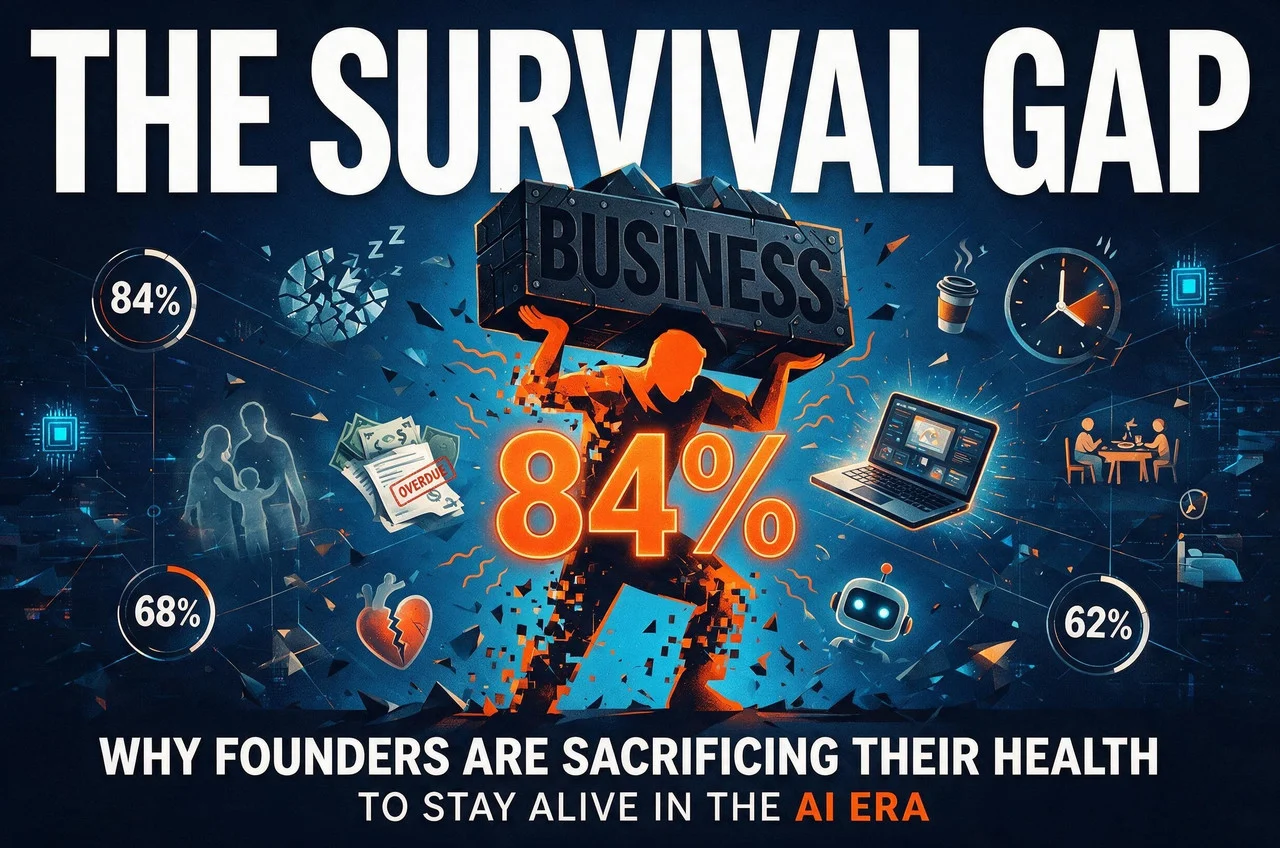
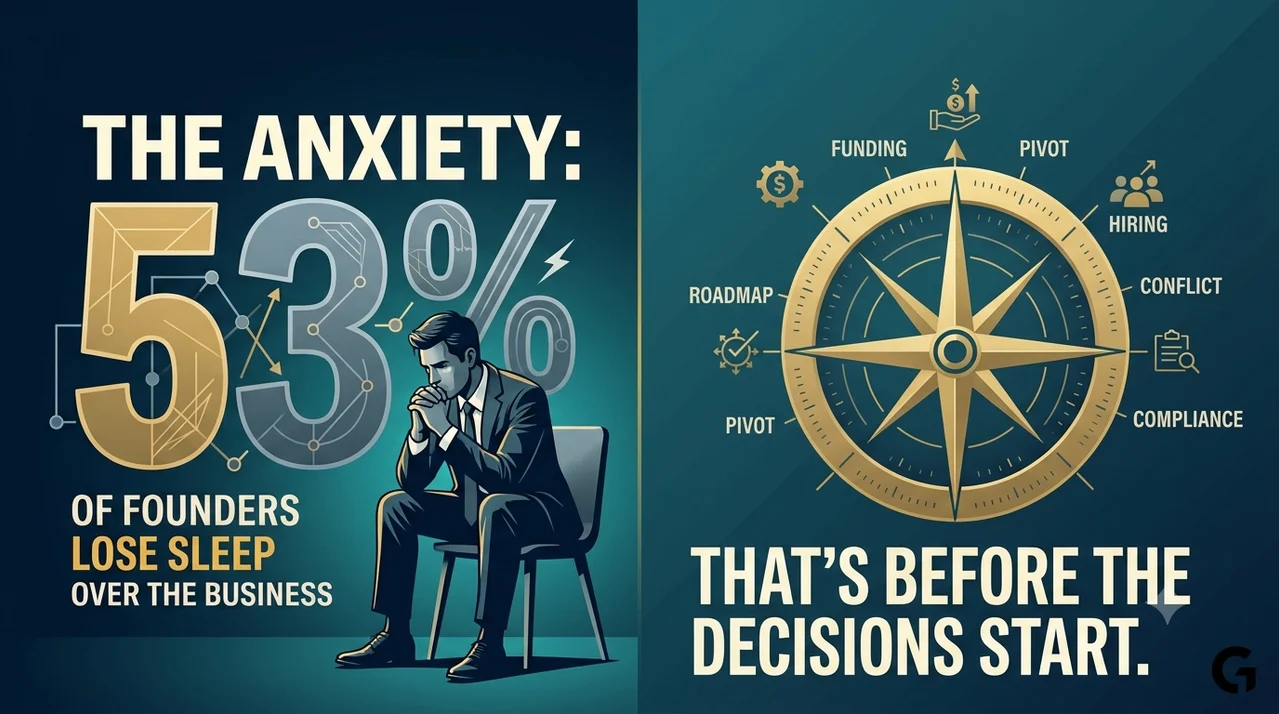
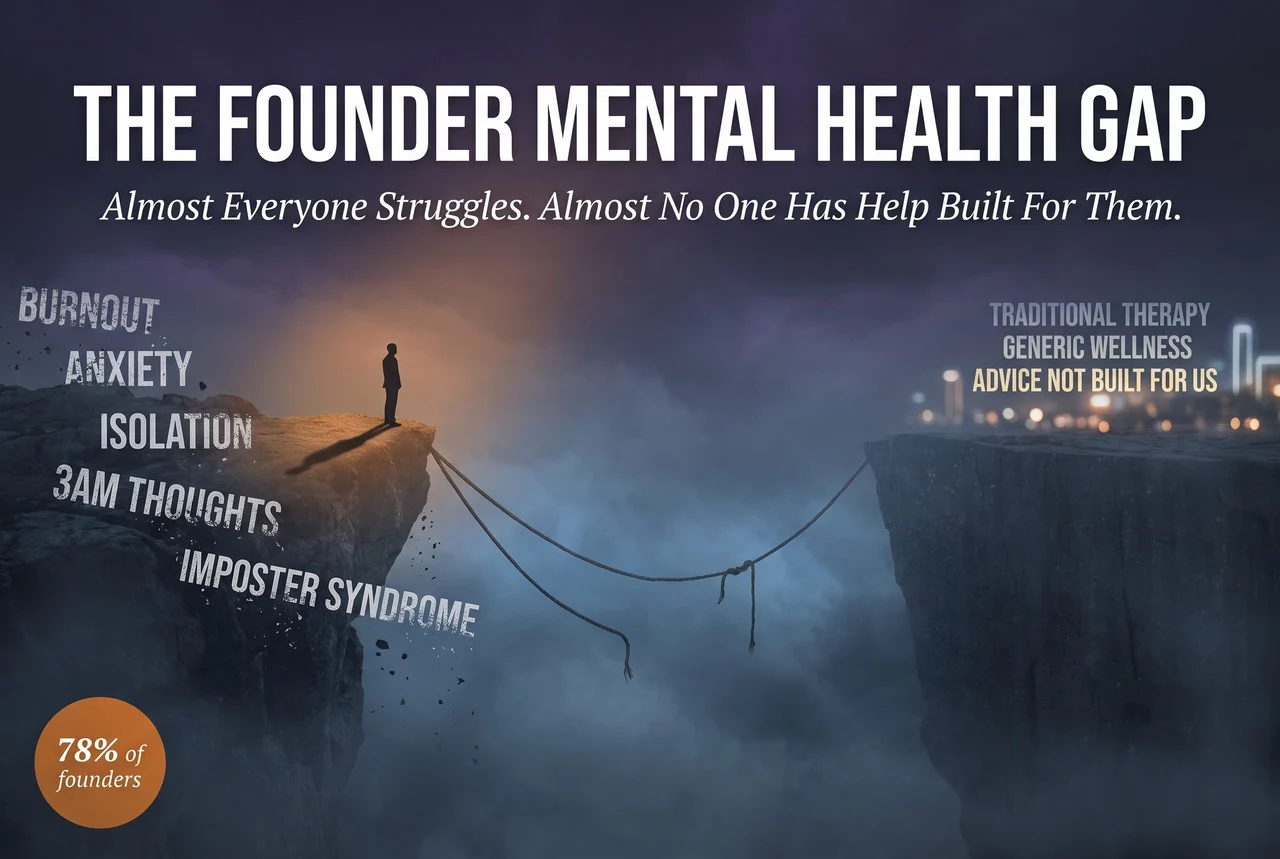



Entrepreneur Burnout: The Silent Killer Behind 87% of Startup Failures
Michael Dermer2026-08-31T12:49:15-04:00
Entrepreneur Burnout: The Silent Killer Behind Startup Collapse
Why the founders most likely to succeed are the ones most likely to collapse. 87% of founders report anxiety, depression, or burnout — and the same obsessive drive that builds a company is the exact mechanism that breaks the person building it. Here's the clinical framework that stops the cycle before it starts, in six charts.
Entrepreneur burnout is a state of chronic physical, emotional, and cognitive exhaustion caused by the prolonged stress of building a business without adequate support systems. According to a 2025 study published in Fortune, 87% of founders report experiencing anxiety, depression, or burnout — or all three simultaneously. Unlike ordinary workplace fatigue, entrepreneur burnout is uniquely destructive because the founder is the business: when the founder breaks, everything breaks.
These aren't abstract numbers. They represent real founders — people who left stable careers, risked personal savings, and committed every waking hour to a vision — who are now running on empty. And the most dangerous part is that entrepreneur burnout disguises itself as dedication. The same drive that makes founders successful is the exact mechanism that erodes them.
"When I burned out, I didn't just lose energy. I lost the ability to make decisions. And when the founder can't decide, the entire company is paralyzed." — Founder, $4M services company, The Lonely Entrepreneur community
The scale of the problem.
Founder mental-health strain isn't a fringe story — it's the majority experience. The numbers count up as you scroll.
Chart 1 — The evidence
How widespread founder burnout really is
Selected indicators
Sources: Fortune/UCSF (2025) — 87% of founders report burnout, anxiety, or depression; Startup Snapshot (2025) — 72% direct mental-health impact; CEREVITY (2025) — 45% rate their mental health poor/very poor; Harvard Business Review — 50% of CEOs report chronic loneliness.
Why entrepreneur burnout is different
Corporate burnout is painful. Entrepreneur burnout is existential. The distinction matters because it determines which recovery strategies actually work — and which ones are useless advice from people who have never built anything. In a corporate environment, your identity exists separately from your employer. You can quit, take medical leave, or transfer departments, and the company continues without you. When founders burn out, the math is different: their identity, their financial security, their employees' livelihoods, and their family's future are all fused into a single entity — the business. Harvard Business Review reports that 50% of CEOs experience chronic loneliness, and for solo founders and small-business owners, that number climbs even higher.
Michael Dermer — founder of The Lonely Entrepreneur, who worked 20-hour days for three consecutive years rebuilding after the 2008 financial crisis — puts it this way: entrepreneur burnout is not a time-management problem. It is a systems-architecture problem. The founder's life lacks the structural support that prevents collapse under load.
The 7 warning signs that hide in plain sight.
The WHO classifies burnout by three dimensions — energy depletion, mental distance, and reduced efficacy. In founders they wear a disguise. Tap each sign.
Chart 2 — The clinical signals
What burnout looks like in a founder
Each sign masquerades as "normal" founder behavior. Tap a segment.
Framework: WHO ICD-11 burnout dimensions applied to founders. The danger is that each sign looks like dedication or high standards — which is exactly why they go unnoticed until Stage 3 or 4.
The seven signs are worth naming precisely, because each one hides behind a virtue. Decision fatigue disguised as perfectionism: the average CEO makes roughly 35,000 decisions a day (Columbia University research), and for founders without an executive team it's higher; when fatigue sets in, founders don't stop deciding — they avoid deciding, over-researching and demanding needless perfection as the prefrontal cortex quietly shuts down. Isolation that feels like independence: a 2026 Rise Report found 1 in 7 female founders name loneliness as their single biggest challenge, rising to 30.7% for founders under 34 — and "I work best alone" is the most common cover story for someone afraid to look weak. Revenue obsession without profit awareness turns drive into a hamster wheel. Physical symptoms dismissed as "just stress" — 77% of people report stress affecting their physical health (American Institute of Stress). Emotional numbness mistaken for toughness is the penultimate stage before breakdown. Relationship deterioration blamed on "the business" — where the milestone that will fix everything keeps moving. And Sunday-night dread that never lifts: when Monday feels like a threat for seven straight weeks, burnout has gone from acute to chronic.
The neuroscience: your best asset degrades first.
Chronic stress doesn't just feel bad — it reshapes the two brain systems founders depend on most. Hover the chart.
Chart 3 — The stress curve
Cortisol: from "wired" to depleted
The HPA-axis arc over prolonged founder stress. Hover a phase.
Source: HPA-axis dysregulation research. Early chronic stress elevates cortisol (hypervigilance, insomnia); prolonged stress collapses it (fatigue, brain fog) — the "tired but wired" state. Meanwhile MRI studies show gray-matter reduction in the prefrontal cortex, the exact region founders need for strategy and decisions.
Understanding the brain science isn't academic — it directly informs which interventions actually work. The hypothalamic-pituitary-adrenal (HPA) axis, which regulates cortisol, becomes dysregulated under prolonged stress. Early on, cortisol is elevated, producing hypervigilance, insomnia, and anxiety. Later, the system collapses into cortisol depletion — fatigue, brain fog, and an inability to respond even to genuine emergencies. That's why burned-out founders describe feeling "tired but wired": their stress system is simultaneously overactive and exhausted. At the same time, the prefrontal cortex — responsible for strategic thinking, decision-making, and impulse control — literally shrinks under chronic stress, with MRI studies showing measurable gray-matter reduction. For founders, this is the cruelest twist: the exact brain region they need most is the first one degraded by the lifestyle they're living.
Resilience isn't about enduring more damage. It's about engineering your business and life so you absorb less damage in the first place.
This is precisely why the Entrepreneur Survival Guide's "Resilience" weapon includes the tactic "Build Systems That Take a Punch." Michael Dermer's practice of a five-minute cold shower every morning since October 2008 isn't masochism — it's a deliberate HPA-axis reset that helps restore cortisol regulation.
The five stages — and where you can still turn back.
Burnout isn't a switch; it's a progression. The earlier you catch it, the easier the recovery. Tap each stage.
Chart 4 — The progression
The 5 stages of founder burnout
Reversibility drops sharply after Stage 2. Tap a stage.
Model: 5-stage burnout progression applied to entrepreneurs. Most founders don't realize they're burning out until Stage 3 or 4 — when damage hits health, relationships, and business performance at once. Early detection at Stage 2 delivers the greatest return on effort.
The five stages run from Honeymoon — unlimited energy, high optimism, voluntary overwork, fully reversible and lasting 6 to 18 months — into Onset of Stress, where sleep disruption, irritability, and declining productivity appear despite longer hours, still reversible with intervention. Stage three, Chronic Stress, brings physical symptoms, emotional withdrawal, and cynicism about the business, and now requires structured recovery. Stage four, Burnout proper, means decision paralysis, emotional numbness, and relationship collapse, and calls for professional support. Stage five, Habitual Burnout, is chronic and can involve deep depression and an inability to function; it requires clinical intervention. The critical insight is the shape of the reversibility curve: it falls off a cliff after Stage 2, which is exactly why learning to spot the early signals is the highest-leverage skill a founder can build.
The recovery architecture: six weapons.
Generic advice — "take a vacation," "meditate" — fails founders because it treats symptoms, not structure. This treats burnout as a systems problem. Tap each weapon.
Chart 5 — The survival system
How founders actually recover
The six weapons of the Entrepreneur Survival Guide. Tap a weapon.
Framework: The Entrepreneur Survival Guide (6 weapons, 30 tactics). A founder who takes a two-week vacation returns to the same system that burned them out and is back at Stage 3 within 60 days. Structure — not rest alone — is what holds.
The framework treats burnout as an architecture problem, addressed through six weapons. Finding your playground reduces cognitive load with the tactic "Don't Penetrate Markets, Define Them" — when you define your space, you stop comparing yourself to every competitor. Brand chemistry ("More Than They Ask, Before They Ask") builds customer relationships that generate energy instead of draining it; founders with genuine market chemistry report 40% higher job satisfaction (Gallup). Obsession gets operationalized — channeled into one compounding thing rather than forty simultaneous fires. Resilience means "Build Systems That Take a Punch": financial reserves, documented processes, empowered team members, and contingency plans that absorb disruption so the founder doesn't have to. Stretch your limits ("Stretch the Mind") preserves the cognitive flexibility burnout destroys — Michael's 38-year unbroken workout streak is a capacity-building system, not a willpower stunt. And A.I. becomes a survival tool: McKinsey estimates up to 70% of knowledge-work tasks can be automated or accelerated, so applying AI to the highest-drain, highest-revenue tasks creates a multiplier that cuts workload while lifting output.
Systems run when motivation fails. That's the difference between surviving one burnout episode and preventing the next one.
The 30-day recovery protocol.
This isn't a vacation — it's a structural redesign of how you operate, used inside a community of 250,000+ founders. Tap each phase.
Chart 6 — The reset
From overload to operating system, in 30 days
Four phases, one week at a time. Tap a phase.
Tap any phase to see the move in practice. The pattern The Lonely Entrepreneur keeps returning to: recovery is a structure you build, not a feeling you wait for — and no founder rebuilds it entirely alone.
Framework: the 30-Day Burnout Recovery Protocol. The goal isn't to rely on willpower or motivation — it's to convert your best week into a repeatable system that runs even when motivation is gone.
The protocol moves in four one-week phases. Days 1–7, the Audit: document every task from the last 30 days and sort each into "Only I Can Do This," "Someone Else Could Do This," and "This Should Not Be Done At All" — most founders discover 60 to 70% of their work falls into the last two buckets. Days 8–14, the Elimination: remove or delegate everything in buckets two and three, using AI for content, scheduling, analysis, and customer communication, and checking each remaining task against the six weapons — if it serves none, it goes. Days 15–21, the Rebuild: restructure the week around the highest-value work only you can do, and block time for recovery — exercise, human connection, unstructured thinking — treating those blocks as load-bearing walls, not luxuries. Days 22–30, the System: convert the new structure into repeatable routines — morning rituals, weekly planning, monthly reviews, quarterly resets — so the design holds without depending on willpower.
The bottom line
Entrepreneur burnout is the silent tax on the founders most committed to winning, precisely because the traits that build a company — drive, obsession, deep involvement — are the same ones that quietly deplete the person behind it. The data is unambiguous: the vast majority of founders feel it, most don't recognize it until the reversibility curve has already dropped, and generic self-care doesn't touch the structural causes. But burnout responds to architecture. Spot the early signals, respect the neuroscience, catch it by Stage 2, rebuild around systems instead of willpower — and, above all, don't try to do the hardest part alone. The founders who recover almost always do it alongside people who've been there.
You built the company by carrying everything. You'll save yourself by finally building something that carries you back.
Stop surviving. Build systems that do it for you.
The Entrepreneur Survival Guide gives you 6 weapons and 30 tactics — including the full burnout-recovery architecture used by 250,000+ founders. And you won't run it alone.
Get the Survival Guide
The complete 6-weapon, 30-tactic system — including the recovery protocol laid out in this article.
Get the Guide →Join the Learning Community
250,000+ founders who've hit the wall too — and rebuilt with structure and support instead of grinding alone.
Find your people →Keep reading
Frequently asked questions
This article is for educational purposes and is not a substitute for professional medical or mental-health advice. If you're struggling, consider reaching out to a licensed professional. In the U.S., you can call or text 988 (Suicide & Crisis Lifeline) any time; elsewhere, contact your local emergency or mental-health services.
'+d.lab+'
'+r.t+'
'+r.d+'
';}).join(''); root.querySelector('#tFaq').innerHTML=[ ['What is entrepreneur burnout and how is it different from regular burnout?','Entrepreneur burnout is chronic exhaustion caused by the unique pressures of building a business \u2014 financial risk, identity fusion with the business, loneliness, and the absence of institutional support. Unlike corporate burnout, it threatens not just the individual\u2019s wellbeing but the survival of the entire enterprise, which makes it existentially more dangerous.'], ['What percentage of entrepreneurs experience burnout?','According to a 2025 study published in Fortune and conducted by UCSF researchers, 87% of founders report experiencing anxiety, depression, or burnout. A separate 2025 Startup Snapshot survey found 72% of entrepreneurs experienced direct mental-health impacts from running their businesses.'], ['How do you recover from entrepreneur burnout?','Recovery requires structural change, not just rest. The most effective approach is a 30-day protocol: audit all tasks (days 1\u20137), eliminate or delegate non-essential work using AI and team members (days 8\u201314), rebuild your week around high-value activities (days 15\u201321), and convert the new structure into repeatable systems (days 22\u201330). The Survival Guide\u2019s six-weapon framework provides the architecture for the rebuild.'], ['Can AI tools help prevent entrepreneur burnout?','Yes. McKinsey research estimates up to 70% of knowledge-work tasks can be automated or significantly accelerated by AI. Applying AI to content creation, data analysis, customer communication, and scheduling can meaningfully reduce workload, directly addressing the overwork that drives burnout. The Survival Guide\u2019s sixth weapon \u2014 A.I. \u2014 provides a tactical framework for using it to cut founder workload while increasing revenue.'], ['When should a burned-out entrepreneur seek professional support?','When symptoms persist \u2014 emotional numbness lasting more than two weeks, inability to make routine decisions, complete withdrawal from relationships, or physical symptoms such as chronic insomnia or panic attacks. Stage 4 and Stage 5 burnout warrant support from mental-health professionals who understand entrepreneurial stress. Reaching out early is a sign of strength, not weakness.'] ].map(function(f){return ''+f[0]+'
'+f[1]+'