

 Founder Data Report
The Businesses Are Thriving. The Founders Are Quietly Breaking.
Get clarity — download the free Entrepreneur Survival Guide Summary.
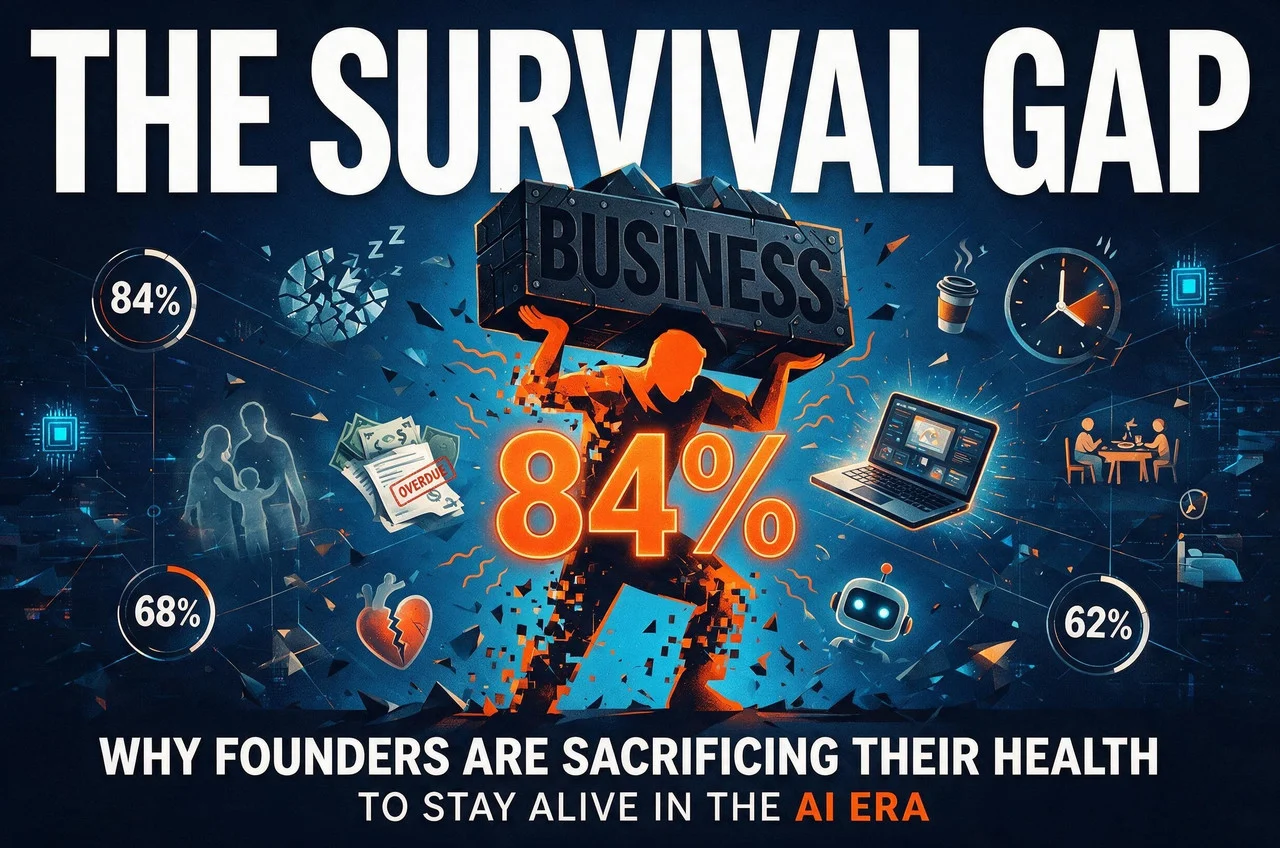
Three brand-new 2026 surveys reveal that 84% of small business owners have sacrificed their health, relationships, or sanity to keep the doors open — and in the AI era, the pressure is only compounding. Here’s the data, and the survival system that closes the gap.
Quick answer: New 2026 research shows a widening “Survival Gap” — the distance between how a business looks and how its founder feels. Only 22.5% of small business owners say their mental health is thriving (Patriot Software, May 2026, n=1,000); 84.4% have personally sacrificed their health, relationships, or wellbeing for the business; 71% report moderate-to-extreme financial stress and 62% have skipped their own paycheck this year (Bluevine, May 2026, n=781). The AI era is a stress multiplier on top of this baseline — which is exactly why Michael Dermer wrote Entrepreneur Survival Guide: Will You Survive in an AI World? The fix isn’t more hustle; it’s a survival system that protects the founder as deliberately as the business.
- The gap is real: only 22.5% of owners describe their mental health as thriving — the other ~77.5% are surviving or struggling.
- The price is personal: 84.4% have sacrificed health, family time, or mental wellbeing; 62% have skipped their own paycheck this year.
- It’s a 3 a.m. problem: 68% lose sleep over money, and the #1 trigger is timing — the gap between income and bills due (41%), not the size of the bills.
- Gen Z is hit first: 65.7% of the youngest founders are in “survival mode,” yet 61.2% remain “exhausted but believing.”
- The play: protect a non-negotiable recovery core, fix cash-flow timing, break isolation, and turn AI anxiety into an AI edge.
On paper, entrepreneurship has never looked healthier. Americans started more than 5.5 million new businesses in 2025, and National Small Business Week speeches call the country’s 36 million small firms “the engine of the American Dream.” Then you talk to the people actually running them. In a new Patriot Software survey of 1,000 owners (May 2026), only 22.5% described their mental health as “thriving.” Everyone else was surviving or struggling.
That’s the gap this report is about — the widening distance between how a business looks from the outside and how it feels to the person carrying it. We call it the Survival Gap. And it’s arriving at the worst possible moment. The AI era has stacked a new fear on top of the old ones: as we covered in our report on the CNBC / Generation Lab poll, roughly 45% of young adults believe AI will hurt their careers. For a founder already at capacity, “adapt or die” is one more brick. This is precisely why Michael Dermer wrote his newest book, Entrepreneur Survival Guide: Will You Survive in an AI World? — because survival, not scale, has quietly become the real question on every founder’s mind.
Founders don’t burn out because they work hard. They burn out because they carry the weight alone, at 3 a.m., sure everyone else has it figured out.
What founders are actually giving up
Ask an owner what running a business costs and they’ll talk about money. But the Patriot data shows the real currency is personal. Only 15.4% reported no significant sacrifice. The other 84.4% gave up something that never shows on a balance sheet — and, tellingly, the top sacrifices are the exact things that would have protected them from burning out.
Source: Patriot Software Small Business Owner Burnout Survey, May 2026 (n=1,000).
Sacrifice feels like strength. It’s usually the beginning of a slow-motion breakdown. The founders who last aren’t the ones who sacrifice the most — they’re the ones who protect a small, non-negotiable core (sleep, one relationship, one recovery ritual) and defend it like a business asset. Because it is one.
The 3 a.m. problem: financial stress that follows you to bed
The Bluevine Small Business Burnout Report (May 2026, n=781) confirms that financial stress has stopped being a spreadsheet problem and become a health problem. 68% of owners lose at least one night of sleep per month to money worry, 44% report general sleep disruption, and 53% feel emotionally drained or burned out specifically by their business finances.
Source: Bluevine Small Business Burnout Report, May 2026 (n=781).
The most revealing finding wasn’t the size of the bills — it was the timing. Bluevine’s split bar below shows what actually drives the anxiety: the gap between when money comes in and when bills come due (41%) dwarfs both taxes and payroll. Cash-flow whiplash, not debt, is what keeps founders awake.
Source: Bluevine Small Business Burnout Report, May 2026 (n=781). “What causes you the most financial anxiety?”
Gen Z founders are hitting the wall first
Every generation is under strain, but the youngest are absorbing the most damage — and the earliest. Across the Patriot data, Gen Z owners (18–29) posted the highest strain scores in nearly every category. This tracks with the loneliness research too: founders 34 and under report significantly more isolation than those 35+.
Source: Patriot Software Small Business Owner Burnout Survey, May 2026 (n=1,000). Gen Z = ages 18–29.
There’s a paradox hiding in this chart. The same Gen Z founders reporting the highest exhaustion also posted the highest belief: 61.2% call themselves “exhausted but believing,” and they’re not quitting. They’re grinding — which is exactly why they need a survival system before the wall becomes a breaking point.
The AI multiplier — and the survival gap it widens
Founder stress isn’t operating in a vacuum. It’s being amplified by the biggest business shift of the decade: AI. Our earlier report on the CNBC / Generation Lab poll found roughly 45% of young adults fear AI will hurt their careers, distrust of AI leaders runs as high as 81%, and 60% want AI data-center expansion slowed. For a founder already at 3 a.m. capacity, that’s a new, permanent layer of pressure — and the single fastest way to widen the Survival Gap is to face it alone.
of founders are surviving or struggling — not thriving — even as their businesses look successful from the outside.
Derived from Patriot Software Small Business Owner Burnout Survey, May 2026 (n=1,000): 100% − 22.5% “thriving”.
AI can copy your product overnight. It can’t carry your load for you. In the AI era, protecting the founder is the strategy.
The way out, in three numbers
Here’s the encouraging part of the data. When owners were asked what would most reduce their burnout, they didn’t ask for magic — they named concrete, learnable things: cash-flow visibility, financial breathing room, and support. The gap isn’t a lack of grit. It’s a lack of a system.
Compiled from Patriot Software & Bluevine burnout reports (May 2026) and Founder Reports mental-health data.
The four survival moves — starting Monday
Closing your own Survival Gap doesn’t take a sabbatical — it takes four deliberate moves. Separate the founder’s health from the business’s health: write down one recovery non-negotiable (a fixed sleep window, a daily walk, one night off) and defend it like payroll. Fix the timing, not just the total: since 41% of stress comes from the income-vs-bills gap, a simple 13-week cash-flow forecast removes more anxiety than a bigger balance. Break the isolation on purpose: only 18.5% of founders know resources exist for them, so one peer group, mentor, or community is the fastest lever on the mental-health data. And turn AI anxiety into an AI edge: use AI to reclaim hours, then spend those hours being the trustworthy human your customers can’t get from a chatbot.
You have everything you need to survive this. You just weren’t meant to do it alone.
Frequently Asked Questions
What is the Survival Gap for entrepreneurs?
The Survival Gap is the distance between how a business looks and how the founder feels. In 2026, only 22.5% of small business owners describe their mental health as thriving even as new business formation stays near record highs.
How many founders sacrifice their health for their business?
84.4% of small business owners have personally sacrificed their health, relationships, hobbies, or mental wellbeing for the business, per Patriot Software's May 2026 survey of 1,000 owners.
Why is financial stress causing founders to lose sleep?
68% of owners lose at least one night of sleep per month to money worry. The top trigger is timing: 41% cite the gap between incoming money and bills coming due, outranking taxes (25%) and payroll (20%).
Are younger entrepreneurs more burned out?
Yes. Gen Z owners report the highest strain of any generation: 65.7% are in survival mode and 58.2% have skipped their own pay, yet 61.2% remain exhausted but believing.
How does AI affect founder burnout?
AI multiplies stress but can also be an edge: free up hours with AI, then spend them being the trustworthy human a chatbot cannot replace. This is a core theme of Michael Dermer's Entrepreneur Survival Guide: Will You Survive in an AI World?
Published by The Lonely Entrepreneur — the community and coaching platform for entrepreneurs who are building alone. lonelyentrepreneur.com
This article is for educational purposes and is not a substitute for professional financial or legal advice.