

 Founder Data Report
The Founder Mental Health Gap. Almost Everyone Struggles. Almost No One Has Help Built For Them.
Join us Fridays at 12 PM ET to ask TLE CEO Michael Dermer your questions live.
Nearly 9 in 10 entrepreneurs report at least one mental-health struggle. Fewer than 1 in 5 even know a resource made for them. The gap between how much founders suffer and how little support exists is the quietest crisis in business. Here it is in six charts — and what the data says actually fixes it.
We have a story we tell about founders. The one who works through the weekend, answers email at 2 a.m., runs on caffeine and conviction, and carries the whole company on their back without complaint. We put that person on magazine covers. We call it hustle. We call it grit.
What we almost never talk about is the invoice that comes due for living that way — the anxiety that hums under every decision, the isolation that grows the more successful you get, the burnout that doesn’t announce itself until it’s already taken something you can’t easily get back.
So instead of telling the story again, we went looking for the numbers. Real ones. And the numbers are stark. In one global survey of 227 entrepreneurs across 46 countries, 87.7% reported struggling with at least one mental-health issue. A separate study led by Lehigh University with the Nasdaq Entrepreneurial Center — more than 300 founders — found the same pattern, and, crucially, found what actually changes it.
But the headline finding isn’t just that founders struggle. It’s that they struggle alone, inside a support system that was never designed for them. That distance — between how many founders are hurting and how many even know where to turn — is what we call the Founder Mental Health Gap.
The problem was never that entrepreneurs are weak. It’s that entrepreneurship is uniquely isolating — and almost nobody built the safety net. That gap is the whole opportunity.
This piece walks through six things the data makes undeniable: how much of the struggle is hidden, how the pressures stack on one person at once, how wide the support gap really is, why it gets worse the higher you climb, what genuinely protects founders, and where to start. Let’s begin below the surface — because that’s where most of this lives.
1. What you see is the smallest part.
Only 12.3% of founders in the survey reported no mental-health struggle. The other 87.7% is the mass below the waterline — the part the highlight reel never shows. Watch it surface as you scroll.
Source: Founder Reports Entrepreneur Mental Health Survey, 2025.
The iceberg isn’t a metaphor for drama — it’s how the data behaves. The visible founder is the confident LinkedIn post, the fundraising announcement, the “we’re crushing it.” The submerged founder is the one lying awake doing math on payroll. Both are the same person. And because the culture rewards showing only the tip, the 87.7% below the line stays invisible — even to other founders going through the exact same thing three feet away at the same coworking desk.
That invisibility is the first mechanism of the gap. You can’t ask for help with something you believe only you are feeling.
2. It’s never just one thing.
Founders didn’t report a single struggle — they reported several at once, piled on one person. This is the stack of pressure the average struggling founder carries simultaneously. Hover any layer.
Source: Founder Reports, 2025. Anxiety 50.2%, high stress 45.8%, financial worries 39.2%, burnout 34.4%, imposter syndrome 31.7%, loneliness/isolation 26.9%, depression 19.8%.
Look at how it compounds. Anxiety and high stress sit on top — the ones we’re almost willing to admit, because we’ve decided they’re the “acceptable” cost of ambition. But underneath them sit financial worry, imposter syndrome, isolation, and depression, each carried by a large minority of founders, and each one making the others heavier.
This is why “just manage your stress” is useless advice. You’re not managing one thing. You’re managing a load-bearing stack where pulling out the bottom brick — say, the isolation — can bring the anxiety and the imposter syndrome down with it. Which is exactly why the intervention that works isn’t targeted at any single layer, as we’ll see.
3. The gap, drawn to scale.
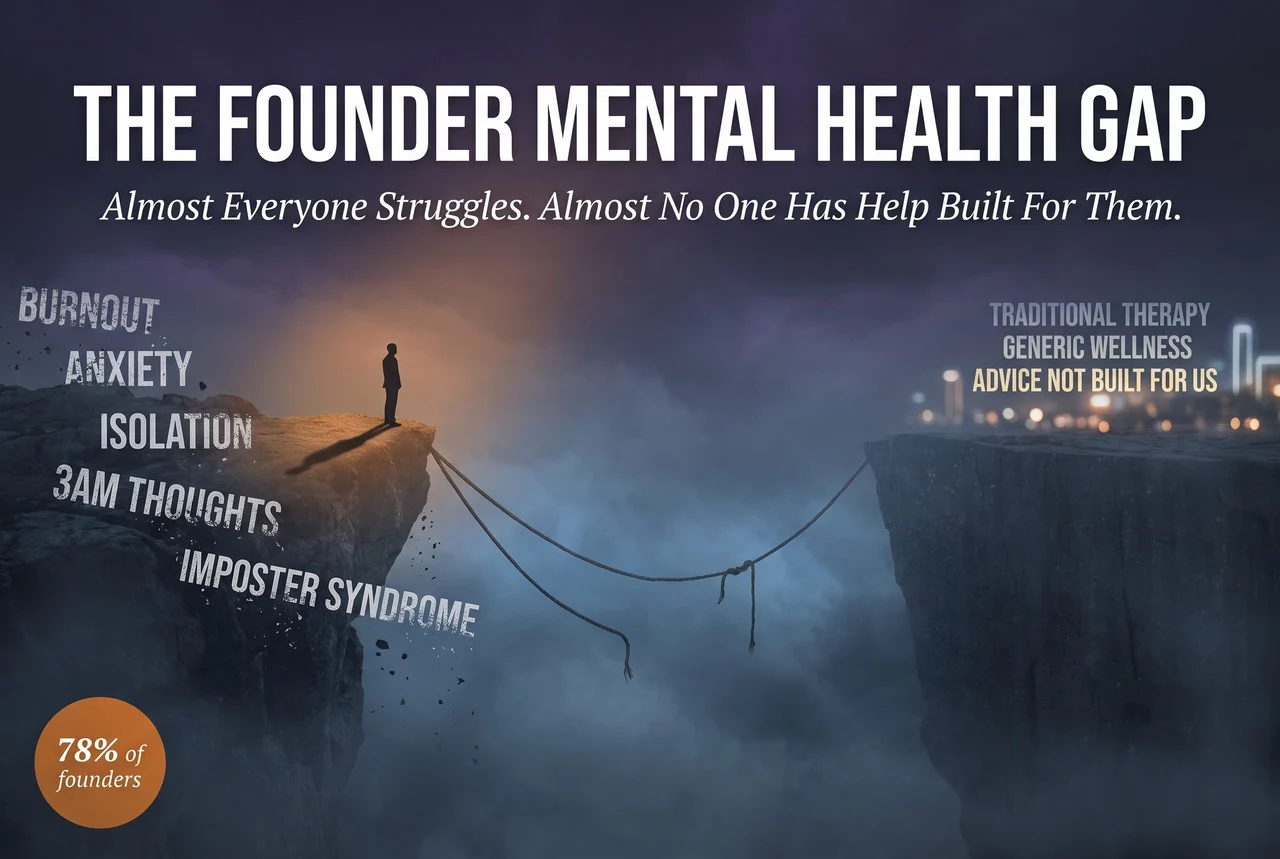
Here is the whole crisis in one image: on one cliff, the 87.7% who struggle. On the far cliff, the 18.5% who even know support built for them exists. The canyon between is the Founder Mental Health Gap.
Source: Founder Reports, 2025. 87.7% struggle; only 18.5% aware of founder-specific resources (56.4% not aware, 25.1% somewhat).
Sit with the distance for a second. It isn’t that founders struggle a little more than they get help — it’s that nearly everyone is on the far cliff and almost no one has found the bridge. Employees at a mid-size company have an HR department, an EAP hotline, benefits, colleagues, a manager who is (in theory) responsible for their workload. The solo founder has none of that. They are the HR department.
And the ~69-point gap between those two cliffs isn’t a personal failing — it’s a market failing. The support infrastructure of the working world was built for employees, and founders fall straight through it.
4. It gets lonelier the higher you climb.
You’d expect success to relieve the isolation. It does the opposite. Loneliness rises with seniority — from younger founders to CEOs to brand-new CEOs. Watch the path climb.
Sources: Founder Reports 2025 (35+: 21.2%; all founders: 26.9%; ≤34: 30.7%); Harvard Business Review (CEOs 50%; new CEOs ~70%).
This is the cruelest turn in the data. The very thing everyone is chasing — reaching the top, building the thing, being the one in charge — is the thing that isolates hardest. Half of CEOs report loneliness, and among new CEOs it climbs toward seven in ten. The higher you go, the fewer peers can relate to your specific pressure, the more people depend on you looking certain, and the more expensive it feels to admit you’re struggling.
Younger founders feel it too, and differently: 30.7% of founders 34 and under report loneliness and isolation, versus 21.2% of those 35 and older. Early in the journey it’s the isolation of nobody understanding why you’d choose this. Later it’s the isolation of everyone needing you to be fine. The loneliness never leaves — it just changes costume.
And it isn’t only emotional. Founders already run harder than almost anyone: many work 50–60 hours a week, well beyond the standard 40, and top performers famously trade sleep for hours. When you combine chronic overwork with structural isolation, you get a population whose rates of depression and anxiety run far above the roughly 7% seen in the general public. The climb has a real physiological cost.
5. The fork that changes everything.
Here’s the hopeful part. The Lehigh study found one lever that dramatically changes founder burnout — and it isn’t more grit. It’s boundaries. Founders arrive at a fork; the two roads lead to very different places. Hover each path.
Source: Lehigh University / Nasdaq Entrepreneurial Center study, via Fortune, Sept 2025. Founders who couldn’t hold boundaries: 67% high burnout, only 6% low burnout. Boundary-setters: 45% low burnout — roughly 3x less likely to be highly burned out.
Read those two destinations again. Among founders who couldn’t maintain work-life boundaries, 67% hit high burnout and only 6% stayed at low burnout. Among founders who set and held boundaries, 45% reported low burnout — a roughly threefold difference in outcome from what looks, on paper, like a small behavioral choice.
Boundaries sound almost too simple to matter. But that’s the point: the fork isn’t about working less because you care less. It’s about protecting the recovery, the relationships, and the perspective that let you keep working at all. The founders on the healthier road didn’t love their businesses less. They just refused to set themselves on fire to keep the company warm.
The same study found founders with mentors and genuine emotional support reported markedly higher resilience. Which points at the real fix — and it’s not a solo one.
6. The whole gap, at a glance.
The topline readings that make the case — a dashboard of the founder condition. The gauges fill as you scroll.
Sources: Founder Reports 2025; Lehigh/Fortune 2025; Harvard Business Review.
Why this is our mission, not just our content
Put the six readings together and the shape of the problem is obvious. Struggle is near-universal. The specific pressures — anxiety, burnout — are widespread. Awareness of help is almost nonexistent. Loneliness runs from the newest founder to the most senior CEO. And the one behavior we know changes outcomes, holding boundaries, is available to anyone — but only really works when it’s supported by people around you.
The Lonely Entrepreneur exists on the far side of this gap on purpose. The name isn’t decoration — it’s the diagnosis. Where the world tells founders to grind alone and treats asking for help as a confession of weakness, we build the thing the data keeps pointing to: community, boundaries, and honest relationships with people who actually understand the weight you’re carrying.
Boundaries cut burnout roughly threefold. Mentors and emotional support raise resilience. Peer community breaks the isolation that makes every other struggle heavier. None of that requires a bigger valuation or a fancier title. It requires not doing this alone — which, for most founders, is the one thing no one ever told them was allowed.
So here’s the invitation. Take the two-minute check below to see where your own support net has holes. Then do the least founder-like, most founder-saving thing there is: reach out.
Quiz: Where’s your founder support gap?
Six questions, two minutes. See how much of a support net you’ve actually built — and we’ll send your result to Michael’s team so they can point you to the right next step.
You weren’t meant to do this alone.
Tell us where you are and we’ll send The Lonely Entrepreneur’s founder well-being toolkit — practical boundary and support strategies built for people running a business.
Find your people.
After boundaries, the single biggest thing the research points to is not doing this alone.
250,000+ builders who get it — the honest circle the data says protects founders from burnout and isolation.
Why 50% of CEOs suffer in silence — and what actually fixes it.
Frequently Asked Questions
How many founders struggle with mental health?
In the Founder Reports Entrepreneur Mental Health Survey (2025), 87.7% of founders reported struggling with at least one mental-health issue. The most common were anxiety (50.2%), high stress (45.8%), financial worries (39.2%), burnout (34.4%) and impostor syndrome (31.7%).
Why do so few founders get help?
Because most do not know help exists. In the same survey only 18.5% of founders were aware of mental-health resources built for founders — 56.4% were not aware at all. The gap is not between struggling and coping; it is between struggling and knowing there is somewhere to go.
Does founder loneliness get better as the company grows?
It tends to get worse. Loneliness was reported by 26.9% of founders overall, but Harvard Business Review found roughly 50% of CEOs report loneliness and about 70% of first-time CEOs describe isolation as a significant challenge. The higher you climb, the fewer people you can speak to plainly.
Are younger founders affected differently?
Slightly more. Founder Reports recorded loneliness in 30.7% of founders aged 34 and under, against 21.2% of those 35 and over. Every age band is affected; the youngest simply report it most.
What actually reduces founder burnout?
Boundaries, measurably. A Lehigh University and Nasdaq Entrepreneurial Center study reported via Fortune (September 2025) found founders who could not hold boundaries showed 67% high burnout and only 6% low burnout — while founders who did set boundaries were far more likely to report low burnout.
Published by The Lonely Entrepreneur — the community and coaching platform for entrepreneurs who are building alone. lonelyentrepreneur.com
This article is for educational purposes and is not a substitute for professional medical or mental-health advice.