


 Founder Data Report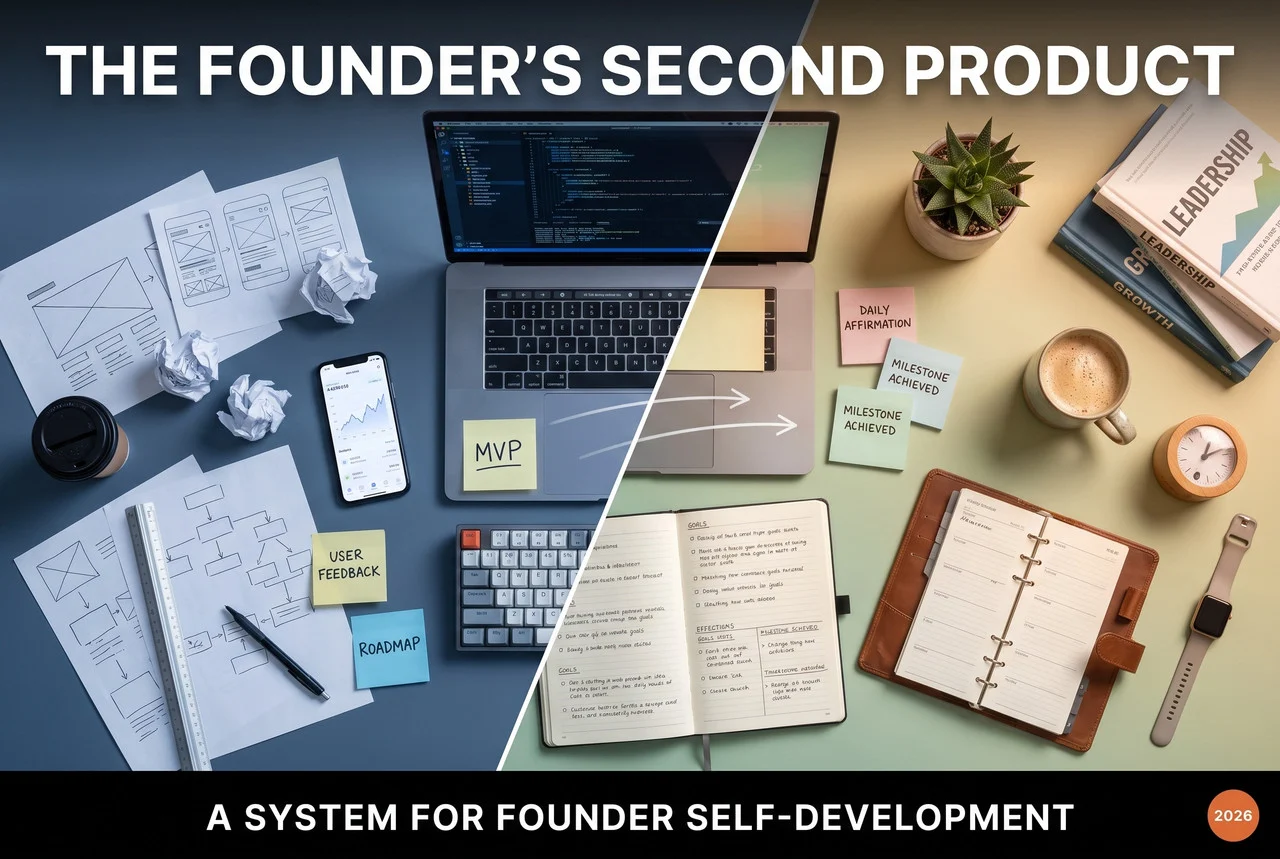
The Founder’s Second Product: You Are Building Two Things at Once
Join us Fridays at 12 PM ET to ask TLE CEO Michael Dermer your questions live.
Every founder thinks they’re building one product: the company. But there’s a second product being built in parallel, with no roadmap and no reviews — you. And whichever one you ship worse eventually caps the other. Here’s how to give the second product a real roadmap, in six charts.
The founder’s second product is the person you become while building your company — your judgment, resilience, relationships, and self-knowledge — developed (or neglected) in parallel with the business itself. Almost every founder pours relentless product discipline into the company: roadmaps, sprints, metrics, retros, user feedback. And almost none apply a fraction of that discipline to the second product, even though the two are deeply coupled. Your company cannot outgrow the person running it for very long. Sooner or later, the ceiling on the business becomes the ceiling on the founder.
This is the quiet asymmetry at the heart of entrepreneurship. You will spend thousands of hours making the product better and almost no structured time making yourself better — and then wonder why growth stalls exactly at the level of your own unaddressed limitations. The most durable founders eventually realize that developing themselves isn’t a distraction from building the company. It’s the highest-leverage feature work available, because everything the company can become passes through them first.
“I shipped forty releases of the product before I ever shipped a single deliberate release of myself. The company was always waiting on the version of me I hadn’t built yet.” — Founder, The Lonely Entrepreneur community
Two roadmaps, wildly unequal investment.
Founders resource the company like a serious product and the self like an afterthought. This shows the hours the average founder invests in each “product” per week. Hover a bar.
Model: representative weekly time allocation for a growth-stage founder. The pattern is consistent across the community — the “self” product gets a rounding error of the hours the company gets.
Why the second product decides the first
There’s a hard reason founder development is not a soft topic: businesses are constrained by the decision quality of the person at the top, and decision quality is a property of the founder, not the company. A better product roadmap doesn’t help if the founder can’t prioritize under pressure. A great hire doesn’t stick if the founder can’t delegate or receive hard feedback. A pivot opportunity is worthless if the founder’s ego is too fused to the original vision to see it. Every one of these is a limitation of the second product masquerading as a business problem — which is exactly why founders keep trying to solve them with business tactics and keep failing.
Michael Dermer, founder of The Lonely Entrepreneur, frames this as the difference between working in yourself and working on yourself. Working in yourself is running on instinct, reacting, using whatever version of you showed up today. Working on yourself is treating your judgment, emotional regulation, and blind spots as things you deliberately upgrade — the way you’d never ship a company feature without design, testing, and iteration, yet ship your own reactions a hundred times a day with none. The founders who scale furthest are almost always the ones who eventually gave the second product a real development process instead of leaving it to chance.
The founder capability stack.
The second product has a stack, just like software. Each layer sits on the one below it — and a weak lower layer caps everything above. Tap each layer.
Framework: the founder capability stack. Like any architecture, the top layers are only as reliable as the foundation beneath them — a founder with brilliant vision and a broken base ships instability.
The capability stack runs from the ground up. At the base sits the Physical Foundation — sleep, movement, energy — because every layer above it degrades when this one is starved; a depleted body makes worse decisions, full stop. Above it is Emotional Regulation, the capacity to stay steady under volatility so that fear and euphoria don’t drive your choices. Next is Judgment, the pattern-recognition and prioritization that separates good decisions from busy ones. Above that is Relational Capacity — the ability to build trust, delegate, receive feedback, and not lead alone. At the top is Vision, the layer everyone admires and the one founders most want to live in. The trap is obvious once you see the stack: founders obsess over the top layer while their base quietly crumbles, then can’t understand why their brilliant vision keeps producing shaky execution. You cannot out-vision a broken foundation. The second product gets built bottom-up or it doesn’t get built at all.
The maturity curve: where founders actually are.
Most founder development isn’t linear — it moves through stages, and most founders are stuck earlier than they think. Hover each stage.
Framework: the founder maturity S-curve. The steepest, most uncomfortable growth happens in the middle — which is exactly where most founders stall, because that’s where growth stops feeling good.
The maturity curve moves through five stages, and naming yours honestly is more useful than pretending you’re further along. In Reactive, the founder runs entirely on instinct and adrenaline — every day is whatever happens to them, with no separation between stimulus and response. In Aware, they start noticing their own patterns: the way they avoid hard conversations, the fear that drives their over-control. Awareness alone changes nothing, but nothing changes without it. In Deliberate, the hardest and most valuable stage, they begin actively working on the second product — installing habits, seeking feedback, sitting in the discomfort of changing long-held reactions; this is where most founders quit because growth here stops being fun. In Fluent, the new capabilities become second nature — steadiness under pressure and clean delegation no longer require effort. And in Integrated, the founder and the version of themselves they built are the same person; development becomes a permanent operating mode rather than a project. The uncomfortable truth in the data is that the vast majority of founders are clustered in Reactive and Aware — they know something needs to change and have simply never given the second product a real process.
Awareness feels like progress. It isn’t. It’s the on-ramp. The work \u2014 and the payoff \u2014 lives one stage further, where it stops feeling good.
The compounding gap: why small self-investment wins.
Self-development compounds like interest. A tiny consistent investment beats sporadic heroics — and the gap widens brutally over time. Hover the lines.
Model: illustrative compounding of consistent small development versus sporadic intensive effort. Founders overrate the retreat and the seminar; they underrate the boring weekly rep that actually compounds.
Founders have a distorted relationship with self-development because they picture it as an event — a retreat, a book binge, a breakdown followed by a breakthrough. But the second product, like the first, compounds through consistent iteration, not occasional heroics. A founder who improves one small thing about how they operate every week, and holds it, ends up somewhere unrecognizable in three years, because each improvement raises the baseline the next one builds on. A founder who does nothing for months and then attends an intense weekend gets a spike that decays back to baseline within weeks, because there was no system to hold the gain. This is the same logic every founder already believes about product and revenue — compounding beats bursts — and the same logic they mysteriously abandon when the product is themselves. The unglamorous weekly rep is where the entire game is won: a standing reflection habit, one hard piece of feedback actively sought, one reaction deliberately practiced. It feels too small to matter, which is exactly why it works and why almost nobody does it.
The bottleneck map: which layer is capping you now.
At any moment, one layer of the stack is the binding constraint on both you and the company. Fixing anything else is wasted motion. Tap each layer to see its symptom.
Framework: the constraint-diagnosis map. Borrowed from operations theory — a system improves only when you improve its actual bottleneck, and the founder is usually their own.
The most useful move in developing the second product is refusing to work on everything at once. At any given moment, exactly one layer of your capability stack is the binding constraint — the thing actually holding you and the company back — and effort spent anywhere else is motion without progress. If your Physical Foundation is the constraint, the tell is that your judgment collapses by afternoon and small problems feel enormous; the fix is embarrassingly basic and embarrassingly effective — sleep and movement before optimization of anything else. If Emotional Regulation is the constraint, you make reactive decisions you regret and your team walks on eggshells; the fix is building a gap between trigger and response. If Judgment binds, you’re busy but not effective, drowning in decisions that don’t compound; the fix is frameworks and ruthless prioritization. If Relational Capacity binds, you can’t delegate, you lead alone, and you’re the bottleneck for every decision; the fix is trust and structured feedback. And if Vision binds, the company drifts without a clear “why”; the fix is stepping back far enough to see it. The discipline is diagnostic: find the lowest broken layer, fix that one, and ignore the rest until it’s solid.
The self-development sprint: shipping a better you.
Run your own growth the way you’d run a product sprint — a defined cycle with a backlog, a focus, a review. Tap each phase of the loop.
Framework: the founder self-development sprint. The same cadence you already trust for the first product, pointed at the second — the version of it most founders never run even once.
The bottom line
The final move is to stop treating self-development as a vague aspiration and start running it as a sprint — the exact cadence you already trust for the company, pointed at yourself. The loop has four phases. In Diagnose, you find your current binding constraint using the map above: which layer is actually capping you right now? In Focus, you pick exactly one thing to improve for the cycle — not five, one — because the second product ships through concentration, not breadth. In Install, you build the small repeated habit that develops that one capability, and you hold it long enough to compound; this is the boring middle where the actual growth happens. In Review, you run a retro on yourself with the same honesty you’d bring to a product retro: what changed, what didn’t, what the new constraint is. Then the loop repeats, and the new constraint becomes the next focus. Run this cycle a dozen times over a couple of years and you become a founder your earlier self couldn’t have imagined — not through a breakthrough, but through a process. And here is the part that matters most: you should not run it alone. The founders who develop fastest do it inside a community of people running the same loop, because outside eyes see the constraint you can’t, and other people building their second product make it far harder to quietly abandon yours.
You are building two products whether you acknowledge it or not: the company, and the person building the company. The first gets your obsession, your discipline, and every waking hour. The second gets whatever’s left, which is usually nothing — and then, right on schedule, the underbuilt second product becomes the ceiling on the first. The founders who break through their hardest plateaus are rarely the ones who found a better growth hack. They’re the ones who finally gave the second product a roadmap: a stack to build from the bottom up, a maturity curve to climb past the comfortable early stages, a compounding weekly rep instead of sporadic heroics, an honest diagnosis of their binding constraint, and a repeatable sprint to ship a better version of themselves. The company can only ever be as good as the person running it. So build that person on purpose — deliberately, in the open, and not alone.
Ship the company with everything you have. But never forget you’re also shipping the person who has to run it \u2014 and that one has no one else on the roadmap but you.
Give the second product a roadmap.
The Entrepreneur Survival Guide is a development system for the founder, not just the company — 6 weapons and 30 tactics for building the person who can actually run what you’re building.
The complete 6-weapon, 30-tactic system for developing the founder behind the company.
250,000+ founders running the same self-development loop — because the second product ships faster in good company.
Keep reading
Frequently asked questions
Frequently Asked Questions
What is a founder's second product?
The founder's second product is the person you become while building your company — your judgment, resilience, emotional regulation, relationships, and self-knowledge — developed in parallel with the business. Founders apply relentless product discipline to the company and almost none to themselves, even though the company can't outgrow the person running it for long.
Why does developing yourself matter for the business?
A business is constrained by the decision quality of the person at the top, and decision quality is a property of the founder, not the company. Poor prioritization, inability to delegate, and resistance to pivots are limitations of the second product masquerading as business problems, which is why founders keep trying to solve them with tactics and keep failing.
What is the founder capability stack?
A five-layer model of what the self is built from, bottom to top: Physical Foundation, Emotional Regulation, Judgment, Relational Capacity, and Vision. Each layer sits on the one below, so a weak lower layer caps everything above it. You can't out-vision a broken foundation.
How should a founder actually work on themselves?
Run it like a product sprint with four phases: Diagnose your current binding constraint, Focus on exactly one improvement, Install a small repeated habit and hold it long enough to compound, and Review with an honest retro before repeating. Consistent 1% weekly improvement compounds far beyond sporadic retreats, and works best inside a community running the same loop.
Why do most founders stall at self-development?
Most founders cluster in the early Reactive and Aware stages of the maturity curve. Awareness feels like progress but changes nothing alone. Real growth lives in the Deliberate stage, where it stops feeling good, so most people quit. Those who scale furthest gave self-development a repeatable process instead of leaving it to chance.
Published by The Lonely Entrepreneur — the community and coaching platform for entrepreneurs who are building alone. lonelyentrepreneur.com
This article is for educational purposes and is not a substitute for professional medical or mental-health advice.