

 Founder Data Report
At Firms Under Two Years Old, Settled Workers’ Jobs End 1.6 Times as Often. Nearly Nine-Tenths of the Gap Is Jobs That Disappear.
Get clarity — download the free Entrepreneur Survival Guide Summary.
Census data shows settled workers leave young firms faster than old ones in every industry. Most of the difference is not people walking out of jobs that stay. It is the jobs going.
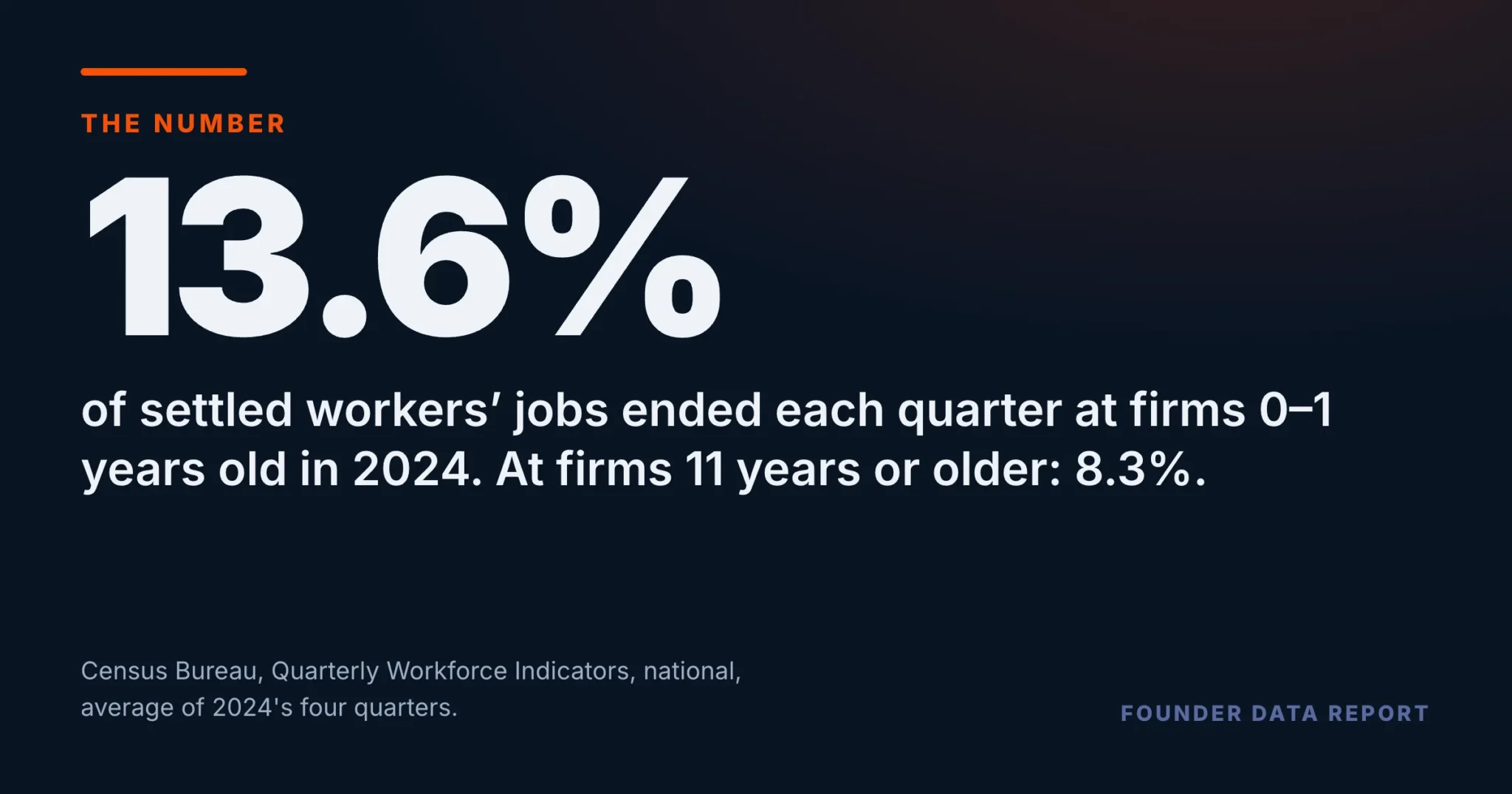
Census Bureau data on U.S. private employers shows that settled workers leave young firms faster than old ones. In 2024, at firms 0–1 years old, 13.6% of workers who had held their job for at least a full quarter saw it end in a typical quarter. At firms 11 years or older it was 8.3%. About 88% of that gap is jobs the firms lost on net. Exits from jobs that remained run at 5.8% against 5.2%.
- Share of settled workers whose job ended in a quarter, 2024: firms 0–1 years old 13.6%, 2–3 years 13.1%, 11 years or older 8.3%.
- The rate falls at every step of firm age, in every year from 2015 to 2024, and the youngest firms are above the oldest in all 19 industry sectors.
- Of the 5.3-point gap between the youngest and oldest firms, 4.7 points is jobs that disappeared and 0.6 is exits from jobs that remained.
- In 10 of the 19 sectors, exits from jobs that remained were lower at the youngest firms than the oldest.
- The data does not record whether a worker quit or was let go.
Settled workers, young firms and old
The Census Bureau’s Quarterly Workforce Indicators follow jobs at private employers quarter by quarter. One measure tracks settled workers: people who had held a job for at least a full quarter and then saw it end. Across all private employers, that happened to 9.0% of settled workers in a typical quarter of 2024. Split by the age of the firm, the rate falls at every step. At firms 0–1 years old it was 13.6%. At 2–3 years it was 13.1%, at 4–5 years 12.6%, at 6–10 years 11.5% and at 11 years or more 8.3%. The youngest firms run at about 1.6 times the rate of the oldest, and the order by age held in every year from 2015 to 2024.
Orange marks firms 0–1 years old. Bars are drawn on a 0–20% scale. A settled worker had held the job for at least a full quarter; each figure is the average of the four quarters of 2024.
U.S. Census Bureau, Quarterly Workforce Indicators (LEHD program), national, private employers, by firm age, not seasonally adjusted, release R2026Q3, downloaded from lehd.ces.census.gov on October 11, 2026. Each figure is the average of the four quarters of 2024.
At a young firm, most of the extra departures are jobs that went away, not people leaving jobs that stayed.
Most of the gap is the job, not the person
A settled worker’s job can end two ways from the firm’s side. The firm can shrink, so the job disappears with the person in it. Or the job can remain while the person leaves, and the firm has to fill it again. The file reports both on the same base. At the youngest firms, jobs that disappeared on net came to 7.8% of settled employment per quarter, against 3.1% at the oldest. Exits from jobs that remained came to 5.8% against 5.2%. So of the 5.3-point gap, 4.7 points is jobs disappearing and 0.6 is people leaving jobs that stayed. In every year from 2015 to 2024, jobs disappearing accounted for between 76% and 93% of the gap.
Orange is jobs the firms lost on net; slate is the remaining exits. Both are shares of the same settled employment and together make up the total in each row label; rounded figures can differ from it by 0.1. Bars are drawn on a 0–10% scale.
U.S. Census Bureau, Quarterly Workforce Indicators (LEHD program), national, private employers, by firm age, not seasonally adjusted, release R2026Q3, downloaded from lehd.ces.census.gov on October 11, 2026. Each figure is the average of the four quarters of 2024.
It holds in every industry
Young firms are more common in some industries than others, so the national pattern could in principle be a mix effect. It is not. In each of the 19 private industry sectors, settled workers’ jobs ended more often at firms 0–1 years old than at firms 11 years or older, in every year from 2015 to 2024. The levels differ widely: in accommodation and food services the rates were 18.4% and 13.2% in 2024, in finance and insurance 8.7% and 4.9%. In 2024, in all 19 sectors, jobs disappearing made up more of the gap than exits from jobs that remained, and in 10 of them those exits were lower at the youngest firms than at the oldest.
Orange is firms 0–1 years old; slate is firms 11 years or older. Sectors are ordered by the young-firm rate. Bars are drawn on a 0–20% scale.
U.S. Census Bureau, Quarterly Workforce Indicators (LEHD program), national, private employers, by firm age and NAICS sector, not seasonally adjusted, release R2026Q3, downloaded from lehd.ces.census.gov on October 11, 2026. Each figure is the average of the four quarters of 2024.
What to take from this if you run a young firm
If people seem to leave your young company more often than they would leave an established one, the national numbers agree. But they also say where most of that difference comes from. At young firms, settled jobs end more often because the firm’s headcount moved down than because people left jobs that carried on, and the rate of those other exits is close to the rate at old firms. For a founder, that makes swings in headcount as much a part of the picture as people leaving. The data cannot show that any particular practice changes either.
Four limits worth holding. The data covers private employers, and firm age is the age of the firm, not of the worker’s job. A settled worker is one who held the job for at least a full quarter. Figures are averages of four quarters, not seasonally adjusted. And the file does not record whether a worker quit or was let go, and it does not separate firms that closed from firms that shrank.
U.S. Census Bureau, Quarterly Workforce Indicators, national, by firm age, 2024 and 2015–2024.
Frequently Asked Questions
Do employees leave young companies more often?
Yes. In 2024, 13.6% of settled workers at private firms 0–1 years old saw their job end in a typical quarter, against 8.3% at firms 11 years or older, according to the Census Bureau's Quarterly Workforce Indicators.
Is that because people quit young firms?
Mostly not. About 88% of the gap is jobs the firms lost on net. Exits from jobs that remained were 5.8% at the youngest firms and 5.2% at the oldest. The data does not separate quits from layoffs.
Is this just because young firms are in high-turnover industries?
No. The youngest firms had the higher rate in all 19 private industry sectors, in every year from 2015 to 2024.
What counts as a settled worker?
Someone who had held the job for at least a full quarter with the same employer. Short jobs that start and end within a quarter are not counted in this measure.
Does the rate keep falling as firms age?
In this data, yes. It fell at every step of firm age in 2024: 13.6% at 0–1 years, 13.1% at 2–3, 12.6% at 4–5, 11.5% at 6–10 and 8.3% at 11 or more.
Published by The Lonely Entrepreneur — the community and coaching platform for entrepreneurs who are building alone. lonelyentrepreneur.com
This article is for educational purposes and is not a substitute for professional financial or legal advice.