

 Founder Data Report
8.6% of Finance Employers Name Managing Staff at Home as the Obstacle. In Retail, 3.0% Do — and They Employ 21.4% of the Workers.
Get clarity — download the free Entrepreneur Survival Guide Summary.
Nationally, 4% of employers say managing people who work from home is what holds remote work back. Split by trade, the answer changes six-fold — and inside most trades it is coming from the biggest firms.
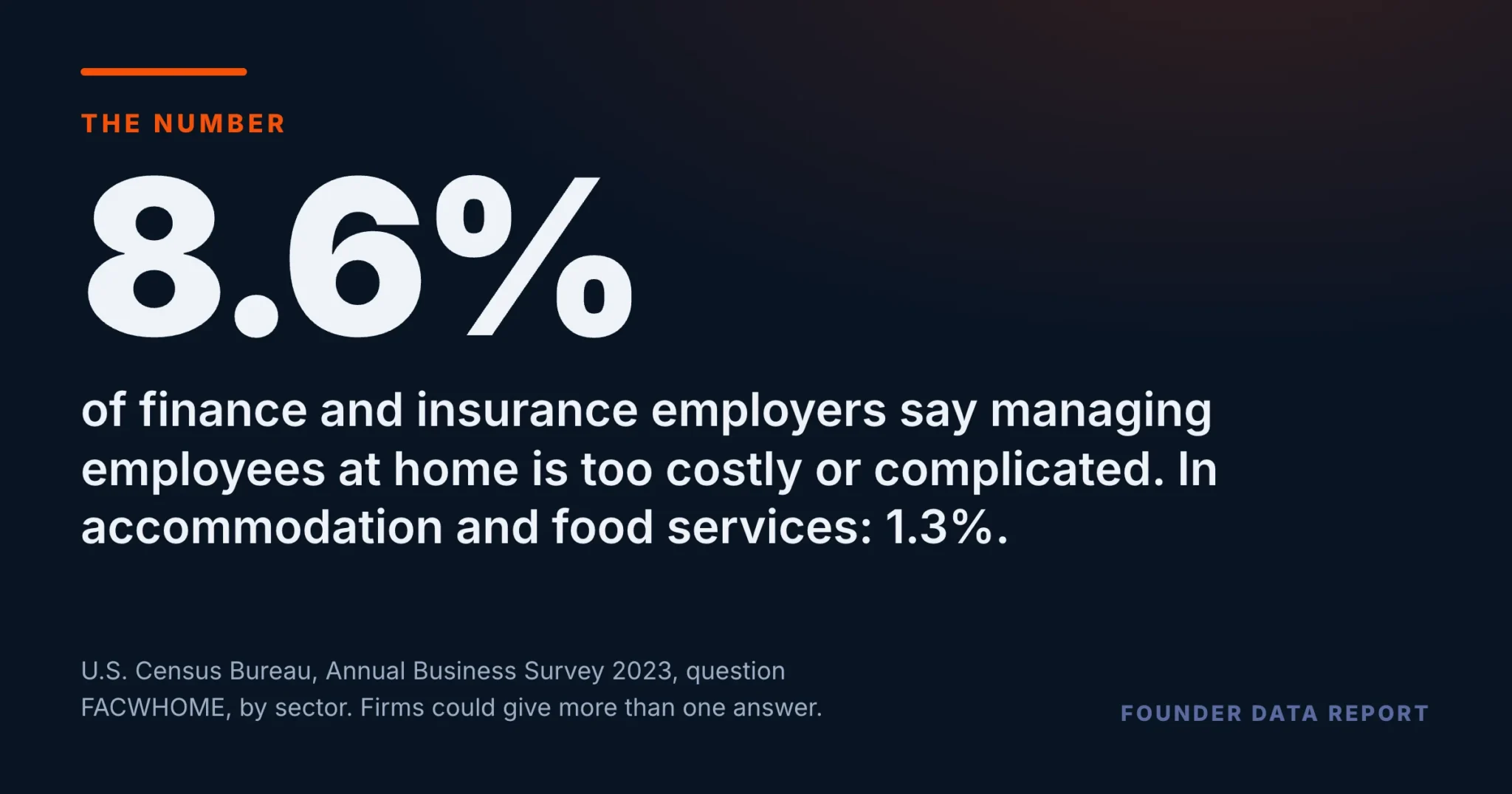
When the Census Bureau asked employers what limits working from home, the answer management of employees too costly or complicated came from 8.6% of finance and insurance firms — the highest of any precisely measured trade — and from 1.3% in accommodation and food services, 6.6 times less. But the bigger finding is who inside each trade gives that answer. In 17 of the 18 trades with a published figure, the firms naming management employ a larger share of the trade’s workers than their share of its firms. In retail they are 3.0% of firms and employ 21.4% of the workers. Finance is the one trade where it is not a big-firm answer.
- Nationally, 4.0% of answering employer firms name managing staff at home as a limit on remote work. By trade it runs from 8.6% in finance and insurance to 1.3% in accommodation and food services.
- Finance sits clearly above the next two, professional services (6.3%) and wholesale (6.2%). Management of companies reads 10.2%, but its error is too wide to rank.
- In 17 of 18 trades, the firms giving the management answer employ more than their share of workers — at the median, 3.2 times their share of firms.
- Retail is the extreme: 3.0% of firms, 21.4% of employees, 7.3 times. The retailers saying it average 279 employees.
- Finance runs the other way (8.6% of firms, 7.7% of employees): the firms saying it are no bigger than the trade’s average.
The trade sets how often the question even comes up
The Annual Business Survey gave employers five answers to the question of what limits working from home, and let them pick more than one. Nationally, 4.0% chose management of employees too costly or complicated. Split by trade, that answer ranges six-fold. Finance and insurance gives it most often among the trades the survey measures tightly, at 8.6% — clearly above professional and technical services at 6.3% and wholesale at 6.2%, which are level with each other. At the bottom, accommodation and food services (1.3%), other services (1.5%) and arts and recreation (1.7%) are too close to call among themselves. These are the trades where the work mostly cannot leave the building, so the management question rarely gets the chance to arise.
Bars share one scale, set by the largest value. Slate bars (management of companies; manufacturing; utilities; mining, oil and gas) carry a standard error of 1.5 points or more, printed under each, and should be read as approximate. Agriculture’s figure is suppressed by the Bureau and is not shown. Firms could give more than one answer.
U.S. Census Bureau, Annual Business Survey 2023, Characteristics of Businesses (AB2300CSCB01), question FACWHOME by 2022 NAICS sector, employer firms, released January 2026. Shares are of firms in each sector that answered the question; nationally that is about 49% of the 5,934,950 employer firms in scope.
In retail, 3.0% of employers named managing staff at home. They employ 21.4% of the workers.
Inside most trades, it is the big firms saying it
Count employees rather than firms and the answer moves in almost every trade. The Census file attaches to each answer the total employment of the firms that gave it, so the employee share shows how large those firms are compared with the rest of their trade. In 17 of 18 trades, the firms naming management hold a bigger share of the workers than of the firms. In retail, 3.0% of answering firms employ 21.4% of the workers at answering retailers — the retailers saying it average 279 employees, against 38 for every retailer that answered. Transportation and warehousing runs the same way: 3.7% of firms, 22.6% of employees. Those are firms the size of chains and fleets — businesses large enough to have a layer of managers between the owner and the work. That layer is where the difficulty appears to arrive.
Slate is the share of answering firms in the trade giving the management answer; orange is the share of the trade’s employees who work at those firms — everyone on their payroll, not only the people whose jobs are affected. Eight trades shown; both bars use one scale. Finance is the only trade where orange is shorter.
U.S. Census Bureau, Annual Business Survey 2023, Characteristics of Businesses (AB2300CSCB01), question FACWHOME by 2022 NAICS sector, employer firms, released January 2026. Shares are of firms in each sector that answered the question; nationally that is about 49% of the 5,934,950 employer firms in scope.
Finance is the exception, and remote-friendly work does not explain it
Finance and insurance is the one trade where the management answer is not a big-firm answer: 8.6% of firms, 7.7% of employees. The finance firms giving it are, on average, no bigger than the trade’s other answering firms. It would be tidy to say the answer simply shows up wherever the work could go home — finance is where the job is least often tied to the building, with only 28.9% saying it cannot be done at home. But real estate breaks that story. Only 37.7% of real-estate firms say the job cannot be done at home, yet just 2.8% name management — a gap the survey’s error cannot close. Across all 18 trades, the link between the two answers is weak. Something about the work in finance, not just its location, makes remote management harder to sign off on.
1.0x would mean the firms giving the management answer are the same size, on average, as every answering firm in their trade. 11 of 18 trades sit at 3x or more. Finance (slate) is the only trade below 1.0x. The ratio is built from published firm and employment counts; the Bureau publishes no standard error for it, so treat small differences as unranked.
U.S. Census Bureau, Annual Business Survey 2023, Characteristics of Businesses (AB2300CSCB01), question FACWHOME by 2022 NAICS sector, employer firms, released January 2026. Shares are of firms in each sector that answered the question; nationally that is about 49% of the 5,934,950 employer firms in scope.
What to do with this if you run a small business
If you are holding work in the building because you doubt you can manage it from a distance, the trade you are in shapes how unusual that is. In finance, roughly one employer in twelve gives that answer, small or large. In most other trades it is an answer that grows with the payroll — the retailers giving it average 279 people. For a small owner that is worth separating out: a doubt that belongs to a company with several layers of supervision may not be your constraint yet. The decision to settle early is how work gets checked, because that is what gets harder as the headcount grows — whether or not anyone ever works from home.
Four limits worth holding. The survey covers employer firms only. Only about 49% of employer firms answered this question, and every share here is of the firms in each trade that answered. The question is multiple response in every trade, so no answer can be read as ‘everyone else’. And the employee figures count everyone at a firm giving the answer, which is what makes them a reading of firm size rather than of how many workers are affected.
U.S. Census Bureau, Annual Business Survey 2023, Characteristics of Businesses (AB2300CSCB01), question FACWHOME, answer ‘management of employees too costly or complicated’.
Frequently Asked Questions
Which industries find remote employees hardest to manage?
In the Census Bureau's Annual Business Survey 2023, finance and insurance had the highest precisely measured share of employer firms naming 'management of employees too costly or complicated' as a limit on working from home, at 8.6%. Professional and technical services (6.3%) and wholesale (6.2%) followed. Management of companies read 10.2% with a wide error.
Which industries name it least?
Accommodation and food services (1.3%), other services (1.5%) and arts, entertainment and recreation (1.7%). The three are within the survey's margin of error of one another.
Is managing remote staff mainly a big-company concern?
In most trades, yes. In 17 of the 18 trades with a published figure, the firms giving the management answer employ a larger share of workers than their share of firms. In retail they are 3.0% of firms and employ 21.4% of workers. Finance and insurance is the exception, at 8.6% of firms and 7.7% of employees.
Do industries where work can be done from home name management more often?
Only loosely. Finance, where the fewest firms say the job cannot be done at home, names management most often among the precisely measured trades. But real estate, where only 37.7% say the job cannot be done at home, names it at 2.8%. Across trades the relationship is weak.
What does the employee share mean here?
It is the share of a trade's employees who work at firms giving the answer — all of those firms' employees, not only the people whose jobs could be done at home. Because it counts whole payrolls, it shows how large the answering firms are compared with the rest of their trade.
Published by The Lonely Entrepreneur — the community and coaching platform for entrepreneurs who are building alone. lonelyentrepreneur.com
This article is for educational purposes and is not a substitute for professional financial or legal advice.