

 Founder Data Report
In Real Estate, 1.2% of Workplaces Hold 32.7% of the Jobs. In Manufacturing, 16.7% Hold 80.2%.
You can’t afford to risk your business without a Sidekick at your side.
The Census Bureau counts every American workplace that meets a payroll and sorts it by how many people work there. Nationally, workplaces of fifty or more are 5.4% of all workplaces and hold 61.2% of the jobs. What nobody publishes is how far that varies by industry — and it varies enormously.
The Census Bureau counted 8,361,342 private workplaces in the United States in 2023, holding 139,831,742 jobs. Workplaces with fifty or more people are 5.4% of that count and hold 61.2% of the jobs. That national figure is already published. The part that is not is how differently it lands by trade: in other services the share of jobs at workplaces of fifty or more is 25.5%, and in management of companies it is 89.7%. In real estate and leasing 1.2% of workplaces hold 32.7% of the jobs — a multiple of 26.7. In manufacturing it takes 16.7% of workplaces to hold 80.2%, a multiple of 4.8.
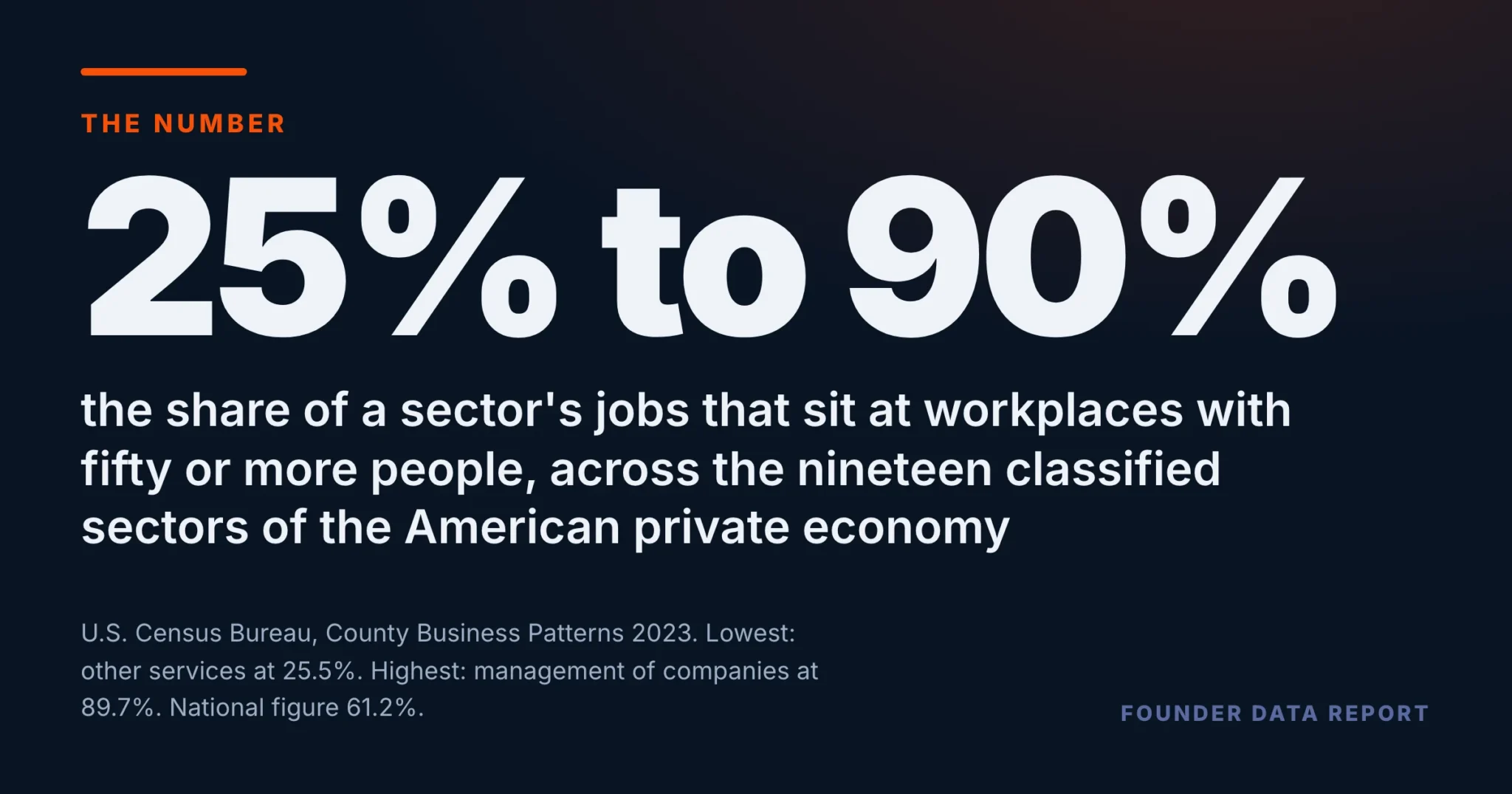
- Across all 19 classified sectors, the share of jobs at workplaces of fifty or more runs from 25.5% (other services) to 89.7% (management of companies). The national figure is 61.2%.
- Big workplaces hold a larger share of the jobs than of the workplaces in every one of the 19 sectors, without exception. What changes is by how much: from 4.2 times in management of companies to 26.7 times in real estate and leasing.
- Nine of the 19 sectors sit below the national 61.2%, so in those trades most of the work is at places under fifty people.
- Nationally the median private-sector job is at a workplace of 50 to 99 people. The 9,470 workplaces of a thousand or more — 0.11% of all workplaces — hold 17.8% of the jobs, against 5.4% at the 4,639,650 workplaces with fewer than five.
- These are workplaces, not companies: a forty-person branch of a national chain counts in the same band as a forty-person independent. The size of the site is not the size of the business behind it.
Everything feels important, and this is one number that tells you what to ignore
Everything feels important when you are running a small business, and the hardest call of the week is what to leave alone. This is one number that helps you make it, because it tells you who is actually in the market around you. In a trade where a quarter of the jobs sit at large workplaces, the businesses you are competing with for staff and for customers are mostly the size of yours. In a trade where nine in ten do, they are not — and effort scattered across priorities borrowed from the wrong kind of competitor shows up faster there. The gap between 25.5% and 89.7% is not a matter of degree. It changes which problems are worth your week.
One series: the share of the sector’s JOBS, in orange. Every bar is a share of that sector’s own employment, not of the national total. The national figure is 61.2%; nine of the 19 sectors sit below it. Sector 99 (Unclassified, 13,192 jobs) is left out.
U.S. Census Bureau, County Business Patterns 2023, national file (cbp23us), published 26 June 2025 and re-fetched 28 September 2026. Establishment and employment counts by employment-size class; employment is for the pay period including 12 March 2023. CBP is published on NAICS 2017. Sector 99 (Unclassified, 13,192 jobs) is excluded.
25.5% in one trade. 89.7% in another. Same country, same year.
The few big workplaces outweigh the many small ones in every sector — the question is by how much
There is no sector where this runs the other way. In all 19 of them the share of jobs at workplaces of fifty or more is larger than the share of workplaces that size, which is what it means for work to gather. But the multiple is not a constant. In real estate and leasing the jobs share is 26.7 times the workplace share — 1.2% of workplaces holding 32.7% of the jobs. In management of companies it is 4.2 times, because that sector has far more large sites to begin with: 21.6% of its workplaces are already at fifty or more. A high share of jobs at big workplaces and a high concentration are not the same fact, and management of companies has the first without much of the second.
Slate is the share of that sector’s workplaces with fifty or more people; orange is the share of its jobs. Both dots are percentages of the same sector, on a 0-100 track. The three widest and three narrowest gaps among the 16 sectors holding at least a million jobs; the 4.2x-to-26.7x range quoted in the text is across all 19 sectors and uses no size floor.
U.S. Census Bureau, County Business Patterns 2023, national file (cbp23us), published 26 June 2025 and re-fetched 28 September 2026. Establishment and employment counts by employment-size class; employment is for the pay period including 12 March 2023. CBP is published on NAICS 2017. Sector 99 (Unclassified, 13,192 jobs) is excluded.
The median American private-sector job is at a workplace of fifty to ninety-nine people
Read the national file from the smallest workplaces upward and the halfway point arrives inside the 50 to 99 band: everything under fifty people accounts for 38.8% of private-sector jobs, so the median job in the country is at a workplace of 50 to 99. The tails are what make the curve steep. 4,639,650 workplaces have fewer than five people — 55.5% of every workplace in the country — and they hold 5.4% of the jobs. At the other end, 9,470 workplaces have a thousand or more, which is 0.11% of the count, and they hold 17.8%: 3.3 times as many jobs as the under-five group, from 490 times fewer workplaces.
Each point is the share of all private-sector jobs at workplaces of that size or smaller. The line crosses 50% inside the 50 to 99 band, which is where the median American private-sector job sits. The axis is the full 0-100.
U.S. Census Bureau, County Business Patterns 2023, national file (cbp23us), published 26 June 2025 and re-fetched 28 September 2026. Establishment and employment counts by employment-size class; employment is for the pay period including 12 March 2023. CBP is published on NAICS 2017. Sector 99 (Unclassified, 13,192 jobs) is excluded.
Four limits worth holding. These are workplaces, not companies: County Business Patterns counts establishments, so a forty-person branch of a chain and a forty-person independent land in the same band, and the branch has a head office doing work the independent does itself. The universe is employers only — a business with no payroll is not in this file at all, and there are more of those than there are employers. The count of workplaces depends on which file you use: CBP counts 8,361,342 private workplaces and the BLS Quarterly Census of Employment and Wages counts 11,657,676, because the two draw their universe differently — so the under-five share is 55.5% here and 67.1% there, and neither is wrong. The direction is the same in both. And two sectors, utilities and transportation and warehousing, are 0.04 points apart and print the same figure to one decimal, so nothing here ranks one against the other.
U.S. Census Bureau, County Business Patterns 2023 national file. Nineteen classified sectors; sector 99 (Unclassified) excluded.
Frequently Asked Questions
What share of American jobs are at small workplaces?
In the Census Bureau's County Business Patterns file for 2023, workplaces with fewer than fifty people hold 38.8% of the 139,831,742 private-sector jobs in the United States, and workplaces of fifty or more hold 61.2%. Workplaces of fifty or more are 5.4% of the 8,361,342 workplaces counted.
Which industries have the most jobs at large workplaces?
The three highest are management of companies at 89.7%, administrative and waste services at 81.1%, manufacturing at 80.2%. The three lowest are other services at 25.5%, real estate and leasing at 32.7%, accommodation and food services at 36.9%. The national figure is 61.2%.
Is there any industry where small workplaces hold most of the jobs?
Yes. Nine of the 19 classified sectors sit below the national 61.2%, and in five of them most of the jobs are at workplaces under fifty people: other services, real estate and leasing, accommodation and food services, agriculture and forestry, construction. In those trades the businesses around you are mostly the size of yours.
Does this tell me how big my competitors are?
Not directly, and the difference matters. County Business Patterns counts workplaces, not companies, so a large firm operating forty small sites appears as forty small workplaces. The figures describe where the work is done, not who owns it. A trade can look fragmented by workplace and be consolidated by ownership.
Why does this file count fewer workplaces than other government figures?
County Business Patterns counted 8,361,342 private workplaces for 2023; the Bureau of Labor Statistics counted 11,657,676 for early 2025 in its Quarterly Census of Employment and Wages. The two programmes define their universe differently, so the levels differ and the small-workplace share differs with them — 55.5% under five people here against 67.1% there. Both files agree on the shape: most workplaces are small and most jobs are not at them.
Published by The Lonely Entrepreneur — the community and coaching platform for entrepreneurs who are building alone. lonelyentrepreneur.com
This article is for educational purposes and is not a substitute for professional financial or legal advice.