

 Founder Data Report
A Third of American Employer Businesses Pay People Who Are Not on Their Payroll. Almost One in Five Has No Full-Time Employee.
Get clarity — download the free Entrepreneur Survival Guide Summary.
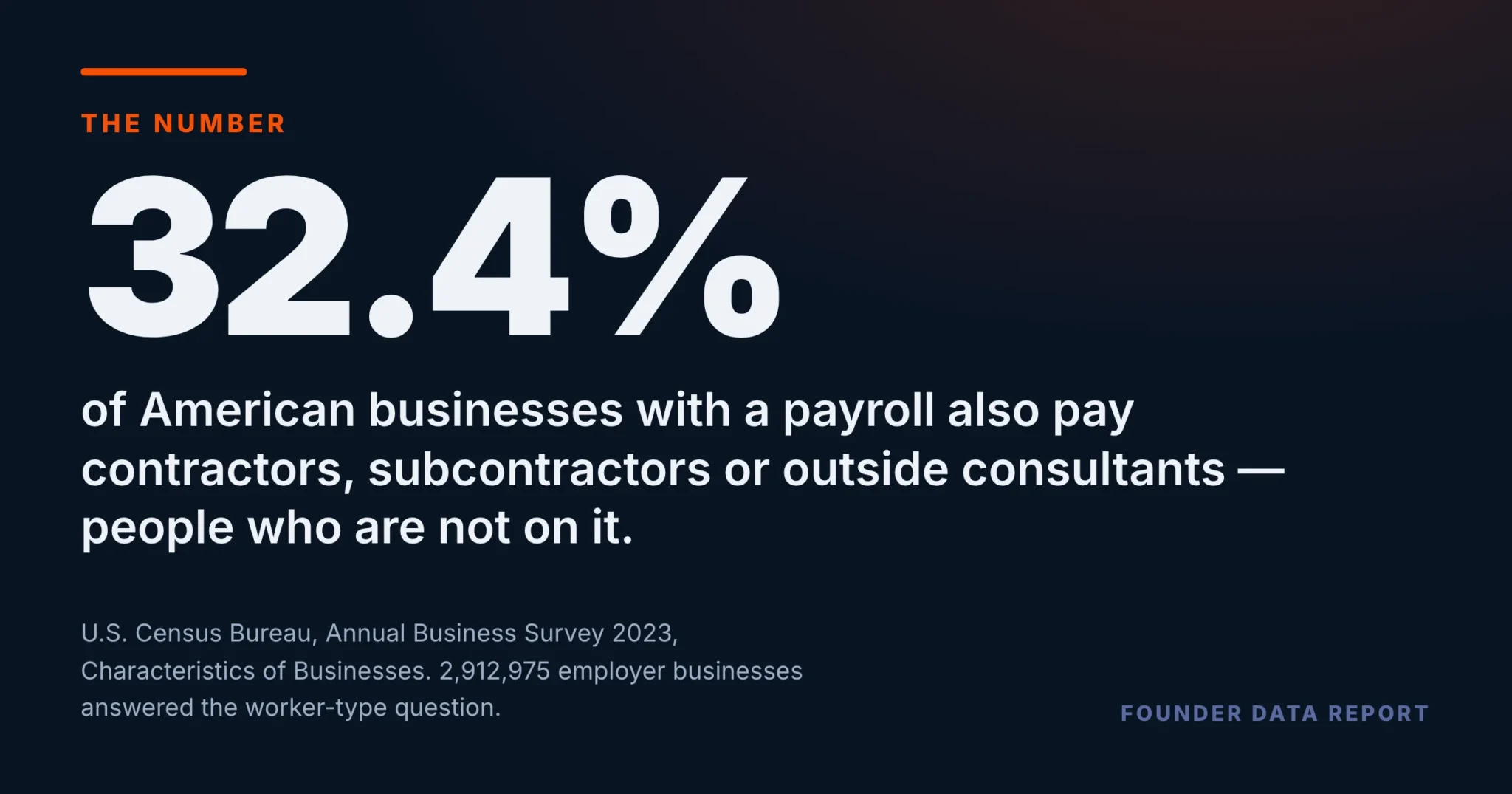
The Census Bureau asked 2.91 million U.S. businesses with employees which kinds of worker they use. 32.4% named contractors or outside consultants, 50.1% named part-timers, and 18.4% did not name full-time employees at all. The average business named 1.71 kinds.
2,912,975 U.S. businesses with employees told the Census Bureau which kinds of worker they use, ticking every kind that applied. 81.6% use full-time paid employees. 50.1% use part-time ones. 32.4% — 943,375 businesses — pay contractors, subcontractors, independent contractors or outside consultants, who are not on the payroll at all. The average business named 1.71 kinds of worker, and because two groups this large have to overlap, at least 31.7% of them are running full-time and part-time employees at the same time. 18.4% of these employers, 536,914 of them, did not name a full-time employee at all.
- 32.4% of employer businesses use contractors or outside consultants; 50.1% use part-timers; 81.6% use full-timers.
- 18.4% — 536,914 businesses that meet a payroll — report no full-time employee.
- The seven options add to 170.8% of the base because a business ticks every kind it uses, so the average one names 1.71 kinds.
- Contractor use runs from 54.2% in information and 50.3% in construction down to 14.7% in accommodation and food services.
- In two industries part-time use beats full-time use: educational services (68.3% against 59.0%) and accommodation and food services (86.8% against 79.8%).
Almost two kinds of worker per business
The question is a tick-all-that-apply, and that is the finding. Across the 2,912,975 employer businesses that answered, the seven published options add to 170.8% of the total — an average of 1.71 kinds of worker each. Full-time employees are the most common at 81.6%, half of these businesses run part-timers and about a third buy work from people they do not employ. Only 1.5% answered “none of these”. The survey does not publish how many kinds each business ticked, so the mean is all there is — but two shares this size have to overlap, and 81.6% plus 50.1% means at least 31.7% of these businesses run full-timers and part-timers together, with at least 14.0% running full-timers and contractors together. Those are floors, not estimates.
Bars are drawn on a 0–85% axis, not 0–100. A business ticks every kind it uses, so these shares overlap and add to 170.8% — they are seven separate yes-or-no answers on the same 2,912,975 businesses, not slices of a whole, and they must not be summed into a total. Orange marks the three options more than one business in ten reports. The three smallest bars are drawn at the chart’s minimum width and should be read from their printed values.
U.S. Census Bureau, Annual Business Survey 2023, Characteristics of Businesses, question WORKERS, employer firms. Standard errors as published.
A third of them pay people they do not employ
943,375 employer businesses — 32.4% — report paying contractors, subcontractors, independent contractors or outside consultants. That is work handed to someone whose hours the owner does not control, whose loyalty is not bought with a salary, and whose mistakes still land on the owner’s name. It is most common in information at 54.2% and construction at 50.3% — the two are 3.9 points apart against a combined standard error of 3.8, so they should be read as a pair rather than ranked. It is least common in accommodation and food services at 14.7%, where the work happens on the premises at fixed hours.
Bars are drawn on a 0–60% axis, not 0–100. Orange marks a sector whose estimate carries a standard error of 3.0 points or less; slate marks the 5 whose error is larger, and those should not be ranked against each other — management of companies is 42.3% plus or minus 21.0 points. “Industries not classified” is a residual group, and the Bureau withholds its figure. A business operating in more than one sector is counted in each, so the sector totals add to 100.7% of the national base and the column must not be summed.
U.S. Census Bureau, Annual Business Survey 2023, Characteristics of Businesses, question WORKERS by 2022 NAICS sector, including the published ranges 31-33, 44-45 and 48-49.
81.6% use full-time employees. 32.4% use people who are not employees at all. Both numbers describe the same businesses.
The businesses that use everything are the ones with the payroll
The same table carries each group’s own paid employment, and it splits the picture in two. The 3.0% of businesses that use a temporary staffing service employ 40.5% of all the people on the payrolls in this survey. The 0.7% that use leased employees or a professional employer organisation employ 13.1%. Those arrangements are not what small employers do — they are what big ones do. Contractors are the exception: the businesses that use them are 32.4% of the count and 58.9% of the payroll, which is a far smaller gap, because buying an afternoon of somebody’s expertise is available to a business with eight people in it.
Both bars in a row sit on the same 0–100% scale. The right-hand bar is the reporting businesses’ OWN paid employment, not the number of workers of that kind: the businesses using a temporary staffing service carry 28.7 million people on their own payrolls, which is not a count of temporary staff. Employment shares are of the 70,857,272 employees at the 2,912,975 businesses that answered, and the rows overlap because a business appears in every kind it uses.
U.S. Census Bureau, Annual Business Survey 2023, Characteristics of Businesses, question WORKERS, employer firms and their paid employment.
Two industries where part-time is the more common answer
In 17 of the 19 named industries, more businesses use full-time employees than part-time ones. Two run the other way. In educational services, 68.3% of employer businesses use part-timers against 59.0% using full-timers, a gap of 9.3 points. In accommodation and food services it is 86.8% against 79.8%, a gap of 7.0 points. Both gaps clear the combined standard error of the two estimates. That is the shape of a business built out of shifts, and it is also the shape of a business where the owner is the only person whose week is not scheduled by somebody else.
What the question does and does not measure
It counts businesses, not workers. A business that uses one contractor once and a business that runs on forty of them both tick the same box, so 32.4% is the share that does it at all, not a measure of how much. The survey’s universe is 5.93 million employer firms and the ones that answered this question are 49.1% of them, so every share here belongs to that reporting base. And because a business ticks every kind it uses, the only honest complement is inside a single option: 81.6% named full-time employees, so 18.4% did not. Two options can never be added into a total here. They can be overlapped: shares of 81.6% and 50.1% on the same base must share at least 31.7% of it, which is a floor the arithmetic guarantees rather than a figure the Bureau publishes.
U.S. Census Bureau, Annual Business Survey 2023, Characteristics of Businesses, question WORKERS. The last cell is not a published figure: it is the smallest overlap two shares of 81.6% and 50.1% on the same base can have. The true figure is higher, and the survey does not give it.
Frequently Asked Questions
What share of small businesses use independent contractors?
32.4% of the 2,912,975 U.S. employer businesses that answered the 2023 Annual Business Survey reported using contractors, subcontractors, independent contractors or outside consultants — 943,375 businesses.
Can a business have employees but no full-time staff?
Yes, and 536,914 of them do. 18.4% of the employer businesses that answered did not report using full-time paid employees, while 50.1% reported part-time ones.
How many kinds of worker does a typical small business use?
1.71 on average. The question lets a business tick every kind it uses, and the seven published options add to 170.8% of the 2,912,975 businesses answering.
Which industries rely most on contractors?
Information at 54.2% and Construction at 50.3% are the highest, and they are close enough to be treated as a pair. The lowest is accommodation and food services at 14.7%.
Do many small businesses use temp agencies or a PEO?
Few do. 3.0% use a temporary staffing service and 0.7% use leased employees or a professional employer organisation. Both are concentrated in large employers: those businesses hold 40.5% and 13.1% of the survey's payroll employment.
Published by The Lonely Entrepreneur — the community and coaching platform for entrepreneurs who are building alone. lonelyentrepreneur.com
This article is for educational purposes and is not a substitute for professional financial or legal advice.