

 Founder Data Report
Only 4.0% of Employers Say Managing People at Home Is the Problem. 60.1% Say the Work Can’t Leave the Building.
Join us Fridays at 12 PM ET to ask TLE CEO Michael Dermer your questions live.
The Census Bureau asked every surveyed employer two plain questions: did anyone work from home, and if not more of them, what stopped it. The answer most owners would guess is not the one they gave.
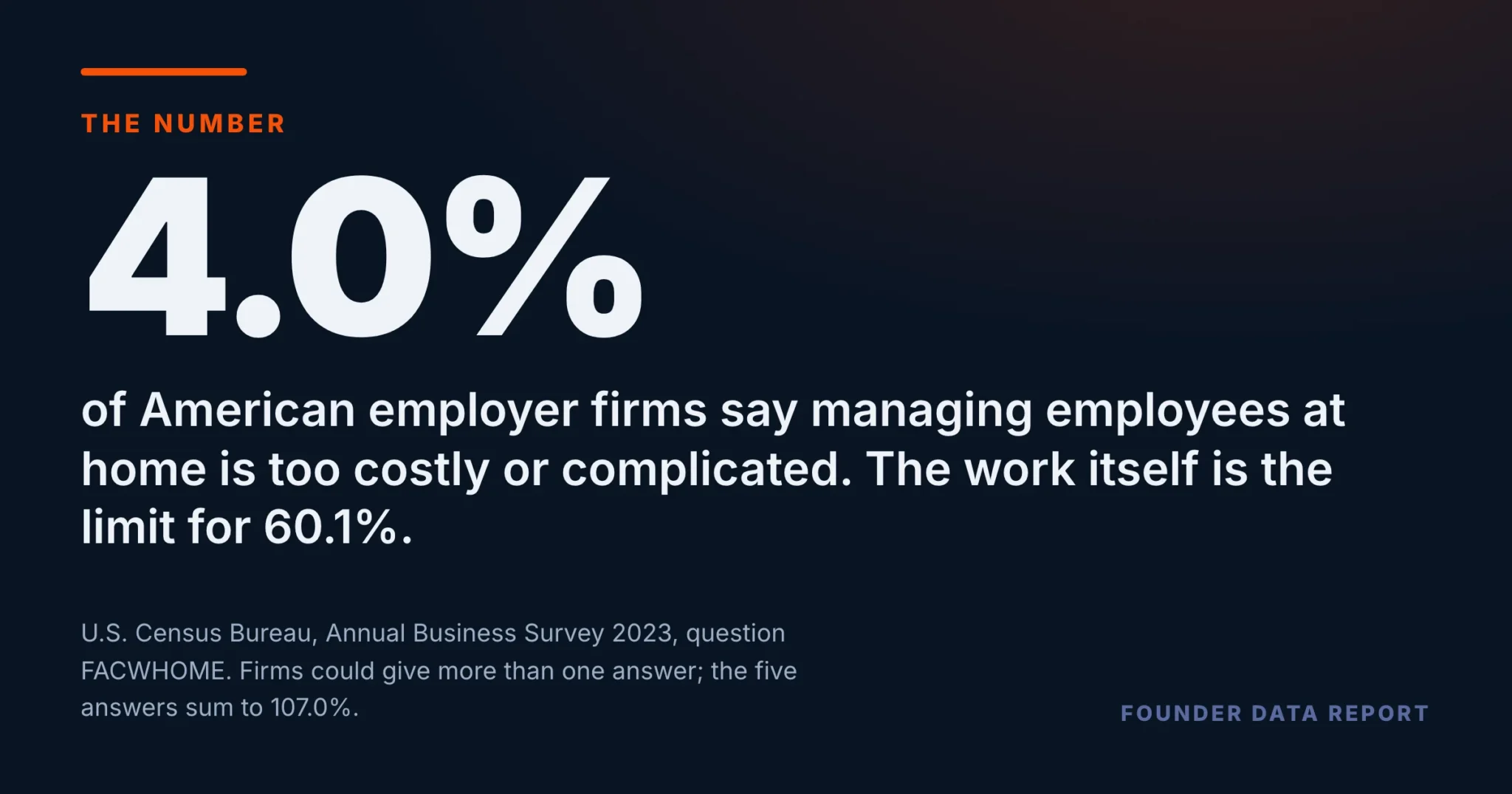
When the Census Bureau asked American employers what limits working from home, 60.1% said the job, or part of it, cannot be done there. Only 4.0% said managing employees at home is too costly or complicated, and 3.9% named security. 36.5% said nothing limits it at all. The worry that gets the most airtime — can I manage people I cannot see — is the answer almost nobody gave. And the few who did give it are not small: they average 75 employees, against 24 for all firms that answered.
- 35.9% of employer firms that answered had any employee who worked from home. Those firms employ 68.4% of the workers at firms that answered — because they are bigger, averaging 46 employees against 12.
- The limit is the work: 60.1% say the job cannot be done at home. 4.0% name managing people there, and 3.9% name security — the two are statistically indistinguishable.
- Measured by employees rather than firms, the management answer triples, to 12.3%. It is a concern of larger employers, not of the typical small one.
- By trade it runs from 5.4% of firms in accommodation and food services to 75.9% in information, which is level with professional and technical services at 70.2%.
- Firms could give more than one reason, and only about half of employer firms answered the question at all. Every share here is of the firms that answered.
The reason owners give is the work, not the people
There is a version of this argument that every owner has had with themselves: if I let people work where I cannot see them, will the work still get done? It is a question about trust, and it gets a lot of airtime. The Census Bureau’s Annual Business Survey asked employers directly what limits working from home in their business, and gave them five answers to choose from. The one closest to that argument — management of employees too costly or complicated — was chosen by 4.0% of firms. The job itself was the limit for 60.1%. The honest reading is that for most small employers, working from home is not a leadership decision at all. The till, the truck, the patient and the job site decide it before the owner does.
Firms could choose more than one answer, so the five shares sum to 107.0%, not 100%. Orange marks the management answer; the others are slate. Management (4.0%) and security (3.9%) are within each other’s standard errors and are not ranked. Shares are of the 2,910,545 firms that answered.
U.S. Census Bureau, Annual Business Survey 2023, Characteristics of Businesses (AB2300CSCB01), questions WORKHOME and FACWHOME, employer firms, released January 2026. Shares are of firms that answered each question, about 49% of the 5,934,950 employer firms in scope.
60.1% said the work can’t go home. 4.0% said managing it was the problem.
The management worry grows with the headcount
Count employees instead of firms and the picture moves. Firms that named managing people at home as a limit are 4.0% of the firms but employ 12.3% of the workers at firms that answered — 3.1 times their share by count. They average 75 employees. Firms that said nothing limits working from home run the other way: 36.5% of firms, 18.8% of the workers, and an average of 12 employees each. Put plainly, the owners who find remote work hard to manage are running organizations large enough to have managers of their own, and the ones who say nothing stands in the way average about a dozen people. The trust problem, where it exists, is a scale problem.
Slate is the share of the 2,910,545 answering firms; orange is the share of the 70,660,136 people those firms employ. The employee figure counts everyone at a firm giving the answer, not only the people whose jobs are affected. ‘Other reasons’ (2.5% of firms) is left out of this chart. Firms could give more than one answer.
U.S. Census Bureau, Annual Business Survey 2023, Characteristics of Businesses (AB2300CSCB01), questions WORKHOME and FACWHOME, employer firms, released January 2026. Shares are of firms that answered each question, about 49% of the 5,934,950 employer firms in scope.
Whether anyone works from home depends almost entirely on the trade
Across the whole survey, 35.9% of answering employer firms had any employee who worked from home. By sector that share runs from 5.4% in accommodation and food services to 75.9% in information, with professional and technical services at 70.2% — a gap the survey’s own error margins cannot separate. Retail sits at 14.7%. In 12 of the 19 classified sectors, most firms clearly had nobody at home, outside the survey’s error margins. The reason is the one in the first chart: 80.2% of food-service and hospitality firms say the job cannot be done at home, against 28.9% in finance and insurance, the lowest of any sector.
Orange bars have a standard error under five points. The slate bars (manufacturing; mining, oil and gas; utilities; management of companies) have a standard error of five points or more and should be read as approximate; the error is printed under each. Information (75.9%) and professional services (70.2%) are not statistically different.
U.S. Census Bureau, Annual Business Survey 2023, Characteristics of Businesses (AB2300CSCB01), question WORKHOME by 2022 NAICS sector, including the published ranges 31-33, 44-45 and 48-49. Sector 99 (not classified) excluded.
What to do with this if you run a small business
If your work can be done away from the building and you are holding it there because you are not sure you can manage it, you are giving an answer only 4.0% of employers gave. That is worth knowing, because it separates a constraint you set from one the work sets. The first can be changed by a decision; the second cannot. It is also worth knowing that the firms which do name management as the obstacle are, on average, 75 people strong — big enough, usually, to have a layer of managers between the owner and the work. That is where the difficulty appears to arrive, and it is the point to decide how work is checked, not only where it is done.
Four limits worth holding. The survey covers employer firms only; a business with no payroll is not in it. Only about 49% of employer firms answered these questions — they hold 53% of the employment — and every share here is of those firms, not the full 5,934,950. The limiting-factor question is multiple response, so its answers sum to 107.0% and no answer can be read as ‘everyone else’. And the employee figures count everyone at a firm giving an answer: a firm with one person working from home counts all of its employees in that column.
U.S. Census Bureau, Annual Business Survey 2023, Characteristics of Businesses, questions WORKHOME and FACWHOME.
Frequently Asked Questions
What share of small businesses let employees work from home?
In the Census Bureau's Annual Business Survey 2023, 35.9% of employer firms that answered had at least one employee who worked from home. Those firms employ 68.4% of the workers at answering firms, because firms with remote work tend to be larger — an average of 46 employees, against 12 at firms without it.
Why don't more small businesses allow remote work?
Overwhelmingly because of the work itself. 60.1% of answering employer firms said the job, or part of it, cannot be done at home. 4.0% said managing employees at home is too costly or complicated, 3.9% named security concerns, and 36.5% said nothing limits it. Firms could give more than one answer.
Is managing remote employees a bigger problem for larger companies?
The survey suggests so. Firms naming management as a limit are 4.0% of answering firms but employ 12.3% of their workers, and they average 75 employees. Firms reporting no limit at all average 12.
Which industries have the most remote work?
Information (75.9%) and professional, scientific and technical services (70.2%) have the highest share of firms with anyone working from home; the two are within the survey's margin of error. Accommodation and food services is lowest, at 5.4%, followed by other services at 10.7% and retail at 14.7%.
Does this survey measure how many employees work from home?
No. It records whether a firm had any employee who worked from home, and the employee counts attached are all the employees of those firms. It does not say how many of them worked from home or how often, and the Bureau's companion question on frequency does not state a consistent base, so it is not used here.
Published by The Lonely Entrepreneur — the community and coaching platform for entrepreneurs who are building alone. lonelyentrepreneur.com
This article is for educational purposes and is not a substitute for professional financial or legal advice.