

 Founder Data Report
Setting Priorities by Firm Age: 42% of the Youngest Firms Named Credit Availability. At 21 Years or More, 17% Did
Get clarity — download the free Entrepreneur Survival Guide Summary.
Which money problem deserves your attention first? The Federal Reserve asks employers to name theirs, and the list from a two-year-old firm does not read like the list from a twenty-five-year-old one.
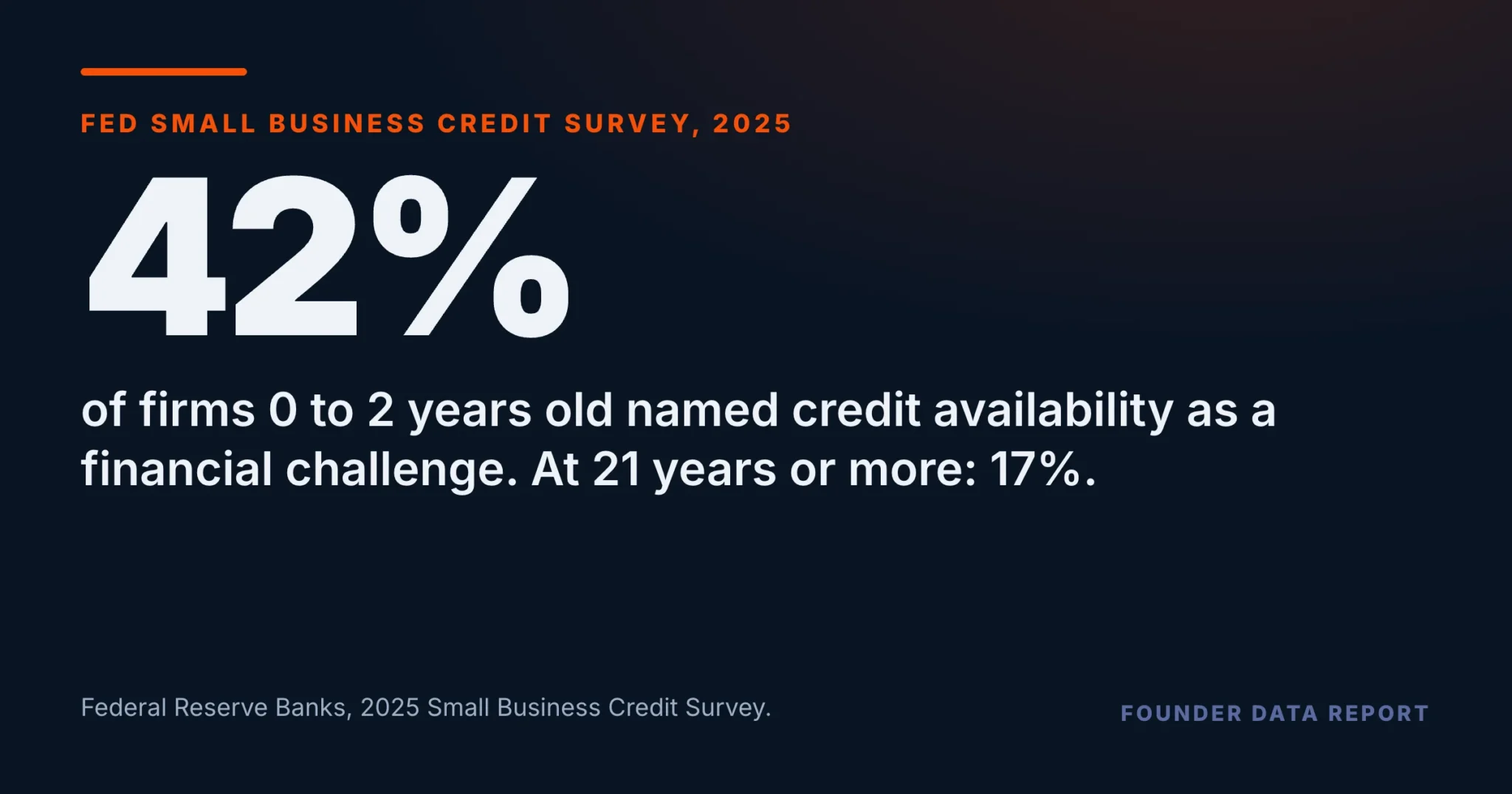
In the Federal Reserve Banks’ 2025 Small Business Credit Survey, 42% of employer firms 0 to 2 years old named credit availability as a financial challenge in the prior 12 months. At firms 21 years or older it was 17%. Rising costs of goods, services or wages had the highest share at both ends, 66% and 75%, but only from six years on did they stand clear of every other challenge.
You have a limited number of hours and a longer list of things that could sink the month. The priority problem is deciding which of them gets the hours. Any general list of small business money problems will tell you costs, cash, sales and credit, and it will be right, and it will not help you choose.
Sorting by the age of the firm helps a little. The Fed’s survey lets owners name as many challenges as apply, and it publishes the answers by how long the business has been around. Some answers differ a great deal from one end of that range to the other. Some hardly differ at all.
- Credit availability: 42% at firms 0 to 2 years old, 17% at 21 years or more. Every age band under 11 years sits clear of every band 11 or older.
- Rising costs: the highest share at every age, 66% to 79%, and clear of every other challenge from year six on. Higher at firms 11 to 15 years old and at 21 or more than at the youngest firms.
- Paying operating expenses: 59% to 60% through year ten, 44% at 21 or more.
- Weak sales: 44% to 53% at every age, and no two age bands separate.
- This is a snapshot of different firms at one time, not the same firms followed as they age.
Credit is the widest gap on the list
Across all employer firms in the survey, 29% named credit availability. By age it runs 42%, 38% and 32% for firms under 11 years, then 22%, 23% and 17% for the older three bands. Every one of the three younger bands sits clear of every one of the three older bands once the survey’s 95% confidence intervals are counted.
At the youngest firms, credit is level with weak sales and tariff costs in the middle of the list. At firms 21 or older, it is the least named of the seven challenges and clear of all six others, including debt payments at 25%. If you are in your first few years and access to credit feels like a bigger issue than it does to the owner down the street who has been open for 30, the survey lines up with that.
Share of employer firms naming each challenge in the prior 12 months. Both bars on one scale, 0 to 100%. More than one answer allowed, so shares do not sum to 100.
Federal Reserve Banks, 2025 Small Business Credit Survey, 2026 Report on Employer Firms data appendix, sheet ‘Age of firm’: ‘Financial challenges, prior 12 months’. Employer firms with fewer than 500 employees; weighted convenience sample; more than one answer allowed.
Share of employer firms in each age band. Bars on a 0 to 60% axis. Firms under 11 years clear firms 11 or older; neighboring bands within those two groups do not separate.
Federal Reserve Banks, 2025 Small Business Credit Survey, 2026 Report on Employer Firms data appendix, sheet ‘Age of firm’: ‘Financial challenges, prior 12 months’. Employer firms with fewer than 500 employees; weighted convenience sample; more than one answer allowed.
Costs lead at every age, but not alone at first
Rising costs of goods, services or wages had the highest share in every age band, from 66% at the youngest firms to 79% at firms 11 to 15 years old. For firms under six years, though, that lead does not clear paying operating expenses: 66% against 59% at 0 to 2 years, 70% against 59% at 3 to 5. From six years on, costs stand clear of every other challenge on the list.
Paying operating expenses holds at 59% to 60% through year ten, and firms 21 or older named it at 44%. Uneven cash flow is 53% at the youngest firms and 42% at the oldest. Debt payments and interest rates take a different shape: firms 6 to 10 years old named them at 43%, above all three older bands, and level with the two younger ones.
Weak sales: 44% at the youngest firms, 46% at the oldest, and no two age bands separate.
Share of employer firms naming each challenge. Both bars on one scale, 0 to 100%. The gap clears the 95% confidence intervals from 6 to 10 years on; it does not at 0 to 2 or 3 to 5 years.
Federal Reserve Banks, 2025 Small Business Credit Survey, 2026 Report on Employer Firms data appendix, sheet ‘Age of firm’: ‘Financial challenges, prior 12 months’. Employer firms with fewer than 500 employees; weighted convenience sample; more than one answer allowed.
What to take from this if you run one
Use the list as a check, not a verdict. If you are under six years in, the survey says your peers have operating expenses beside costs at the top of the page, and credit higher than an established firm would have it. If you have been open more than 20 years, your peers have costs clear of everything else, and if credit is on your own short list, that is less common at your age and worth a closer look.
Then pick. You will not fix seven things this quarter. Write down the one that would do the most damage if it stayed where it is, and say out loud what you will leave alone. That call goes better with someone in the room who has run a business and has no stake in your answer.
Three limits worth holding. This is a snapshot of different firms, not the same firms followed over time, and firms that closed are not in it, so it does not show anyone growing out of a problem. Firm age is not separated from firm size: the survey’s size table also shows credit falling, from 31% at firms with 1 to 4 employees to 15% at 50 to 499. And the survey is a weighted convenience sample, and it does not say why these answers differ.
Federal Reserve Banks, 2025 Small Business Credit Survey.
Frequently Asked Questions
What financial challenge do small businesses name most often?
Rising costs of goods, services or wages, in every firm-age band of the Fed's 2025 survey, from 66% at firms 0 to 2 years old to 79% at firms 11 to 15 years old. Under six years, it does not clear paying operating expenses once the margins of error are counted.
Do younger businesses have more trouble getting credit?
More of them name it as a challenge: 42% at 0 to 2 years against 17% at 21 years or more. The question asks whether credit availability was a challenge, not whether a firm applied or was turned down.
Does weak sales depend on the age of the firm?
Not in this survey. It runs from 44% to 53% across the six age bands, and no two bands separate on their 95% confidence intervals.
Does this show businesses grow out of these problems?
No. It is one survey of different firms at different ages, and firms that have closed are not in it. It also does not separate a firm's age from its size.
Where does the data come from?
The Federal Reserve Banks' 2025 Small Business Credit Survey, 2026 Report on Employer Firms data appendix, covering employer firms with fewer than 500 employees. It is a weighted convenience sample, and every share is published with a 95% confidence interval.
Published by The Lonely Entrepreneur — the community and coaching platform for entrepreneurs who are building alone. lonelyentrepreneur.com
This article is for educational purposes and is not a substitute for professional financial or legal advice.