

 Founder Data Report
Under 10 Employees, the Top Problem Is Customers. From 20 Up, It Is Finding and Keeping Staff.
Get clarity — download the free Entrepreneur Survival Guide Summary.
A Federal Reserve survey of 6,425 employer firms shows the most common operational challenge changing with size: customers for the smallest firms, staff from 20 employees up.
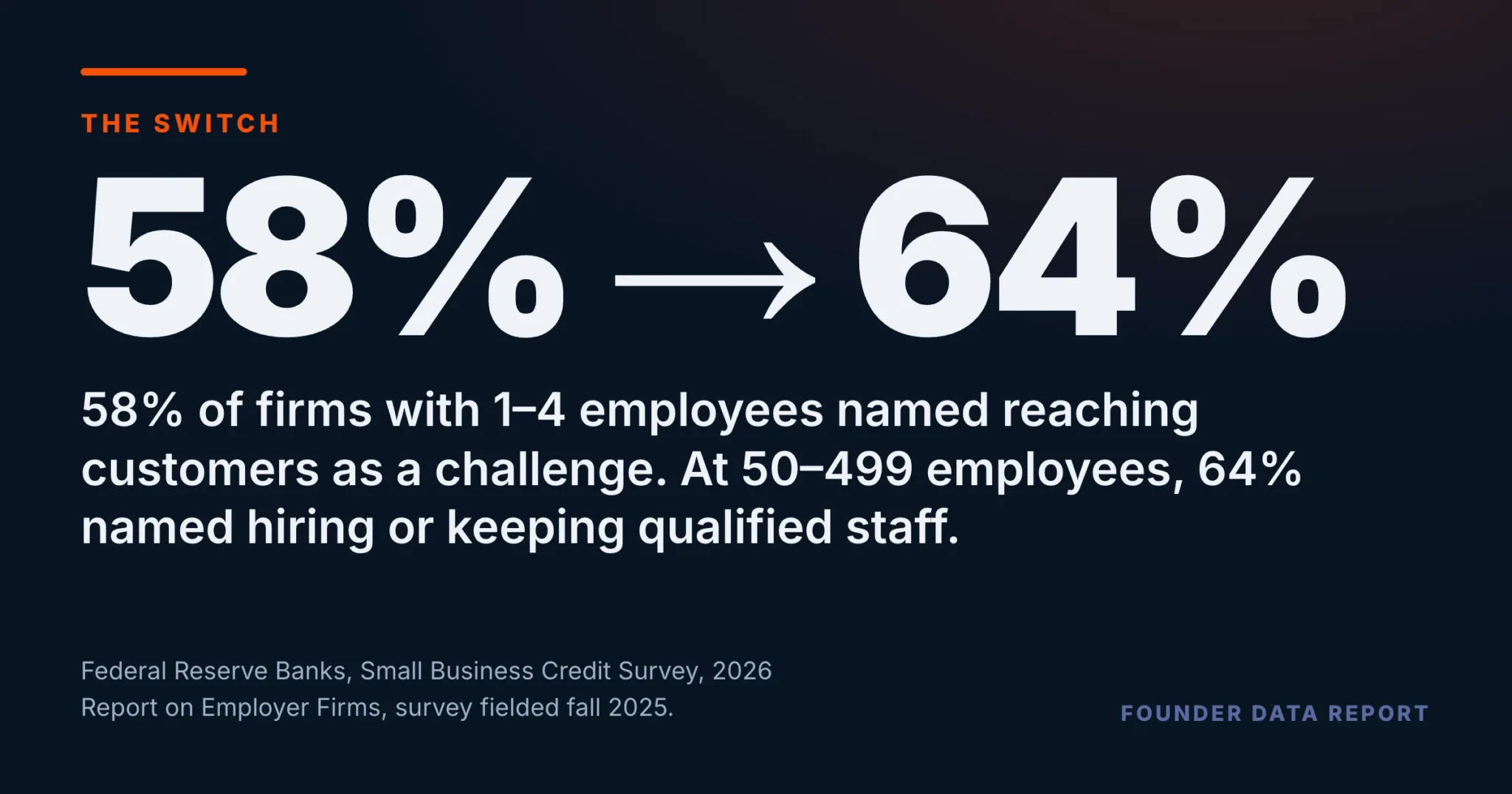
In the Federal Reserve Banks’ 2025 Small Business Credit Survey, the most common operational challenge depended on how many people a firm employed. Among firms with 1–4 employees, 58% named reaching customers and growing sales, against 37% who named hiring or retaining qualified staff. Among firms with 50–499 employees the order reversed: 64% named staff and 49% named customers. Customers led clearly below 10 employees, the two were level at 10–19, and staff led clearly from 20 up.
- Across all employer firms: reaching customers 57%, hiring or retaining qualified staff 46% (firms could name more than one challenge).
- 1–4 employees: customers 58%, staff 37%. 50–499 employees: staff 64%, customers 49%.
- The switch happens between 10 and 19 employees, where the two are statistically level.
- The share naming staff rises at every size step, from 37% to 64%.
- Young firms are customer-first too: 65% of firms aged 0–2 years named customers, 43% named staff.
Two challenges, five sizes of firm
Every year the Federal Reserve Banks ask small employer firms which operational challenges they faced in the previous 12 months. Firms can pick several from a list: reaching customers and growing sales, hiring or retaining qualified staff, supply chain issues, using technology, complying with regulations, and health and safety. Across all employer firms in the survey fielded in autumn 2025, reaching customers came first at 57% and staff second at 46%. Split by size, those two swap places. The share naming customers runs 58%, 61%, 55%, 49%, 49% from the smallest band to the largest. The share naming staff runs 37%, 50%, 60%, 62%, 64%.
Slate is reaching customers or growing sales; orange is hiring or retaining qualified staff. Firms could name more than one challenge, so the two do not add to 100%.
Federal Reserve Banks, Small Business Credit Survey, 2026 Report on Employer Firms and its data appendix (sbcs-employer-firms-appendix-2025.xlsx). Survey fielded September 3 to November 14, 2025; employer firms with 1–499 employees; operational challenges in the prior 12 months. Retrieved from fedsmallbusiness.org on October 10, 2026.
Below 10 employees the hard part is finding the customers. From 20 up, it is finding and keeping the people who serve them.
Where the switch happens, and how sure the survey is
The survey publishes a 95% confidence interval for every share, so the comparison can be made carefully. Here two shares are only called different when their intervals do not overlap. On that test, customers lead staff for firms with 1–4 employees (58% against 37%) and with 5–9 (61% against 50%). At 10–19 employees staff is ahead on the point estimate, 60% to 55%, but the intervals overlap, so the two are level. From 20 employees up staff leads clearly: 62% against 49% at 20–49 and 64% against 49% at 50–499. The biggest single move is the first one: the share naming staff goes from 37% at 1–4 employees to 50% at 5–9.
Bar length is the larger of the two shares. Orange marks the sizes where staff leads and the intervals do not overlap. The ranges in each label are the 95% confidence intervals for the two shares.
Federal Reserve Banks, Small Business Credit Survey, 2026 Report on Employer Firms and its data appendix (sbcs-employer-firms-appendix-2025.xlsx). Survey fielded September 3 to November 14, 2025; employer firms with 1–499 employees; operational challenges in the prior 12 months. Retrieved from fedsmallbusiness.org on October 10, 2026.
Young firms look like small firms
Cut by firm age instead of size, the pattern is similar at the young end. Among firms aged 0–2 years, 65% named reaching customers and 43% named staff; at 3–5 years it was 64% and 49%; at 6–10 years, 58% and 51%. In all three, customers lead clearly. The share naming customers then falls with age, to 48% among firms 21 years or older, where it is level with staff at 45%. Unlike the size cut, staff never clearly leads by age. Size and age overlap (young firms tend to be small), and this table cannot separate the two.
Slate is reaching customers or growing sales; orange is hiring or retaining qualified staff. Firms could name more than one challenge.
Federal Reserve Banks, Small Business Credit Survey, 2026 Report on Employer Firms and its data appendix (sbcs-employer-firms-appendix-2025.xlsx). Survey fielded September 3 to November 14, 2025; employer firms with 1–499 employees; operational challenges in the prior 12 months. Retrieved from fedsmallbusiness.org on October 10, 2026.
What to take from this if you run a small firm
If you have fewer than ten people, the most common problem among firms like yours is the front end: finding customers and growing sales. Somewhere between ten and twenty people the most common problem changes to the team. The practical reading: if you are growing past ten, put hiring, training and keeping people into the owner’s week before the firm reaches twenty, rather than waiting for it to become the most common complaint. Regulation follows the same direction: 22% of the smallest firms named it, against 39% at 50–499 employees.
Four limits worth holding. The survey is a convenience sample, not a random one; the Federal Reserve weights it to match the population of employer firms with 1–499 employees by size, age, industry, geography and owner demographics. Firms could pick more than one challenge. The question asks which challenges a firm had, not which mattered most or what it did about them. And it covers employer firms only, not one-person businesses.
Federal Reserve Banks, Small Business Credit Survey, 2026 Report on Employer Firms.
Frequently Asked Questions
What is the most common operational challenge for small businesses?
Reaching customers and growing sales, named by 57% of employer firms in the Federal Reserve Banks' 2025 Small Business Credit Survey. Hiring or retaining qualified staff was second at 46%.
Does it change with the size of the business?
Yes. Among firms with 1–4 employees, 58% named customers and 37% named staff. Among firms with 50–499 employees, 64% named staff and 49% named customers.
At what size does staffing become the bigger challenge?
Between 10 and 19 employees the two are statistically level. From 20 employees up, staff leads with confidence intervals that do not overlap.
Is this a random survey?
No. The Small Business Credit Survey is a convenience sample of employer firms, weighted by the Federal Reserve to match the national population of firms with 1–499 employees.
Does the survey say which challenge matters most?
No. Firms could name several challenges, and the question records which ones they faced in the prior 12 months, not how they ranked them.
Published by The Lonely Entrepreneur — the community and coaching platform for entrepreneurs who are building alone. lonelyentrepreneur.com
This article is for educational purposes and is not a substitute for professional financial or legal advice.