

 Founder Data Report
Owners 65 or Older: 55% Operating at a Profit, 25% Planning to Hire. Owners 35 to 44: 44% and 52%
Get clarity — download the free Entrepreneur Survival Guide Summary.
The Federal Reserve’s 2025 small-business survey splits every answer by the age of the person who runs the firm. Profit, hiring plans and money troubles all move with it.
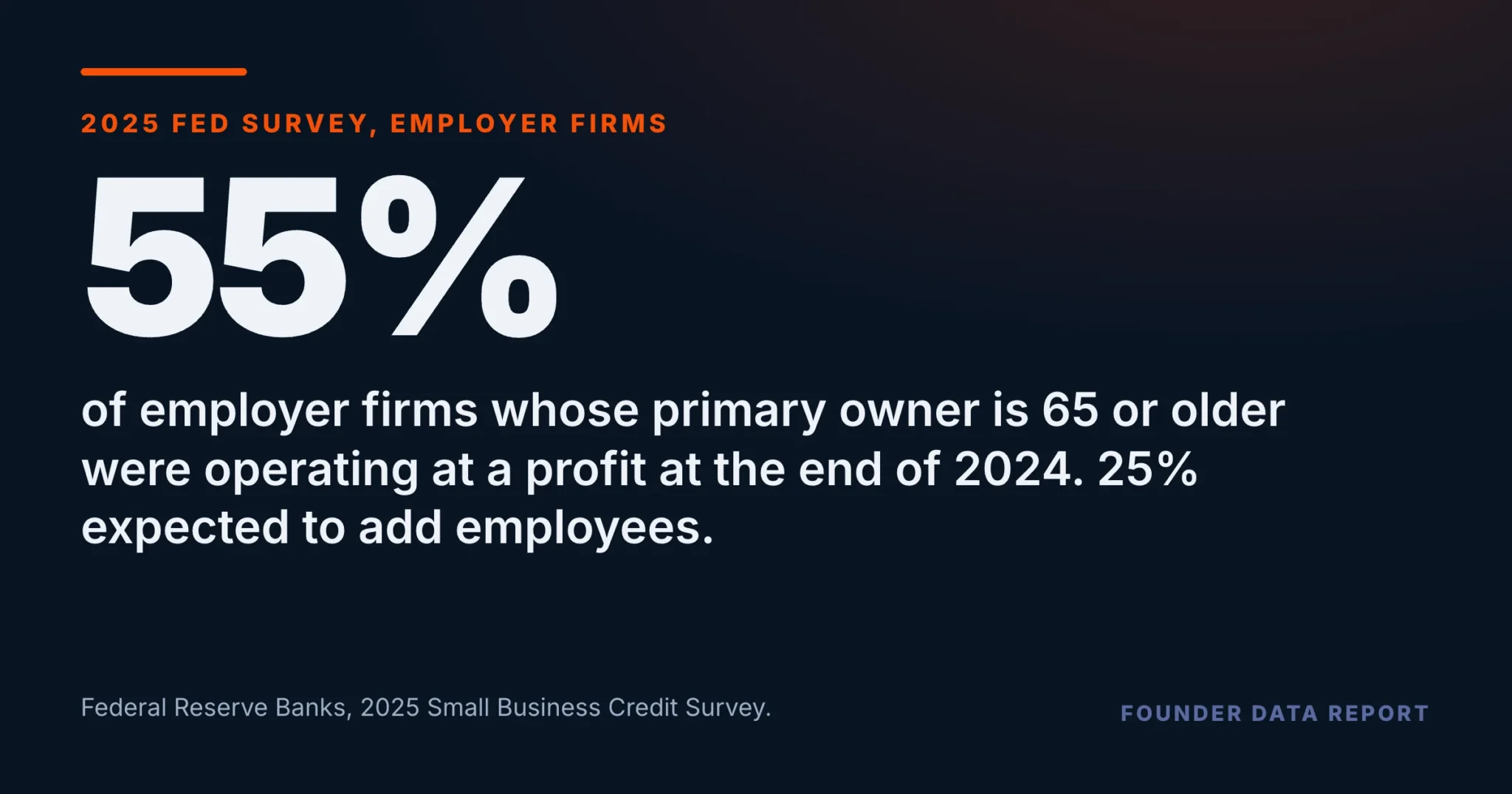
In the Federal Reserve Banks’ 2025 Small Business Credit Survey, 55% of employer firms whose primary owner was 65 or older were operating at a profit at the end of 2024, more than among owners aged 35 to 64. Only 25% expected to add employees in the next 12 months. Among firms with owners aged 35 to 44, the figures were 44% and 52%. Owners 65 or older also named three money problems less often: getting credit, paying operating expenses and making debt payments.
- 24% of employer firms have a primary owner 65 or older; another 29% have one aged 55 to 64.
- Operating at a profit at the end of 2024: 55% with owners 65 or older, against 42% to 46% with owners 35 to 64.
- Planning to add employees: 52% under 35 and 52% at 35 to 44, against 25% at 65 or older.
- Named getting credit as a challenge: 35% at 35 to 44, 17% at 65 or older.
- Owner age and business age travel together: 58% of firms with owners 65 or older have been open 21 years or more.
Who runs America’s employer firms
The Small Business Credit Survey asks employer firms, businesses with at least one employee besides the owner, the age of their primary owner. In the 2025 survey, 5% of employer firms had a primary owner under 35, 17% one aged 35 to 44, 25% one aged 45 to 54, 29% one aged 55 to 64 and 24% one aged 65 or older. More than half are run by someone 55 or over. The Federal Reserve’s data appendix then splits every other answer in the survey by that age.
On profit, one group stands apart. 55% of firms whose owner was 65 or older were operating at a profit at the end of 2024, a larger share than among owners 35 to 44 (44%), 45 to 54 (42%) or 55 to 64 (46%). The under-35 group, at 46%, is a small sample and could not be told apart from any of them. Across all employer firms it was 47%. Hiring plans ran the other way. 52% of firms with owners under 35 and 52% with owners 35 to 44 expected to add employees in the next 12 months, against 38% at 45 to 54, 30% at 55 to 64 and 25% at 65 or older.
Employer firms. Orange: share operating at a profit at the end of 2024. Slate: share expecting to add employees in the next 12 months. The axis runs from 0 to 100%. The under-35 group is the smallest sample (151 firms), so its margins are the widest.
Federal Reserve Banks, 2025 Small Business Credit Survey, 2026 Report on Employer Firms data appendix (updated March 3, 2026), sheet ‘Age of primary owner’; retrieved October 10, 2026. Employer firms.
Most firms with owners 65 or older expect to keep the same headcount. 63% of them expected no change in the number of employees, against 37% at 35 to 44. Revenue expectations followed: 68% of owners 35 to 44 expected revenue to rise over the next 12 months, against 46% of owners 65 or older.
Growing, by the Fed’s definition
The Fed also flags a growing firm: one that increased both revenue and employees over the prior 12 months and plans to keep or add staff over the next 12. 35% of firms with owners under 35 met that bar. At 65 or older, 12% did, a smaller share than in each of the younger groups. The groups in between, 28%, 23% and 18%, were close enough to their neighbours that the survey cannot tell each step apart.
Employer firms. Growing: revenue and employees both increased in the prior 12 months, and the firm plans to keep or add employees in the next 12. Bars on a 0 to 40% scale. Orange: owners 65 or older.
Federal Reserve Banks, 2025 Small Business Credit Survey, 2026 Report on Employer Firms data appendix (updated March 3, 2026), sheet ‘Age of primary owner’; retrieved October 10, 2026. Employer firms.
Firms with owners 65 or older were more often in profit and less often planning to hire.
Three money problems, named less often at 65 and over
Asked which financial challenges they faced in the prior 12 months, owners 65 or older named three of the common ones less often than owners 35 to 44. 44% named paying operating expenses, against 59%. 17% named getting credit, against 35%. 24% named making debt or interest payments, against 33%. One challenge did not move with age: rising costs of goods, services or wages, named by 71% and 72%.
Employer firms. Respondents could name more than one challenge, so shares do not add to 100. All bars on one scale, 0 to 100%. Rising costs is the only row where the two groups’ 95% ranges overlap.
Federal Reserve Banks, 2025 Small Business Credit Survey, 2026 Report on Employer Firms data appendix (updated March 3, 2026), sheet ‘Age of primary owner’; retrieved October 10, 2026. Employer firms.
What to take from this if you run a small one
The age of the person at the top goes with a different kind of business. In this survey, the firms run by owners 65 or older were more often in profit, less often named getting credit as a challenge, and mostly expected to keep the same headcount. The firms run by owners under 45 were reaching: about half planned to hire and two in three of those aged 35 to 44 expected more revenue, and owners 35 to 44 named money challenges more often. If you run one, it is worth knowing which of those two businesses you are running now, and whether that is still the one you mean to run. The plan for each is different.
Three limits worth holding. Owner age and business age move together: 58% of firms with owners 65 or older have been open 21 years or more, against 4% at 35 to 44, and the survey cannot say which of the two goes with the differences. The SBCS is a convenience sample, weighted by the Federal Reserve to match the employer-firm population, so every share carries a margin of error and only differences where the 95% ranges do not overlap are stated here. And it covers employer firms only; owners with no employees are outside it.
Federal Reserve Banks, 2025 Small Business Credit Survey.
Frequently Asked Questions
Are businesses with older owners more often in profit?
In the Federal Reserve Banks' 2025 Small Business Credit Survey, 55% of employer firms whose primary owner was 65 or older were operating at a profit at the end of 2024, against 42% to 46% with owners 35 to 64. Older owners also tend to run older firms, and the survey cannot separate the two.
Do younger business owners plan to hire more?
Yes. 52% of firms with owners under 35 and 52% with owners 35 to 44 expected to add employees in the next 12 months, against 25% with owners 65 or older.
How many employer firms are run by owners 65 or older?
24% of employer firms in the 2025 survey had a primary owner 65 or older, and 29% one aged 55 to 64.
Which financial challenges differ by owner age?
Owners 65 or older named getting credit (17% against 35% at 35 to 44), paying operating expenses and making debt payments less often. Rising costs were named by about seven in ten owners in both groups.
Where does the data come from?
The Federal Reserve Banks' 2025 Small Business Credit Survey, from the data appendix to the 2026 Report on Employer Firms. It is a convenience sample of employer firms, weighted to the national population.
Published by The Lonely Entrepreneur — the community and coaching platform for entrepreneurs who are building alone. lonelyentrepreneur.com
This article is for educational purposes and is not a substitute for professional financial or legal advice.