

 Founder Data Report
When Money Got Tight, 58% of Owners With 1 to 4 Employees Used Their Own Funds. At 20 to 49, the Business’s Reserves Came First.
Get clarity — download the free Entrepreneur Survival Guide Summary.
Federal Reserve survey data, 2025: when a small business hit a money problem, the most common fix was the owner’s own money. Bigger and older firms reached for the business’s reserves first.
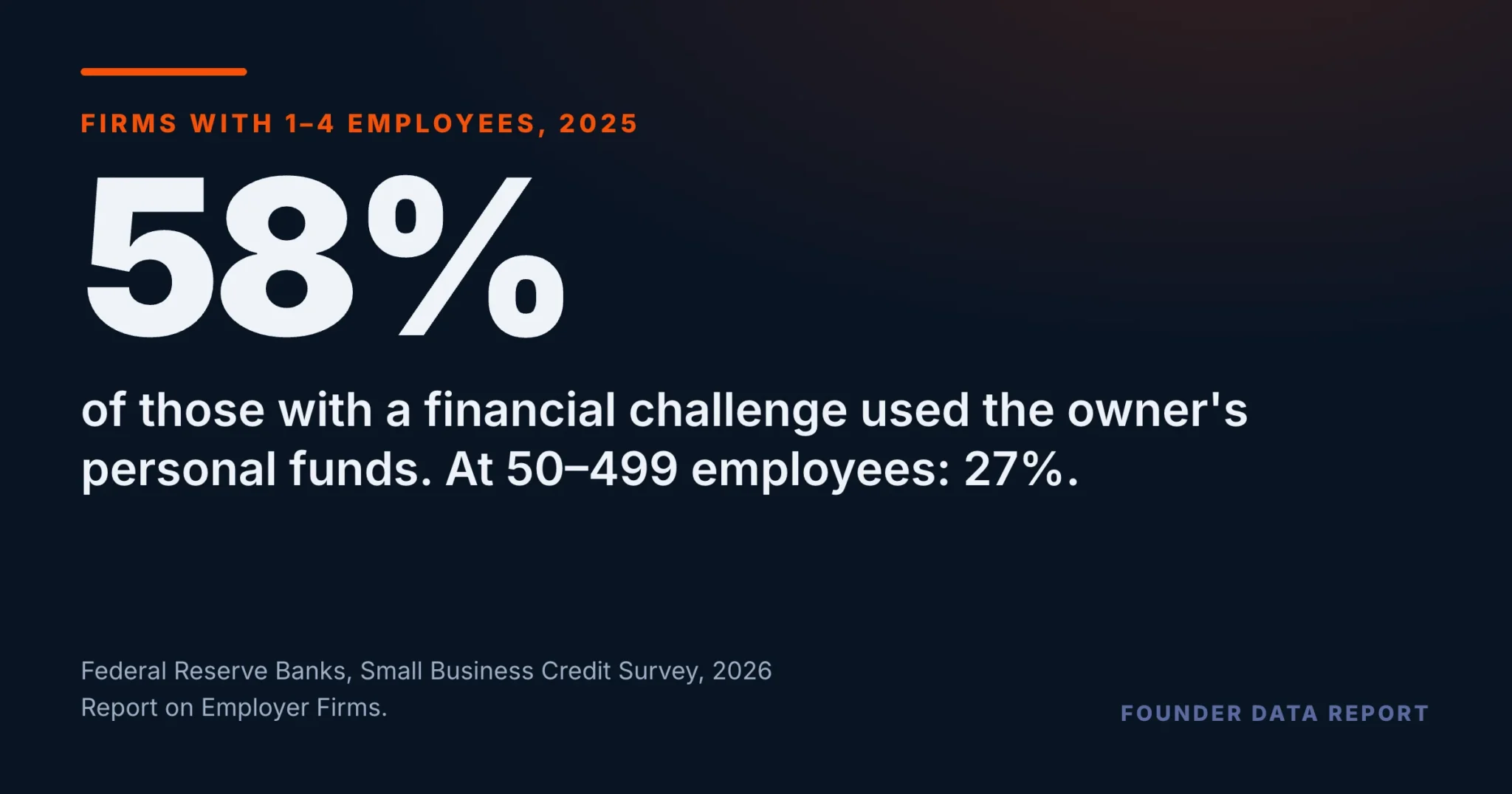
In the Federal Reserve’s 2025 Small Business Credit Survey, 54% of employer firms that had a financial challenge in the prior 12 months dealt with it by using the owner’s personal funds, the most common response of all. At firms with 1 to 4 employees it was 58%, ahead of using the business’s cash reserves (47%). At 20 to 49 employees the order flipped: 52% used cash reserves and 41% used personal funds. At 50 to 499, personal funds fell to 27%.
- 94% of employer firms reported at least one financial challenge in the prior 12 months.
- Among them, the most common response was the owner’s own money: 54%, clear of every other option.
- Under 10 employees, personal funds came first; at 10–19 the two were about even; from 20 up, the business’s cash reserves came first.
- Firms 0–2 years old: 67% used personal funds. Firms 21+ years old: 39%.
- Firms rated medium or high credit risk used personal funds far more often (76% and 78%) than low-risk firms (50%).
The first place the money comes from
Every year the Federal Reserve Banks ask several thousand employer firms what went wrong with their money and what they did about it. In the 2025 survey, 94% reported at least one financial challenge, from rising costs to uneven cash flow. Firms could name every response that applied, so the shares add up to more than 100. At firms with one to four employees, 58% used the owner’s personal funds, 47% used cash reserves, 47% cut costs, 45% raised prices and 35% took on debt. Only 5% did nothing. Run the same question up the size ladder and, from 20 employees on, the owner’s wallet falls behind the business’s cash reserves.
Base: employer firms that reported at least one financial challenge in the prior 12 months. Multiple responses allowed. Bars drawn on a 0 to 80% scale; 95% ranges as published.
Federal Reserve Banks, Small Business Credit Survey, 2026 Report on Employer Firms and its data appendix (sbcs-employer-firms-appendix-2025.xlsx). Survey fielded September 3 to November 14, 2025; employer firms with 1–499 employees. Retrieved from fedsmallbusiness.org on October 10, 2026.
At the smallest firms the reserve fund has a name, and it is the owner’s.
Age moves it the same way
Cut by the age of the business, the pattern runs the same direction. At firms up to two years old, 67% of those with a money problem used personal funds and 43% used reserves. At three to five years it was 65% against 48%. From six to 20 years old the two are about even, inside the survey’s margins. At firms 21 years and older, reserves came first: 45% against 39% for personal funds. An earlier piece here found that the firms with one to four employees were less often satisfied with big banks than larger firms. At those same firms, the owner’s money came ahead of the business’s reserves.
Base: employer firms that reported at least one financial challenge in the prior 12 months. Multiple responses allowed. Bars drawn on a 0 to 80% scale; 95% ranges as published.
Federal Reserve Banks, Small Business Credit Survey, 2026 Report on Employer Firms and its data appendix (sbcs-employer-firms-appendix-2025.xlsx). Survey fielded September 3 to November 14, 2025; employer firms with 1–499 employees. Retrieved from fedsmallbusiness.org on October 10, 2026.
Where personal money goes with a weaker position
The survey also sorts firms by credit risk. Among firms rated low risk, 50% of those with a money problem used personal funds. Among medium-risk firms it was 76%, and among high-risk firms 78%. The same firms were far more likely to pay a bill late or not at all: 17% of low-risk firms against 44% and 59%. Personal money is not only the small firm’s first step. It sits alongside the other signs that a business is short.
Base: employer firms that reported at least one financial challenge in the prior 12 months. Drawn on a 0 to 100% scale. Low-risk row faded. Medium and high are level within their 95% ranges.
Federal Reserve Banks, Small Business Credit Survey, 2026 Report on Employer Firms and its data appendix (sbcs-employer-firms-appendix-2025.xlsx). Survey fielded September 3 to November 14, 2025; employer firms with 1–499 employees. Retrieved from fedsmallbusiness.org on October 10, 2026.
What to take from this if you are the backstop
If your business has fewer than ten employees or is under six years old and you have covered a gap from your own account, you are in the majority, not the exception. The problem is what it does to the line between you and the business. Money that moves in without a record blurs that line, and the business never has to learn to carry its own lean months. Three moves help. Write down every transfer as a loan or as capital, with a date, so you know the real number. Set a ceiling before the next squeeze, not during it. And treat building a cash reserve as the business’s job. In this survey, the bigger and older firms reached for theirs before the owner’s.
Four limits worth holding. The survey is a convenience sample, not a random one; the Federal Reserve weights it to match the population of employer firms with 1–499 employees. Firms could pick several responses, so the shares overlap and never sum to 100. The comparisons here are made only where the published 95% ranges do not overlap; where they do, this piece says the groups are about even. And the survey records what owners did, not how much money moved or why they chose it.
Federal Reserve Banks, Small Business Credit Survey, 2026 Report on Employer Firms.
Frequently Asked Questions
How often do small business owners use their own money to cover a shortfall?
In the Federal Reserve's 2025 Small Business Credit Survey, 54% of employer firms that had a financial challenge used the owner's personal funds, the most common response. At firms with one to four employees it was 58%.
Do bigger businesses use the owner's money less?
Yes. Personal funds fell to 41% at 20–49 employees and 27% at 50–499, where using the business's cash reserves was more common.
Does the age of the business matter?
Yes. 67% of firms up to two years old used personal funds, against 39% of firms 21 years and older.
What else do firms do when money gets tight?
Among firms with one to four employees: 47% used cash reserves, 47% cut costs, 45% raised prices and 35% took on debt. Firms could give more than one answer.
Where does the data come from?
The Federal Reserve Banks' Small Business Credit Survey, 2026 Report on Employer Firms and its data appendix. The survey was fielded in late 2025 among employer firms with 1–499 employees.
Published by The Lonely Entrepreneur — the community and coaching platform for entrepreneurs who are building alone. lonelyentrepreneur.com
This article is for educational purposes and is not a substitute for professional financial or legal advice.