

 Founder Data Report
Resilience by Trade: When Setbacks Hit, How Many Lost Jobs Go With a Business That Closed? In Restaurants, More Than One in Four
You can’t afford to risk your business without a Sidekick at your side.
Most lost jobs in America go at businesses that keep their doors open. In a handful of trades, a much bigger share goes with the whole business closing. Federal data show which trades, and that the pattern has held for twenty years.
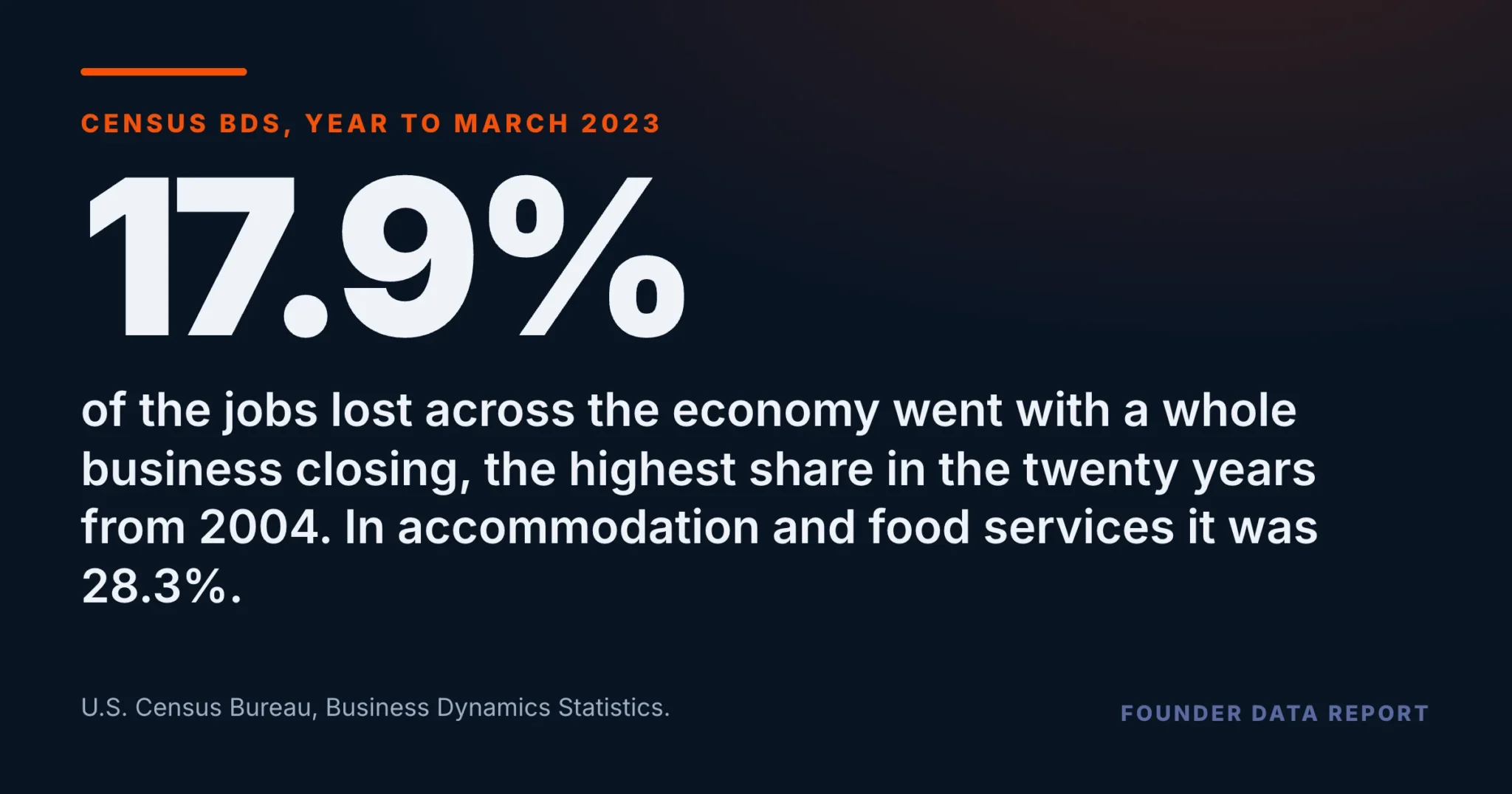
In the Census Bureau’s Business Dynamics Statistics, 17.9% of the jobs lost in the year to March 2023 went with a whole business closing, the highest share in the twenty years from 2004. In accommodation and food services it was 28.3%, and in repair and personal services and in real estate it was about 27%. In management of companies it was 2.6%. In every trade, in every year from 2004 to 2023, most lost jobs were at locations that stayed open.
That is a resilience question for anyone who runs a business. When jobs go in your trade, are they going with whole businesses closing, or with businesses that survive getting smaller? The answer differs by trade, and in six trades the share lost to closures has run above the all-sector figure every year for twenty years.
Resilience under pressure looks different by trade. In six trades, a larger share of the jobs lost to setbacks goes with whole businesses closing. In others, more of the same pressure shows up as businesses that keep going, smaller. Knowing which kind of setback your trade tends to face is part of building resilience before the uncertainty arrives.
- Across all sectors in the year to March 2023: 17.9% of lost jobs went with a whole business closing, 13.4% with one location of a continuing business closing, and 68.7% at locations that stayed open.
- Accommodation and food services, agriculture, repair and personal services, and real estate each lost 27% to 28% of their jobs to whole-business closures that year.
- Six trades ran above the all-sector share in all twenty years from 2004 to 2023: those four plus construction and professional and technical services.
- Four ran below it in all twenty: manufacturing, information, finance and insurance, and management of companies.
- In every trade and every year, most lost jobs were at locations that stayed open. The data do not say why the split differs by trade.
Three ways a job disappears
The Census Bureau’s Business Dynamics Statistics counts every job lost at every employer, each year from March to March, and records where it went. Some went with a whole business closing, every location at once. Some went when one location closed and the business carried on elsewhere. The rest went at a location that stayed open and got smaller.
Across all sectors in the year to March 2023, about 15 million jobs were lost this way. 17.9% went with a whole business closing, 13.4% with a single location closing, and 68.7% at places that stayed open. The closure share was the highest of the twenty years from 2004, up from a low of 11.4% in the year to March 2021. It ran higher in the 1980s, at 23.4% in 1985.
Share of all job destruction. A whole-business closure counts every job at every location of a firm that shut down. A location closure is a closed site of a business that carried on.
U.S. Census Bureau, Business Dynamics Statistics (BDS), firm age by sector table (BDSFAGE), all firm ages, national, 2004–2023 releases on www2.census.gov; job destruction split by whole-firm closure (FIRMDEATH_EMP), location closure and job loss at continuing locations. Utilities excluded (suppressed cells). Each year runs March to March.
The trades where a closing business takes more of the jobs
In accommodation and food services, 28.3% of the jobs lost in the year to March 2023 went with a whole business closing, about 1.7 million jobs lost in all. Repair, personal and other services ran 27.4%, real estate 27.1%, and agriculture, forestry and fishing about the same. Construction was at 23.6% and professional and technical services at 22.0%.
At the other end, management of companies lost 2.6% of its jobs to whole-business closures, finance and insurance 7.6%, information 11.5% and manufacturing 12.4%. In those trades a lost job was much less often part of a whole business closing.
Highlighted: the six trades above the all-sector share in every year from 2004 to 2023. All sectors: 17.9%. Bars on a 0 to 30% scale. Utilities is left out: some of its cells are suppressed.
U.S. Census Bureau, Business Dynamics Statistics (BDS), firm age by sector table (BDSFAGE), all firm ages, national, 2004–2023 releases on www2.census.gov; job destruction split by whole-firm closure (FIRMDEATH_EMP), location closure and job loss at continuing locations. Utilities excluded (suppressed cells). Each year runs March to March.
In every trade, in every year for twenty years, most lost jobs were at places that stayed open.
A pattern that held for twenty years
One year can mislead, so the test is whether each trade sat above or below the all-sector share year after year. Six trades were above it in all twenty years from 2004 to 2023: accommodation and food services, repair and personal services, real estate, agriculture, construction, and professional and technical services. Four were below it in all twenty: manufacturing, information, finance and insurance, and management of companies. The rest moved above and below it.
Even in the trades where closures take the most, they are not most of the story. In every trade in every year from 2004 to 2023, more than half of lost jobs were at locations that stayed open. Real estate came closest to even, with 58.3% at open locations in 2023, and accommodation and food services was at 62.3%.
Count of years in which the share of the trade’s lost jobs that went with a whole business closing was higher than the same share for all sectors. Bars on a 0 to 20 year scale. Highlighted: above in all twenty.
U.S. Census Bureau, Business Dynamics Statistics (BDS), firm age by sector table (BDSFAGE), all firm ages, national, 2004–2023 releases on www2.census.gov; job destruction split by whole-firm closure (FIRMDEATH_EMP), location closure and job loss at continuing locations. Utilities excluded (suppressed cells). Each year runs March to March.
What to take from this if you run one
If you run a restaurant, a repair shop, a real estate office, a construction firm or a professional practice, the job losses around you lean more than most toward whole businesses closing. That is the risk these numbers point at, not a forecast for any one business. If your business is in one of these trades, it is worth knowing how many months you could carry the payroll through a bad stretch, and what you would cut before you would close.
Three limits worth holding. The figures count jobs, not businesses, so larger employers weigh more in each trade’s share. A whole-business closure here means every location of the firm shut. And the data do not say why the split differs by trade.
U.S. Census Bureau, Business Dynamics Statistics.
Frequently Asked Questions
How many lost jobs come from businesses closing?
In the year to March 2023, 17.9% of all jobs lost in the U.S. went with a whole business closing, according to the Census Bureau's Business Dynamics Statistics. Another 13.4% went with one location of a continuing business closing.
Where do most lost jobs go, then?
At locations that stay open and get smaller: 68.7% across all sectors in the year to March 2023. That was a majority in every trade in every year from 2004 to 2023.
Which trades lose the most jobs to closures?
In the year to March 2023, accommodation and food services (28.3%), repair and personal services, real estate, and agriculture, forestry and fishing each lost about 27% to 28% of their jobs to whole-business closures.
Is that new?
No. Six trades, those four plus construction and professional and technical services, were above the all-sector share in every year from 2004 to 2023.
Where does the data come from?
The U.S. Census Bureau's Business Dynamics Statistics, which counts jobs created and lost at every employer in the country each year from March to March, split by sector and by firm age.
Published by The Lonely Entrepreneur — the community and coaching platform for entrepreneurs who are building alone. lonelyentrepreneur.com
This article is for educational purposes and is not a substitute for professional financial or legal advice.