

 Founder Data Report
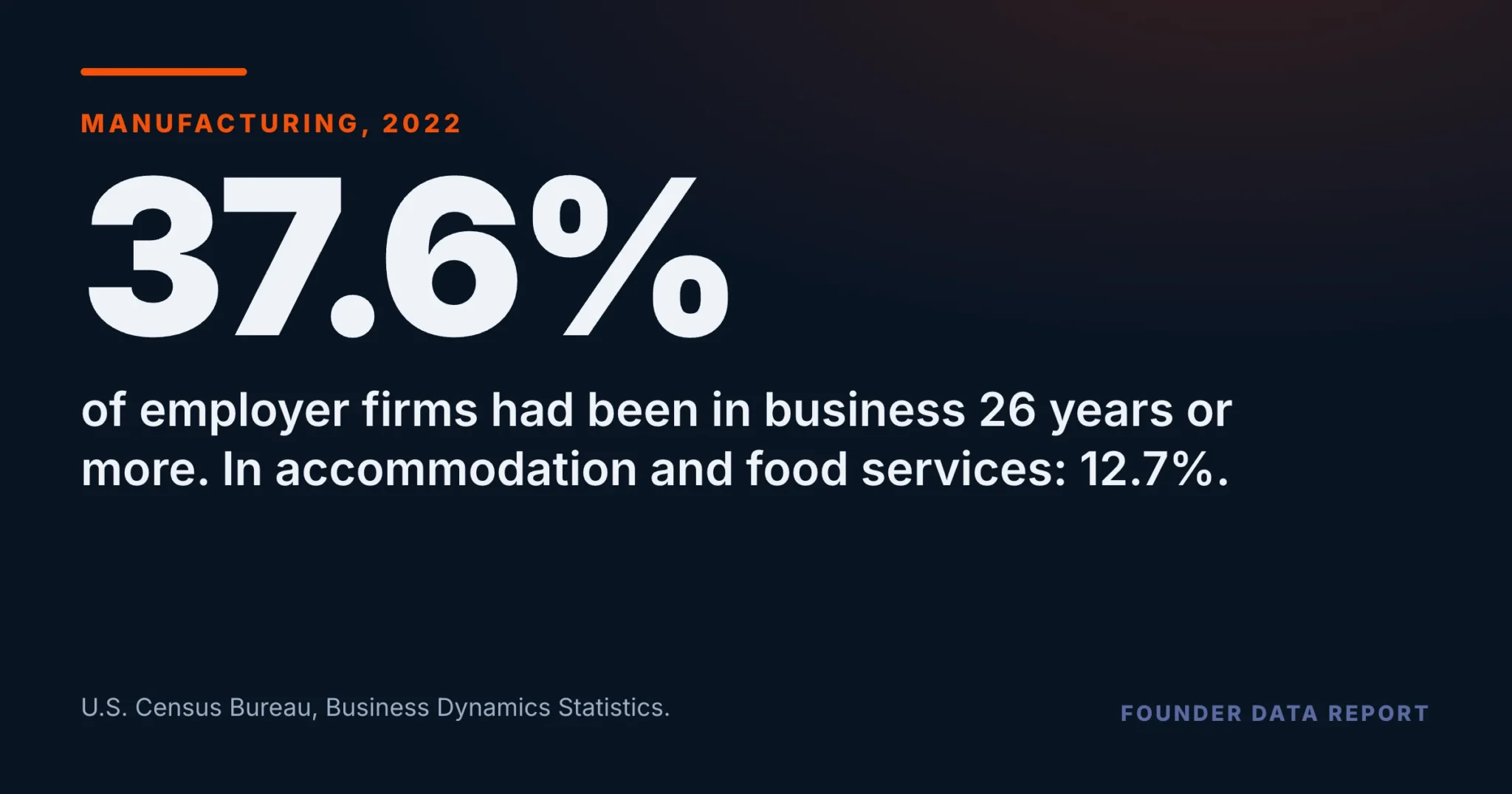
In Manufacturing, 37.6% of Employer Firms Have Been in Business 26 Years or More. In Restaurants and Hotels, 12.7%
You can’t afford to risk your business without a Sidekick at your side.
Census counts every employer firm in the country by age. Cut by industry, the share that has been open a generation or more runs, trade by trade, from about one in eight to about one in two.
In the Census Bureau’s Business Dynamics Statistics, 20.7% of US employer firms in 2022 had been in business 26 years or more. By industry the share ran from 49.5% in utilities and 37.6% in manufacturing down to 13.0% in transportation and warehousing and 12.7% in accommodation and food services. In every industry, those older firms held a larger share of the jobs than of the firms.
- 20.7% of US employer firms were 26 or older in 2022; 36.0% were five or younger.
- Oldest trades: utilities 49.5%, manufacturing 37.6%, other services such as repair and personal care 33.9%, wholesale 30.8%.
- Youngest: transportation and warehousing, where 49.5% of firms were five or younger and 13.0% were 26 or older; restaurants and hotels, 12.7% at 26 or older.
- In every sector, firms 26 or older held a bigger share of jobs than of firms: 77.5% of manufacturing jobs, 42.0% in restaurants and hotels.
- Since 2004 the 26-or-older share rose in every industry except educational services.
How Census dates a business
The Business Dynamics Statistics count every employer firm in the United States each year, sorted by the age of the firm. Census dates a firm from the year its oldest location first had employees, so a business that adds a second shop keeps the age of its first. The records start in 1978, and firms that were already operating then are counted separately as older than the data. This piece adds those to the firms Census lists as 26 years or more, so “26 or older” means every firm that age, however far back it goes. The figures are for 2022. The release also carries 2023, which is left out here: a release’s newest year is the one most open to revision.
The oldest and youngest trades
Across all sectors, 20.7% of employer firms were 26 or older in 2022. Utilities had the highest share of any trade at 49.5%, followed by manufacturing at 37.6%, other services at 33.9% (repair shops, salons, dry cleaners and civic groups among them) and wholesale at 30.8%. At the other end, 13.0% of transportation and warehousing firms and 12.7% of accommodation and food services firms, the restaurants, bars and hotels, had been in business that long. Head offices and holding companies, which Census files as their own sector, sat at 64.7%; they are shown but not ranked, since nobody opens one as a trade.
Firms aged 26 or more, including firms in business before 1978, as a share of the sector’s employer firms. Orange: manufacturing and accommodation and food services. A firm in more than one sector is counted in each (sector counts sum to 1.2% more than the national total). Axis 0 to 70%.
U.S. Census Bureau, Business Dynamics Statistics, firm-age tables by sector (BDSFAGE), 1978–2023 release, employer firms, United States, retrieved from www2.census.gov on September 18, 2026. Aged 26 or more includes firms in business before 1978. Figures for 2022.
At the young end: in transportation and warehousing, 49.5% of firms were five years old or younger, the highest of any trade. In utilities, manufacturing and wholesale, fewer than one in four were. Only five trades had more firms aged 26 or older than aged five or younger: utilities, manufacturing, wholesale, other services, and mining, oil and gas. Everywhere else, the newcomers outnumbered the long-timers.
Share of the sector’s employer firms in each age group; the ages in between are not shown, so a pair does not add to 100. The four trades with the highest share aged 26 or more, and four of the five with the lowest. All bars on one scale.
U.S. Census Bureau, Business Dynamics Statistics, firm-age tables by sector (BDSFAGE), 1978–2023 release, employer firms, United States, retrieved from www2.census.gov on September 18, 2026. Aged 26 or more includes firms in business before 1978. Figures for 2022.
Only five trades had more firms aged 26 or older than five or younger. Everywhere else, the newcomers outnumbered the long-timers.
Older firms hold more of the jobs
In every sector, firms 26 or older held a bigger share of the jobs than of the firms. Across all sectors they were 20.7% of firms and 61.7% of jobs. In manufacturing the figures were 37.6% of firms and 77.5% of jobs; in accommodation and food services, 12.7% and 42.0%. In 12 of the 18 trades, firms of 26 or more years employed more than half of the sector’s workers. Accommodation and food services and construction were among the six where they did not.
Employer firms aged 26 or more, including firms in business before 1978. Jobs = March employment. Axis 0 to 100%.
U.S. Census Bureau, Business Dynamics Statistics, firm-age tables by sector (BDSFAGE), 1978–2023 release, employer firms, United States, retrieved from www2.census.gov on September 18, 2026. Aged 26 or more includes firms in business before 1978. Figures for 2022.
The older share has grown. In 2004, the first year the data can count every firm of 26 or more years, 15.1% of employer firms were that old, against 20.7% in 2022. It rose in every trade except educational services, which went from 21.6% to 20.4%. Manufacturing went from 25.3% to 37.6%, and accommodation and food services from 9.7% to 12.7%.
What to take from this if you run a small one
If you are in a trade where a third or more of the firms have been around for a generation, you are competing alongside businesses that have had decades to build their customer lists and supplier ties, and most of the jobs in your sector sit with them. If you are in a trade where newcomers outnumber the long-timers, a large share of the firms around you are in their first five years. Either way, the useful question is the same one: what would your business need to have in place to be among the firms still counted in this table twenty-six years from now?
Three limits worth holding. This is a snapshot of ages, not a survival rate: it counts the firms operating in 2022, and it cannot say what share of firms that opened in a given year are still open. It counts employer firms only; owners with no employees are outside it. And a firm working in more than one sector is counted in each, so the sector figures cannot be added up.
U.S. Census Bureau, Business Dynamics Statistics.
Frequently Asked Questions
What share of US businesses have been open 26 years or more?
20.7% of US employer firms in 2022, in the Census Bureau's Business Dynamics Statistics, counting firms that were already in business before the data begins in 1978.
Which industries have the oldest businesses?
Utilities (49.5% of firms 26 or older), manufacturing (37.6%), other services such as repair and personal care (33.9%) and wholesale trade (30.8%).
Which industries have the youngest businesses?
Transportation and warehousing, where 49.5% of firms were five or younger, and accommodation and food services, where only 12.7% were 26 or older.
Do older businesses employ more people?
In every sector, firms 26 or older held a bigger share of the jobs than of the firms. Across all sectors: 20.7% of firms and 61.7% of jobs in 2022.
Where does the data come from?
The U.S. Census Bureau's Business Dynamics Statistics, firm-age tables by sector, which count every employer firm in the United States from administrative records.
Published by The Lonely Entrepreneur — the community and coaching platform for entrepreneurs who are building alone. lonelyentrepreneur.com
This article is for educational purposes and is not a substitute for professional financial or legal advice.