

 Founder Data Report
8% of Employer Firms Took a Natural-Disaster Loss in a Year. 34% of Them Called Their Finances Poor, Against 20% of Everyone Else
Get clarity — download the free Entrepreneur Survival Guide Summary.
The Federal Reserve’s 2025 small-business survey asked employer firms whether a natural disaster had cost them in the past year. The ones that said yes looked different on almost every money question.
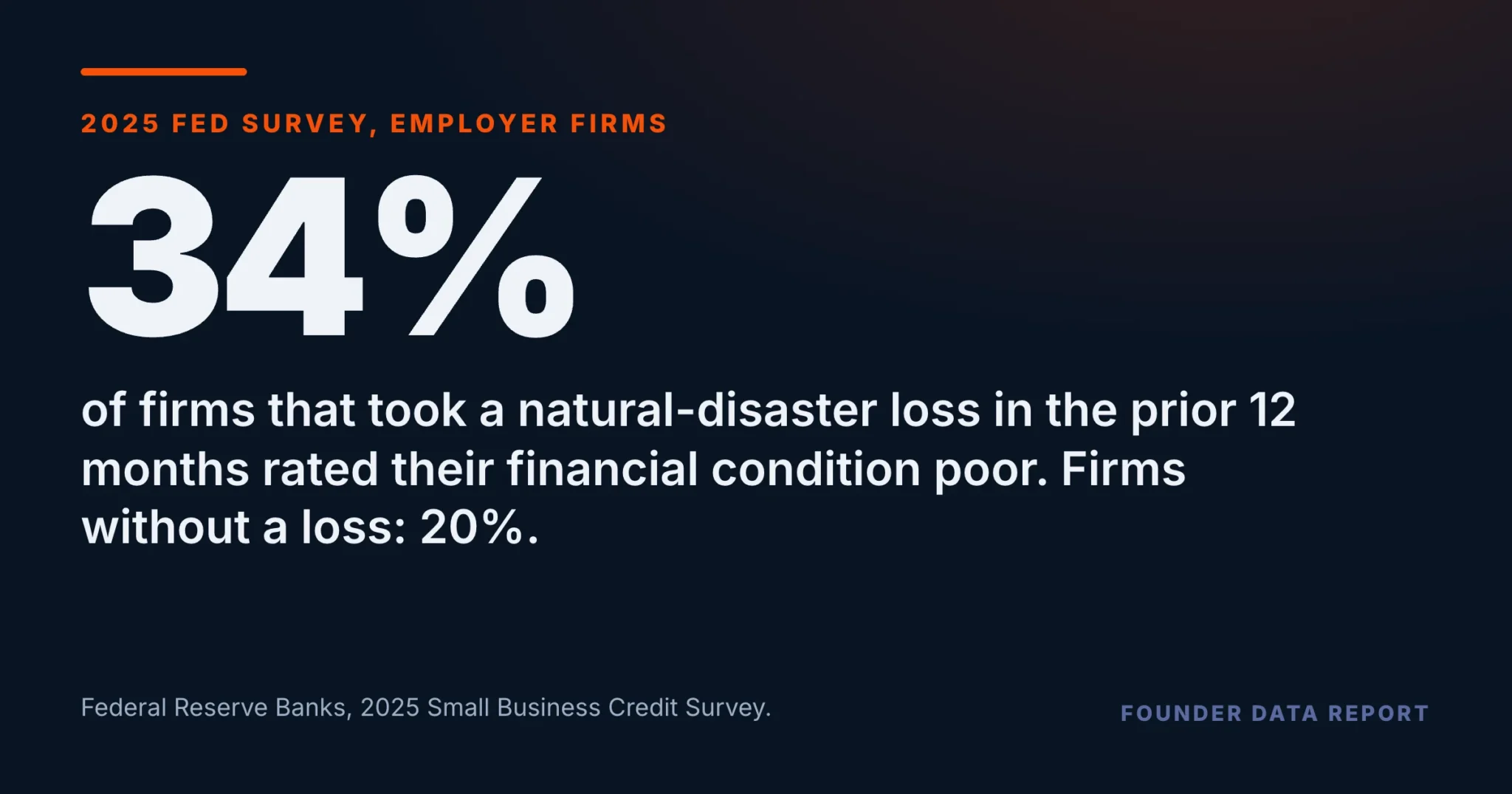
In the Federal Reserve Banks’ 2025 Small Business Credit Survey, 8% of employer firms said they had sustained natural disaster-related losses in the previous 12 months. Of those firms, 34% rated their financial condition poor when they answered, against 20% of firms with no such loss. They were also more likely to report falling revenue and, among firms facing financial challenges, to have used the owner’s personal funds and to have downsized.
- 8% of employer firms reported a natural-disaster loss in the 12 months before the 2025 survey.
- Firm size made no measurable difference: every size band from 1–4 to 50–499 employees sat between 6% and 9%, and none differed from another.
- Place did. The South Atlantic division was at 17%; five divisions were at 4% or less. Florida was at 29% and North Carolina at 28%.
- Firms with a loss: 34% in poor financial condition (others 20%); 56% saw revenue fall (others 41%).
- Among firms facing financial challenges, 66% of those with a loss used the owner’s personal funds, against 52%. 46% downsized, against 30%.
Who reported a loss
The survey asked employer firms one direct question: did the business sustain losses related to a natural disaster in the prior 12 months? Across all employer firms, 8% said yes (95% range 7.2–9.5%). The share barely moved with size. Firms with 1–4 employees were at 9%, firms with 50–499 at 9%, and no two size bands differed by more than their margins of error. Rural firms (10%) and urban firms (8%) did not differ either.
Where a business sat mattered far more. In the South Atlantic division, which runs from Delaware down the coast to Florida, 17% of employer firms reported a loss, a higher share than in every other division except the Pacific (11%). Five divisions, across the North and the Mountain West, were at 4% or below. Of the 20 states the survey publishes, Florida had the largest share at 29%, above 17 of the other 19; North Carolina (28%) and Tennessee, where the samples were smaller and the margins wide, could not be told apart from it. California was at 15%.
Employer firms reporting losses related to a natural disaster in the 12 months before the survey. 95% range in brackets. Orange: South Atlantic. Axis 0 to 20%.
Federal Reserve Banks, 2025 Small Business Credit Survey, 2026 Report on Employer Firms data appendix (updated March 3, 2026), retrieved October 10, 2026. Employer firms; losses in the 12 months before the survey.
By industry, leisure and hospitality (restaurants, hotels, arts and recreation) had the largest share, 16%, above manufacturing (6%) and professional services and real estate (3%). Retail, at 12%, could not be told apart from leisure and hospitality.
How the firms with a loss were doing
The appendix also splits every other answer in the survey by whether the firm reported a disaster loss. That is 523 firms with a loss against 5,785 without. On financial condition at the time of the survey, 34% of firms with a loss said poor, against 20%. At the other end, 17% said good, 6% very good and 2% excellent, against 27%, 12% and 5%. Only the middle answer, fair, could not be told apart.
Employer firms. Disaster loss: 523 firms reporting losses related to a natural disaster in the prior 12 months. No disaster loss: 5,785 firms. All bars on one scale. Fair is the only answer where the two groups’ 95% ranges overlap.
Federal Reserve Banks, 2025 Small Business Credit Survey, 2026 Report on Employer Firms data appendix (updated March 3, 2026), retrieved October 10, 2026. Employer firms; losses in the 12 months before the survey.
Revenue told the same story. 56% of firms with a loss said revenue fell over the prior 12 months, against 41%; 28% said it rose, against 41%. Asked which financial challenges they had faced, 70% of firms with a loss named paying operating expenses (others 52%), 64% named weak sales (others 46%) and 51% named making payments on debt (others 31%). Rising costs were named by most firms in both groups (84% and 72%) and did not tell them apart.
The size of the business made no measurable difference to who took a loss. Where it was made a large one.
What they did about it
Among firms that faced a financial challenge, those with a disaster loss were more likely to have taken almost every action the survey lists. 66% used the owner’s personal funds (others 52%). 60% cut costs, 57% drew on cash reserves, 49% took on debt, 46% downsized and 33% paid a bill late or not at all. The one action that did not differ was raising prices: 45% against 48%.
Employer firms that faced a financial challenge in the prior 12 months. Respondents could choose more than one action, so shares do not add to 100. Axis 0 to 100%. Raising prices is the only action where the two groups’ 95% ranges overlap.
Federal Reserve Banks, 2025 Small Business Credit Survey, 2026 Report on Employer Firms data appendix (updated March 3, 2026), retrieved October 10, 2026. Employer firms; losses in the 12 months before the survey.
They also went looking for money more often. 72% of firms with a loss applied for some kind of financing in the prior 12 months, against 58%. 12% received a grant, against 5%, and 14% took a loan from family or friends, against 8%.
What to take from this if you run a small one
The first finding: being small did not make a firm more or less likely to take a disaster loss. The map did. If you operate somewhere like Florida, where more than a quarter of employer firms reported a loss, the planning question is not whether your business is too small to matter but what the first ninety days look like if it happens. The second finding is where the strain landed. Among firms with a loss, the owner’s own money was named as often as cutting costs or drawing on the business’s reserves, and more often than taking on debt or raising prices. Knowing in advance which of those you would reach for first, and how deep each one goes, is the part of the plan only you can write.
Three limits worth holding. The survey cannot say the disaster caused the weaker finances: firms with a loss were concentrated in particular regions and industries, and the appendix does not separate those effects. The SBCS is a convenience sample weighted by the Federal Reserve to match the employer-firm population by size, age, industry, region, urban or rural location and owner demographics, so every share carries a margin of error, and only differences where the 95% ranges do not overlap are stated here. And it covers employer firms only; owners with no employees are outside it.
Federal Reserve Banks, 2025 Small Business Credit Survey.
Frequently Asked Questions
How many small businesses had natural-disaster losses in the past year?
In the Federal Reserve Banks' 2025 Small Business Credit Survey, 8% of employer firms said they sustained natural disaster-related losses in the prior 12 months.
Are smaller businesses more likely to take a disaster loss?
Not in this survey. Every size band from 1–4 to 50–499 employees reported between 6% and 9%, and none differed from another beyond the margin of error.
Which states had the most businesses with disaster losses?
Of the 20 states the survey publishes, Florida had the largest share, 29%, above 17 of the other 19. North Carolina (28%) and Tennessee could not be told apart from it. The South Atlantic division as a whole was at 17%.
How did businesses with a disaster loss differ financially?
34% rated their financial condition poor, against 20% of firms without a loss, and 56% saw revenue fall, against 41%. The survey cannot say the loss caused the difference.
Where does the data come from?
The Federal Reserve Banks' 2025 Small Business Credit Survey, from the data appendix to the 2026 Report on Employer Firms. It is a convenience sample of employer firms, weighted to the national population.
Published by The Lonely Entrepreneur — the community and coaching platform for entrepreneurs who are building alone. lonelyentrepreneur.com
This article is for educational purposes and is not a substitute for professional financial or legal advice.