

 Founder Data Report
Small Employers With No Plans for AI: 56% Say It Doesn’t Apply to Them. Only 13% Name Cost
Get clarity — download the free Entrepreneur Survival Guide Summary.
Ask small employers what stands between them and AI and the answer depends on where they stand. The Federal Reserve’s survey asked all three groups: the ones with no plans, the ones planning, and the ones already using it.
In the Federal Reserve Banks’ 2025 Small Business Credit Survey, 46% of employer firms used AI, 15% planned to within a year and 33% had no plans to. Among the firms with no plans, 56% said AI is not applicable to their business and 30% preferred not to use it; only 13% named cost. Firms planning to use AI most often named finding the right tools (54%). Firms already using it most often named accuracy (46%) and adapting tools to their needs (43%).
- Where employer firms stood on AI: using it 46%, planning to within 12 months 15%, no plans 33%, unsure 6%.
- No plans: ‘not applicable to my business’ 56%, ‘prefer not to use’ 30%. Cost 13%, lack of time 12%.
- Planning: finding the right tools 54%, time to implement or train staff 37%, cost 32%.
- Using: accuracy 46% and adapting tools 43%, level with each other; cost 21%; 24% named no challenge at all.
- Three different groups of firms answering at one time, not the same firms followed over time.
Most of the firms saying no are not saying ‘too expensive’
The Small Business Credit Survey is run every year by the twelve Federal Reserve Banks. In the 2025 round 5,248 employer firms answered whether they use artificial intelligence. 46% said they do. Another 15% said they don’t yet but plan to within 12 months. A third, 33%, said they don’t and have no plans to.
One answer per firm; the four shares add to 100% within rounding.
Federal Reserve Banks, 2025 Small Business Credit Survey, 2026 Report on Employer Firms data appendix (updated March 3, 2026), sheet ‘Employer firms’; retrieved October 10, 2026. Employer firms; weighted convenience sample.
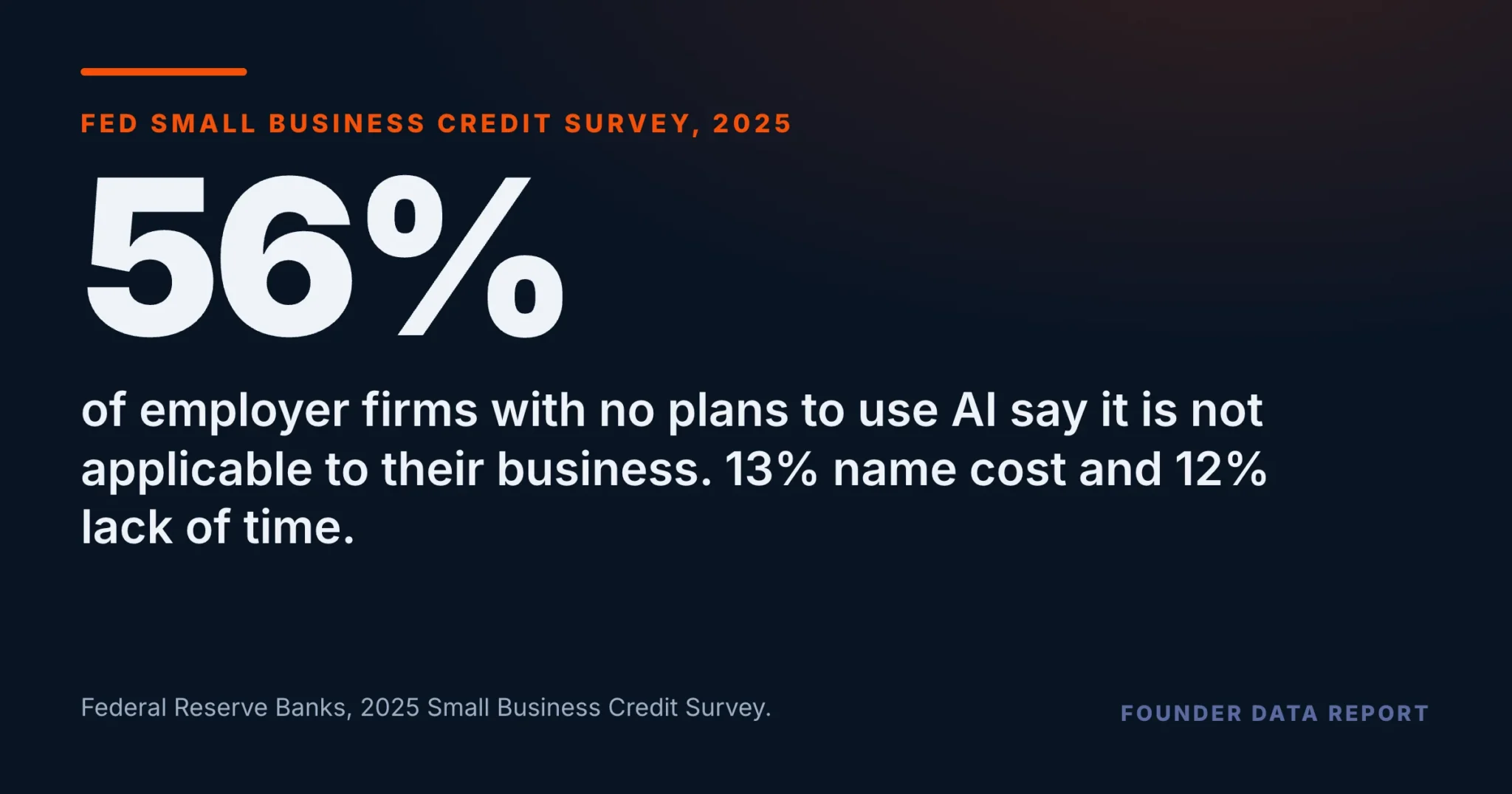
The survey then asked that last group why, and let them pick as many reasons as applied. The answer at the top was not money and not time. 56% said AI is not applicable to their business. 30% said they would prefer not to use it, clearly ahead of everything below it. Cost was named by 13%, lack of time by 12%, both near the bottom of the list.
Base: employer firms not using AI and with no plans to (n = 1,855). Firms could name more than one reason, so the shares do not add to 100%. ‘Other’ (6%) not shown.
Federal Reserve Banks, 2025 Small Business Credit Survey, 2026 Report on Employer Firms data appendix (updated March 3, 2026), sheet ‘Employer firms’; retrieved October 10, 2026. Employer firms; weighted convenience sample.
Planners name the tool. Users add accuracy
Firms that planned to use AI were asked what challenges they expected. The top one was finding the right tools for their business, at 54%, clearly ahead of time to implement or train staff (37%) and cost (32%), which were about level with each other.
Firms already using AI were asked what challenges they had run into. Two led, about level: accuracy, meaning bias or misinformation in what the tools produce, at 46%, and adapting tools to their needs at 43%. Where the two groups were offered the same answer, the differences are clear. Accuracy was named by 46% of users against 25% of planners. Cost went the other way: 32% of planners, 21% of users. So did time to implement or train staff, 37% against 25%. Data security came out about the same in both groups, 29% and 28%.
Bases: employer firms planning to use AI (n = 810) and employer firms using AI (n = 2,203). Multiple answers allowed. The track runs from 0% to 60%. Accuracy, cost and time differ between the two groups beyond the survey’s 95% confidence intervals; data security does not.
Federal Reserve Banks, 2025 Small Business Credit Survey, 2026 Report on Employer Firms data appendix (updated March 3, 2026), sheet ‘Employer firms’; retrieved October 10, 2026. Employer firms; weighted convenience sample.
Accuracy was named by 46% of the firms using AI and 25% of the firms still planning to.
What the users say they got
The survey also asked firms using AI what had changed. 71% said productivity went up, and 31% said sales did. On labor costs, 77% reported no change and 16% a decrease. These are the owners’ own reports, not measured results, and the survey cannot say whether the firms that use AI would have done just as well without it.
Ethical and social concerns, for what it is worth, were steady across all three groups: 16% of firms with no plans, 19% of planners and 18% of users, too close to tell apart. And about a quarter of both planners and users, 25% and 24%, named no challenge at all.
What to take from this if you are deciding
If you have ruled AI out, you are in large company, and most of that company says it simply does not fit the work rather than that it costs too much. If you are planning, the firms in your position most often expect the hard part to be choosing the tool. The firms already using it name accuracy, checking what it gives them, as often as anything. Budget for that review time, not just for the software.
Three limits. These are three different groups of firms answering at one moment, not the same firms followed as they took AI up, so nothing here shows how any one firm’s worries changed. The Small Business Credit Survey is a convenience sample the Fed weights to look like the population of employer firms, and differences are claimed only where its 95% confidence intervals do not overlap. And the answer lists were not identical across the three groups, so only answers worded the same way are compared.
Federal Reserve Banks, 2025 Small Business Credit Survey.
Frequently Asked Questions
Why don't small businesses use AI?
Among employer firms with no plans to use it, 56% said AI is not applicable to their business and 30% preferred not to use it. Cost (13%) and lack of time (12%) were near the bottom, according to the Fed's 2025 Small Business Credit Survey.
How many small employers use AI?
46% of employer firms said they used AI in the 2025 survey, 15% planned to within 12 months and 33% had no plans to.
What is the biggest challenge for small businesses using AI?
Accuracy, named by 46% of firms using AI, and adapting tools to their needs, 43%. The two are too close to rank.
Is cost the main barrier to AI for small businesses?
Not in this survey. Cost was named by 32% of firms planning to use AI, 21% of firms using it and 13% of firms with no plans, below the top answer in every group.
Where does the data come from?
The Federal Reserve Banks' 2025 Small Business Credit Survey, 2026 Report on Employer Firms data appendix, 'Employer firms' sheet. Shares are weighted; each comes with a 95% confidence interval.
Published by The Lonely Entrepreneur — the community and coaching platform for entrepreneurs who are building alone. lonelyentrepreneur.com
This article is for educational purposes and is not a substitute for professional financial or legal advice.