

 Founder Data Report
Twenty-Six Years In, Firms That Started With One to Four Employees Still Close More Than Twice as Often
You can’t afford to risk your business without a Sidekick at your side.
Census business data, 2010 to 2023: the number of people a company starts with stays attached to its odds of closing for decades.
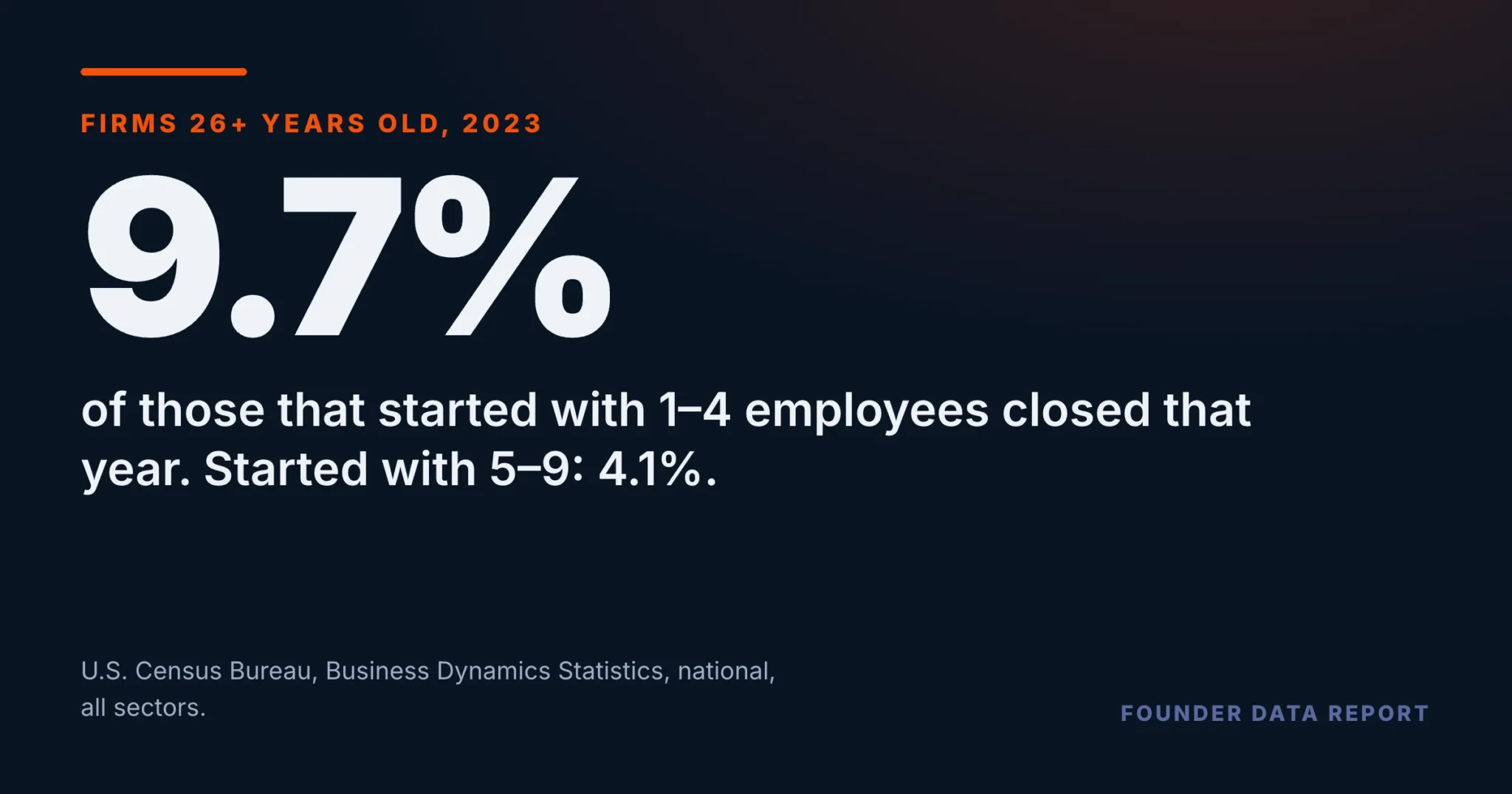
In the Census Bureau’s Business Dynamics Statistics, firms that are 26 years or older and started with one to four employees closed at a rate of 9.7% in 2023. Firms the same age that started with five to nine employees closed at 4.1%. Firms that started with one to four close more often than those that started with five to nine at every age, in every year from 2010 to 2023. From age 11 on the two groups never overlap: across those age bands and years, 6.7% was the lowest rate for the smaller starters and 4.5% the highest for the larger ones.
- 26+ years old, 2023: 9.7% of firms that started with 1–4 employees closed, against 4.1% of those that started with 5–9.
- The smaller starters close more often at every age from one year to 26+, in every year from 2010 to 2023.
- From age 1 to 26+, the closure rate fell 59% for firms that started with 1–4 and 69% for those that started with 5–9. The smaller fall was the 1–4 group’s in every year.
- For the 1–4 starters, the rate stops falling after about 11 years: from 2015 to 2023 the bands from 11–15 to 26+ sat within 1.2 points of each other each year.
- Of the firms operating in 2023 that Census can trace to their first year, 59.3% started with 1–4 employees.
The size a firm started at
Most closure statistics sort businesses by how old they are or how big they are now. The Business Dynamics Statistics also publish a third cut: how many employees a firm had in its first year. A firm that opened with three people and grew to forty stays in the one-to-four group for life. A closure here means every location the firm ran stopped having employees, and the rate is the share of firms that closed in the year to March. Sorted that way, the youngest firms show what everyone expects: at one year old, 23.4% of the firms that started with one to four employees closed in 2023, against 13.1% of those that started with five to nine. What nobody tells you is how long that gap lasts.
Firm deaths as a share of firms plus firm deaths, year to March 2023. Initial size is the firm’s employment in its first year. National, all sectors. All bars on one scale.
U.S. Census Bureau, Business Dynamics Statistics, firm age by initial firm size (BDSFAGEIFSIZE), national, all sectors, file dated September 2025, retrieved October 16, 2026. Closure rate = firm deaths / (firms + firm deaths).
Firms that opened with one to four people still close more often a quarter century later.
Twenty-six years later, the gap is still there
An earlier piece here found that surviving 26 years cuts a business’s odds of closing a long way. Split by starting size, the cut is not the same for everyone. From age one to 26 and older, the closure rate fell 59% for firms that started with one to four employees and 69% for firms that started with five to nine, and the smaller starters had the smaller fall in every year from 2010 to 2023. At 26 and older the rate drops at every step of starting size: 9.7% for one to four, 4.1% for five to nine, 3.4% for 10 to 19, 2.5% for 20 to 99 and 1.3% for 100 to 499. That is 383,644 firms in the one-to-four group alone.
Firm deaths as a share of firms plus firm deaths, year to March 2023. Firms with 500 or more employees at the start are suppressed at this age and are not shown. National, all sectors.
U.S. Census Bureau, Business Dynamics Statistics, firm age by initial firm size (BDSFAGEIFSIZE), national, all sectors, file dated September 2025, retrieved October 16, 2026. Closure rate = firm deaths / (firms + firm deaths).
Not one year’s quirk
The gap at 26 and older is there in every year from 2010 to 2023. From 2014 to 2023 the rate for the one-to-four starters ran from 7.1% to 9.7%, and for the five-to-nine starters from 2.9% to 4.1%. The ranges never meet. In every year from 2015 to 2023, a firm 26 years or older that started with one to four employees closed more often than a four-year-old firm that started with five to nine. And for the smaller starters the rate flattens out after about 11 years: from 2015 to 2023, the age bands from 11–15 to 26+ sat within 1.2 points of each other in every year.
Firm deaths as a share of firms plus firm deaths, each year to March. National, all sectors. All bars on one scale.
U.S. Census Bureau, Business Dynamics Statistics, firm age by initial firm size (BDSFAGEIFSIZE), national, all sectors, file dated September 2025, retrieved October 16, 2026. Closure rate = firm deaths / (firms + firm deaths).
What to take from this if you started small
If your business opened with you and a couple of people, the national numbers say time alone does not buy the safety it seems to. The risk drops hard in the first years and then levels off, and it levels off higher than it does for firms that started with five to nine. That is worth knowing before you decide the business is past the dangerous part. The data do not say why, so do not read it as a verdict. Read it as a prompt: whatever a bigger start gives a firm, whether it is more money, more customers or more people who know how the work is done, ask which of those your business still runs short of, and build it on purpose.
Four limits worth holding. The data cover employer firms only, so businesses with no employees are not in them. Initial size is the firm’s employment in its first year in the data, so firms founded before 1978 have no starting size and are left out. A closure means every location stopped having employees, so a business that was sold and kept running is not counted as closed. And the file shows who closed, not why: it does not show that starting bigger keeps a firm open, only that the firms that started bigger closed less often.
U.S. Census Bureau, Business Dynamics Statistics, 2010–2023.
Frequently Asked Questions
Do businesses that start small close more often?
Yes, at every age. In Census Business Dynamics Statistics, firms that started with one to four employees closed more often than firms that started with five to nine at every age, in every year from 2010 to 2023.
Does the gap disappear once a business has been around for decades?
No. Among firms 26 years or older in 2023, 9.7% of those that started with one to four employees closed, against 4.1% of those that started with five to nine.
What does initial firm size mean?
It is the number of employees a firm had in its first year. A firm that started with three people and later grew stays in the one-to-four group.
Does starting with more employees keep a business open?
The data do not show that. They show which firms closed, not why, so the gap could reflect money, customers or anything else that comes with a bigger start.
Where does the data come from?
The U.S. Census Bureau's Business Dynamics Statistics, the table of firm age by initial firm size, national figures for all sectors, 2010 to 2023.
Published by The Lonely Entrepreneur — the community and coaching platform for entrepreneurs who are building alone. lonelyentrepreneur.com
This article is for educational purposes and is not a substitute for professional financial or legal advice.