

 Founder Data Report
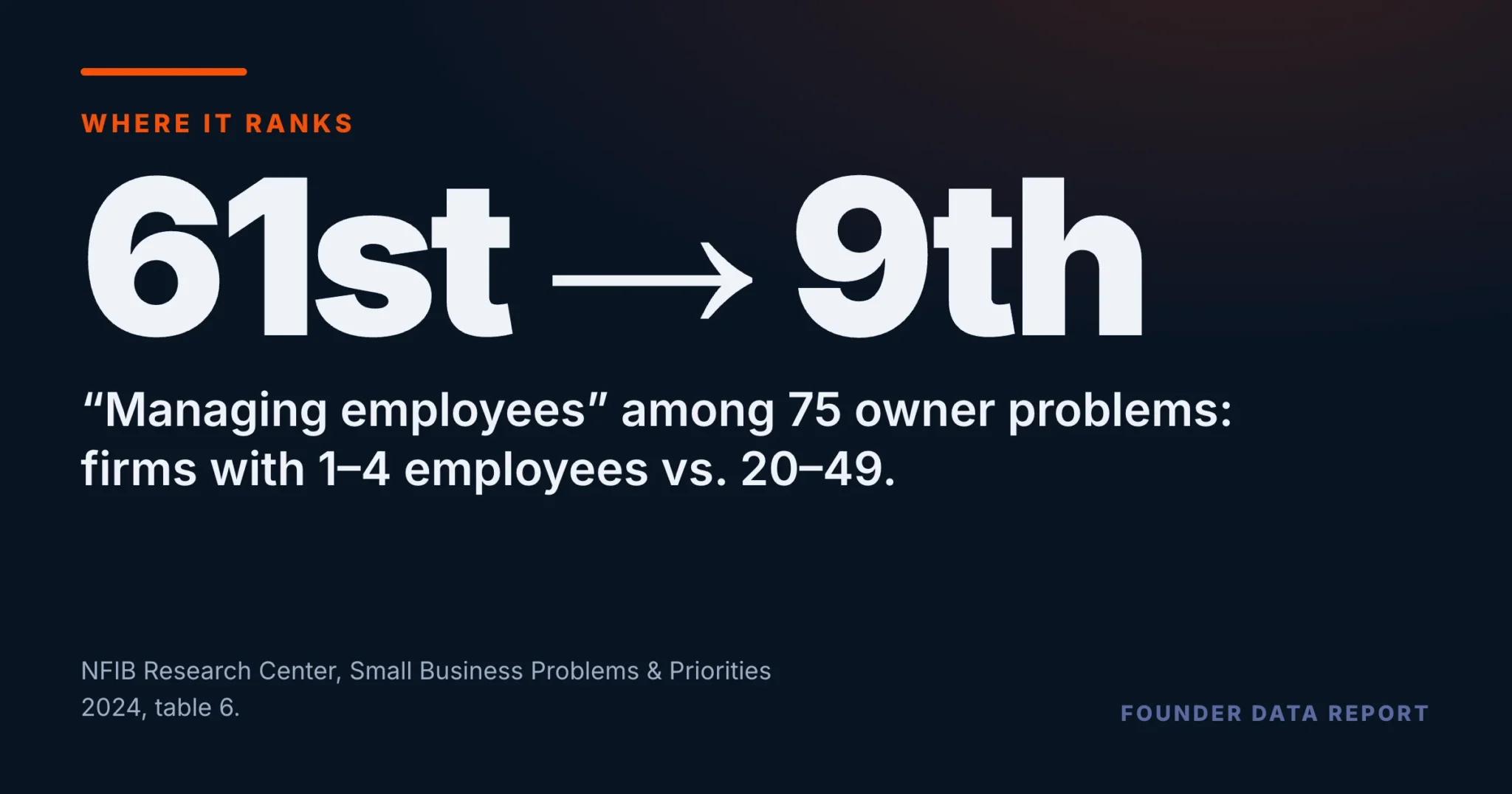
Owners With 1 to 4 Employees Rank Managing Them 61st of 75 Problems. At 20 to 49, It Ranks 9th.
Join us Fridays at 12 PM ET to ask TLE CEO Michael Dermer your questions live.
NFIB’s 2024 problem survey, cut by headcount: the people problems inside the building climb the list as a company grows. The owner’s time problem does not move.
In NFIB’s 2024 Small Business Problems & Priorities survey, owners rated 75 possible problems. Owners with 1 to 4 employees ranked “managing employees” 61st, and 6.5% called it critical. Owners with 20 to 49 ranked it 9th, and 16.1% called it critical. Turnover and training climb the same way. One problem that does not move with headcount: controlling my own time, which about one owner in ten calls critical in every size group from no staff to 50 to 99 employees.
- NFIB asked 2,873 member owners to rate 75 problems on a 1 to 7 scale, from critical to not a problem.
- “Managing employees” ranks 73rd with no staff, 61st at 1–4 employees, 34th at 5–9, 26th at 10–19 and 9th at 20–49.
- The share calling it critical rises from 6.5% at 1–4 employees to 16.1% at 20–49.
- From 20 employees up the groups are small, and the three are level with each other.
- “Controlling my own time” stays between 8.6% and 11.2% critical in every group from no staff through 50–99.
Near the bottom of the list, then the top ten
NFIB has run Problems & Priorities since 1982. The 2024 edition put 75 possible problems in front of its member owners and asked them to rate each one from 1 (critical) to 7 (not a problem). Across all owners, “managing employees (e.g., performance, absenteeism, appearance)” lands 4.36 on that scale and ranks 43rd. That middle position hides a steep climb by headcount. With no staff it ranks 73rd, which is no surprise. With 1 to 4 employees it is still 61st: sixty problems rank above it, and 6.5% of these owners call it critical. At 5 to 9 employees it rises to 34th, at 10 to 19 to 26th, and at 20 to 49 to 9th, inside the top ten, with 16.1% calling it critical. Each of those steps is larger than the survey’s sampling noise. The groups from 20 employees up are small (281, 81 and 44 owners) and cannot be told apart from each other.
Share rating it 1 (critical) on NFIB’s 1 to 7 scale, with its rank among 75 problems in that group. No staff is shown in slate as the baseline. Groups: 263, 800, 575, 451, 281, 81 and 44 owners. The 20–49, 50–99 and 100+ groups are level with each other. The 100+ group, at 44 owners, is shown faded: it is too small to read on its own.
NFIB Research Center, Small Business Problems & Priorities, 11th edition (2024), table 6: mail survey of NFIB member owners, February to April 2024, 2,873 usable responses; retrieved from nfib.com on October 13, 2026.
With 1 to 4 employees, sixty problems rank above managing them. With 20 to 49, eight do.
The problems that come after the hire
Finding people is its own problem, and an earlier piece here followed it up the size bands using a different survey. This one is about what comes once they are on the payroll. Managing them, keeping them and training them all climb together. Employee turnover ranks 57th at 1 to 4 employees and 17th at 20 to 49. Training ranks 52nd and 24th. In both cases the move from the smaller group to the larger one is well outside the sampling noise. None of the three is in the top ten for the smallest employers. For owners with 20 to 49 employees, managing them is.
Share rating each problem 1 (critical) on NFIB’s 1 to 7 scale, with its rank among 75 problems in that group; all bars on one scale. 800 owners with 1–4 employees, 281 with 20–49.
NFIB Research Center, Small Business Problems & Priorities, 11th edition (2024), table 6: mail survey of NFIB member owners, February to April 2024, 2,873 usable responses; retrieved from nfib.com on October 13, 2026.
The problem headcount does not fix
“Controlling my own time” behaves differently. Owners with no staff rank it 45th. Owners with 50 to 99 employees rank it 40th. Every group from no staff through 50 to 99 places it between 35th and 45th, and the share calling it critical stays between 8.6% and 11.2%. On that share, none of those six groups differs from another by more than the sampling noise. (On the average score, owners with no staff rate it slightly less severe than owners with 10 to 19.) Only the 100+ group reads lower (63rd, 5.4% critical), and at 44 owners it is too small to read alone. In this survey, owners with 50 to 99 employees rate their time as a problem about as often as owners with none. The survey does not ask where the time goes.
Share rating it 1 (critical) on NFIB’s 1 to 7 scale, drawn on a 0 to 20% scale. The six groups from no staff to 50–99 are level with each other. The 100+ group (44 owners) is shown faded and is too small to read on its own.
NFIB Research Center, Small Business Problems & Priorities, 11th edition (2024), table 6: mail survey of NFIB member owners, February to April 2024, 2,873 usable responses; retrieved from nfib.com on October 13, 2026.
What to take from this if you are building a company
The order matters. With 1 to 4 employees, managing people barely registers, so it is easy to put off building the habits for it: regular one-on-ones, clear standards, a way to deal with someone who is falling short, and a plan for training. With 20 to 49 employees it is one of the ten problems owners rate most severe, and those habits are much harder to install with a full team watching. The time problem is the other half of the lesson. Owners in this survey with more people did not rate their time as less of a problem. If the plan is to hire your way out of being stretched, decide in advance which decisions leave your desk with each hire. Otherwise the hours stay with you and the people problems arrive on top of them.
Four limits worth holding. The respondents are NFIB members who returned a mail survey (2,873 of 40,000 mailed). NFIB notes its members lean toward interior states and include agriculture. The survey is one point in time: it compares different owners of different-sized firms, not the same owners followed over time. NFIB publishes no margins of error; the comparisons here use the overall spread of answers for each problem and the size of each group, and only gaps well clear of that are reported. And ranks are relative: a problem can climb the list when others fall.
NFIB Research Center, Small Business Problems & Priorities, 2024.
Frequently Asked Questions
What is NFIB's Problems & Priorities survey?
A mail survey the NFIB Research Center has run roughly every four years since 1982. The 2024 edition asked member owners to rate 75 possible problems from 1 (critical) to 7 (not a problem). 2,873 returned usable answers.
How does “managing employees” rank by company size?
73rd with no staff, 61st at 1–4 employees, 34th at 5–9, 26th at 10–19, 9th at 20–49, 10th at 50–99 and 18th at 100 or more. The three largest groups are level with each other.
What share of owners call managing employees critical?
6.5% of owners with 1–4 employees and 16.1% of owners with 20–49. Across all owners it is 9.5%.
Does hiring free up an owner's time?
Not in this survey. The share calling “controlling my own time” critical stays between 8.6% and 11.2% in every group from no staff through 50–99 employees.
Does this represent all small businesses?
Not exactly. The respondents are NFIB members who answered a mail survey. NFIB notes they lean toward interior states and include agriculture, which Census small-business counts leave out.
Published by The Lonely Entrepreneur — the community and coaching platform for entrepreneurs who are building alone. lonelyentrepreneur.com
This article is for educational purposes and is not a substitute for professional financial or legal advice.