

 Founder Data Report
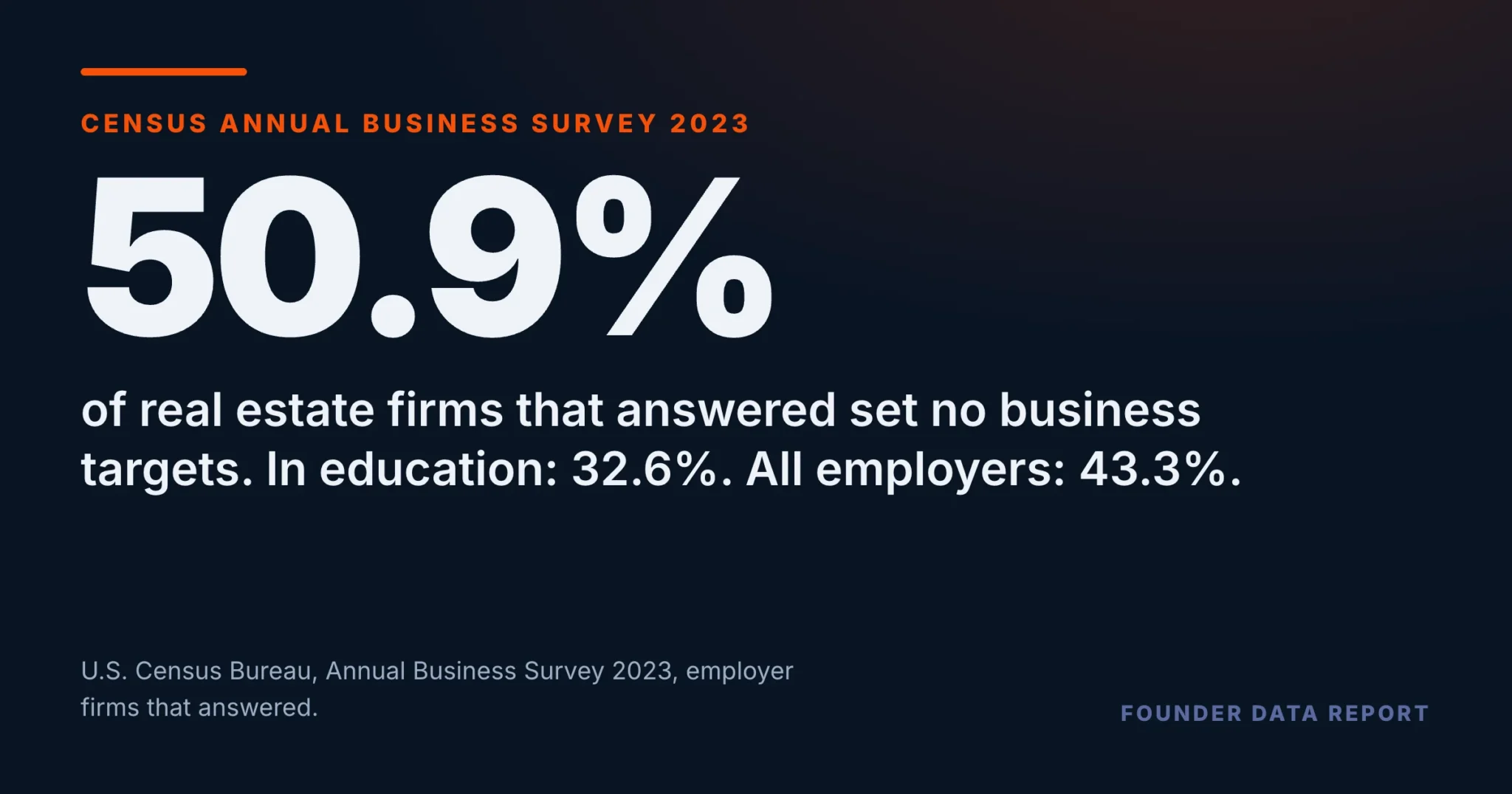
Setting Priorities by Trade: 50.9% of Real Estate Firms That Answered Set No Business Targets. In Education, 32.6%
You can’t afford to risk your business without a Sidekick at your side.
A priority needs something to be measured against. Census asked U.S. employers whether they set business targets, and over what horizon. Your trade says a lot about the likely answer.
In the Census Bureau’s Annual Business Survey 2023, 43.3% of U.S. employer firms that answered set no business targets. By trade that runs from 50.9% in real estate and 50.2% in repair and personal services down to 32.6% in educational services. Among firms in 12 of 13 trades shown, a main focus on short-term targets is clearly more common than a main focus on long-term ones. Finance and insurance is the exception, level at 11.6% and 11.9%.
The priority problem is deciding what gets your hours when everything on the list looks urgent. A target is one of the few tools that settles it, since a written number tells you what today’s work is for. Without one, whichever problem is loudest this morning wins.
We have already looked at this question by firm size, where the no-targets share is highest at the smallest firms. Census also publishes it by trade. About 48% of employer firms in scope answered, and every share below is of those firms.
- No business targets: 50.9% in real estate and 50.2% in repair and personal services, level with each other, and 32.6% in education. All employers that answered: 43.3%.
- Mainly long-term targets are rare: 6.4% of all firms that answered, and 11.9% at the top in finance and insurance.
- Construction leans hardest on the short term: 23.1% mainly short-term, 4.0% mainly long-term.
- No key performance indicators: higher than no targets in every trade, from 57.3% in education to 72.5% in real estate.
- This shows what firms report, not whether targets help. Trade is not separated from firm size.
Which trades run without a target
Real estate and repair and personal services are the only two of the 13 trades shown where more than half of firms that answered set no targets, and they stand clear of retail at 45.4%. Transportation reads 49.7%, but with a wider margin, so it does not separate from the top two. At the other end, education at 32.6% clears every trade shown except wholesale at 35.4%.
Manufacturing reads 28.3% but with a margin of about ten points either way, so it is left off the chart. Even so, its range sits below retail and repair. Firms in these trades differ in size and in many other ways the file does not measure.
Share of firms in each trade that answered. Bars on a 0 to 60% axis. Trades with a margin wider than about 6.5 points or a data flag are left out: agriculture, mining, utilities, manufacturing, information, management of companies.
U.S. Census Bureau, Annual Business Survey 2023, Module Characteristics of Businesses by sector (AB2300MCB01), U.S. employer firms, released January 2026. Shares are of firms in each trade that answered the question, about 48% of the 5,934,950 employer firms in scope.
Few firms aim mainly past one year
The survey splits firms that set targets by main focus: short-term (under a year), long-term (over a year), or a combination. Across all employers that answered, 18.8% said mainly short-term, 6.4% mainly long-term and 31.5% a combination. The combination is the most common answer among firms with targets in every trade shown, and in 12 of those 13 trades short-term sits clear of long-term.
Construction is the far end, the highest short-term share of any trade at 23.1% and the lowest long-term share at 4.0%. Finance and insurance is the one trade where the two are level, with the highest long-term share at 11.9% and the lowest short-term at 11.6%. Education has the largest combination share at 38.6%, level with finance at 36.7% and clear of repair at 26.5%.
Mainly long-term targets: 6.4% of employer firms that answered. Fewer than one firm in fifteen.
Share of all firms in each trade that answered, including those with no targets. Both bars on one scale, 0 to 100%. Eight of 13 trades shown. ‘Combination’ is not drawn.
U.S. Census Bureau, Annual Business Survey 2023, Module Characteristics of Businesses by sector (AB2300MCB01), U.S. employer firms, released January 2026. Shares are of firms in each trade that answered the question, about 48% of the 5,934,950 employer firms in scope.
Targets and tracking are not the same gap
The same survey asked how many key performance indicators the business monitored. 64.5% of all firms that answered said none. Real estate at 72.5%, construction at 70.8% and repair at 70.7% are at the top, level with each other, and education has the lowest share at 57.3%, level with finance at 59.5%. In every one of the 13 trades, the no-KPI share is above the no-targets share.
The distance between the two varies. Construction has the widest, 70.8% with no indicators against 44.6% with no targets. Health care has the narrowest, 60.0% and 45.1%. Census publishes these as two separate answers with no cross-tabulation, so this does not show that any particular firm has a target and no number to check it against. It shows only that, trade by trade, more firms say they set targets than say they monitor indicators.
Share of firms in each trade that answered each question. Both bars on one scale, 0 to 100%. Two separate questions, with no cross-tabulation published. Eight of 13 trades shown.
U.S. Census Bureau, Annual Business Survey 2023, Module Characteristics of Businesses by sector (AB2300MCB01), U.S. employer firms, released January 2026. Shares are of firms in each trade that answered the question, about 48% of the 5,934,950 employer firms in scope.
What to take from this if you run one
If you are in a trade where half your peers set no targets, you will not feel behind for skipping it. That makes it easy to let your week get set by whoever calls first. Write one target for the next 90 days, with a number on it, and decide which item on your list stops getting your time as a result.
If you have a target and no number you look at every week, that is the cheaper fix. Pick one number, put it somewhere you will see it, and have someone outside the business ask you about it.
Three limits worth holding. The shares are of firms that answered, about half of those in scope. Trade is not separated from firm size, and the no-targets share also differs by size. And this is what firms report doing: the survey does not say whether setting targets helps, or why trades differ.
U.S. Census Bureau, Annual Business Survey 2023, Module Characteristics of Businesses (AB2300MCB01).
Frequently Asked Questions
What share of small businesses set business targets?
In the Census Annual Business Survey 2023, 43.3% of employer firms that answered set no targets, so about 56.7% set some. About 48% of employer firms in scope answered. The figure covers firms of every size.
Which industries are least likely to set business targets?
Among the 13 trades with tight enough margins to compare, real estate at 50.9% and repair and personal services at 50.2% report the highest no-targets shares. They are level with each other, and with transportation, which has a wider margin.
Do businesses set short-term or long-term targets?
A combination, most often: 31.5% of firms that answered. 18.8% focused mainly on short-term targets and 6.4% mainly on long-term ones. Finance and insurance is the only trade shown where short and long are level.
Does setting targets make a business perform better?
This survey cannot say. It records what firms report doing at one point, and trade is not separated from firm size.
Where does the data come from?
The U.S. Census Bureau's Annual Business Survey 2023, Module Characteristics of Businesses by sector (AB2300MCB01), released January 2026. Every share is of firms that answered, and differences are called only where the 95% ranges do not overlap.
Published by The Lonely Entrepreneur — the community and coaching platform for entrepreneurs who are building alone. lonelyentrepreneur.com
This article is for educational purposes and is not a substitute for professional financial or legal advice.