

 Founder Data Report
Most Employers With Fewer Than 20 People Track No Key Performance Indicators. Half of Those With 1 to 4 Set No Targets.
You can’t afford to risk your business without a Sidekick at your side.
Census asked U.S. employers whether they track performance numbers and set targets. Below 20 employees, most that answered track none. The line moves steadily with size.
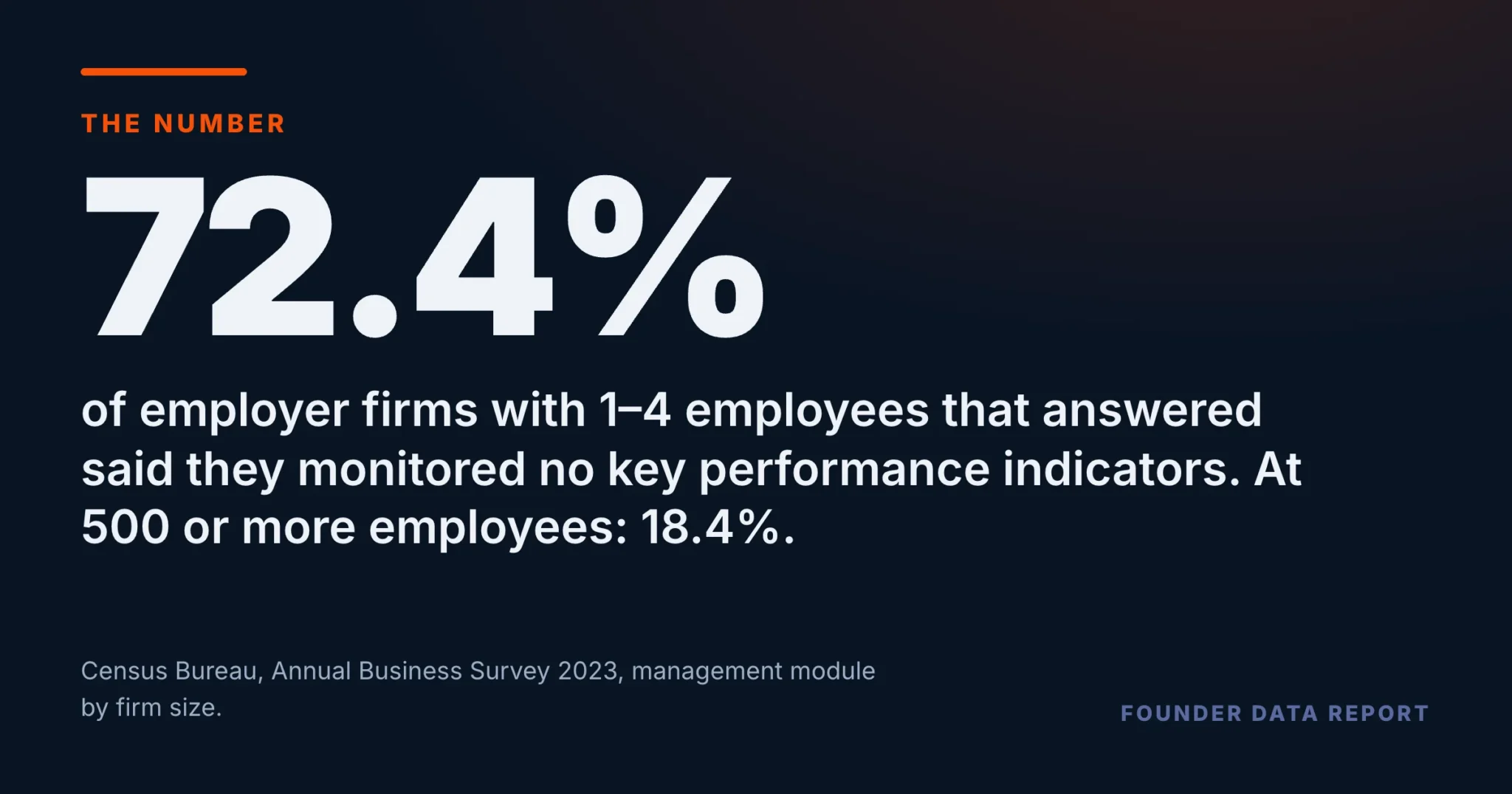
Census Bureau survey data on U.S. employer firms shows that most small employers do not track performance numbers. Among firms with 1–4 employees that answered, 72.4% monitored no key performance indicators, and 50% set no business targets. In the published figures the no-KPI share falls at every size step: 59.8% at 5–9 employees, 52.0% at 10–19, 44.3% at 20–49 and 18.4% at 500 or more. Every band under 20 employees is above half.
- No key performance indicators monitored: 72.4% of firms with 1–4 employees, 59.8% at 5–9, 52.0% at 10–19, 18.4% at 500 or more.
- No business targets set: 50% at 1–4 employees, 26.9% at 20–49, 11.7% at 500 or more.
- Among firms that do track KPIs, the share with monthly indicators rises from 33.3% at 1–4 employees to 62.6% at 250–499.
- Among firms that set targets, the share saying reaching them took “normal effort” is 56.5% to 59.7% in every size band.
- Shares are of firms that answered, about half of all employer firms. The survey shows what firms do, not whether it works.
What gets counted at a small firm
The Census Bureau’s Annual Business Survey asked employer firms how many key performance indicators they monitored. Among firms under 500 employees that answered, 64.6% said none. Split by size, the pattern is steep. At 1–4 employees it was 72.4%. At 5–9 it was 59.8%, at 10–19 52.0% and at 20–49 44.3%. Each of those steps is wider than the survey’s margin of error. Above that the bands carry wider margins: 36.0% at 50–99 and 26.9% at 100–249. At 500 employees or more, 18.4% tracked none, so the smallest firms are about four times as likely to run without a single tracked number.
Orange marks the three bands under 20 employees, each above half even at the low end of its margin of error. The 250–499 band has a wide margin (±29 points at 95%). Employer firms with no one on payroll in March are left out.
U.S. Census Bureau, Annual Business Survey 2023, Module Characteristics of Businesses by employment size of firm (AB2300MCB04), U.S. employer firms, all sectors, released January 2026. Shares are of firms in each size band that answered the question — about 48% of the 5,934,950 employer firms in scope.
Below 20 employees, most firms that answered track no performance numbers at all.
Targets follow the same line
The survey also asked whether the business set targets, and over what horizon. At 1–4 employees, exactly 50% of firms that answered set none. That fell to 38.8% at 5–9, 32.1% at 10–19 and 26.9% at 20–49, each step clear of the margin of error, and to 11.7% at 500 or more. Among firms that do set targets, the survey asked how much effort reaching them took. In every size band, between 56.5% and 59.7% said normal effort.
Orange marks firms with 1–4 employees. The remaining firms in each band set short-term targets, long-term targets or a combination. The 250–499 band has a margin of ±32 points at 95%.
U.S. Census Bureau, Annual Business Survey 2023, Module Characteristics of Businesses by employment size of firm (AB2300MCB04), U.S. employer firms, all sectors, released January 2026. Shares are of firms in each size band that answered the question — about 48% of the 5,934,950 employer firms in scope.
Among firms that track, monthly numbers are more common at larger sizes
Among firms that monitored at least one indicator, the survey asked how often. Firms could name more than one frequency, so the answers do not add to 100. The share naming monthly indicators was 33.3% at 1–4 employees, 37.0% at 5–9, 40.5% at 10–19 and 43.8% at 20–49, each step clear of the margin of error. It kept rising in the bands above that, to 62.6% at 250–499, though those steps are within the survey’s error.
Firms could name several frequencies (yearly, quarterly, monthly, weekly, daily), so a firm not counted here may still track weekly or daily. Orange marks 1–4 employees.
U.S. Census Bureau, Annual Business Survey 2023, Module Characteristics of Businesses by employment size of firm (AB2300MCB04), U.S. employer firms, all sectors, released January 2026. Shares are of firms in each size band that monitored at least one key performance indicator and answered how often.
What to take from this if you run a small firm
If you run a business with a handful of people and track no numbers, you are in the majority, not behind a crowd. The data does not say that tracking numbers makes a firm grow. Bigger firms differ from small ones in many ways at once, and this is one survey at one point in time. What it does show is that tracking at least one number is the norm among large employers (about four in five at 500 or more employees) and the exception among the smallest. Picking one or two numbers that tell you how the business is doing, and checking them on a set schedule, is a small change to try.
Three limits worth holding. The shares are of firms that answered, between 39% and 54% of employer firms depending on the size band. The survey asked what firms did, not how well it worked. And it covers employer firms, not businesses with no payroll.
U.S. Census Bureau, Annual Business Survey 2023, Module Characteristics of Businesses (AB2300MCB04).
Frequently Asked Questions
Do small businesses track key performance indicators?
Most of the smallest do not. In the Census Bureau's Annual Business Survey 2023, 72.4% of employer firms with 1–4 employees that answered monitored no key performance indicators, against 18.4% of firms with 500 or more employees.
At what size do most firms start tracking numbers?
In this survey, every size band under 20 employees had more than half of firms tracking none. At 20–49 employees the share was 44.3%, so most firms of that size tracked at least one indicator.
Do small firms set business targets?
Half do. Exactly 50% of firms with 1–4 employees that answered set no targets, falling to 26.9% at 20–49 employees and 11.7% at 500 or more.
Does tracking KPIs make a business grow?
The survey cannot say. It records what firms did at one point in time, and larger firms differ from smaller ones in many ways besides measurement.
Who answered the survey?
The Annual Business Survey covers U.S. employer firms in all sectors. About 48% of the firms in scope answered this question, and every share in this article is of those that did.
Published by The Lonely Entrepreneur — the community and coaching platform for entrepreneurs who are building alone. lonelyentrepreneur.com
This article is for educational purposes and is not a substitute for professional financial or legal advice.