

 Founder Data Report
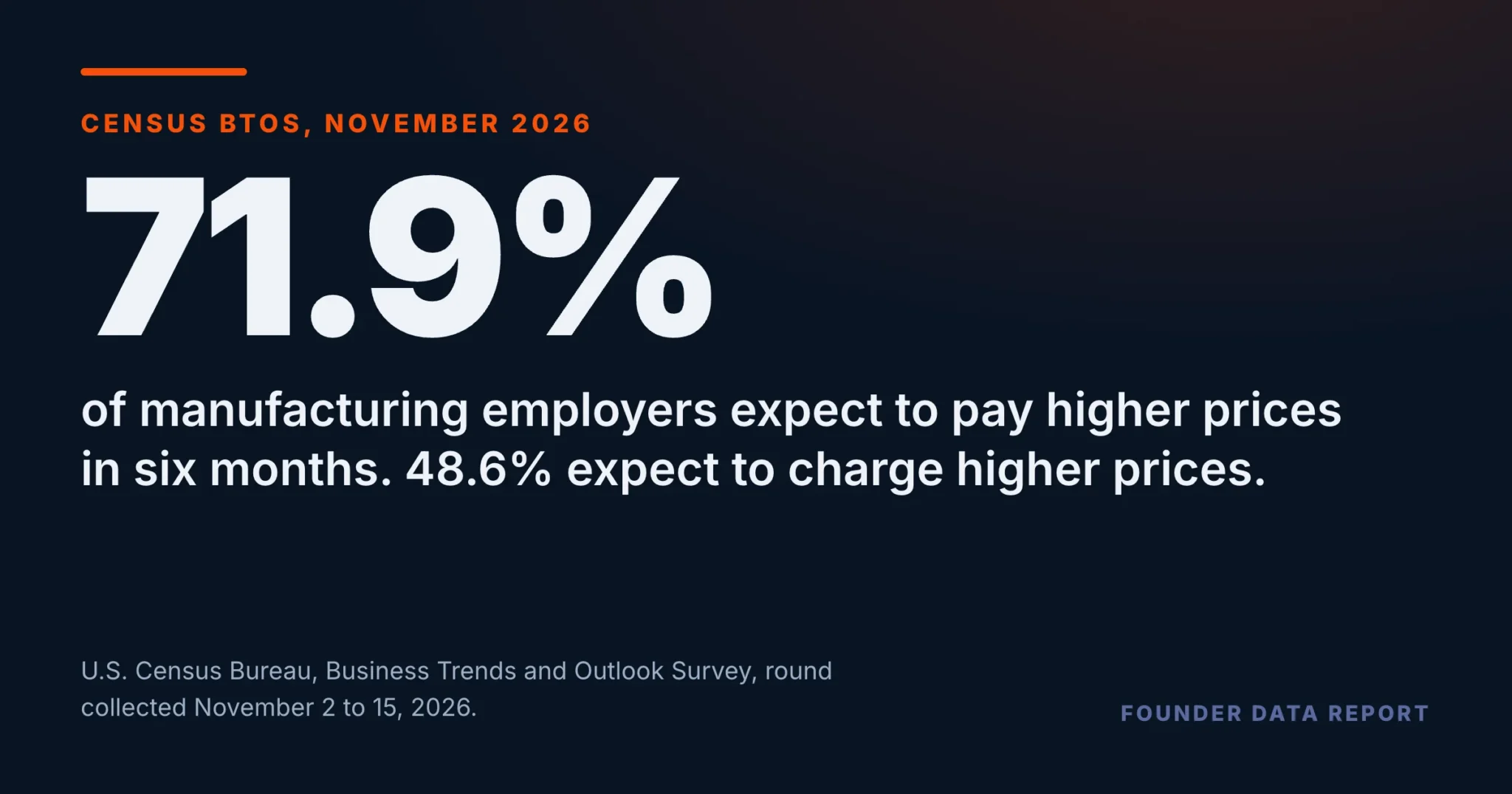
Setting Priorities by Trade: 71.9% of Manufacturers Expect to Pay Higher Prices. 48.6% Expect to Charge More
Get clarity — download the free Entrepreneur Survival Guide Summary.
Pricing competes with everything else on your list. Every two weeks the Census Bureau asks employers where they think prices are going, both the ones they pay and the ones they charge.
In the Census Bureau’s Business Trends and Outlook Survey round collected November 2 to 15, 2026, 57.9% of U.S. employers expected the prices they pay to be higher in six months, and 36.6% expected the prices they charge to be higher. In each of fifteen trades, the first share was clearly above the second, in all eight rounds since late July.
You have a supplier notice in one tab, a price list in another and a week that is already full. Does pricing go to the top of the list, or does it wait? It is worth knowing what other employers in your trade expect before you decide.
- Nationally, 57.9% of employers expect to pay higher prices in six months. 36.6% expect to charge higher prices.
- In all fifteen trades shown, the share expecting to pay more was clearly above the share expecting to charge more, in all eight rounds.
- Manufacturing (71.9%) and construction (67.4%) sat above the national share on prices paid in every round.
- Finance and insurance: 42.2% expect to pay more and 18.4% expect to charge more.
- These are expectations. The figures count businesses and say nothing about how large any price change will be.
Two questions, and a gap between them
The survey asks employers what they think will have happened to prices six months from now. One question covers what the business pays for goods or services. The other covers what it charges for its own. In the latest round, 57.9% answered that prices paid will have increased. For prices charged, the share was 36.6%. Most of the rest on that second question, 59.2% of all employers, expected no change, and 4.1% expected to charge less.
Be careful with the gap. These are two separate questions, and the published files do not show how one business answered both. So the numbers cannot tell you how many owners expect to pay more while holding their own prices where they are. They show that, taken as a group, more employers see their costs going up than see their own prices going up.
The nation and six trades. Slate: expect to pay higher prices. Orange: expect to charge higher prices. Bars on a 0 to 100% scale.
U.S. Census Bureau, Business Trends and Outlook Survey (BTOS), sector and national files, round collected November 2 to 15, 2026. Questions: ‘Six months from now, how do you think the prices this business pays for goods or services will have changed?’ and ‘Six months from now, how do you think the prices this business charges for its own goods or services will have changed?’ Share answering ‘increased’ to each.
On costs, two trades sit above the nation and three below
Compare each trade with the national share on prices paid. A trade is called apart here only if it was outside the survey’s margin of error in all eight rounds. Two trades were above the nation every time: manufacturing, at 71.9% in the latest round, and construction, at 67.4%. Three were below it every time: finance and insurance (42.2%), real estate and rental (47.8%) and arts and recreation (45.3%).
Bars on a 0 to 100% scale. National share: 57.9%. Orange: apart from the national share in all eight rounds. Do not rank the slate trades against each other; some have wide margins of error.
U.S. Census Bureau, Business Trends and Outlook Survey (BTOS), sector and national files, round collected November 2 to 15, 2026. Share answering ‘increased’ to ‘Six months from now, how do you think the prices this business pays for goods or services will have changed?’ Fifteen sectors.
In every one of the fifteen trades, more employers expect to pay higher prices than expect to charge them.
On your own price list, the trades split further
Prices charged split the trades further. Four were above the national share in all eight rounds: manufacturing (48.6%), construction (46.5%), wholesale trade (45.1%) and retail (45.1%). Five were below it in all eight: health care (27.3%), information (27.3%), real estate and rental (24.5%), arts and recreation (27.5%) and finance and insurance (18.4%).
Health care shows why both numbers matter. 55.1% of its employers expect to pay higher prices, and 27.3% expect to charge higher prices. Education reads 55.8% and 23.6%. The survey does not say why, and it does not say what any one business is free to charge.
Bars on a 0 to 100% scale. National share: 36.6%. Orange: apart from the national share in all eight rounds. Do not rank the slate trades against each other.
U.S. Census Bureau, Business Trends and Outlook Survey (BTOS), sector and national files, round collected November 2 to 15, 2026. Share answering ‘increased’ to ‘Six months from now, how do you think the prices this business charges for its own goods or services will have changed?’ Fifteen sectors.
Deciding where pricing goes on your list
Start with your own two answers. What do you expect to pay in six months? What do you expect to charge? Write both down. If the first is up and the second is flat, name what covers the difference: margin, a leaner way of delivering, or your own time.
Then compare yourself with your trade, and treat that as context for a decision that is still yours. These are expectations, not results. The survey does not say why a trade answers as it does, it counts businesses and not the size of price changes, and the trade rows cover businesses operating in one sector.
U.S. Census Bureau, Business Trends and Outlook Survey (BTOS), round collected November 2 to 15, 2026.
Frequently Asked Questions
Do small businesses expect to raise prices in the next six months?
In the Census Bureau's Business Trends and Outlook Survey round collected November 2 to 15, 2026, 36.6% of U.S. employers expected the prices they charge to be higher in six months, 59.2% expected no change and 4.1% expected them to be lower. The figure covers employer businesses of every size.
How many employers expect their costs to go up?
57.9% expected the prices they pay for goods or services to be higher in six months, in the same round.
Which industries most clearly expect higher costs?
Manufacturing (71.9%) and construction (67.4%) were above the national share, outside the margin of error, in all eight rounds from late July to mid November 2026.
Does this show how much prices will change?
No. The figures are shares of businesses expecting an increase. They carry no size of change, and they are expectations rather than results.
Where does the data come from?
The U.S. Census Bureau's Business Trends and Outlook Survey, sector and national files, eight two-week rounds collected from July 27 to November 15, 2026, not seasonally adjusted, with published standard errors.
Published by The Lonely Entrepreneur — the community and coaching platform for entrepreneurs who are building alone. lonelyentrepreneur.com
This article is for educational purposes and is not a substitute for professional financial or legal advice.