

 Founder Data Report
The Leadership Burden of a Pricing Decision: 54.7% of the Smallest Firms Expect to Pay More. 33.4% Expect to Charge More
Get clarity — download the free Entrepreneur Survival Guide Summary.
Your costs are going up. Do your prices? If you own the business, that call is yours. The Census Bureau asks employers both halves of it every two weeks, and the two answers do not match at any size of business.
In the Census Bureau’s Business Trends and Outlook Survey, 54.7% of employers with 1 to 4 employees said in August to October 2026 that the prices they pay will be higher six months from now. 33.4% said the prices they charge will be higher. The difference is about 21 to 22 points in all seven size classes the survey reports, from the smallest firms to those with 250 or more employees.
If you own the business, the price list is yours to sign. The supplier sends the new invoice, the customer holds the old quote, and the decision about what to do between them sits on your desk. That is one of the quieter parts of the leadership burden, and it comes around again every time a cost moves.
The Census Bureau asks employers about both sides of it, every two weeks: which way the prices they pay are heading, and which way the prices they charge are heading. Set side by side, more businesses expect the first to rise than the second, in every size class and in every round the survey has published since 2023.
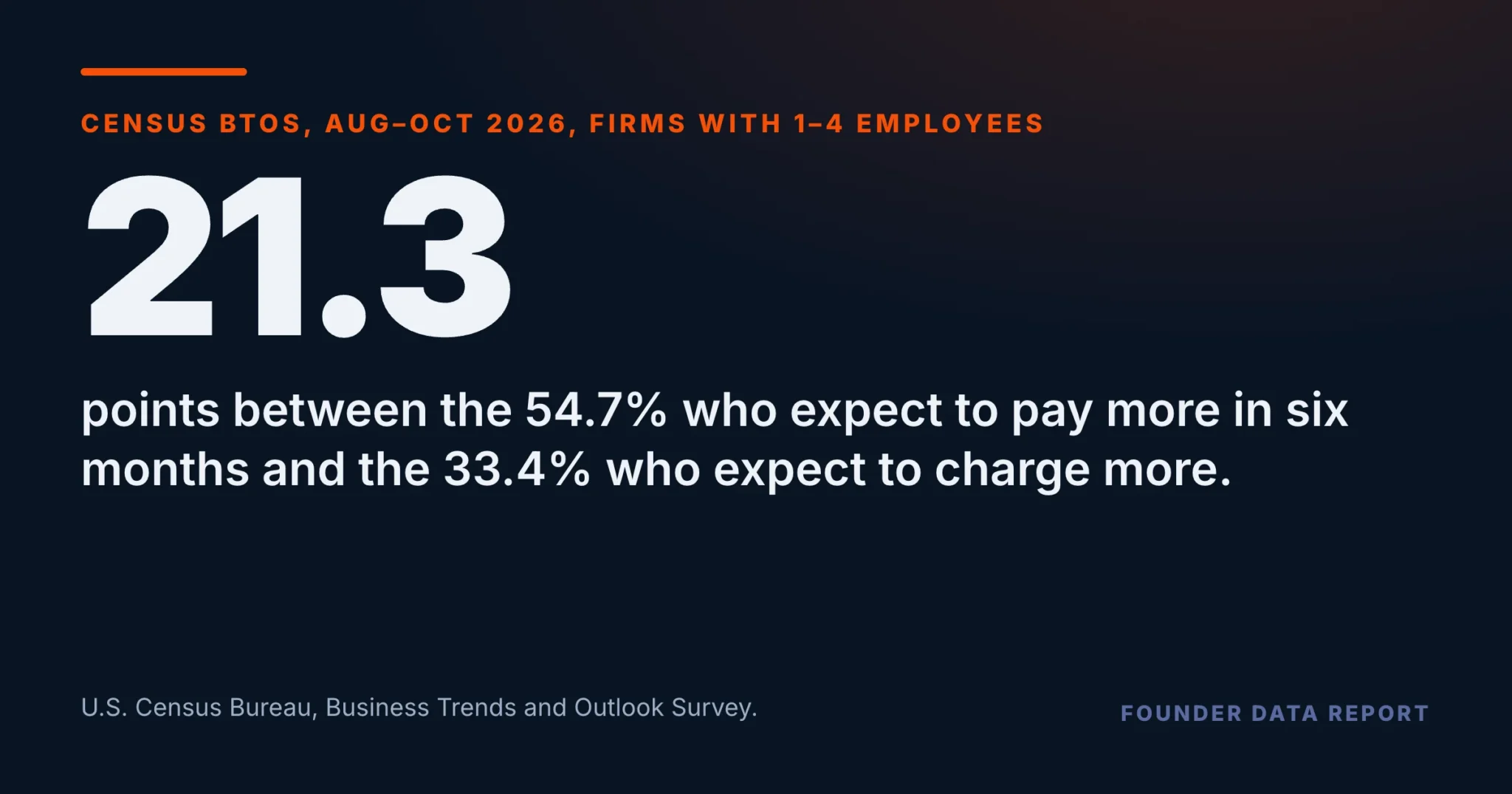
- At firms with 1 to 4 employees, 54.7% expect to pay more in six months and 33.4% expect to charge more, a gap of 21.3 points.
- At firms with 250 or more, it is 55.1% and 33.5%, a gap of 21.6. Size does not change the gap.
- Firms with 5 to 49 employees sit above both the smallest and the largest on both questions. The smallest and the largest are level with each other.
- The same pair over the last two weeks: 43.3% paid more and 15.9% charged more at the smallest firms.
- The survey asks about direction only. It does not say how large a rise is, or why.
The same gap at every size
Across the seven size classes, between 54.7% and 63.2% of employers expect the prices they pay to be higher in six months. Between 33.4% and 41.2% expect the prices they charge to be higher. The gap between those two answers runs from 21.3 to 22.4 points, and no size class separates from another on it once the survey’s margin of error is counted.
The levels do move with size, in a shape worth noticing. Firms with 5 to 49 employees sit above both ends on both questions, at 62.0% to 63.2% on what they pay. Firms with 1 to 4 employees and firms with 250 or more are level with each other, at 54.7% and 55.1%. The gap sits on top of that shape and does not change with it.
Share of employers in each size class answering ‘increased’ to each question, average of five survey rounds. Both bars on one scale, 0 to 100%. The survey publishes two shares, not how many firms gave both answers.
U.S. Census Bureau, Business Trends and Outlook Survey, by employment size: ‘Six months from now, how do you think the prices this business pays for goods or services will have changed?’ and the same question for prices it charges. Average of five survey rounds, August 10–October 18, 2026.
It already shows in the last two weeks
The survey asks the same pair about the last two weeks. At firms with 1 to 4 employees, 43.3% said the prices they pay went up and 15.9% said the prices they charge went up. At firms with 250 or more, it was 30.7% and 11.5%. In every size class, the answer on paying is at least twice the answer on charging.
Here size does change the picture. The share reporting higher prices paid peaks at 47.8% among firms with 5 to 9 employees, level with firms with 10 to 19, and falls to 30.7% at 250 or more. A two-week window and a six-month window are different questions, so these are not to be set against the forecasts above.
Share of employers in each size class answering ‘increased’, average of five survey rounds. Four of the seven size classes shown. Both bars on one scale, 0 to 100%.
U.S. Census Bureau, Business Trends and Outlook Survey, by employment size: ‘In the last two weeks, how did the prices this business pays for goods or services change?’ and the same question for prices it charges. Average of five survey rounds, August 10–October 18, 2026.
In every size class and every survey round since 2023, more employers expected to pay more than to charge more.
This is not a new reading
The pattern has held across 78 survey rounds since September 2023, in all seven size classes. The sample is redrawn each year, so the fair way to read it is the gap inside each window. At the smallest firms the gap has been 19.3, 17.9, 20.9 and 21.3 points.
That persistence is the useful part. A gap that opened last month could be a reaction to last month. One that has stood for three years is a standing feature of how employers answer, and it leaves the same question on the owner’s desk each time.
Share expecting to pay more minus share expecting to charge more, six months out, rounds averaged in each window. Bars on a 0 to 30 point axis. Read the gap inside a window; the windows are separate samples. Latest window: 54.7% and 33.4%.
U.S. Census Bureau, Business Trends and Outlook Survey, employers with 1 to 4 employees, six-months-out questions. Each window is a separate annual sample; rounds not collected in the fall 2025 federal funding lapse are left out.
What to take from this if you run one
If you are the one who sets prices, treat them as a decision with a date on it, not something you get to when there is time. Know what your three largest costs did this year. Know when you last changed your price list, and whether that was a choice or a default. Then have the conversation with someone who has run a business and can argue with you about it. This is a call worth making with a second set of eyes on the numbers.
Three limits worth holding. The survey records direction only: a firm paying 1% more and charging 5% more gives the same answers as one paying 5% more and charging 1% more, so this does not measure anyone’s margin. It publishes two separate shares, not how many firms gave both answers. And these are expectations, which the survey does not check against what later happens.
U.S. Census Bureau, Business Trends and Outlook Survey.
Frequently Asked Questions
Do small businesses expect their costs to rise faster than their prices?
More of them expect a rise in what they pay than in what they charge: 54.7% against 33.4% at firms with 1 to 4 employees. The Census Bureau's survey asks about direction, not size, so it does not measure how much faster.
Is the gap wider at smaller firms?
No. It is about 21 to 22 points in all seven size classes: 21.3 at firms with 1 to 4 employees and 21.6 at firms with 250 or more.
Are the smallest firms the most likely to expect higher prices?
No. Firms with 5 to 49 employees sit above both ends, on both questions. On prices paid they run from 62.0% to 63.2%, against 54.7% at the smallest firms and 55.1% at the largest.
Does the survey say why businesses are not raising prices as often?
No. It records which way owners expect prices to move, not the reason, and it does not show how many firms gave both answers.
Where does the data come from?
The U.S. Census Bureau's Business Trends and Outlook Survey, which asks employer businesses about current conditions and six-month expectations every two weeks. These figures average five rounds from August 10 to October 18, 2026.
Published by The Lonely Entrepreneur — the community and coaching platform for entrepreneurs who are building alone. lonelyentrepreneur.com
This article is for educational purposes and is not a substitute for professional financial or legal advice.