

 Founder Data Report
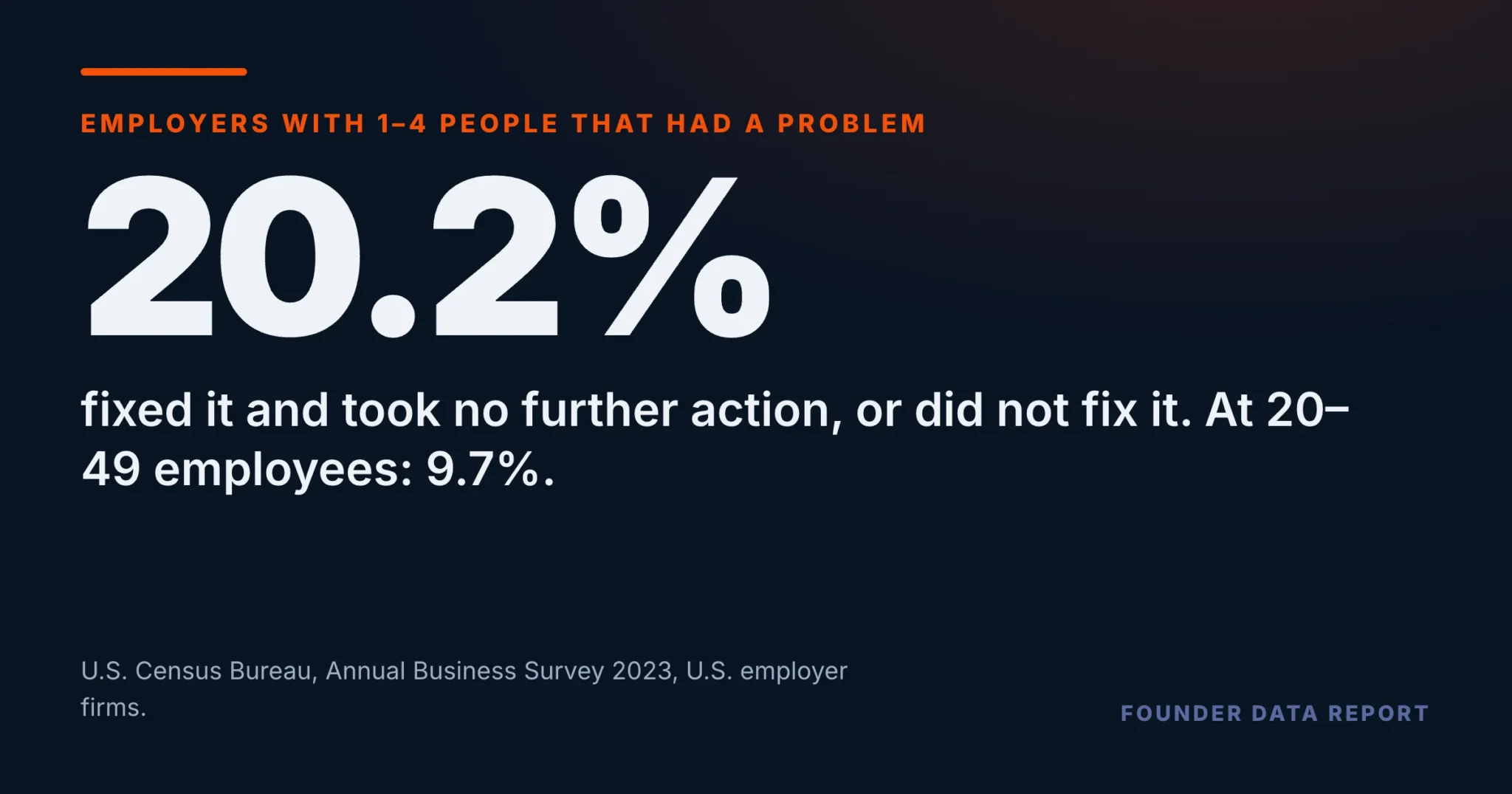
After a Problem, 20.2% of Employers With 1 to 4 People Fixed It and Moved On or Did Nothing. At 20 to 49: 9.7%
You can’t afford to risk your business without a Sidekick at your side.
Census asked employers what they did when something went wrong in the work. The answers change with the size of the firm.
In the Census Bureau’s Annual Business Survey 2023, 20.2% of employer firms with one to four employees that had a service or production problem fixed it and took no further action, or did not fix it. At 20 to 49 employees the figure was 9.7%. The share that fixed the problem and also ran a continuous-improvement process rose from 36.8% at one to four employees to 44.8% at 10 to 19.
- 61.6% of firms with 1–4 employees said no service or production problem came up, against 37.5% at 20–49.
- Of the 1–4 employee firms that did have a problem, 13.5% fixed it and took no further action and 6.6% did not fix it: 20.2% in all. At 20–49 employees: 9.7%.
- Fixing it and running a continuous-improvement process: 36.8% at 1–4, 41.0% at 5–9, 44.8% at 10–19.
- At every size shown, at least 79.8% of firms with a problem fixed it and either took further action or had a continuous-improvement process.
- The survey cannot tell whether the smallest firms have fewer problems or notice fewer.
The question
The Annual Business Survey asked employer firms what best described what happened when a problem came up in their service or production. There were five answers: no problem came up; the firm fixed it and took no further action; it fixed it and took further action; it fixed it and had a continuous-improvement process; or it did not take action to fix it. Each firm picked one. Sorted by the number of people a firm employs, the first answer already splits the field. 61.6% of firms with one to four employees said no problem came up, against 47.4% at five to nine and 41.8% at 10 to 19. That could mean fewer things go wrong in a smaller operation, or that fewer of them get noticed and named as problems. The survey cannot say which.
Share of firms answering the question. Roughly half of the firms in each band answered (49% to 53%). The fall from 10–19 to 20–49 is inside the survey’s margin of error.
U.S. Census Bureau, Annual Business Survey 2023, Module Characteristics of Businesses by employment size of firm (AB2300MCB04), question on service or production problems, U.S. employer firms, all sectors; retrieved from census.gov on October 11, 2026.
One small employer in five that hit a problem either fixed it and stopped there or left it unfixed.
Fixed once, or fixed for good
Now take only the firms that did have a problem. Among those with one to four employees, 20.2% fixed it and moved on or did not fix it. At five to nine that was 15.3%, and at 20 to 49 it was 9.7%. At the other end of the scale, the share that fixed the problem and had a continuous-improvement process rose from 36.8% at one to four employees to 41.0% at five to nine and 44.8% at 10 to 19. An earlier piece here looked at the same question in manufacturing plants; this is every kind of employer, sorted by size.
Share of firms that had a problem. The rest fixed it and took further action. Orange bars: 1–4 differs from every other size shown, and 5–9 from 20–49; the 5–9 to 10–19 and 10–19 to 20–49 steps are inside the margin of error. Blue bars: only the 10–19 to 20–49 step is inside it. Firms of 50 or more are not shown: one cell at 50–99 is suppressed and the larger bands carry wide margins. All bars on one scale.
U.S. Census Bureau, Annual Business Survey 2023, Module Characteristics of Businesses by employment size of firm (AB2300MCB04), question on service or production problems, U.S. employer firms, all sectors; retrieved from census.gov on October 11, 2026.
Inside the smallest firms
Most of the smallest employers that had a problem did more than patch it. 43.1% fixed it and took further action, and 36.8% fixed it and had a continuous-improvement process. But 13.5% fixed it and took no further action, and 6.6% did not take action to fix it at all. Those shares cover 575,108 firms with one to four employees that had a problem.
Share of firms with 1–4 employees that had a service or production problem. One answer per firm; the four shares add to 100 within rounding.
U.S. Census Bureau, Annual Business Survey 2023, Module Characteristics of Businesses by employment size of firm (AB2300MCB04), question on service or production problems, U.S. employer firms, all sectors; retrieved from census.gov on October 11, 2026.
What to take from this if you run a small team
If you are the one who fixes things, a problem that gets fixed and forgotten comes back to you. A late delivery, a wrong order, a job that had to be redone: patch it once and it is gone for today. Patch it every time and you have made yourself the process. The survey cannot say that firms with an improvement process do better, and it does not say why smaller firms use one less often. But the question it asks is a useful one to put to yourself. The last time something went wrong, did you only fix it, or did you change something so that nobody would have to fix it again? Pick the problem that has come back most this year and spend an hour on the second answer.
Four limits worth holding. The survey covers employer firms; firms with no one on the payroll in March are left out. Roughly half the firms in each size band answered this question, and the shares are of those that did. The answers describe the firm’s own account of what happened, so a problem nobody noticed is not counted. And the survey shows what firms did, not why, or whether it worked.
U.S. Census Bureau, Annual Business Survey 2023, Module Characteristics of Businesses (AB2300MCB04).
Frequently Asked Questions
What do small employers do after a problem in their work?
Most do more than fix it. Among firms with one to four employees that had a service or production problem, 79.8% fixed it and either took further action or had a continuous-improvement process. 20.2% fixed it and took no further action, or did not fix it.
Do bigger firms handle problems differently?
At 20 to 49 employees, 9.7% of firms with a problem fixed it and moved on or did not fix it, against 20.2% at one to four. The share running a continuous-improvement process rose from 36.8% at one to four to 44.8% at 10 to 19.
Do the smallest firms have fewer problems?
61.6% of firms with one to four employees said no problem came up, against 37.5% at 20 to 49. The survey cannot tell whether that means fewer problems or fewer noticed.
How many firms answered this question?
Roughly half of the employer firms in each size band from one to four employees to 20 to 49 (49% to 53%). The shares are of the firms that answered.
Where does the data come from?
The U.S. Census Bureau's Annual Business Survey 2023, the module on characteristics of businesses by employment size, national figures for all sectors.
Published by The Lonely Entrepreneur — the community and coaching platform for entrepreneurs who are building alone. lonelyentrepreneur.com
This article is for educational purposes and is not a substitute for professional financial or legal advice.