How to lay off employees as a founder — deciding if it is the right call, the runway-severance trade-off, protecting survivor morale, and leading yourself through the guilt. In 6 charts.
The Founder’s Layoff: Leading Through the Hardest Decision You’ll Ever MakeSamantha Lankford2026-08-31T12:37:25-04:00
By Michael Dermer • Updated July 23, 2026 • 12 min read
★ The Lonely Entrepreneur · Why Co-Founders Break 2026
Why Co-Founder Relationships Break: The Partnership That Quietly Kills Startups
You spend months choosing an investor and minutes choosing a co-founder. Then the relationship becomes the single biggest risk to everything you build. The data is sobering — and more preventable than founders think. Harvard research pins up to 65% of high-potential startup failures on co-founder conflict, roughly a third of founding teams break up within two years, and the split usually costs more equity than your seed round. Here's why co-founders break, in six charts.
Every founder obsesses over the wrong risks. They stress about competitors, funding rounds, and product roadmaps — the visible threats. Meanwhile the single most dangerous relationship in the company sits right next to them, and almost nobody plans for it failing. The co-founder relationship is the startup's load-bearing wall. When it cracks, everything above it comes down: the team fractures, the cap table freezes, investors get spooked, and the founder who's left has to rebuild the company and grieve a partnership at the same time. It's the divorce and the bankruptcy arriving together.
What makes it so lethal is precisely what makes it so avoidable. Co-founder breakups almost never come out of nowhere. They follow a recognizable pattern — a slow erosion of trust, a set of unspoken misalignments, and a handful of warning signs that were visible months before the blowup. We pulled from the deepest research available: Noam Wasserman's Harvard Business School work on founding teams, CB Insights' 2026 analysis of 400+ startup post-mortems, Icehouse Ventures' portfolio study of 100 funded companies, and practitioner data from SaaStr and startup-law sources. Some of it is uncomfortable. All of it points to the same conclusion: the breakup that kills your company is usually the one you saw coming and didn't name.
You spend months choosing an investor and minutes choosing a co-founder. Then you bet the whole company on that choice.
What actually breaks co-founders.
The reasons cluster into a handful of patterns — and it's almost never the thing founders fear most. Rarely the market. Almost always the people. Hover any block.
Chart 1 — The reasons
Why co-founder relationships break down
Relative share of what drives founding-team splits. Hover a block.
Directional weighting synthesizing Wasserman (HBS) founding-team research, Icehouse Ventures portfolio data, and SaaStr practitioner analysis. A relative map, not survey percentages.
When you map what actually breaks founding teams, the biggest blocks are never technical. Misaligned vision leads — founders who agreed on the idea but never agreed on the ambition, the timeline, or what "success" even means. One wants a lifestyle business; the other wants a rocket ship. Close behind is unequal commitment: the moment one founder is grinding sixty-hour weeks while the other treats it as a side project, resentment starts compounding faster than the company does. Then come trust and communication breakdowns, equity and money disputes, overlapping or undefined roles, and raw personality clashes. Notice what's missing from the top of the list: the market, the product, the competition. The things founders spend their energy on are rarely what ends the partnership. The partnership ends because two people who moved in together in a matter of weeks discovered they wanted different lives.
How trust actually erodes.
A breakup isn't a moment — it's a curve. Trust doesn't collapse overnight; it leaks, quietly, through a series of unaddressed cracks. Knowing the shape is half the battle. Hover any stage.
Chart 2 — The erosion curve
How co-founder trust decays over time
A directional map of the trust-erosion arc, from honeymoon to break. Hover a stage.
Directional model synthesizing founding-team conflict research (Wasserman) and practitioner post-mortems (SaaStr, Icehouse). The stages are consistent; the timeline varies by team.
The erosion curve is remarkably consistent. It starts at the honeymoon — high trust, shared excitement, the "we finish each other's sentences" phase that convinces founders they'll never need a hard conversation. Then comes first friction: a disagreement about strategy or effort that gets smoothed over instead of resolved. Here's where the damage begins, because the crack doesn't close — it goes underground into silent resentment, where each founder starts keeping a private ledger of the other's failures. Next is avoidance: the founders stop having the real conversation entirely, routing around each other, until the relationship is running on fumes. Finally comes the break, which feels sudden to everyone watching but was months in the making. The founders who survive aren't the ones who never hit friction — everyone hits friction. They're the ones who resolve it at the first crack, before it goes silent.
Trust rarely collapses in a blowup. It leaks — quietly, through every crack you smoothed over instead of closing.
The equity-split trap.
How you split the company predicts how likely you are to fight over it. Fast, lopsided, and never-revisited splits are conflict factories. Hover any point.
Chart 3 — Equity vs. conflict
How the equity split predicts conflict risk
Each dot is a common split scenario, plotted by fairness and conflict risk. Hover a dot.
73% of founding teams split equity within a month of starting — before they know each other's real contribution. The rushed handshake split is the single most common source of later resentment.
Sources: Founders-Journey / equity-split research (73% split within a month); Icehouse Ventures vesting analysis. Conflict-risk positions are directional.
Equity is where founding relationships quietly detonate. The research is striking: about 73% of founding teams lock in their equity split within a month of starting — long before anyone knows who'll actually carry the load. That rushed handshake, meant to signal trust, becomes the seed of resentment when reality diverges from the split. The scenarios cluster predictably. A quick 50/50 done to "keep things fair and avoid the awkward conversation" feels equal but carries hidden risk, because it locks in equality before anyone has proven their contribution, and it offers no tiebreaker when the founders deadlock. A lopsided split with no vesting is the worst of all worlds: the founder who leaves after eight months walks away with 20–30% of a company they no longer build, poisoning the cap table for the next raise. The lowest-conflict scenarios share one trait — a split negotiated honestly and protected by a real vesting schedule, so that equity is earned over the years it takes to build value, not claimed in the first excited month.
The handshake 50/50 feels like trust. Without vesting, it's just a lawsuit you haven't scheduled yet.
When breakups actually happen.
The danger isn't spread evenly across a startup's life. Most co-founder splits cluster in a specific, predictable window — and it's earlier than you'd guess. Hover any bar.
Chart 4 — The timing
When co-founders are most likely to split
Relative share of founder departures by company age. Hover a bar.
Source: Icehouse Ventures portfolio study (35% of 100 funded companies had a founder leave, most within the first two years). Distribution is directional.
Icehouse Ventures ran the numbers on 100 companies it funded since 2012, and the finding is one every founder should sit with: 35% of them had a founder leave — and most of those departures happened within the first two years of investment. That's the danger window. It maps directly onto the trust-erosion curve, because the first two years are when the honeymoon wears off, the real workload becomes clear, and the misalignments that were papered over during the excitement of launch finally surface under pressure. The early stage feels like the safest time — everyone's aligned, the vision is fresh, the relationship is new. It's actually the most fragile. Departures taper after year two not because the risk disappears, but because the teams that make it that far have usually already survived their first real friction and learned how to fight without breaking. The teams that didn't learn are already gone.
The warning signs you can't ignore.
Breakups broadcast themselves months in advance. The signals are specific, observable, and — if you name them early — reversible. Tap any sign.
Chart 5 — The early warnings
The signs a co-founder split is coming
The observable signals that trust is eroding. Tap a sign.
Tap any warning sign to see what it really means — and the conversation that defuses it before it becomes a split.
The warning signs are almost embarrassingly consistent once you know to look. The first is avoidance: founders who used to hash everything out start dodging the hard conversation, mistaking silence for peace. The second is scorekeeping — the moment either founder starts privately tallying who did more, who sacrificed more, who's owed more, the partnership has already shifted from "us" to "me vs. you." The third is unilateral decisions: choices that used to be made together quietly become one person's call, signaling that the partnership has stopped being a partnership. The fourth is the energy mismatch — one founder still all-in, the other visibly checked out, running on obligation instead of belief. And the fifth, the most dangerous, is us-vs-them framing, where founders start recruiting the team, the board, or investors to their side. Every one of these is reversible if it's named early. The tragedy of co-founder breakups is that the signals are loud, and founders spend months pretending they can't hear them.
The breakup that kills your company is almost never the one you didn't see coming. It's the one you saw and refused to name.
Why co-founders break, in numbers.
Put it all on one wall. These are the figures that turn "choose your co-founder carefully" from a platitude into a real, buildable discipline. They count up as you scroll.
Chart 6 — The bottom line
The co-founder breakup by the numbers
Selected indicators
Sources: Wasserman / HBS (up to 65% of high-potential failures tied to co-founder conflict); Icehouse Ventures (35% founder departure; most within 2 years); equity-split research (73% split within a month); CB Insights 2026 (team issues among top failure causes).
Up to sixty-five percent of high-potential startup failures trace back to conflict among the people at the top, according to Harvard's Noam Wasserman — not the market, not the product, the founders. Thirty-five percent of funded founding teams see a founder leave, most within the first two years. Seventy-three percent lock in their equity split within a month, before they know what anyone's really worth. Read together, these numbers make one argument: the co-founder relationship is the most important, most under-managed asset in the entire company — and the founders who treat it like the load-bearing wall it is, rather than assuming it'll hold, are the ones who don't get crushed when the pressure comes.
How to protect the partnership on purpose
The research converges on the same answer, and it isn't "hope you chose well" — it's "build the guardrails before you need them." Three moves account for most of it. First, have the awkward conversation upfront: what does success look like for each of you, how big a company are you actually trying to build, how much are you each committing, and what happens if one of you wants out? These questions are ten times easier before there's tension than during it. Icehouse's core advice is blunt — plan for the breakup while you're still in the honeymoon, because the conversation is impossible once trust has already eroded. Second, set up real vesting, ideally three to four years, so no one can walk away early with a chunk of equity that poisons the cap table; good vesting protects everyone, founders and investors alike. Third, resolve friction at the first crack. The erosion curve is only fatal if you let it run — the founders who last are the ones who treat the first hard disagreement as a conversation to have, not a mood to wait out. The through-line is the same one The Lonely Entrepreneur was built on: you don't have to navigate the hardest relationship in your company alone, or guess at the guardrails. Borrow the hard-won lessons of founders who've already been through the split, and the partnership that usually kills startups becomes the one that carries yours.
Plan for the breakup while you're still in the honeymoon. The guardrails you build in the good times are the only ones that hold in the bad ones.
The hardest relationship in your company deserves a plan.
The data is clear: co-founder conflict is the quiet killer, and it's preventable. Building the guardrails — and having people who've survived the split in your corner — is exactly what The Lonely Entrepreneur exists to do.
Join the Learning Community
250,000+ builders who've navigated co-founder tension, splits, and cap-table fallout — the guardrails you can borrow before you need them.
';}).join('');
var nums=box.querySelectorAll('.num');
reveal('pC6',function(){
nums.forEach(function(n,i){
var d=data[i],t0=null,dur=1300;
function step(ts){if(!t0)t0=ts;var pr=Math.min((ts-t0)/dur,1);n.textContent=d.pre+Math.round(pr*d.v)+d.suf;if(pr<1)requestAnimationFrame(step);}
setTimeout(function(){requestAnimationFrame(step);},i*130);
});
});
})();
/* RELATED + FAQ */
root.querySelector('#relatedGrid').innerHTML=[
{k:'Hiring',t:'The First-Hire Trap',d:'Why the wrong early hires sink you \u2014 49% wish they\u2019d hired sooner, 200% to replace a bad exec.',u:'https://lonelyentrepreneur.com/first-hire-trap-2026/'},
{k:'Resilience',t:'The Resilience Advantage',d:'Why surviving failure is a founder\u2019s real edge \u2014 30% vs 21%, and the scar tissue that compounds.',u:'https://lonelyentrepreneur.com/founder-resilience-advantage-2026/'},
{k:'Leadership',t:'The Loneliness Epidemic at the Top',d:'50% of CEOs feel it, 70% of first-timers \u2014 the isolation nobody warns you about.',u:'https://lonelyentrepreneur.com/leadership-loneliness-epidemic-2026/'},
{k:'Time',t:'The Founder Time Trap',d:'68% of the week runs the business, only 32% grows it \u2014 the leverage founders miss.',u:'https://lonelyentrepreneur.com/founder-time-trap-2026/'}
].map(function(r){return ''+r.k+'
';}).join('');
root.querySelector('#tFaq').innerHTML=[
['What percentage of startups fail because of co-founder conflict?','Harvard Business School professor Noam Wasserman\u2019s widely cited research attributes up to 65% of high-potential startup failures to conflict among co-founders \u2014 issues between the people at the top rather than the product or market. CB Insights\u2019 2026 post-mortem analysis similarly places team problems among the leading causes of failure. The exact figure varies by dataset, but the pattern is consistent: people problems kill more startups than most founders expect.'],
['How often do co-founders actually break up?','Icehouse Ventures studied 100 companies it funded since 2012 and found that 35% of them had a founder leave \u2014 and most of those departures happened within the first two years. Founder relationships are formed fast, under pressure, with far less \u201cdating time\u201d than a marriage, which is exactly why so many don\u2019t survive the early strain.'],
['What is the most common cause of co-founder breakups?','Misaligned vision and goals tops most analyses \u2014 founders who agreed on the idea but never on the ambition, timeline, or definition of success. Close behind are unequal commitment (one grinding, one coasting), trust and communication breakdowns, and equity disputes. Notably, the market and product are rarely the cause; the partnership usually ends over the people, not the business.'],
['How does equity cause co-founder conflict?','Around 73% of founding teams split equity within a month of starting \u2014 before they know each other\u2019s real contribution. When reality diverges from that rushed split, resentment builds. The biggest danger is a split with no vesting: a founder who leaves early can walk away with 20\u201330% of a company they no longer build, poisoning the cap table for the next raise. A negotiated split protected by a 3\u20134 year vesting schedule is the strongest safeguard.'],
['How can founders prevent a co-founder breakup?','Have the awkward conversation upfront \u2014 what success looks like for each of you, how big a company you\u2019re building, your commitment level, and what happens if someone wants out. Set up real vesting (typically 3\u20134 years) so no one can leave early with a damaging equity stake. And resolve friction at the first crack rather than smoothing it over, because trust erosion is only fatal if you let it run silently.']
].map(function(f){return ''+f[0]+'
'+f[1]+'
';}).join('');
})();
Why Co-Founder Relationships Break: The Startup KillerMichael Dermer2026-08-31T12:38:46-04:00
By Michael Dermer • Updated July 23, 2026 • 12 min read
★ The Lonely Entrepreneur · The First-Hire Trap 2026
The First-Hire Trap: Why the Wrong Early Hires Sink You
Everyone tells you to hire slow. Nobody tells you what waiting actually costs. The data cuts both ways — and it's more useful than the advice. Nearly half of founders wish they'd hired sooner, a third wish they'd fired faster, and a single bad executive hire can cost 200% of salary — while in a five-person team, one wrong person reshapes 20% of the culture. Here's the first-hire trap, in six charts.
Every founder can tell you the exact moment they knew they'd made a hiring mistake. It's rarely a dramatic blowup. It's a slow, sinking realization — a project that keeps slipping, a meeting where the energy quietly dies, a Sunday night when you catch yourself doing the job you thought you'd finally handed off. And underneath it sits a quieter fear: did I move too slowly, did I move too fast, or did I hire the wrong person entirely? For most founders, the honest answer is some combination of all three — and that combination is the trap.
Hiring is where the loneliness of the founder role turns expensive. You're making a high-stakes bet on a human being with incomplete information, limited cash, and no HR department to catch your mistakes. Unlike a bad ad spend or a failed feature, a bad early hire doesn't just cost money — it warps the small, fragile culture you're trying to build, one relationship at a time. We pulled from the deepest data available: Wilbur Labs' February 2026 survey of 200 U.S. tech founders (administered by Wakefield Research), U.S. Department of Labor turnover-cost guidance, SHRM's Human Capital Benchmarking reports, CareerBuilder's bad-hire cost data, Leadership IQ's new-hire failure research, Carta's employment-tenure data, and Kauffman early-survival indicators. Some of it complicates the "hire slow" mantra. All of it points to the same conclusion: the trap has two jaws, and most founders walk into both.
The most expensive employee is the one you should have hired a year ago. Because for that whole year, the most expensive employee was you.
What waiting too long actually costs.
Start with the hidden cost — because it's the one founders never see on a spreadsheet. Effort papers over the gap for a while. Then it doesn't. Hover each point.
Chart 1 — The cost of delay
Founder output: hiring on time vs. refusing to hire
Two paths from month zero. One compounds; one plateaus, then declines. Hover a point.
Won't hire — output plateaus, then declinesHires on time — output compounds
Illustrative model based on founder time-allocation research (StealthAgents 2026) and Wilbur Labs 2026. Directional, not survey percentages.
The mechanism behind that curve is brutally real. A founder has a finite number of hours, and in the early days nearly all of them go to work only the founder can do — selling, building, deciding. Every hour spent on work someone else could handle (bookkeeping, scheduling, first-line support) is an hour stolen from the compounding work. For a while, sheer effort hides the gap. Then it doesn't. Output plateaus and then declines, not because the founder got worse, but because there's a hard ceiling on what one exhausted person can carry. The founder who hires on time takes a short-term hit — recruiting taxes your attention, and a new hire is a drag before they're a lift — but crosses into compounding territory at exactly the moment the never-hire founder starts to stall. The delay never shows up as a line item. It shows up as a company that stopped growing.
What founders actually regret.
When you ask founders what they'd do differently, hiring dominates the list — and it runs in both directions at once. Hover each bar.
Chart 2 — The regret list
What founders wish they'd done differently
Share of founders naming each regret. Orange = direct hiring failures. Hover a bar.
Source: Wilbur Labs 2026 survey of 200 U.S. tech founders (Wakefield Research, ±6.9pt).
Two of the top five founder regrets are direct hiring failures — hiring too late (49%) and firing too late (35%) — and a third, "manage risk better" (52%), is often just a polite name for the same mistakes. Only "understand product-market fit sooner" (54%) ranks higher, and that's the regret every founder names. In other words: once you clear the existential question of whether anyone wants what you're building, who you put around you is the thing founders most wish they'd handled better. What makes the second jaw — firing too slowly — so hard is that it feels like loyalty in the moment. You hired this person. You believed in them. You've had the awkward conversations and extended the benefit of the doubt. Letting go feels like a personal failure. But the 35% who wish they'd acted sooner are telling you something uncomfortable: the kindness you think you're extending to the underperformer is a cost you're quietly charging to everyone else on the team.
Waiting to hire and waiting to fire are the same instinct. Both are the founder holding on too tightly, for too long.
Why one bad hire costs so much more than a salary.
Founders anchor on salary — the visible number on the offer letter. But replacement cost is where the real damage lives, and it scales viciously with seniority. Hover each stage.
Chart 3 — The true cost
Cost to replace a bad hire, by seniority
Total replacement cost as a share of the role's annual salary. Hover a step.
Sources: U.S. Dept. of Labor (30% floor, direct cost only); SHRM Human Capital Benchmarking (50–200%); CareerBuilder (~$17K avg / up to ~$240K executive).
The U.S. Department of Labor puts the floor at 30% of the employee's first-year earnings — and that's only direct replacement cost, before productivity loss, management drain, and cultural fallout. SHRM's benchmarking data widens the range dramatically: 50–75% of salary for entry-level roles, 100–150% for mid-level and technical roles, and 200% or more for executives. CareerBuilder's per-hire loss estimate runs about $17,000 for junior and mid roles but climbs upward of $240,000 for a specialized or senior mis-hire. Now translate that into startup terms. When you're a five-person company hiring your first VP, you're making an executive-tier bet at exactly the stage where the executive-tier penalty — 200%+ of salary, six figures in real cash — could be most of your runway. The first-hire trap isn't only about timing. It's about making your most consequential, hardest-to-reverse hires at the precise moment you have the least margin for error.
In a five-person company, one wrong hire isn't 20% of your headcount. It's 20% of your culture, 20% of your calendar, and sometimes 100% of your runway.
The window: too early, too late, and the moment in between.
If regret is the emotional data, survival is the structural data. There's a window for the first hire — and missing it in either direction hurts. Hover along the curve.
Chart 4 — The timing curve
First-hire timing vs. company health
Relative health across first-hire timing. Too early burns cash; too late stalls growth. Hover a stage.
The signal isn't a calendar date. It's the recurring, delegatable work that has become predictable enough to hand off — that's the role, and that's the moment.
Directional synthesis of Carta tenure data, Kauffman early-survival indicators, and premature-scaling research. A relative map, not a fixed timeline.
Hire too early — before you have any signal about what the business actually needs — and you burn cash on a role you'll have to redefine or unwind. Premature scaling is one of the most cited startup killers precisely because founders hire against an imagined future instead of an observed present. But wait too long, past the point where the founder has become a human bottleneck, and growth simply stops, because there's no more of you to give. The peak — the healthy window — is narrower than founders want it to be, and it moves for every company. There is no universal month. The signal you're hunting for isn't a date on the calendar; it's the recurring, delegatable work that has become predictable enough to hand off. When the same task shows up every week and it doesn't require your specific judgment, that's the role. That's the hire. The founders who time it well aren't the ones with a rule of thumb — they're the ones watching where their own hours actually go.
Which role to hire first.
Founders agonize over titles when they should be thinking about leverage. The right first hire buys back the most founder hours at the lowest risk — and it's rarely the impressive one. Hover any cell.
Chart 5 — The priority map
Which early role frees the founder most
Each role scored 1–10 on hours freed, delegation safety, and cost efficiency. Brighter = stronger early hire. Hover a cell.
Directional framework based on founder delegation and time-allocation research (StealthAgents 2026). A relative map, not survey data.
The map points somewhere counterintuitive: the highest-leverage early hire is often not a specialist but a generalist — an operations person or an executive assistant who can absorb the widest slice of delegatable work at the lowest risk. The instinct to hire a big-title executive first is usually the trap wearing a disguise. It's the highest-cost, highest-risk, hardest-to-reverse hire, made at the stage with the least information — the darkest corner of the map for a reason. The unglamorous generalist buys back your calendar and gives you room to actually learn what senior role you'll eventually need, before you spend 200% of a salary discovering you were wrong. Founders reach for the impressive résumé because it feels like progress. Leverage feels like relief — the quiet return of hours you thought were gone for good. Chase the relief, not the résumé.
Founders reach for the impressive title. The right first hire is the one who quietly gives you your calendar back.
The first-hire trap, in numbers.
Put it all on one wall. These are the figures that turn "hire slow" from a slogan into a real, buildable discipline — and make the case for treating hiring as a core founder skill. They count up as you scroll.
Chart 6 — The bottom line
The first-hire trap by the numbers
Selected indicators
Sources: Wilbur Labs 2026 (49% / 35%); U.S. Dept. of Labor (30% floor); SHRM / CareerBuilder (200%+, ~$240K); Leadership IQ (46% / 89%); team-composition framing.
Forty-nine percent of founders wish they'd hired key people sooner; thirty-five percent wish they'd let underperformers go faster. Thirty percent of salary is the floor cost of a bad hire, climbing past 200% for executives. Forty-six percent of new hires fail within eighteen months — and the research attributed to Leadership IQ is clear that the overwhelming majority fail on attitude, coachability, and fit, not on skills or credentials. Read together, these numbers make one argument: the founder's job isn't to find the most credentialed person. It's to find the person who fits the fragile, specific thing you're building — and to be honest, and fast, when they don't.
How to stay out of the trap on purpose
The escape isn't a hiring hack; it's a change in how you watch your own time. Three moves account for most of it. First, name the recurring, delegatable work — the tasks that show up every week and don't require your specific judgment. That list is your first job description, and it usually points to a generalist who clears the widest swath of it, not the specialist you think you're supposed to want. Second, set your exit criteria before the person starts, not after they've disappointed you. Founders fire too slowly because they never defined what "working out" looks like, so every month of underperformance reads as ambiguous instead of decisive. Decide, in advance, what the first ninety days must produce. Write it down. Share it. Ambiguity is exactly what turns a three-week problem into a nine-month one. Third, treat the first few hires as the culture, not as staff — in a company of five, every person you add rewrites what the place feels like. You are not filling a seat; you are choosing who your next hires will pattern themselves after, and who you'll be a little less lonely with. The through-line is the same one The Lonely Entrepreneur was built on: you don't have to guess at this alone. Borrow the pattern recognition of founders who've already made every one of these mistakes, and the first-hire trap stops being a trap at all.
You don't have to learn every hiring lesson the expensive way. Borrow the scar tissue of founders who already have — and hire on purpose, not under pressure.
Hiring is where founders get lonely — and expensive.
The data is clear: founders wait too long, hire under pressure, and hold on too long. Building the judgment to hire on purpose is exactly what The Lonely Entrepreneur exists to do.
Join the Learning Community
250,000+ builders who've made every hiring mistake already — the pattern recognition you can borrow before you make them too.
';}).join('');
var nums=box.querySelectorAll('.num');
reveal('pC6',function(){
nums.forEach(function(n,i){
var d=data[i],t0=null,dur=1300;
function step(ts){if(!t0)t0=ts;var pr=Math.min((ts-t0)/dur,1);n.textContent=d.pre+Math.round(pr*d.v)+d.suf;if(pr<1)requestAnimationFrame(step);}
setTimeout(function(){requestAnimationFrame(step);},i*130);
});
});
})();
/* RELATED + FAQ */
root.querySelector('#relatedGrid').innerHTML=[
{k:'Resilience',t:'The Resilience Advantage',d:'Why surviving failure is a founder\u2019s real edge \u2014 30% vs 21%, and the scar tissue that compounds.',u:'https://lonelyentrepreneur.com/founder-resilience-advantage-2026/'},
{k:'Time',t:'The Founder Time Trap',d:'68% of the week runs the business, only 32% grows it \u2014 the leverage founders miss.',u:'https://lonelyentrepreneur.com/founder-time-trap-2026/'},
{k:'Founder finance',t:'The Founder Wealth Illusion',d:'Paper-rich, retire-poor: 1 in 5 have $0 saved. The gap between valuation and reality.',u:'https://lonelyentrepreneur.com/founder-wealth-retirement-2026/'},
{k:'Leadership',t:'The Loneliness Epidemic at the Top',d:'50% of CEOs feel it, 70% of first-timers \u2014 the isolation nobody warns you about.',u:'https://lonelyentrepreneur.com/leadership-loneliness-epidemic-2026/'}
].map(function(r){return ''+r.k+'
';}).join('');
root.querySelector('#tFaq').innerHTML=[
['When should a founder make their first hire?','There\u2019s no universal month. The signal is recurring, delegatable work \u2014 tasks that show up every week and don\u2019t require your specific judgment. When that work becomes predictable enough to hand off and it\u2019s crowding out founder-only work like selling, building, and key decisions, you\u2019ve hit the window. Hire too early and you burn cash on an undefined role; hire too late and you become the bottleneck. Nearly half of founders (49%) say they waited too long.'],
['How much does a bad early hire actually cost?','The U.S. Department of Labor puts the floor at 30% of the employee\u2019s first-year earnings, and that\u2019s direct replacement cost only. SHRM\u2019s data ranges from 50\u201375% of salary for entry-level roles up to 200%+ for executives. CareerBuilder estimates roughly $17,000 per bad junior-to-mid hire and upward of $240,000 for a specialized or senior mis-hire. In a five-person startup, an executive-tier mistake can consume most of your runway.'],
['What should a founder\u2019s first hire be?','Usually a generalist, not a specialist. An operations person or executive assistant who can absorb the widest slice of delegatable work, at the lowest risk, buys back the most founder hours and gives you room to learn what senior role you actually need. Hiring a big-title executive first is the highest-cost, hardest-to-reverse bet made at the stage with the least information.'],
['Why do so many early hires fail?','Research attributed to Leadership IQ finds around 46% of new hires fail within 18 months, and the overwhelming majority fail on attitude, coachability, and fit \u2014 not on skills or credentials. In a small startup, fit matters more than anywhere else, because every hire is a meaningful share of the culture. Hire for slope and alignment, and define what \u201cworking out\u201d looks like before day one.'],
['Why is firing too slowly part of the first-hire trap?','Because it\u2019s the same instinct as hiring too late \u2014 holding on too tightly. In the Wilbur Labs 2026 survey, 35% of founders wished they\u2019d let underperformers go sooner. The kindness founders think they\u2019re extending to an underperformer is a cost quietly charged to the rest of the team. Setting exit criteria before someone starts turns a nine-month ambiguity into a clear 90-day decision.']
].map(function(f){return ''+f[0]+'
'+f[1]+'
';}).join('');
})();
The First-Hire Trap: Why the Wrong Early Hires Sink YouMichael Dermer2026-08-31T12:38:51-04:00
By Michael Dermer • Updated July 5, 2026 • 13 min read
★ The Lonely Entrepreneur · The Team Pillar
The Delegation Cliff: Why Founder Delegation Breaks Down — and How to Finally Let Go
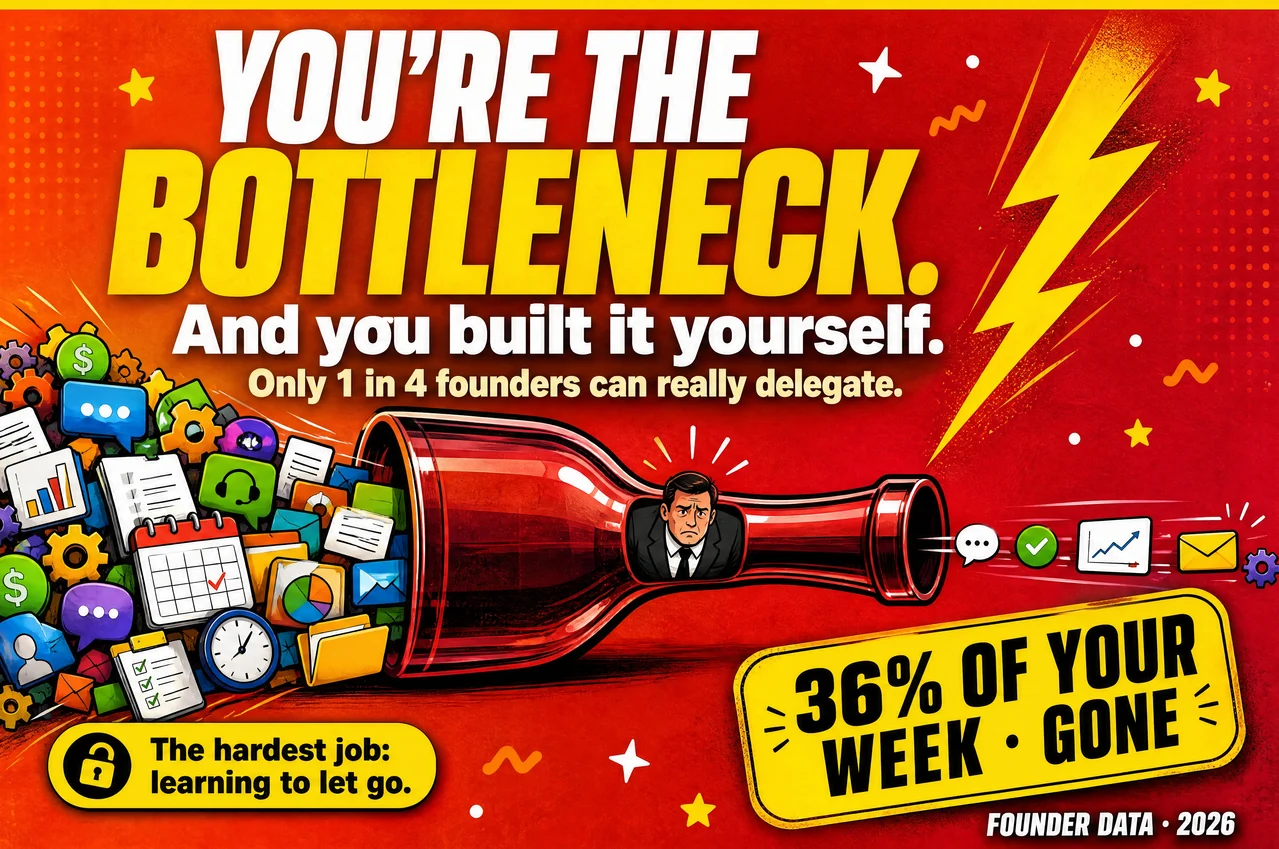
Nobody warns you that the biggest threat to your company's growth might be you. Not your market, not your competitors — your own grip on the wheel. There's a moment every founder hits where the thing that built the company starts to break it. Here's how to see the cliff coming, and step back from it on purpose.
0% of entrepreneurs struggle to delegate at all
0% of founders bottleneck their own company by refusing to let go
0% higher growth for founders who delegate well
Founder delegation, visualized: where the time actually goes
Ask any founder what they should be spending their time on, and they'll give you a sharp, confident answer: strategy, vision, the handful of relationships only they can hold. Ask them to track an honest week, and the picture is almost always the opposite — a calendar quietly colonized by things that never should have stayed on their plate. The gap between those two pictures isn't a time-management problem. It's a letting-go problem.
The founder time wheel
An illustrative breakdown of how a founder's working week actually splits, based on the patterns described in founder-delegation research and coaching data (Entrepreneur, Gallup, Inc., 2025–2026).
Only you can do itVision, culture, the calls nobody else can make
Should already be goneTasks you're still doing out of habit, guilt, or fear
Already handed offThe part of the week you've genuinely let go of
Founder delegation sounds simple on a whiteboard and falls apart in real life. There's a version of the founder story everyone loves to tell — the visionary who does it all, who knows every customer by name, who can jump into any seat and fix any fire. Early on, that story is even true, and it's exactly what makes the company work. Then, without any single dramatic moment, the story stops being true and nobody tells you. You keep doing everything, because doing everything is what got you here, and you assume it's still what will get you there. It isn't. Somewhere in the growth curve there's a cliff, and the thing that built the company is the same thing standing at the edge of it, refusing to step back.
The data on this is remarkably consistent. Roughly three in four entrepreneurs say they genuinely struggle with delegation, and research tracking startup founders has found that well over half operate with weak delegation habits, effectively becoming the bottleneck in their own growing company. Meanwhile, founders who do learn to let go see meaningfully higher growth than those who don't — by some measures a third higher, by others far more. The pattern is almost too clean: the companies that scale are, overwhelmingly, run by founders who figured out how to stop being needed for everything.
So why don't more founders just do it? Because delegation was never really a logistics problem. It's an identity problem wearing a to-do list as a disguise. You didn't build sleepless nights and a company from nothing by being casual about quality, and the instinct that says "I'll just do it myself, it's faster, it's safer, it's mine" isn't irrational — it's the exact same instinct that made the early company survive. The cliff is the point where that same instinct, unexamined, becomes the ceiling on everything you built it to protect.
This isn't an article about hiring a virtual assistant, although that might be part of it. It's about the harder, quieter work of figuring out what to hand off first, what to hold onto longest, and how to survive the strange grief of watching someone else do something — a little differently, maybe a little worse at first — that used to be entirely yours.
The calendar that gave me away
I didn't see my own cliff until someone else pointed it out to me — an early advisor at IncentOne who asked, almost casually, to look at my calendar for the past month. I handed it over a little proudly, honestly, the way you'd show off a full trophy case. Every hour booked. Customer calls, vendor calls, a support ticket I'd personally taken because "the client asked for me," a stack of invoices I was still approving one by one. He didn't say much at first. He just circled, in red, every single meeting that didn't require the founder in the room. When he handed it back, more than half the week was circled.
I remember the specific, defensive heat of that moment — the urge to explain why each one actually did need me. The client relationship was delicate. The vendor negotiation was nuanced. The support ticket was a VIP. Every single item had a good reason, and that was exactly the problem: a good reason to keep something is not the same as a good reason for it to still be yours. I had quietly built an entire company that could not function without my direct, personal touch on almost everything, and I had mistaken that dependency for diligence.
What actually scared me wasn't the workload. It was realizing that if I got hit by a bus that week, half the business would have simply stopped. Not slowed — stopped. That's not what building a company is supposed to feel like. A company you can't step away from for two weeks isn't a company. It's a very demanding job you gave yourself and dressed up as founder status. The letting go, when I finally started it, was slower and more emotional than I expected — not because the tasks were hard to hand off, but because some part of me had built my worth around being the only person who could.
If the business stops the moment you step away, you haven't built a company. You've built a very elaborate way of being unable to leave.
What the grip on the wheel tells you vs. what's actually true
The instinct to hold onto everything talks like it's protecting the business. Usually, it's protecting your own comfort. Here's the translation.
"No one will do it as well as I would."
Almost certainly true, at first. Irrelevant — the standard isn't "as well as you," it's "well enough, freeing you for higher-leverage work." Most experienced operators use a 70% rule: good enough, delegate it.
"It'll take longer to explain than to just do it myself."
True the first time. False every time after. One hour spent training now buys back that same hour, over and over, for as long as the task exists.
"I don't even know what I'd hand off."
You know exactly what — it's the thing you keep dreading, deferring, or doing at 11pm. The tasks draining you most are usually the clearest candidates, not the hardest ones to spot.
"This task is part of who I am here."
Being the one who "handles it all" feels like proof of value. It's actually a ceiling — your identity as the doer is exactly what caps how far the company can grow beyond you.
"We can't afford to hire for this yet."
Growth usually follows delegation, not the other way around. Waiting for perfect timing is how founders end up delegating 18 months later than they should have.
The founder delegation let-go ladder
Not everything should be handed off in the same order. Some tasks are safe exits — low stakes, low context, easy to document. Others sit close to the core of the business and deserve to stay yours a little longer. Climb the ladder from the bottom up: rung one is what to hand off first. Tap any rung to see why it belongs there, and how to actually let it go.
8Vision, culture & final strategic callsKeep longest
This is the top of the ladder for a reason — it's the irreducible core of being founder. Nobody else can hold the full picture of where the company is going or why, at least not for a long while.
Let-go move: eventually build a leadership team you brief deeply enough that they carry the vision when you're not in the room — but don't rush this rung.
7Hiring decisions & team culture callsHand off later
Who joins and how the team behaves shapes everything downstream. This stays close to you until you've built managers you trust to hire in your image.
Let-go move: co-interview with a trusted lead for a few cycles, then let them run point while you do a final gut-check pass.
6Sales conversations & key accountsHand off later
Revenue relationships feel personal, and often are — clients bought from you specifically. But a business that can only sell through its founder has a hard ceiling on it.
Let-go move: shadow-then-lead — bring a rep onto your calls, then flip it so they lead and you shadow, then step out entirely.
5Recruiting logistics & first-round interviewsMiddle of the climb
Sourcing, scheduling, and first-pass screening are process-heavy, not vision-heavy. They eat huge amounts of a founder's week for relatively low strategic return.
Let-go move: write a one-page scorecard for the role, hand the first two rounds to a hiring lead, and only step in for finalists.
4Bookkeeping & financial adminMiddle of the climb
Numbers matter enormously, but entering them, reconciling them, and chasing invoices doesn't require the founder — reading and deciding on them does.
Let-go move: hand the mechanics to a bookkeeper or fractional controller; keep a standing 30-minute review of the output, not the process.
3Content production & social postingEarly exit
Your voice matters, but the mechanics of writing, scheduling, and posting are almost entirely teachable from a few examples and a style guide.
Let-go move: record yourself talking through five pieces, hand the transcript and tone notes to a writer, and review before it goes out — for now.
2Routine customer support & onboardingEarly exit
Most support tickets and onboarding steps are repeatable questions with repeatable answers. The instinct to personally handle "VIP" tickets is usually more about ego than necessity.
Let-go move: turn your last twenty replies into a simple FAQ or macro library, hand it to one hire, and only escalate true edge cases.
1Repetitive admin, scheduling & inbox triageHand off first
The lowest-stakes, highest-volume drain on a founder's week. Almost no judgment call here requires you specifically — it just requires someone reliable.
Let-go move: this is the classic first hire. Give a VA or EA your calendar and inbox rules today, not "when things calm down."
How to actually step back from the cliff
Start with the exit ramp, not the summit. Don't begin by trying to hand off the thing closest to your identity. Begin at the bottom of the ladder — the low-stakes, high-volume tasks that drain hours without requiring your judgment. A small early win builds the muscle you'll need for the harder rungs later.
Document once, delegate forever. The fear that "explaining takes longer than doing" is only true the first time. Record yourself doing a task once, turn it into a short checklist or Loom, and that ten-minute investment repays itself every single time someone else runs it after you.
Adopt the 70% rule. If someone can do a task seventy percent as well as you, hand it over completely. Chasing the remaining thirty percent yourself defeats the entire purpose — you'll spend more time coaching them back to your standard than you would have spent just doing it, and you'll never actually get the task off your plate.
Delegate outcomes, not steps. Micromanaging the how is what quietly drags a "delegated" task right back onto your desk. State the outcome you need and the constraints that matter, then let the person own the path. Check the result, not every move along the way.
Redesign your calendar before you redesign your team. Circle, in red, every meeting on your calendar this month that didn't actually require you in the room. That red ink is your delegation roadmap — it's usually more honest than any org chart.
Grieve it a little, then let it go. If a task was tied to your identity as the person who "handles it all," letting go of it can genuinely feel like a small loss, not just a relief. That's normal. Notice it, don't fight it, and remember what you're trading it for: a company that can actually grow past you.
The founders who scale are the ones who stop being needed
There's an uncomfortable truth buried in all of this: the more indispensable you feel to the daily operation of your company, the more likely you've accidentally built a ceiling instead of a business. Being needed for everything feels like proof of your value. It's actually proof of a design flaw — a system with a single point of failure, and that point is you. The goal was never to become unnecessary to the company's success. It was to become unnecessary to its daily survival, so you're free to spend your time on the strategic, high-leverage work that only a founder can do.
And the strange gift on the other side of the cliff is real. Founders who make the climb down the letting-go ladder consistently describe the same shift — not less involvement, but different involvement. Less firefighting, more architecture. Less doing, more designing the system that does. The company stops being a very demanding job you built for yourself and starts being what you actually set out to build: something bigger than you, that doesn't require you to be everywhere at once to keep standing.
Let go on purpose, before the cliff lets go for you
Every founder eventually meets this cliff, whether they choose the moment or the moment chooses them. Chosen, it looks like a founder calmly handing off the inbox, the invoices, the first-round interviews, one deliberate rung at a time, trading control for capacity. Unchosen, it looks like a plateau you can't explain, a calendar that owns you, a team that waits on you for things they were fully capable of running themselves. The difference isn't talent, or how much you care, or how good your product is. It's whether you climbed down the ladder on your own terms.
So start this week with one rung. Not the vision, not the culture, not the thing tangled up in who you are — just the lowest, most repetitive task still sitting on your plate out of habit. Document it once. Hand it to someone. Tolerate the seventy percent. And notice, a few weeks later, that the company didn't just survive you stepping back from it — it very likely grew because you did. You don't have to let go of everything at once. You just have to stop being the reason nothing else can move.
You don't have to redesign your company alone.
Whether you want a community of founders who've climbed this same ladder, or a trusted thinking partner to help you figure out exactly what to hand off first — there's a door for where you are now.
Join the Learning Community
The full delegation framework in depth — 500+ modules, tools, and a community of founders who've already made the climb down.