15 Aug, 2026

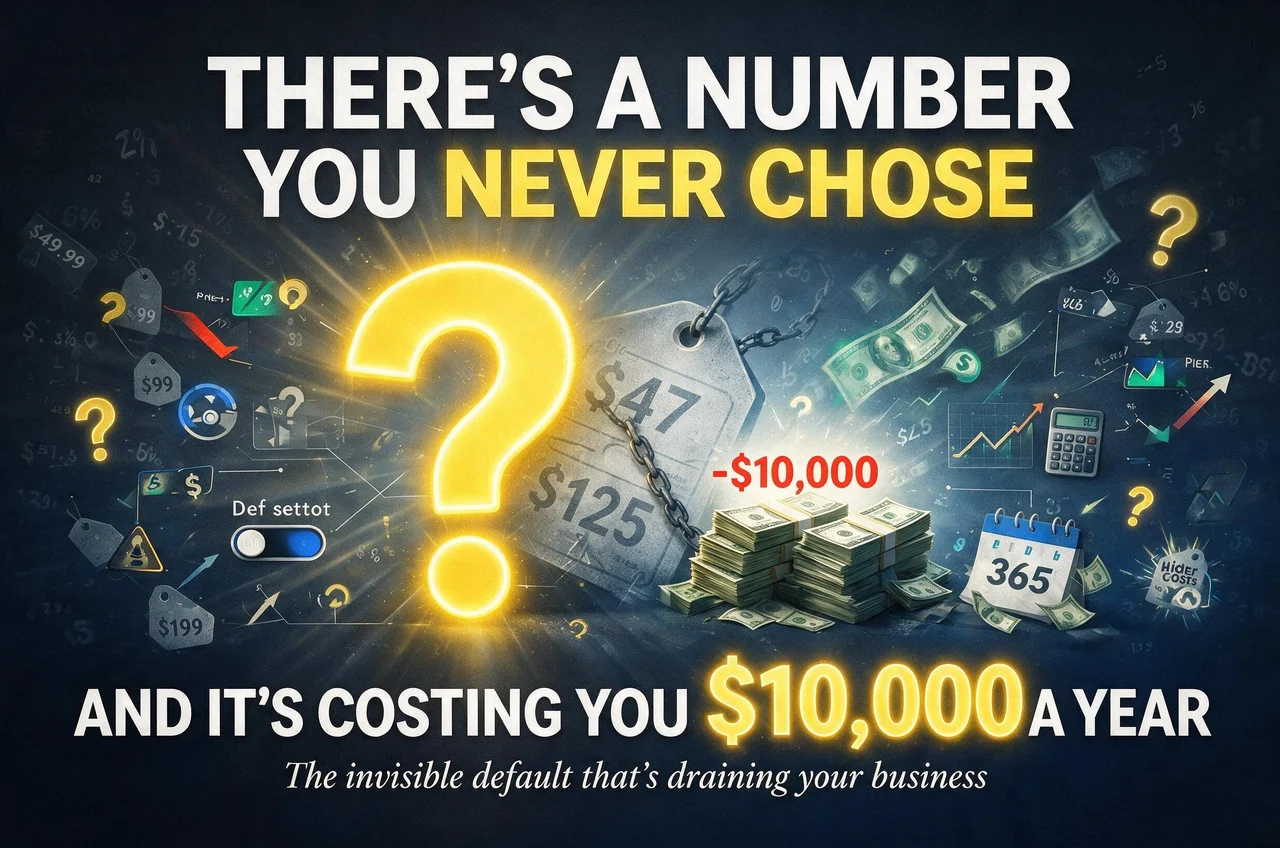
There’s a Number You Never Chose — and It’s Costing You $10,000 a Year.

2026-08-17T15:16:01-04:00

The most expensive decision solo founders make isn't a bad hire or a wasted ad budget. It's how they pay themselves — a tax default that quietly bleeds fiv

There’s a Number You Never Chose — and It’s Costing You $10,000 a Year.2026-08-17T15:16:01-04:00
12 Aug, 2026

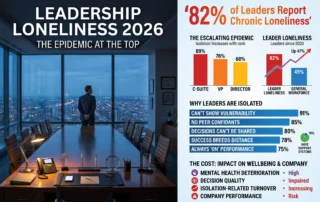
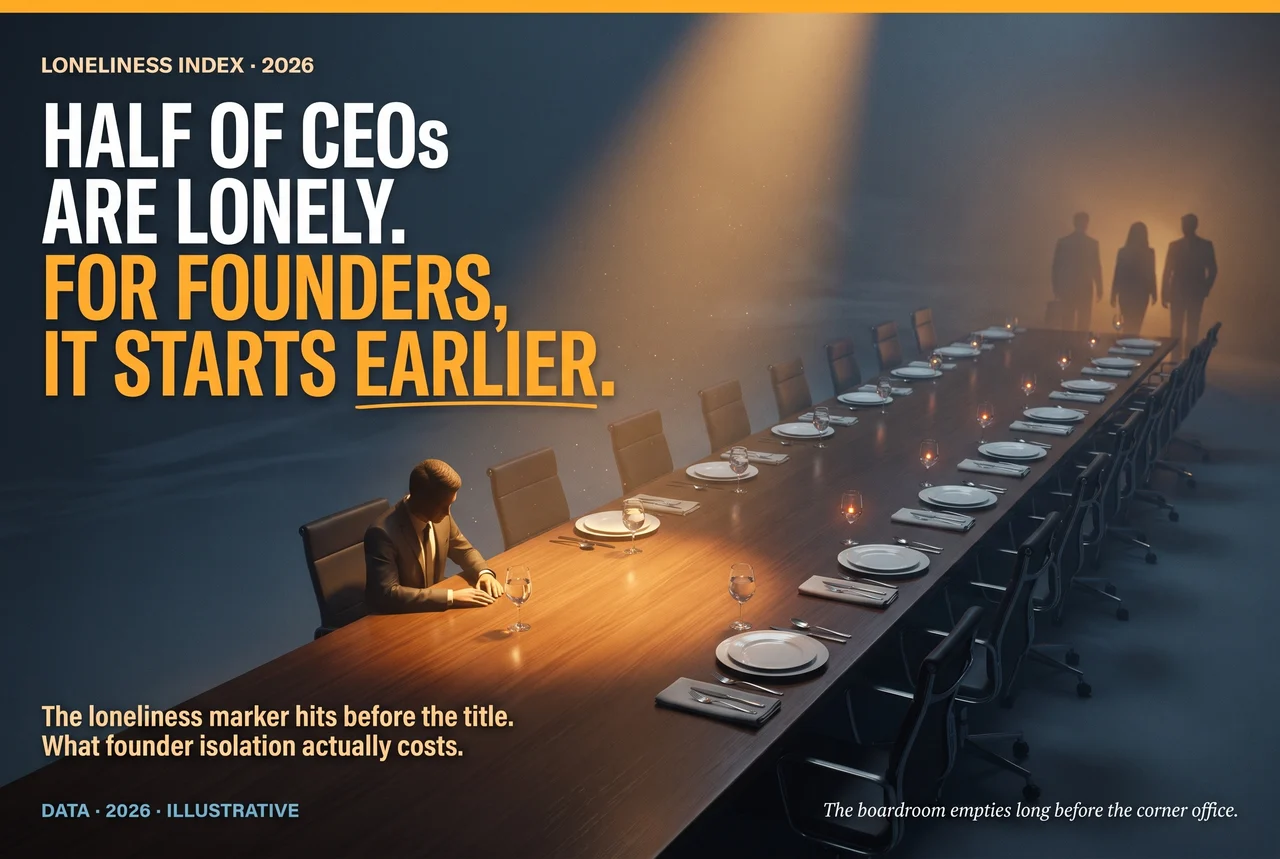
Half of CEOs Are Lonely. For Founders, It Starts Even Earlier.

2026-08-17T15:16:47-04:00

You're surrounded by investors, employees and customers — and there's no one you can be fully honest with. Founder isolation isn't a mood: it's structural, measurable, and it's costing founders their health and their judgment. The 2026 data, in six charts.

Half of CEOs Are Lonely. For Founders, It Starts Even Earlier.2026-08-17T15:16:47-04:00
10 Aug, 2026

AI Made It Possible to Build a Company Alone. That’s Exactly the Problem.

2026-08-17T15:17:10-04:00

Solo business applications are up 20%+ since 2025 and 76% of small businesses use AI — but only 14% have integrated it. The AI solo-founder trap, in six charts.

AI Made It Possible to Build a Company Alone. That’s Exactly the Problem.2026-08-17T15:17:10-04:00
7 Aug, 2026

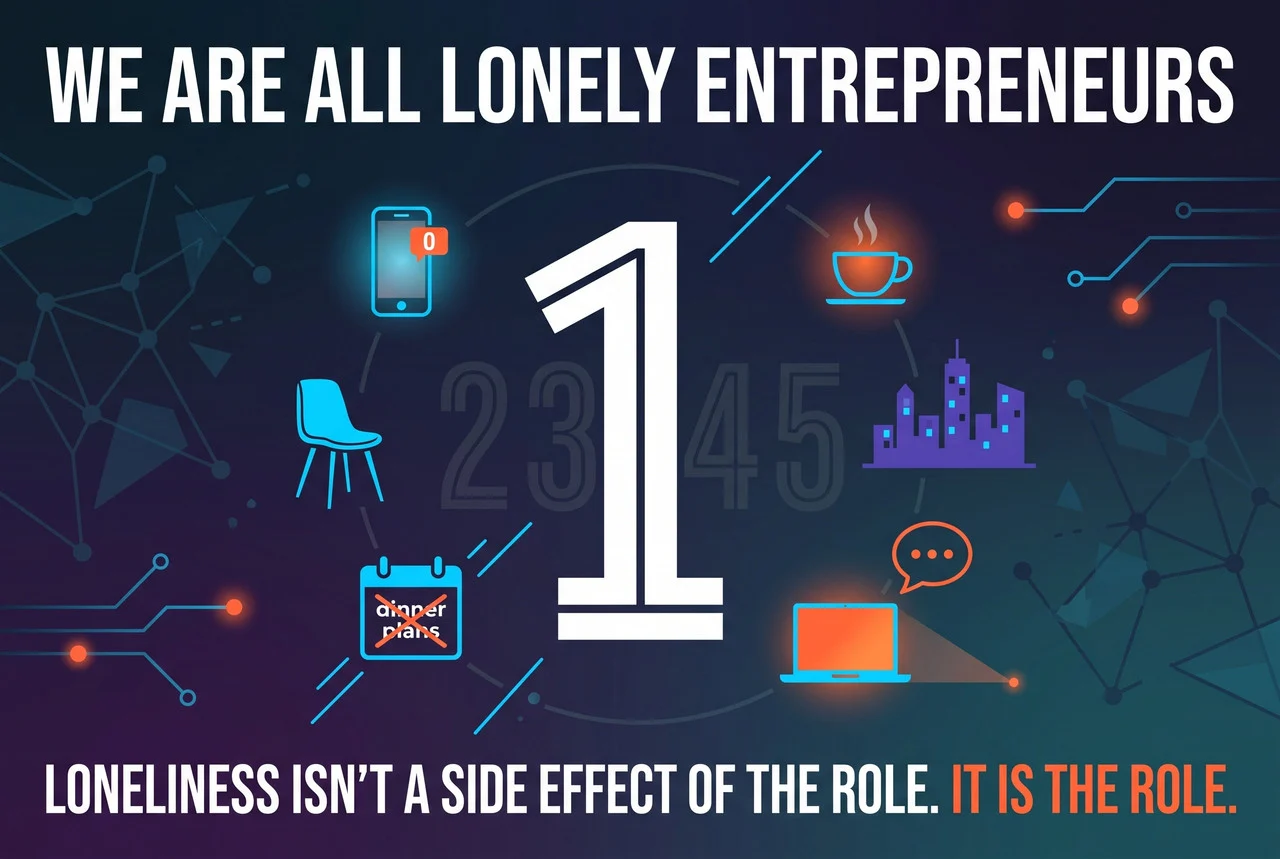
We Are All Lonely Entrepreneurs: Loneliness Isn’t a Side Effect of the Role

2026-08-17T15:17:21-04:00

We are all lonely entrepreneurs — loneliness is not a side effect of building a company, it is structural. The data on founder loneliness and what carrying it alone really costs. In 6 charts.

We Are All Lonely Entrepreneurs: Loneliness Isn’t a Side Effect of the Role2026-08-17T15:17:21-04:00
31 Jul, 2026

Founder Sleep Debt: The Hours You Steal Back at Midnight

2026-08-17T15:18:13-04:00
The founder sleep debt 2026 — why founders steal hours from sleep and pay for it in burnout
★ The Lonely Entrepreneur · The Founder Sleep Debt 2026

The Founder Sleep Debt: The Hours You Steal Back at Midnight

You know you should sleep. It's 12:40 a.m., the laptop's still open, and you're scrolling — not because you have to, but because these are the only hours that feel like yours. It's called revenge bedtime procrastination, and in 2026, 55% of CEOs run on six hours or less while 51% of adults stay up late just to feel in control of their own time. Here's why founders sabotage their own sleep, what it costs, and how to break the cycle, in six charts.

There's a specific kind of tired that founders know intimately. You're exhausted at 11 p.m. You genuinely intend to sleep. And then somehow it's 1 a.m. and you're still awake — not finishing anything urgent, just reclaiming the day. This has a name now: revenge bedtime procrastination, a translation of the Chinese phrase 报复性熬夜, "retaliatory staying up late," coined around 2014 by overworked young professionals who refused to surrender their evenings. The behavior is startlingly common — roughly 40 to 55% of adults regularly delay sleep with no external reason — and it clusters exactly where you'd expect: among people whose entire day belongs to someone else. Which is to say, founders.

We've written about the founder drowning in the time trap, the one who burns out and checks out, and the one who can't stop being the bottleneck. Sleep debt is where all of those quietly get paid for. The midnight scroll feels like a small act of freedom. Compounded over months, it's one of the most self-destructive habits in entrepreneurship — and one of the most invisible.

51% of adults say staying up late helps them feel in control of their time. For founders who control everything all day, the night is the one place left to rebel.

The gap between intended and actual bedtime.

You mean to sleep at 11. You actually sleep at 12:30 or later. That nightly gap is the whole problem. Hover the dial.

Chart 1 — The bedtime dial
Where the night actually goes
Intended bedtime vs. actual, on a clock face. Hover a segment.

Sources: Amerisleep 2026 survey of 1,000 Americans (average bedtime midnight for millennials, 12:30 a.m. for Gen Z; late to bed 3–4 nights/week). The "stolen" arc between intended and actual bedtime is the behavioral core of revenge bedtime procrastination.

Picture a clock face at the end of a founder's day. The intended bedtime sits at 11 p.m. — the reasonable, well-meaning plan you make every single night. The actual bedtime sits somewhere past midnight, and for many it drifts to 12:30 a.m. or later. That arc between the two hands is where revenge bedtime procrastination lives, and it's remarkably consistent: surveys find people going to bed later than they intended three to four nights a week, with millennials clustering around midnight and Gen Z around 12:30. The activities that fill that stolen arc almost never need to happen then — it's scrolling, another episode, online shopping, a non-urgent inbox sweep. The defining feature isn't that the tasks are important; it's that they feel personally rewarding and, crucially, unclaimed by anyone else. For someone who spent the whole day being pulled in every direction, that ninety-minute arc is the only stretch that felt like it belonged to them. Which is exactly why it's so hard to give up, even when you're visibly exhausted.

How the debt compounds.

Lose 90 minutes a night and it doesn't stay small. Sleep debt accumulates like financial debt — quietly, then all at once. Hover the curve.

Chart 2 — The compounding deficit
A small nightly loss becomes a crisis
Cumulative sleep debt over a month at 90 minutes lost per night. Hover a point.

Illustrative model at ~90 min/night deficit, grounded in Amerisleep's finding that the average sleep-anxiety sufferer loses ~364 hours of sleep per year. Sleep debt behaves like compound interest: the daily amount feels trivial; the running total does not.

The reason sleep debt is so dangerous is that it accrues exactly like financial debt — the nightly payment feels trivial, so you keep borrowing, and the balance quietly balloons. Ninety minutes lost on a Tuesday is nothing; you'll "catch up on the weekend," you tell yourself. But do that five nights a week and you've accumulated seven and a half hours of deficit — a full night's sleep gone — every single week. Over a month that's roughly thirty hours; over a year, the picture gets genuinely alarming. Surveys of people with sleep anxiety estimate an average loss of around 364 hours of sleep annually, which is the equivalent of being completely without sleep for more than two straight weeks per year. And unlike financial debt, you can't fully repay sleep debt with a weekend of lie-ins; the cognitive and emotional costs — impaired judgment, blunted emotional regulation, weakened stress resilience — are incurred in real time and don't fully reverse. For a founder whose entire job is making high-stakes decisions and staying steady under pressure, running a chronic deficit on the exact faculties the job demands is a slow-motion liability.

The average sleep-anxiety sufferer loses about 364 hours a year — the equivalent of two full weeks without any sleep at all.

The founder sleep numbers.

Founders and CEOs don't just sleep a little less — they sleep dangerously less, and the data is stark. The numbers count up as you scroll.

Chart 3 — By the numbers
The sleepless class
Selected findings

Sources: Harvard research via Inc. (55% of CEOs sleep ≤6 hrs); Forbes (80%+ of small-business owners report broken sleep; 26% have insomnia/a sleep disorder); Amerisleep 2026 (≤6 hrs sleepers 41% more likely to report high burnout; 56% lack daily personal time; 51% stay up late for a sense of control).

Founders and CEOs aren't merely at the sleepy end of the population — they're at the dangerous end. Harvard research surfaced by Inc. found that 55% of CEOs get six hours of sleep a night or less, well under the seven-to-nine most adults need, and the entrepreneurial population fares no better: Forbes reported that over 80% of small-business owners experience broken sleep or lie awake at night, and roughly 26% meet the criteria for insomnia or another sleep disorder. The consequences show up directly in the burnout data that defines this whole cluster of founder struggles: people who sleep six hours or less are 41% more likely to report high burnout than those getting seven or more (48% versus 34%). And the driver behind the sleeplessness is telling — 56% of adults say their daily routine simply doesn't leave enough time for personal life, and 51% say deliberately staying up late gives them a sense of control over their own time. For a founder, whose day is a relentless sequence of other people's demands, that number lands hard. The midnight hours aren't stolen from the business. They feel stolen back from it.

Why founders actually do it.

Revenge bedtime procrastination isn't laziness or poor discipline. It's a rational-feeling response to specific pressures. Tap any bar.

Chart 4 — The drivers
What keeps the laptop open at midnight
Share of people citing each reason for delaying sleep. Tap a bar.

Sources: Amerisleep 2026 (51% reclaim control; 50% scrolling; 56% lack of daytime personal time). Clinicians note the phone is the favorite instrument — variable-reward feeds trigger dopamine, and tired brains make worse decisions about when to stop.

It's tempting to file revenge bedtime procrastination under weak willpower, but the research is clear that it's better understood as a self-regulation problem driven by very real pressures — not a character flaw. The single biggest driver is autonomy: 51% of people say staying up late gives them a sense of control over their time, a reclaiming of agency after a day that belonged to customers, investors, and employees. Close behind is the simple fact that the day left no room — 56% report their routine doesn't allow enough personal time, so the night becomes the only available window for anything restorative or pleasurable. Then there's the phone, the favorite instrument of the whole phenomenon: about half of adults admit they stay up scrolling instead of sleeping, and the variable-reward design of social feeds and streaming triggers dopamine hits that are neurologically hard to walk away from, especially when a tired brain has depleted exactly the executive function needed to stop. Layer in productivity guilt — the belief that rest must be earned through output — and you get a founder who feels they haven't done enough to deserve sleep, then feels a quiet shame about going to bed at all. None of it is irrational in the moment. All of it compounds.

The nighttime hours offer a rare moment of control and pleasure that can seem worth the next-day fatigue — until the next day arrives.

The vicious cycle.

Burnout drives sleep loss. Sleep loss deepens burnout. It's a loop that feeds itself — and founders sit at the center of it. Tap each stage.

Chart 5 — The burnout–sleep loop
How each side feeds the other
A bidirectional cycle. Tap a stage to see the mechanism.
Tap any stage to trace the loop. The pattern The Lonely Entrepreneur keeps returning to: you can\u2019t out-discipline a cycle that\u2019s feeding itself \u2014 you have to break it at one point, deliberately, usually with support.

Source: Amerisleep / sleep-science framing of the "strong bidirectional relationship" between revenge bedtime procrastination and burnout. Feeling depleted drives the sleep grab; the resulting deficit erodes the resilience you need \u2014 which deepens the depletion.

What makes sleep debt so hard to escape is that it isn't a straight line — it's a loop that powers itself. It starts with depletion: a founder ends the day overwhelmed and emptied out, having given every waking hour to the business. That depletion drives the sleep grab — the mind reaches for the one form of control still available, staying up to reclaim a few hours that feel personal. The predictable result is a sleep deficit, six hours or fewer, night after night. And here's where the loop closes viciously: sleep deprivation directly erodes stress resilience and emotional regulation — the precise capacities that would have helped you handle the next day's pressure — so you wake up with less reserve than you had, face the same relentless demands, and end the day even more depleted than before. Feeling more depleted, you grab even harder for the night. Each rotation tightens. This is why founders can't simply "decide to sleep more"; you cannot out-discipline a system that's generating the very exhaustion driving the behavior. The loop has to be broken deliberately at a single point — and, because the pull is strongest exactly when you're most tired and alone, it's far easier to break with people holding you accountable than by willpower at 1 a.m.

The wind-down that actually works.

You don't fix sleep debt by trying harder at bedtime. You build a descent — a ramp down from the day. Tap each step.

Chart 6 — The wind-down ramp
Engineering the descent into sleep
Five steps down from a wired day to actual rest. Tap each stair.
Tap each stair to descend. New habits take a median of ~66 days to feel automatic \u2014 so the goal isn\u2019t a perfect night, it\u2019s a repeatable ramp you can walk down even when you\u2019re tired.

Synthesized from Cloody & Amerisleep guidance: reclaim daytime personal time (attacks the root cause), a device curfew, a meaningful evening ritual, connecting to your future self, and a consistent wake time to anchor the circadian rhythm.

The mistake founders make with sleep is treating bedtime as a willpower test they keep failing. The fix isn't more discipline at midnight — it's engineering a descent so that stopping feels natural rather than forced. The first and most important step attacks the root cause: reclaim genuine personal time during the day, even fifteen minutes, so the night stops being your only window for anything that feels like yours; when mornings and days feel rewarding, the compulsion to steal hours at night measurably shrinks. The second is a device curfew, because the phone is the single biggest accelerant — variable-reward feeds and blue light are engineered to keep you scrolling, so the decision has to be made before you're too tired to make it. The third is a meaningful evening ritual that gives you the sense of downtime you were chasing anyway, without sacrificing sleep to get it. The fourth is a subtle but powerful lever from the research: people who feel connected to their future self make measurably better long-term choices, so literally picturing the person who has to run tomorrow's board meeting on four hours makes the trade feel real. And the fifth is a consistent wake time, which anchors your circadian rhythm far more reliably than a variable bedtime. None of these work overnight — new habits take a median of about 66 days to feel automatic — so the goal is a ramp you can walk down on autopilot, not a perfect performance every night.

When mornings feel rewarding rather than rushed, the need to "steal" time at night quietly disappears.

What founders should actually do

Start by treating the root cause rather than the symptom: find and protect real personal time inside your day so the night stops being the only place you get to feel free. Set a device curfew and decide on it early, before the tired brain that can't resist the scroll is the one making the call. Build a short evening ritual that gives you the downtime you're actually craving, so bedtime feels like arriving somewhere rather than giving something up. Make tomorrow's version of you concrete — the one who has to lead, decide, and stay steady on too little sleep — because connecting to your future self is one of the few things that reliably shifts late-night decisions. And anchor a consistent wake time, then give the whole system the roughly two months it takes to become automatic, forgiving the imperfect nights along the way. Above all, recognize the burnout–sleep loop for what it is, and break it at one deliberate point instead of trying to out-discipline a cycle designed to exhaust you.

The bottom line

The founder sleep debt is one of the most quietly corrosive traps in entrepreneurship precisely because the behavior feels like self-care in the moment — a small, defiant reclaiming of time in a life that belongs to everyone else. But the numbers are unambiguous: a majority of CEOs run chronically short, most owners sleep badly, and short sleep sharply raises the odds of the very burnout that's already stalking founders. The cruelty is that sleep deprivation attacks exactly the faculties the job depends on — judgment, resilience, emotional steadiness — so the hours you steal at midnight are borrowed against tomorrow's leadership. Stepping off this treadmill doesn't require more grit; it requires reclaiming your days so you stop having to reclaim your nights. And because the pull is strongest when you're most tired and most alone, the founders who break the cycle almost always do it with people who understand the pressure — and who'll remind you that rest isn't something you have to earn.

The hours you steal at midnight aren't taken from the business. They're borrowed against the leader you have to be tomorrow.

You can't out-discipline a cycle that's feeding itself.

Revenge bedtime procrastination runs strongest when you're most tired and most alone — which is exactly when willpower fails. The founders who break the loop do it with people who get the pressure and hold them to it. That's what The Lonely Entrepreneur is for.

Join the Learning Community

250,000+ founders who know the midnight scroll — and are learning to reclaim their days so they stop stealing their nights.

Find your people →

Work with Sidekick

A partner to help you protect real personal time in your day, build the wind-down ramp, and break the burnout–sleep loop at its weakest point.

Get a Sidekick →

Keep reading

Frequently asked questions

'+d.lab+'
';}).join(''); var nums=box.querySelectorAll('.num'); reveal('sC3',function(){ nums.forEach(function(n,i){var d=data[i],t0=null,dur=1300; function step(ts){if(!t0)t0=ts;var pr=Math.min((ts-t0)/dur,1);n.textContent=Math.round(pr*d.v)+d.suf;if(pr<1)requestAnimationFrame(step);} setTimeout(function(){requestAnimationFrame(step);},i*120); }); }); })(); /* CHART 4: DRIVERS HORIZONTAL BARS */ (function(){ var svg=root.querySelector('#s4svg'),tip=root.querySelector('#s4tip'); var W=640,H=340,xL=210,xMax=590,yT=30,rowH=44,gap=14; var bars=[ {n:'Reclaiming control of time',v:51,note:'51%. The top driver: staying up late restores a sense of control after a day owned by everyone else. The core of "revenge."'}, {n:'Scrolling on the phone',v:50,note:'50%. Half stay up scrolling despite knowing they should sleep. Variable-reward feeds + blue light are engineered to hold you.'}, {n:'No personal time in the day',v:56,note:'56%. The root cause: routines leave no room for leisure, so night becomes the only available window.'}, {n:'Tired-but-happy (worth it)',v:57,note:'57%. After staying up, most feel tired but glad they claimed the time \u2014 the reward that keeps the habit alive.'}, {n:'Exhausted & regretful',v:29,note:'29%. Nearly 1 in 3 wake up exhausted and regretful \u2014 the bill for last night\u2019s reclaimed hours.'} ]; var maxV=60; function bw(v){return (xMax-xL)*v/maxV;} bars.forEach(function(b,i){ var y=yT+i*(rowH+gap); svg.appendChild(el('text',{x:xL-10,y:y+rowH/2+4,fill:'#eaf0ff','font-size':11,'font-weight':600,'text-anchor':'end'})).textContent=b.n.replace('&','&'); svg.appendChild(el('rect',{x:xL,y:y,width:xMax-xL,height:rowH,rx:7,fill:'rgba(255,255,255,.05)'})); var col=i>=3?(i===4?'#f7a008':'#3fd08a'):'#f75008'; var bar=el('rect',{x:xL,y:y,width:0,height:rowH,rx:7,fill:col,style:'cursor:pointer'});svg.appendChild(bar); var val=el('text',{x:xL+6,y:y+rowH/2+5,fill:'#fff','font-size':13,'font-weight':900,opacity:0});val.textContent=b.v+'%';svg.appendChild(val); function show(){tip.innerHTML=b.note;tip.style.left=((xL+bw(b.v)/2)/W*100)+'%';tip.style.top=((y-6)/H*100)+'%';tip.style.opacity=1;tip.style.whiteSpace='normal';tip.style.maxWidth='230px';} bar.addEventListener('mouseenter',show);bar.addEventListener('mousemove',show);bar.addEventListener('mouseleave',function(){tip.style.opacity=0;}); bar.addEventListener('touchstart',function(e){e.preventDefault();show();},{passive:false}); b._bar=bar;b._val=val;b._w=bw(b.v); }); reveal('sC4',function(){ bars.forEach(function(b,i){setTimeout(function(){ b._bar.style.transition='width .8s cubic-bezier(.2,.7,.2,1)';b._bar.setAttribute('width',b._w); b._val.style.transition='opacity .4s .4s';b._val.setAttribute('x',xL+b._w-30);b._val.setAttribute('opacity',1); },i*140);}); }); })(); /* CHART 5: VICIOUS CYCLE RING */ (function(){ var svg=root.querySelector('#s5svg'),tip=root.querySelector('#s5tip'),note=root.querySelector('#s5note'); var W=640,H=360,cx=320,cy=175,R=110; var stages=[ {lab:'Depletion',note:'Depletion. You end the day overwhelmed, having given every hour to the business. Emotionally and cognitively empty.'}, {lab:'The sleep grab',note:'The sleep grab. Reaching for the one control left: staying up to reclaim hours that feel personal. Revenge bedtime procrastination.'}, {lab:'Sleep deficit',note:'Sleep deficit. 6 hours or fewer, night after night. The debt compounds silently.'}, {lab:'Eroded resilience',note:'Eroded resilience. Sleep loss directly weakens stress resilience and emotional regulation \u2014 the exact capacities tomorrow demands.'}, {lab:'Deeper depletion',note:'Deeper depletion. With less reserve, the same pressures drain you faster \u2014 so you grab even harder for the night. The loop tightens.'} ]; var n=stages.length; svg.appendChild(el('circle',{cx:cx,cy:cy,r:R,fill:'none',stroke:'rgba(247,80,8,.25)','stroke-width':2})); // curved arrows suggested by dasharray ring stages.forEach(function(s,i){ var a=-Math.PI/2+i/n*Math.PI*2; var x=cx+R*Math.cos(a),yy=cy+R*Math.sin(a); var g=el('circle',{cx:x,cy:yy,r:27,fill:'#1a2c5a',stroke:'#f75008','stroke-width':2.5,opacity:0,style:'cursor:pointer'});svg.appendChild(g); var num=el('text',{x:x,y:yy+5,fill:'#fff','font-size':15,'font-weight':900,'text-anchor':'middle',opacity:0,style:'pointer-events:none'});num.textContent=(i+1);svg.appendChild(num); var lx=cx+(R+54)*Math.cos(a),ly=cy+(R+54)*Math.sin(a); var lab=el('text',{x:lx,y:ly+4,fill:'#eaf0ff','font-size':10.5,'font-weight':700,'text-anchor':'middle',opacity:0});lab.textContent=s.lab;svg.appendChild(lab); function pick(){note.innerHTML=s.note;tip.style.opacity=0;} [g,num,lab].forEach(function(nn){nn.addEventListener('click',pick);nn.addEventListener('mouseenter',pick);nn.addEventListener('touchstart',function(e){e.preventDefault();pick();},{passive:false});}); s._g=g;s._num=num;s._lab=lab; }); svg.appendChild(el('text',{x:cx,y:cy-4,fill:'#f75008','font-size':12,'font-weight':800,'text-anchor':'middle'})).textContent='THE LOOP'; svg.appendChild(el('text',{x:cx,y:cy+14,fill:'#a9b6d6','font-size':10,'text-anchor':'middle'})).textContent='feeds itself'; reveal('sC5',function(){ stages.forEach(function(s,i){setTimeout(function(){ s._g.style.transition='opacity .5s';s._g.setAttribute('opacity',1); s._num.style.transition='opacity .4s .1s';s._num.setAttribute('opacity',1); s._lab.style.transition='opacity .4s .1s';s._lab.setAttribute('opacity',1); },i*170);}); }); })(); /* CHART 6: WIND-DOWN DESCENT STAIRCASE */ (function(){ var svg=root.querySelector('#s6svg'),tip=root.querySelector('#s6tip'),note=root.querySelector('#s6note'); var W=640,H=340,xL=40,yTop=40,steps=5; var data=[ {n:'Reclaim daytime time',note:'Step 1 \u2014 root cause. Protect real personal time in the day so night stops being your only window. When days feel rewarding, the night-grab shrinks.'}, {n:'Device curfew',note:'Step 2 \u2014 the accelerant. Phones away before you\u2019re too tired to resist. Variable-reward feeds + blue light are the biggest sleep thieves.'}, {n:'Evening ritual',note:'Step 3 \u2014 the substitute. A meaningful wind-down gives you the downtime you were chasing \u2014 without trading sleep for it.'}, {n:'Meet your future self',note:'Step 4 \u2014 the lever. Picture the you who leads tomorrow on 4 hours. Feeling connected to your future self reliably improves late-night choices.'}, {n:'Consistent wake time',note:'Step 5 \u2014 the anchor. A fixed wake time steadies your circadian rhythm far more than a variable bedtime. Give it ~66 days to stick.'} ]; var slotW=(W-xL-30)/steps, stepH=(H-yTop-60)/steps; data.forEach(function(s,i){ var x=xL+slotW*i, y=yTop+stepH*i, w=slotW-8, h=(H-40)-y; var col=i===steps-1?'#3fd08a':'#5b8def'; var bar=el('rect',{x:x,y:H-40,width:w,height:0,rx:6,fill:col,opacity:.9,style:'cursor:pointer'});svg.appendChild(bar); var num=el('text',{x:x+w/2,y:y+22,fill:'#fff','font-size':16,'font-weight':900,'text-anchor':'middle',opacity:0});num.textContent=(i+1);svg.appendChild(num); var lab=el('text',{x:x+w/2,y:H-24,fill:'#a9b6d6','font-size':9,'font-weight':600,'text-anchor':'middle'}); lab.textContent=s.n.length>16?s.n.slice(0,15)+'\u2026':s.n;svg.appendChild(lab); function show(){tip.innerHTML=s.note;tip.style.left=((x+w/2)/W*100)+'%';tip.style.top=((y-6)/H*100)+'%';tip.style.opacity=1;tip.style.whiteSpace='normal';tip.style.maxWidth='230px';} bar.addEventListener('mouseenter',show);bar.addEventListener('mousemove',show);bar.addEventListener('mouseleave',function(){tip.style.opacity=0;}); bar.addEventListener('touchstart',function(e){e.preventDefault();show();},{passive:false}); s._bar=bar;s._num=num;s._y=y;s._h=h; }); // descent arrow svg.appendChild(el('text',{x:xL,y:yTop-8,fill:'#f7a008','font-size':11,'font-weight':800})).textContent='wired \u2193'; svg.appendChild(el('text',{x:W-40,y:H-46,fill:'#3fd08a','font-size':11,'font-weight':800,'text-anchor':'end'})).textContent='asleep'; reveal('sC6',function(){ data.forEach(function(s,i){setTimeout(function(){ s._bar.style.transition='height .7s cubic-bezier(.2,.7,.2,1),y .7s cubic-bezier(.2,.7,.2,1)'; s._bar.setAttribute('height',s._h);s._bar.setAttribute('y',s._y); s._num.style.transition='opacity .4s .3s';s._num.setAttribute('opacity',1); },i*160);}); }); })(); /* RELATED + FAQ */ root.querySelector('#relatedGrid').innerHTML=[ {k:'Time',t:'The Founder Time Trap',d:'The daytime crunch that pushes founders to steal hours at night.',u:'https://lonelyentrepreneur.com/founder-time-trap-2026/'}, {k:'Psychology',t:'The Quiet Quitting Founder',d:'Where chronic sleep loss and burnout finally cash out.',u:'https://lonelyentrepreneur.com/quiet-quitting-founder-2026/'}, {k:'Scaling',t:'The Founder Bottleneck',d:'Why "I have to do everything" keeps you awake in the first place.',u:'https://lonelyentrepreneur.com/founder-bottleneck-2026/'}, {k:'Psychology',t:'The "I\u2019ll Be Happy When" Trap',d:'The restless chase that won\u2019t let your mind switch off at night.',u:'https://lonelyentrepreneur.com/hedonic-treadmill-founder-2026/'} ].map(function(r){return ''+r.k+'

'+r.t+'

'+r.d+'

';}).join(''); root.querySelector('#tFaq').innerHTML=[ ['What is revenge bedtime procrastination?','Revenge bedtime procrastination is deliberately delaying sleep \u2014 with no external reason \u2014 to reclaim personal time after a day dominated by other people\u2019s demands. The term translates the Chinese phrase 报复性熬夜 ("retaliatory staying up late"). Roughly 40\u201355% of adults report doing it regularly, and it clusters among people whose day belongs to others, which describes most founders.'], ['Why do founders sabotage their own sleep?','It\u2019s a self-regulation response to real pressure, not weak willpower. 51% say staying up late gives them a sense of control over their time, 56% say their day leaves no room for personal life, and about half stay up scrolling on phones designed to hold their attention. For founders who control everything all day, the night feels like the only time that\u2019s theirs.'], ['How much do CEOs and founders actually sleep?','Harvard research found 55% of CEOs sleep six hours a night or less, and over 80% of small-business owners report broken sleep, with about 26% meeting criteria for insomnia or a sleep disorder. That\u2019s well below the seven-to-nine hours most adults need.'], ['How does sleep debt affect burnout?','There\u2019s a strong bidirectional link. People who sleep six hours or less are 41% more likely to report high burnout than those getting seven-plus (48% vs. 34%). Burnout drives the late-night sleep grab, and the resulting deficit erodes stress resilience and emotional regulation \u2014 which deepens burnout. It\u2019s a self-reinforcing loop.'], ['How do you break the cycle?','Treat the root cause, not just bedtime: reclaim real personal time during the day, set a device curfew before you\u2019re too tired to resist, build a meaningful evening ritual, connect to your future self to make the trade-off feel real, and anchor a consistent wake time. New habits take a median of ~66 days to feel automatic, so aim for a repeatable ramp rather than a perfect night.'] ].map(function(f){return '
'+f[0]+'

'+f[1]+'

';}).join(''); })();
Founder Sleep Debt: The Hours You Steal Back at Midnight2026-08-17T15:18:13-04:00
31 Jul, 2026

Treadmill Founder: Why the Finish Line Keeps Moving

2026-08-24T11:34:39-04:00
The I'll be happy when trap 2026 — why founders never feel like they've made it no matter how much they achieve
★ The Lonely Entrepreneur · The "I'll Be Happy When" Trap 2026

The "I'll Be Happy When" Trap: Why the Finish Line Keeps Moving

First it was landing the customer. Then $5,000 in revenue. Then $100K. Then the round, the exit, the second company. Each one felt incredible — for about two weeks. Then the high faded and the goalpost slid forward again. This is the hedonic treadmill, and for founders it runs faster than for almost anyone. Here's why success never feels like success, and how to finally step off, in six charts.

One founder wrote down his ladder honestly, and it's the clearest map of this trap you'll ever see. His original dream was just to get his favorite creator on the phone. It happened — and he was ecstatic, for a few hours, until the new dream became partnering with him. That happened too, and then the "real" thing that would finally prove himself was making $5,000. Three months later he hit it, celebrated all weekend wandering the city with friends — and by the following weekend was telling someone his actual dream was $10,000. Then $100,000. Then $250,000. Then $500,000. Every rung felt good for a week or two, then the positive feeling evaporated and he was already staring at the next number that would supposedly, finally, make him satisfied. As he put it: his entire entrepreneurial story is the definition of the hedonic treadmill.

We've written about the founder who feels like a fraud even after winning, the emptiness after the exit, and the slow burnout of checking out. The "I'll be happy when" trap is the engine that quietly drives all of them: a mind that treats every achievement as a new baseline instead of a destination, so the target is always somewhere ahead of where you're standing.

I thought each new milestone would bring me closer to peak happiness. Plot twist: it never happens.

The sawtooth of success.

Every milestone gives you a spike of joy — then your happiness slides right back to baseline. Achievement after achievement, the same shape. Hover a peak.

Chart 1 — The hedonic treadmill
Why the high never lasts
Happiness (orange) spikes at each win, then adapts back to baseline (dashed). Hover a milestone.

Framework: hedonic adaptation (Brickman & Campbell). The founder's own ladder: creator call → partnership → $5K → $10K → $100K → $250K → $500K, each high lasting "a week or two." The baseline barely moves.

The shape of the trap is a sawtooth, and once you see it you can't unsee it. Hedonic adaptation — the psychological tendency to return to a relatively stable level of happiness regardless of what happens to us — means every major positive event produces a spike of joy that then decays back toward your personal set point. For a founder, the milestones come fast and the spikes are real: closing the funding, hitting the revenue number, landing the marquee logo, seeing your name in the press. But watch what the line actually does. It jumps, holds for a week or two while you tell your friends and feel briefly like you've arrived, and then quietly slides back down to roughly where it started. The cruel part is that the baseline barely moves. You are objectively more successful at each peak, and subjectively you feel about the same as you did before — which is exactly why the next number always feels necessary. You're not chasing happiness anymore. You're chasing the two-week high, over and over.

The finish line that runs away from you.

Here's the deeper problem: your target doesn't stay put. Every time you get close, it moves further out. Tap any point.

Chart 2 — The receding horizon
Achievement rises. The goalpost rises faster.
What you've achieved (blue) vs. what you now think you need (orange). Tap a stage.

The gap between the two lines is the "I'll be happy when" gap \u2014 and it never closes because each achievement resets what counts as "enough." $5K became $10K became $100K became $500K, always with the same felt distance to the finish.

If the treadmill only reset your happiness, that would be manageable. What makes it a genuine trap is that it also resets your standard of "enough" — so the finish line literally recedes as you approach it. Plot the two lines and the mechanism is obvious: your actual achievement climbs steadily, but the target you believe you need climbs faster, always staying just ahead. When you had nothing, $5,000 was the number that would prove you'd made it. The week you hit $5,000, the real number became $10,000. Then $100,000 felt like the true summit — five figures, baby — until it became $250,000, then $500,000, then the gist you can fill in yourself. The distance between where you are and where you "need to be" stays roughly constant no matter how far you run, because your brain rebases the finish line to your new circumstances the moment you arrive. This is why the wealthiest, most accomplished founders can feel exactly as unsatisfied as they did in year one. The gap is a feeling, not a fact, and feelings don't respond to bank balances.

"I'll be happy when I hit the number." You hit the number. The number moved.

What the research actually says.

The treadmill isn't a character flaw — it's well-documented psychology, and it hits high achievers hardest. The numbers count up as you scroll.

Chart 3 — By the numbers
The science of "never enough"
Selected findings

Sources: Lyubomirsky et al. (happiness ~50% genetic set point, ~10% circumstances, ~40% intentional activity); Kahneman & Deaton (emotional well-being plateaus around a threshold income); Brickman & Campbell (hedonic adaptation). Circumstances \u2014 including money \u2014 move the needle far less than founders expect.

The most freeing thing about this trap is that it's not a personal defect — it's one of the most robust findings in the psychology of well-being. Researchers estimate that roughly 50% of your baseline happiness is set by genetics, a stable temperament you're largely born with. Only about 10% is explained by your life circumstances — your income, your house, your title, the very things founders sacrifice everything to improve. And the remaining 40% comes from intentional activity: what you actually do, day to day, with your attention and relationships. Sit with that ratio for a second, because it upends the founder's entire operating assumption. You are pouring your one life into optimizing the 10% slice — the circumstances — and treating the 40% slice, the part you actually control, as something you'll get to "once things calm down." Layer on the well-known finding that emotional well-being rises with income only up to a threshold and then flattens, and the math of the treadmill becomes brutal: past a certain point, each additional milestone buys you almost no durable happiness, yet costs you enormous amounts of the 40% that would.

Where happiness actually comes from.

If circumstances are only a sliver, what makes up the rest? The split is not what most founders assume. Tap a segment.

Chart 4 — The happiness pie
The 50 / 10 / 40 you're getting backwards
What determines your baseline happiness. Tap a slice.

Source: Lyubomirsky, Sheldon & Schkade "sustainable happiness" model. The slice founders obsess over (circumstances, 10%) is the smallest and least controllable; the one they defer (intentional activity, 40%) is the largest lever they actually hold.

Break the pie apart and the founder's misallocation of effort becomes almost painful to look at. The largest slice, about 50%, is the genetic set point — your default emotional weather, which no exit will permanently change. The smallest slice, about 10%, is circumstances: money, status, possessions, the corner office, the valuation. This is the slice that entire founder lives get sacrificed to, and it's both the tiniest and the one most subject to hedonic adaptation, meaning even its small effect fades fast. Then there's the 40% — intentional activity — the deliberate, repeatable things you do: nurturing relationships, expressing gratitude, pursuing meaning, savoring experiences, helping others. This is by far the biggest lever you actually control, and it's the one founders systematically postpone until "after the raise" or "after the exit," a destination the treadmill guarantees never arrives. The insight isn't that ambition is bad. It's that pouring 90% of your energy into the 10% slice, while starving the 40% slice, is a strategy engineered to leave you feeling exactly as empty at $500K as you did at zero.

You're optimizing the 10% you can barely move while ignoring the 40% that's entirely in your hands.

Scarcity, abundance, and the healthier middle.

The treadmill is fueled by a scarcity mindset — "never enough." But blind abundance is just as damaging. The answer is in between. Drag the slider.

Chart 5 — The mindset spectrum
From "never enough" to "enough for now"
Scarcity ↔ Abundance, with the balanced middle. Tap along the track.
Tap a point on the spectrum. Financial therapists warn that the antidote to scarcity is not blind abundance \u2014 "trust the money will come" crushes you when it doesn't. The goal is the ambivalent middle: prepare for the worst, trust things will work out.

Framework: Wondermind / financial-therapy model (Dr. Stephanie Zepeda, Dr. Megan McCoy). A scarcity mindset can persist even with a 12-month emergency fund \u2014 it's a feeling of "never enough," not a fact about the balance sheet.

The fuel behind the treadmill has a name: the scarcity mindset — the persistent belief that there's never enough of a key resource, whether that's money, time, or proof that you matter. What financial therapists stress is that scarcity is not a description of reality; you can have a twelve-month emergency fund, max out your retirement accounts, and still feel a knot of anxiety over an eight-dollar coffee. For founders, the "resource" that never feels sufficient is often less about money and more about achievement itself — enough success, enough validation, enough evidence that you're not going to be found out. The instinctive fix people reach for is the opposite extreme, a full abundance mindset: trust that the money and the wins will simply keep coming. But therapists warn this is just as damaging, because when you bank on things always working out and they don't, it crushes your hope. The healthier target is the ambivalent middle — hold both truths at once: prepare for the worst and trust that you can handle whatever happens. That balance is what lets a founder feel "enough for now" without abandoning ambition.

How to actually step off.

You don't cure the treadmill — you interrupt the loop. Five moves that break the cycle. Tap each node.

Chart 6 — Breaking the loop
Getting off the treadmill
A repeatable cycle, not a one-time fix. Tap each step.
Tap any node to see the practice. The pattern The Lonely Entrepreneur keeps returning to: the treadmill runs fastest in isolation, and slows the moment you celebrate wins with people who actually understand what they cost you.

Synthesized from hedonic-adaptation research (savoring, gratitude, "stop and celebrate milestones") and financial-therapy practice (define "enough," the ambivalent middle). The quicker you recognize the treadmill, the sooner you can step off.

You can't switch the treadmill off — hedonic adaptation is wired in — but you can interrupt the loop that keeps it accelerating, and it starts with simply naming it. The moment you can catch yourself thinking "I'll be happy when," and recognize it as the treadmill rather than the truth, its grip loosens. The second move is to actually celebrate, deliberately and long enough for it to register, instead of moving the goalpost within hours; savoring a win is one of the few interventions proven to extend the high. The third is to consciously reallocate energy toward the 40% — relationships, meaning, gratitude, service — because that's the slice that compounds while circumstances fade. The fourth is the hardest and most powerful for founders: define "enough" in advance, in writing, so you have a fixed reference point the treadmill can't quietly rebase. And the fifth is to practice gratitude for what's already going right, which directly counters the scarcity mindset's habit of seeing only the gap. None of this means abandoning ambition. It means running toward the next thing because you choose to, not because you're convinced you'll finally feel okay once you get there.

The quicker you recognize the treadmill, the sooner you can step off it.

What founders should actually do

Start by writing down your own ladder — the honest sequence of "I'll be happy when" numbers you've already blown past — because seeing the pattern on paper is what breaks its spell. Then define "enough" concretely and in advance: a revenue figure, a working-hours limit, a life you're actually building toward, so the goalpost has somewhere to stop. When you hit a milestone, refuse to let the next one steal it; celebrate deliberately and let the win land for more than a weekend. Redirect real energy into the 40% that actually moves your baseline — the relationships, meaning, and gratitude you keep deferring — rather than pouring everything into the 10% slice of circumstances that adapts away. And treat the scarcity feeling as a feeling, not a fact: prepare wisely, but practice trusting that you can handle what comes, which is the ambivalent middle that lets you feel secure without needing one more number first.

The bottom line

The "I'll be happy when" trap is one of the quietest tragedies in entrepreneurship, because it turns every hard-won victory into a brief high followed by the same restless hunger. The research is unusually clear and unusually hopeful: the slice of happiness you're chasing is small and fleeting, while the slice you're neglecting is large and durable and entirely yours. Stepping off the treadmill doesn't mean caring less or achieving less. It means noticing that the finish line has been moving the whole time, choosing a definition of "enough" that you get to keep, and refusing to postpone your actual life until a milestone that will only reset the moment you touch it. And because the treadmill runs fastest when you're running it alone, the fastest way to slow it down is to celebrate the wins — and admit the emptiness — alongside people who genuinely understand both.

You already crossed a hundred finish lines you swore would be enough. The next one won't feel different — unless you decide it does.

The treadmill runs fastest when you run it alone.

"I'll be happy when" thrives in isolation, where every win is private and every goalpost slides forward unwitnessed. It slows down the moment you celebrate — and name the emptiness — with founders who truly get it. That's what The Lonely Entrepreneur is for.

Join the Learning Community

250,000+ founders who know the two-week high — and are learning to define "enough" together instead of chasing the next number alone.

Find your people →

Work with Sidekick

A partner to help you name the treadmill in real time, define your "enough," and reinvest in the 40% that actually moves the needle.

Get a Sidekick →

Keep reading

Frequently asked questions

'+d.lab+'
'; return '
'+(d.pre||'')+'0'+d.suf+'
'+d.lab+'
'; }).join(''); var nums=box.querySelectorAll('.num[data-i]'); reveal('tC3',function(){ nums.forEach(function(n){ var d=data[+n.getAttribute('data-i')],t0=null,dur=1300; function step(ts){if(!t0)t0=ts;var pr=Math.min((ts-t0)/dur,1);n.textContent=(d.pre||'')+Math.round(pr*d.v)+d.suf;if(pr<1)requestAnimationFrame(step);} requestAnimationFrame(step); }); }); })(); /* CHART 4: HAPPINESS DONUT 50/10/40 */ (function(){ var svg=root.querySelector('#t4svg'),tip=root.querySelector('#t4tip'); var W=640,H=360,cx=320,cy=175,rO=120,rI=64; var segs=[ {v:50,c:'#5b8def',lab:'Genetic set point',note:'50% \u2014 set point. Your default emotional temperament. Largely fixed at birth; no exit permanently changes it.'}, {v:10,c:'#f75008',lab:'Circumstances',note:'10% \u2014 circumstances. Money, status, possessions, title. The smallest slice \u2014 and the one founders sacrifice everything for. Adapts away fastest.'}, {v:40,c:'#3fd08a',lab:'Intentional activity',note:'40% \u2014 intentional activity. Relationships, gratitude, meaning, savoring, service. The biggest lever you control \u2014 and the one you keep postponing.'} ]; var total=100,ang=-Math.PI/2; function pt(a,r){return [cx+r*Math.cos(a),cy+r*Math.sin(a)];} segs.forEach(function(s){ var a0=ang,a1=ang+(s.v/total)*Math.PI*2;ang=a1; var large=(a1-a0)>Math.PI?1:0; var p0=pt(a0,rO),p1=pt(a1,rO),p2=pt(a1,rI),p3=pt(a0,rI); var d='M'+p0[0]+' '+p0[1]+' A'+rO+' '+rO+' 0 '+large+' 1 '+p1[0]+' '+p1[1]+' L'+p2[0]+' '+p2[1]+' A'+rI+' '+rI+' 0 '+large+' 0 '+p3[0]+' '+p3[1]+' Z'; var seg=el('path',{d:d,fill:s.c,opacity:0,style:'cursor:pointer;transform-origin:'+cx+'px '+cy+'px'});svg.appendChild(seg); var mid=(a0+a1)/2,lp=pt(mid,(rO+rI)/2); var vt=el('text',{x:lp[0],y:lp[1]+5,fill:'#0f1a3a','font-size':16,'font-weight':900,'text-anchor':'middle',opacity:0,style:'pointer-events:none'});vt.textContent=s.v+'%';svg.appendChild(vt); function show(){tip.innerHTML=s.note;tip.style.left=(lp[0]/W*100)+'%';tip.style.top=((lp[1]-20)/H*100)+'%';tip.style.opacity=1;tip.style.whiteSpace='normal';tip.style.maxWidth='230px';} seg.addEventListener('mouseenter',show);seg.addEventListener('mousemove',show); seg.addEventListener('mouseleave',function(){tip.style.opacity=0;}); seg.addEventListener('touchstart',function(e){e.preventDefault();show();},{passive:false}); s._seg=seg;s._vt=vt; }); svg.appendChild(el('text',{x:cx,y:cy-4,fill:'#fff','font-size':13,'font-weight':800,'text-anchor':'middle'})).textContent='BASELINE'; svg.appendChild(el('text',{x:cx,y:cy+14,fill:'#a9b6d6','font-size':11,'text-anchor':'middle'})).textContent='happiness'; // legend segs.forEach(function(s,i){ var ly=320+0;var lx=90+i*175; svg.appendChild(el('rect',{x:lx,y:325,width:12,height:12,rx:3,fill:s.c})); svg.appendChild(el('text',{x:lx+18,y:335,fill:'#eaf0ff','font-size':10.5})).textContent=s.lab; }); reveal('tC4',function(){ segs.forEach(function(s,i){setTimeout(function(){ s._seg.style.transition='opacity .6s';s._seg.setAttribute('opacity',.95); s._vt.style.transition='opacity .5s .2s';s._vt.setAttribute('opacity',1); },i*220);}); }); })(); /* CHART 5: MINDSET SPECTRUM SLIDER */ (function(){ var svg=root.querySelector('#t5svg'),tip=root.querySelector('#t5tip'),note=root.querySelector('#t5note'); var W=640,H=300,y=140,xL=60,xR=580; // gradient track var defs=el('defs',{});var lg=el('linearGradient',{id:'spec',x1:'0',y1:'0',x2:'1',y2:'0'}); [['0','#f75008'],['0.5','#f7a008'],['1','#3fd08a']].forEach(function(s){lg.appendChild(el('stop',{offset:s[0],'stop-color':s[1]}));}); defs.appendChild(lg);svg.appendChild(defs); svg.appendChild(el('rect',{x:xL,y:y-6,width:xR-xL,height:12,rx:6,fill:'url(#spec)'})); svg.appendChild(el('text',{x:xL,y:y-24,fill:'#f75008','font-size':12,'font-weight':800})).textContent='SCARCITY'; svg.appendChild(el('text',{x:(xL+xR)/2,y:y-24,fill:'#f7a008','font-size':12,'font-weight':800,'text-anchor':'middle'})).textContent='AMBIVALENT (balanced)'; svg.appendChild(el('text',{x:xR,y:y-24,fill:'#3fd08a','font-size':12,'font-weight':800,'text-anchor':'end'})).textContent='ABUNDANCE'; var pts=[ {t:0.06,note:'Scarcity. "There is never enough." Persists even with a 12-month emergency fund. Fear drives every decision; you can\u2019t enjoy what you have.'}, {t:0.5,note:'The healthy middle. Prepare for the worst AND trust you can handle whatever comes. "Enough for now" \u2014 secure without needing one more number first.'}, {t:0.94,note:'Abundance (blind). "The money/wins will always come." Feels great \u2014 until they don\u2019t, and the crash crushes your hope. Just as damaging as scarcity.'} ]; var knob=el('circle',{cx:xL+(xR-xL)*0.5,cy:y,r:14,fill:'#fff',stroke:'#f7a008','stroke-width':3,style:'cursor:pointer'}); pts.forEach(function(p){ var c=el('circle',{cx:xL+(xR-xL)*p.t,cy:y,r:9,fill:'#0f1a3a',stroke:'#fff','stroke-width':2,style:'cursor:pointer'});svg.appendChild(c); function pick(){note.innerHTML=p.note;knob.setAttribute('cx',xL+(xR-xL)*p.t);tip.style.opacity=0;} c.addEventListener('click',pick);c.addEventListener('mouseenter',pick); c.addEventListener('touchstart',function(e){e.preventDefault();pick();},{passive:false}); }); svg.appendChild(knob); svg.appendChild(el('text',{x:xL,y:y+34,fill:'#a9b6d6','font-size':10,'text-anchor':'middle'})).textContent='"never enough"'; svg.appendChild(el('text',{x:(xL+xR)/2,y:y+34,fill:'#a9b6d6','font-size':10,'text-anchor':'middle'})).textContent='"enough for now"'; svg.appendChild(el('text',{x:xR,y:y+34,fill:'#a9b6d6','font-size':10,'text-anchor':'middle'})).textContent='"it\u2019ll always come"'; })(); /* CHART 6: LOOP-BREAKER CIRCLE */ (function(){ var svg=root.querySelector('#t6svg'),tip=root.querySelector('#t6tip'),note=root.querySelector('#t6note'); var W=640,H=360,cx=320,cy=175,R=115; var steps=[ {lab:'1. Name it',note:'Name the treadmill. Catch "I\u2019ll be happy when" as it happens and label it. Recognition alone loosens its grip.'}, {lab:'2. Actually celebrate',note:'Let the win land. Savor it deliberately for more than a weekend before the next goalpost steals it. Savoring is proven to extend the high.'}, {lab:'3. Invest in the 40%',note:'Feed the 40%. Pour real energy into relationships, meaning, gratitude, and service \u2014 the slice that compounds while circumstances fade.'}, {lab:'4. Define "enough"',note:'Fix the finish line. Write down what "enough" is \u2014 in advance \u2014 so the treadmill can\u2019t quietly rebase it the moment you arrive.'}, {lab:'5. Practice gratitude',note:'See what\u2019s going right. Gratitude directly counters scarcity\u2019s habit of seeing only the gap. Then choose the next goal freely \u2014 and the loop restarts, slower.'} ]; var n=steps.length; // circular arrows svg.appendChild(el('circle',{cx:cx,cy:cy,r:R,fill:'none',stroke:'rgba(255,255,255,.12)','stroke-width':2,'stroke-dasharray':'4 6'})); steps.forEach(function(s,i){ var a=-Math.PI/2+i/n*Math.PI*2; var x=cx+R*Math.cos(a),yy=cy+R*Math.sin(a); var g=el('circle',{cx:x,cy:yy,r:26,fill:i===n-1?'#3fd08a':'#1a2c5a',stroke:'#f75008','stroke-width':2.5,opacity:0,style:'cursor:pointer'});svg.appendChild(g); var num=el('text',{x:x,y:yy+5,fill:'#fff','font-size':15,'font-weight':900,'text-anchor':'middle',opacity:0,style:'pointer-events:none'});num.textContent=(i+1);svg.appendChild(num); var la=-Math.PI/2+i/n*Math.PI*2; var lx=cx+(R+52)*Math.cos(la),ly=cy+(R+52)*Math.sin(la); var lab=el('text',{x:lx,y:ly+4,fill:'#eaf0ff','font-size':10.5,'font-weight':700,'text-anchor':'middle',opacity:0});lab.textContent=s.lab.replace(/^\d+\.\s/,'');svg.appendChild(lab); function pick(){note.innerHTML=s.note;tip.style.opacity=0;} [g,num,lab].forEach(function(nn){nn.addEventListener('click',pick);nn.addEventListener('mouseenter',pick); nn.addEventListener('touchstart',function(e){e.preventDefault();pick();},{passive:false});}); s._g=g;s._num=num;s._lab=lab; }); svg.appendChild(el('text',{x:cx,y:cy-4,fill:'#fff','font-size':12,'font-weight':800,'text-anchor':'middle'})).textContent='BREAK'; svg.appendChild(el('text',{x:cx,y:cy+13,fill:'#a9b6d6','font-size':11,'text-anchor':'middle'})).textContent='the loop'; reveal('tC6',function(){ steps.forEach(function(s,i){setTimeout(function(){ s._g.style.transition='opacity .5s';s._g.setAttribute('opacity',1); s._num.style.transition='opacity .4s .1s';s._num.setAttribute('opacity',1); s._lab.style.transition='opacity .4s .1s';s._lab.setAttribute('opacity',1); },i*180);}); }); })(); /* RELATED + FAQ */ root.querySelector('#relatedGrid').innerHTML=[ {k:'Psychology',t:'Founder Impostor Syndrome',d:'Why the fraud feeling grows even as you hit every number.',u:'https://lonelyentrepreneur.com/founder-impostor-syndrome-2026/'}, {k:'Identity',t:'The Founder Identity Crisis After Exit',d:'What happens when you finally reach the milestone \u2014 and feel empty.',u:'https://lonelyentrepreneur.com/founder-identity-crisis-after-exit-2026/'}, {k:'Psychology',t:'The Quiet Quitting Founder',d:'When the endless chase finally burns the founder out.',u:'https://lonelyentrepreneur.com/quiet-quitting-founder-2026/'}, {k:'Scaling',t:'The Founder Bottleneck',d:'When "I have to do it all" caps the company \u2014 and the founder.',u:'https://lonelyentrepreneur.com/founder-bottleneck-2026/'} ].map(function(r){return ''+r.k+'

'+r.t+'

'+r.d+'

';}).join(''); root.querySelector('#tFaq').innerHTML=[ ['What is the "I\u2019ll be happy when" trap?','It\u2019s the founder\u2019s version of the hedonic treadmill \u2014 the tendency to believe the next milestone will finally bring lasting happiness, only to adapt back to baseline within a week or two and immediately fixate on a new target. Because each achievement resets what counts as "enough," the finish line keeps receding no matter how much you accomplish.'], ['What is the hedonic treadmill?','The hedonic treadmill (or hedonic adaptation) is the well-documented tendency to return to a relatively stable level of happiness regardless of positive or negative events. A big win produces a spike of joy that then decays back toward your personal set point, which is why the high from closing a round or hitting a revenue number rarely lasts.'], ['Why doesn\u2019t more money or success make founders happier?','Research suggests only about 10% of baseline happiness is explained by life circumstances like income and status, while roughly 50% is a genetic set point and 40% comes from intentional activity you control. Emotional well-being also tends to plateau above a threshold income. So past a point, each milestone buys little durable happiness \u2014 yet costs the relationships and meaning that would.'], ['What is a scarcity mindset and how does it relate?','A scarcity mindset is the persistent feeling that there\u2019s never enough of a key resource \u2014 money, time, or proof you matter \u2014 even when reality says otherwise; it can persist with a full emergency fund. It fuels the treadmill by keeping founders focused on the gap. The antidote isn\u2019t blind abundance but an "ambivalent" middle: prepare for the worst while trusting you can handle what comes.'], ['How do you get off the treadmill?','You interrupt the loop rather than cure it: name the "I\u2019ll be happy when" thought when it appears, actually celebrate wins instead of instantly moving the goalpost, reinvest energy in the 40% (relationships, meaning, gratitude), define "enough" in advance so it can\u2019t rebase, and practice gratitude to counter the scarcity habit. The sooner you recognize the treadmill, the sooner you can step off.'] ].map(function(f){return '
'+f[0]+'

'+f[1]+'

';}).join(''); })();
Treadmill Founder: Why the Finish Line Keeps Moving2026-08-24T11:34:39-04:00
30 Jul, 2026

Founder Bottleneck: When You Become Your Company’s Ceiling

2026-08-24T11:34:47-04:00
The founder bottleneck 2026 — when the founder becomes the ceiling on their own company's growth
★ The Lonely Entrepreneur · The Founder Bottleneck 2026

The Founder Bottleneck: When You Become Your Company's Ceiling

The skills that built the company are the exact skills that cap it. Every decision routes through you, every output gets your "fix," and the business quietly stops growing the moment it hits the limit of one person's hours. In 2026, only 70% of firms past $25M are still run by their founding CEO — because at scale, control becomes the constraint. Here's how founders become their own ceiling, and how they break through, in six charts.

There's a moment every scaling founder hits and almost none see coming. For the first few years, running the company on sheer force of will works — you make every important call, you touch every output, and it's genuinely faster that way. Then somewhere around a dozen people, the math silently inverts. When there are sixty things to do, you're far better off raising the ceiling on fifteen people than trying to touch all sixty yourself. The founders who don't feel that inversion keep doing what worked. And what worked becomes the thing that stalls them.

We've written about the founder who checks out, the one drowning in the time trap, and the isolation at the top. The bottleneck is the structural version of all of them: not a feeling but a chokepoint, where the company's growth rate gets pinned to the founder's personal capacity. As one investor put it bluntly — most founders don't have a growth problem, they have a structure problem, and the structure is them.

The strongest signal you've become the bottleneck: you take a few days off, and the company meaningfully slows down.

The point where the lines cross.

The company's needs grow exponentially. One founder's capacity grows linearly — then flattens. Where they cross is where growth stalls. Hover the chart.

Chart 1 — The ceiling line
Why one person becomes the constraint
Company demand (orange) vs. founder capacity (blue) as headcount grows. Hover a zone.

Framework: CRV, "Micromanagement vs. Delegation for Startup Leaders" (2026) — the math inverts around ~12 people; with 60 things to do, raising the ceiling on 15 people beats touching all 60 yourself. Beyond the crossover, unmet demand becomes stalled growth.

Look at where those two lines cross, because that intersection is the whole story. In the earliest phase, the founder's capacity sits comfortably above what the company demands — you can genuinely do it all, and doing it all is the right call. But company demand doesn't grow in a straight line; it compounds. Every new hire creates coordination needs, every new customer creates edge cases, every new feature creates decisions. A single person's capacity, by contrast, is capped by a hard ceiling of hours and attention, and it flattens fast. The crossover point — typically somewhere around a dozen people — is the moment the founder stops being the engine and starts being the brake. Everything past it that the founder insists on owning is demand the company can't meet. That gap, compounding week after week, is exactly what a growth plateau looks like from the inside.

The staircase every scaling company climbs.

Growth isn't smooth — it comes in steps, and the hardest steps are where founders get stuck. Tap any stair.

Chart 2 — The plateaus of growth
Where companies flatline
Revenue milestones and the founder-CEO retention rate at each. Tap a step.

Source: Tercera analysis of 100+ services firms, $1M–$200M revenue (2026). 80% of firms in the first two plateaus are led by the founding CEO; that falls to 70% past $25M and keeps dropping. The hardest jumps: $10M→$25M and $25M→$50M.

Growth doesn't arrive as a smooth ramp — it comes as a staircase, and the risers are where founders get pinned. The build phase, from zero to roughly $10M and about 100 people, is about vision, culture, and doing everything yourself; force of will still works. But the jump from $10M to $25M is where companies struggle most, because founding teams have to expand beyond their known universe and the business finally has to look like a company, with real layers of leadership. The next riser, $25M to $50M, is nearly as brutal. And here's the number that names the bottleneck precisely: when Tercera analyzed more than a hundred firms, 80% of companies in the first two plateaus were still led by their founding CEO, but that dropped to 70% once revenue crossed $25M and kept falling as companies grew. It's not that those founders failed. It's that the job at each new step requires a different skill and a different mindset — and the ones who can't decentralize decision-making are the ones whose companies stall.

What got you here doesn't work at the next phase. At scale, the CEO has to stop being a player-coach and become a head coach — or the business plateaus.

What the bottleneck actually costs.

Micromanagement never shows up as a line item. It drains the three things a scaling company can't afford to lose. The numbers count up as you scroll.

Chart 3 — The hidden bill
The cost of being the constraint
Selected indicators

Sources: CRV / HBR (high performers 400% more productive, up to 800% in complex roles); Gallup (high-engagement teams 21–51% lower turnover; low-engagement teams 21% less profitable). Micromanagement is the fastest way to gut engagement and push out your best people.

The cruelty of the founder bottleneck is that it never appears on a P&L, so it goes unpriced until it's expensive. It drains the three things a scaling startup can least afford to lose: top talent, decision speed, and culture. Start with talent. High performers are roughly 400% more productive than average employees, and in highly skilled or complex roles that gap can reach 800% — and those are precisely the people with the lowest tolerance for having their autonomy stripped away. When one of them leaves because they're tired of every decision being second-guessed, you're not replacing one person; you're replacing four to eight people's worth of output. Then there's engagement: high-engagement teams see 21 to 51% lower turnover depending on industry, while low-engagement teams run about 21% less profitable — and nothing guts engagement faster than teaching people to tailor their work to what the founder wants to see instead of what customers actually need. Speed suffers too, because every decision queues behind one person's calendar, erasing the very nimbleness that let you beat better-funded competitors in the first place.

The decision queue, one domino at a time.

When everything routes through you, work doesn't stop — it stacks. Each decision waits on the one before it. Hover a domino.

Chart 4 — The bottleneck chain
How one calendar stalls a whole company
Each decision waits for founder availability before the next can move. Hover a step.

Illustrative model grounded in CRV's warning signs: decisions bottleneck, projects stall, and team members wait for your calendar to open before making calls that should be obvious. The queue is invisible — until you're on vacation.

Picture what actually happens when everything routes through one person. Work doesn't stop — it stacks, quietly, in a queue nobody can see. A pricing question waits for your reply. Behind it, the proposal that depends on the price waits too. Behind that, the customer waiting on the proposal starts wondering. A hire can't be extended an offer until you approve the comp; the candidate keeps interviewing elsewhere. A feature ships late because the spec needs your sign-off and your calendar is full of the previous three approvals. None of these are dramatic failures — each is just a small, reasonable pause. But they chain. Each decision waits on the one in front of it, and the whole company moves at exactly the speed of your available attention. The clearest diagnostic is also the most humbling: take a few days genuinely off, and watch how much slows to a crawl. If the answer is "a lot," the bottleneck isn't a process. It's you.

The company's speed advantage over better-funded rivals disappears the moment every call has to queue behind one person's capacity.

When to hold on, and when to let go.

Not all involvement is micromanagement. The right level depends on two things: the stakes, and your team's expertise. Tap any quadrant.

Chart 5 — The delegation matrix
How much you should actually be involved
Stakes (vertical) × team expertise (horizontal). Tap a zone.

Framework: CRV delegation model (2026). Match your involvement to stakes and domain expertise, not to habit. Full delegation when expertise is high and stakes are low; hands-on only when stakes are high and the domain is unfamiliar to the team — with a built-in expiration date.

Breaking the bottleneck doesn't mean disappearing — it means calibrating. The mistake founders make in both directions is treating involvement as a personality trait rather than a decision that should flex with the situation. A cleaner model maps two variables: how high the stakes are, and how much domain expertise your team member actually has. When expertise is high and the stakes are low, delegate fully — assign ownership of the outcome and the decision, and commit to accepting anything that meets the bar even if the approach looks nothing like yours. When the stakes are high but the domain is unfamiliar to your team, don't dictate the answer; ask them to bring you a proposal, which builds their judgment instead of your dependency. There are genuine moments for close involvement — existential crises, onboarding windows, standard-setting, and major strategic pivots — but each one shares a defining feature: a clear reason for stepping in, and a built-in expiration date. If you find you can't pull back after the triggering situation resolves, that inability is itself the dysfunction worth naming.

From player-coach to head coach.

Breaking the bottleneck is a transition — from controlling inputs to owning outcomes. Drag or tap along the track.

Chart 6 — The founder transition
The shift that breaks the ceiling
From operator to leader, one mindset move at a time. Tap each stage.
Tap any stage to see the shift in practice. The pattern The Lonely Entrepreneur keeps returning to: delegation is a learnable skill, not a personality trait — and the shift is emotional before it's operational.

Synthesized from CRV (input control → outcome accountability; define "good enough" before handing off) and Tercera (player-coach → head coach; decentralize decision-making at scale). The goal: build people who make good decisions without you.

The way out is a transition, and it's emotional long before it's operational. For technical and hands-on founders especially, the zero-to-one mindset creates a deep tie between who you are and what you personally build — so letting go of execution doesn't feel like a management decision, it feels like becoming someone else. But delegation is a learnable skill, not an innate talent, and it starts with something concrete: define "good enough" before you hand a task off, then commit to accepting anything that clears that bar even when the approach looks nothing like yours. Replace constant check-ins with systems that keep you informed — decision logs, documented processes, outcome-based updates — so you get visibility without hovering. Shift every conversation from "how are you doing this?" to "where are we on the outcome?" And when you feel the urge to jump in, diagnose it instead of suppressing it, because that urge usually points at something real: a trust gap, an unclear expectation, or a missing process. Fix the underlying thing, and the urge fades. The end state isn't detachment; it's designing the picture so your presence adds value rather than constraining it.

Delegation isn't finding people who do it like you. It's finding people who do it their own way — and discovering that's actually better.

What founders should actually do

If you suspect you're the bottleneck, run the vacation test first — take a few genuine days off and watch what stalls; the size of that list is your diagnosis. Then move from controlling inputs to owning outcomes: define what "good enough" looks like before you delegate, and accept any output that clears the bar even when the method differs from yours. Build lightweight systems — decision logs, documented standards, outcome-based updates — so you stay informed without becoming the approval gate. Match your involvement to stakes and expertise rather than habit: delegate fully where your team is capable and the stakes are low, and reserve hands-on mode for genuine crises, onboarding, standard-setting, and pivots, each with an explicit endpoint. And treat the emotional side as real, because for most founders letting go of the work feels like losing part of their identity — which is exactly why so few do it in time.

The bottom line

The founder bottleneck is one of the most self-inflicted traps in entrepreneurship, precisely because the behaviors that create it once looked like strengths — drive, attention to detail, deep involvement — that hardened into control as the team grew. The data is clear about where it leads: companies stall at predictable plateaus, and a shrinking share stay founder-led as they scale, not because founders are replaced for failing, but because the job changes and control stops working. Breaking through doesn't require becoming a different person. It requires becoming a different kind of leader — one whose value comes from raising the ceiling on other people rather than being the ceiling themselves. And no founder makes that shift alone; it's the kind of transition that's far easier alongside people who've made it before you.

You built the company by doing everything. You'll scale it by finally doing less.

You can't break the ceiling alone — nobody does.

The founder bottleneck is as much emotional as operational, and the founders who get past it almost always do it alongside people who've already made the shift. That's what The Lonely Entrepreneur is for.

Join the Learning Community

250,000+ founders who've hit the ceiling too — and figured out how to lead through it instead of grinding against it.

Find your people →

Work with Sidekick

A partner to help you spot where you've become the constraint, build the systems that replace you, and make the brave call to let go.

Get a Sidekick →

Keep reading

Frequently asked questions

'+d.lab+'
'; return '
'+(d.pre||'')+'0'+d.suf+'
'+d.lab+'
'; }).join(''); var nums=box.querySelectorAll('.num[data-i]'); reveal('bC3',function(){ nums.forEach(function(n){ var d=data[+n.getAttribute('data-i')],t0=null,dur=1300; function step(ts){if(!t0)t0=ts;var pr=Math.min((ts-t0)/dur,1);n.textContent=(d.pre||'')+Math.round(pr*d.v)+d.suf;if(pr<1)requestAnimationFrame(step);} requestAnimationFrame(step); }); }); })(); /* CHART 4: DOMINO DECISION QUEUE */ (function(){ var svg=root.querySelector('#b4svg'),tip=root.querySelector('#b4tip'); var W=640,H=300; var items=[ {n:'Pricing Q',note:'Waits on you. A pricing question sits in your inbox. Nothing downstream can move until you answer.'}, {n:'Proposal',note:'Waits on pricing. The customer proposal can\u2019t go out until the price is set. Now two things are stalled.'}, {n:'Customer',note:'Waits on proposal. The prospect starts wondering why it\u2019s taking so long. Momentum leaks.'}, {n:'Offer',note:'Waits on you. A great candidate can\u2019t get an offer until you approve comp. They keep interviewing elsewhere.'}, {n:'Feature',note:'Waits on sign-off. The release needs your approval \u2014 which is stuck behind the previous three. The whole line moves at your speed.'} ]; var n=items.length,gap=(W-40)/n,dw=42,dh=110,y=70; items.forEach(function(it,i){ var x=25+gap*i+(gap-dw)/2; // arrow between if(i>0){var ax=x-(gap-dw);svg.appendChild(el('path',{d:'M'+(x-14)+' '+(y+dh/2)+' l-14 0 m14 0 l-6 -5 m6 5 l-6 5',stroke:'#f7a008','stroke-width':2,fill:'none','stroke-linecap':'round'}));} var rect=el('rect',{x:x,y:y,width:dw,height:dh,rx:6,fill:'#1a2c5a',stroke:'#f75008','stroke-width':2,opacity:0,style:'cursor:pointer;transform-origin:'+(x+dw/2)+'px '+(y+dh)+'px'});svg.appendChild(rect); var t=el('text',{x:x+dw/2,y:y+dh+20,fill:'#eaf0ff','font-size':10.5,'font-weight':700,'text-anchor':'middle'});t.textContent=it.n;svg.appendChild(t); var qn=el('text',{x:x+dw/2,y:y+dh/2+4,fill:'#f7a008','font-size':13,'font-weight':900,'text-anchor':'middle',opacity:0});qn.textContent=(i+1);svg.appendChild(qn); function show(){tip.innerHTML=it.note;tip.style.left=((x+dw/2)/W*100)+'%';tip.style.top=((y-8)/H*100)+'%';tip.style.opacity=1;tip.style.whiteSpace='normal';tip.style.maxWidth='220px';} rect.addEventListener('mouseenter',show);rect.addEventListener('mousemove',show); rect.addEventListener('mouseleave',function(){tip.style.opacity=0;}); rect.addEventListener('touchstart',function(e){e.preventDefault();show();},{passive:false}); it._r=rect;it._qn=qn; }); svg.appendChild(el('text',{x:W/2,y:30,fill:'#a9b6d6','font-size':11,'font-weight':700,'text-anchor':'middle'})).textContent='Every decision queues behind the one before it \u2014 at the speed of your calendar'; reveal('bC4',function(){ items.forEach(function(it,i){setTimeout(function(){ it._r.style.transition='opacity .5s';it._r.setAttribute('opacity',1); it._qn.style.transition='opacity .4s .2s';it._qn.setAttribute('opacity',1); },i*180);}); }); })(); /* CHART 5: DELEGATION MATRIX 2x2 */ (function(){ var svg=root.querySelector('#b5svg'),tip=root.querySelector('#b5tip'); var W=640,H=380,x0=90,y0=30,x1=560,y1=300; var midX=(x0+x1)/2,midY=(y0+y1)/2; // quadrant backgrounds var quads=[ {x:x0,y:y0,w:midX-x0,h:midY-y0,c:'rgba(247,80,8,.16)',lab:'STEP IN',sub:'High stakes · Low expertise',note:'Step in \u2014 temporarily. High stakes + unfamiliar domain: existential crises, onboarding, pivots. Get in the room \u2014 but with a clear expiration date.'}, {x:midX,y:y0,w:x1-midX,h:midY-y0,c:'rgba(247,160,8,.16)',lab:'COLLABORATE',sub:'High stakes · High expertise',note:'Collaborate. High stakes but capable team: ask them to bring you a proposal instead of dictating. Builds their judgment, not dependency on yours.'}, {x:x0,y:midY,w:midX-x0,h:y1-midY,c:'rgba(91,141,239,.16)',lab:'COACH',sub:'Low stakes · Low expertise',note:'Coach. Low stakes, still-learning team: a safe place to develop skill. Set goals, let them try, give feedback on outcomes.'}, {x:midX,y:midY,w:x1-midX,h:y1-midY,c:'rgba(63,208,138,.18)',lab:'DELEGATE FULLY',sub:'Low stakes · High expertise',note:'Delegate fully. Capable team, low stakes: hand over the outcome AND the decision. Accept anything that meets the bar, even if the approach differs from yours.'} ]; quads.forEach(function(q){ var r=el('rect',{x:q.x,y:q.y,width:q.w,height:q.h,fill:q.c,stroke:'rgba(255,255,255,.12)','stroke-width':1,style:'cursor:pointer'});svg.appendChild(r); var lab=el('text',{x:q.x+q.w/2,y:q.y+q.h/2-4,fill:'#fff','font-size':14,'font-weight':900,'text-anchor':'middle',opacity:0});lab.textContent=q.lab;svg.appendChild(lab); var sub=el('text',{x:q.x+q.w/2,y:q.y+q.h/2+16,fill:'#a9b6d6','font-size':10.5,'text-anchor':'middle',opacity:0});sub.textContent=q.sub;svg.appendChild(sub); function show(){tip.innerHTML=q.note;tip.style.left=((q.x+q.w/2)/W*100)+'%';tip.style.top=((q.y+8)/H*100)+'%';tip.style.opacity=1;tip.style.whiteSpace='normal';tip.style.maxWidth='230px';} r.addEventListener('mouseenter',show);r.addEventListener('mousemove',show); r.addEventListener('mouseleave',function(){tip.style.opacity=0;}); r.addEventListener('touchstart',function(e){e.preventDefault();show();},{passive:false}); q._lab=lab;q._sub=sub; }); // axes labels svg.appendChild(el('text',{x:(x0+x1)/2,y:y1+28,fill:'#f7a008','font-size':11.5,'font-weight':800,'text-anchor':'middle'})).textContent='TEAM EXPERTISE \u2192'; var yl=el('text',{x:0,y:0,fill:'#f7a008','font-size':11.5,'font-weight':800,'text-anchor':'middle',transform:'translate(30,'+((y0+y1)/2)+') rotate(-90)'});yl.textContent='STAKES \u2192';svg.appendChild(yl); svg.appendChild(el('text',{x:x0-8,y:y0+8,fill:'#a9b6d6','font-size':9,'text-anchor':'end'})).textContent='high'; svg.appendChild(el('text',{x:x0-8,y:y1,fill:'#a9b6d6','font-size':9,'text-anchor':'end'})).textContent='low'; svg.appendChild(el('text',{x:x0+4,y:y1+16,fill:'#a9b6d6','font-size':9})).textContent='low'; svg.appendChild(el('text',{x:x1-4,y:y1+16,fill:'#a9b6d6','font-size':9,'text-anchor':'end'})).textContent='high'; reveal('bC5',function(){ quads.forEach(function(q,i){setTimeout(function(){ q._lab.style.transition='opacity .5s';q._lab.setAttribute('opacity',1); q._sub.style.transition='opacity .5s .1s';q._sub.setAttribute('opacity',1); },i*140);}); }); })(); /* CHART 6: TRANSITION TRACK — operator to leader */ (function(){ var svg=root.querySelector('#b6svg'),tip=root.querySelector('#b6tip'),note=root.querySelector('#b6note'); var W=640,H=300,y=130,xL=50,xR=590; // track svg.appendChild(el('line',{x1:xL,y1:y,x2:xR,y2:y,stroke:'rgba(255,255,255,.18)','stroke-width':4,'stroke-linecap':'round'})); var fill=el('line',{x1:xL,y1:y,x2:xL,y2:y,stroke:'#f75008','stroke-width':4,'stroke-linecap':'round'});svg.appendChild(fill); var stages=[ {n:'Do it all',note:'Operator. You make every call and touch every output. Correct early \u2014 dangerous once the team crosses ~12.'}, {n:'Control inputs',note:'The trap. You delegate tasks but keep the authority, revising outputs to match how you\u2019d have done them. Bottleneck locks in.'}, {n:'Define "good enough"',note:'The turn. Before handing off, define the bar \u2014 then commit to accepting anything that clears it, even if the approach differs.'}, {n:'Own outcomes',note:'The shift. Move from "how are you doing this?" to "where are we on the outcome?" Build systems (decision logs, updates) instead of hovering.'}, {n:'Head coach',note:'Leader. Your value is raising the ceiling on others, not being the ceiling. You develop people who make good calls without you.'} ]; var n=stages.length; function X(i){return xL+(xR-xL)*i/(n-1);} stages.forEach(function(s,i){ var c=el('circle',{cx:X(i),cy:y,r:11,fill:i===n-1?'#3fd08a':'#1a2c5a',stroke:'#f75008','stroke-width':2.5,style:'cursor:pointer',opacity:0});svg.appendChild(c); var num=el('text',{x:X(i),y:y+4,fill:'#fff','font-size':11,'font-weight':900,'text-anchor':'middle',opacity:0,style:'pointer-events:none'});num.textContent=(i+1);svg.appendChild(num); var lab=el('text',{x:X(i),y:i%2?y+38:y-24,fill:'#eaf0ff','font-size':10.5,'font-weight':700,'text-anchor':'middle',opacity:0});lab.textContent=s.n;svg.appendChild(lab); function pick(){note.innerHTML=s.note;fill.setAttribute('x2',X(i));tip.style.opacity=0;} [c,num,lab].forEach(function(nn){nn.addEventListener('click',pick);nn.addEventListener('mouseenter',pick); nn.addEventListener('touchstart',function(e){e.preventDefault();pick();},{passive:false});}); s._c=c;s._num=num;s._lab=lab; }); svg.appendChild(el('text',{x:xL,y:y-60,fill:'#5b8def','font-size':11,'font-weight':800})).textContent='OPERATOR'; svg.appendChild(el('text',{x:xR,y:y-60,fill:'#3fd08a','font-size':11,'font-weight':800,'text-anchor':'end'})).textContent='LEADER'; reveal('bC6',function(){ stages.forEach(function(s,i){setTimeout(function(){ s._c.style.transition='opacity .5s';s._c.setAttribute('opacity',1); s._num.style.transition='opacity .4s .1s';s._num.setAttribute('opacity',1); s._lab.style.transition='opacity .4s .1s';s._lab.setAttribute('opacity',1); fill.style.transition='x2 .5s ease';fill.setAttribute('x2',X(i)); },i*180);}); }); })(); /* RELATED + FAQ */ root.querySelector('#relatedGrid').innerHTML=[ {k:'Time',t:'The Founder Time Trap',d:'When your calendar owns you \u2014 the daily face of the bottleneck.',u:'https://lonelyentrepreneur.com/founder-time-trap-2026/'}, {k:'Psychology',t:'Founder Impostor Syndrome',d:'The self-doubt that makes letting go feel like being exposed.',u:'https://lonelyentrepreneur.com/founder-impostor-syndrome-2026/'}, {k:'Leadership',t:'The Loneliness Epidemic at the Top',d:'Why the founder who controls everything ends up carrying it all alone.',u:'https://lonelyentrepreneur.com/leadership-loneliness-epidemic-2026/'}, {k:'Psychology',t:'The Quiet Quitting Founder',d:'What happens when the bottleneck finally burns the founder out.',u:'https://lonelyentrepreneur.com/quiet-quitting-founder-2026/'} ].map(function(r){return ''+r.k+'

'+r.t+'

'+r.d+'

';}).join(''); root.querySelector('#tFaq').innerHTML=[ ['What is the founder bottleneck?','The founder bottleneck is when a company\u2019s growth gets capped by the founder\u2019s personal capacity because every important decision, approval, and output routes through them. The strengths that built the company \u2014 drive, attention to detail, deep involvement \u2014 harden into control, and the business can only move as fast as one person\u2019s calendar allows.'], ['When does a founder become the bottleneck?','Usually around the point the team crosses roughly a dozen people. Before that, doing everything yourself is genuinely faster. After it, the math inverts: with 60 things to do, you\u2019re better off raising the ceiling on 15 people than touching all 60 yourself. The clearest test is taking a few days off \u2014 if the company meaningfully slows, you\u2019re the constraint.'], ['What does the founder bottleneck cost?','It drains talent, speed, and culture. High performers are 400% (up to 800%) more productive than average, and they have the lowest tolerance for lost autonomy \u2014 so they leave first. High-engagement teams see 21\u201351% lower turnover; low-engagement teams run ~21% less profitable. And decisions queue behind one calendar, erasing your speed advantage.'], ['How do founders break the bottleneck?','Move from controlling inputs to owning outcomes: define "good enough" before delegating and accept anything that clears the bar, replace check-ins with systems like decision logs and outcome updates, and match your involvement to stakes and expertise rather than habit. Delegation is a learnable skill, not a personality trait.'], ['Do founders have to be replaced to scale?','Not necessarily. Data shows 80% of firms in the first two plateaus are founder-led, dropping to 70% past $25M and falling further \u2014 but many founders successfully make the shift from player-coach to head coach. The ones who stall are those who can\u2019t decentralize decision-making, not those who lack talent.'] ].map(function(f){return '
'+f[0]+'

'+f[1]+'

';}).join(''); })();

Founder Bottleneck: When You Become Your Company’s Ceiling2026-08-24T11:34:47-04:00
28 Jul, 2026

AI FOMO Fatigue: How AI Is Quietly Burning Founders Out

2026-08-17T15:18:45-04:00
AI FOMO fatigue 2026 — why the tool that promised to save founders is quietly burning them out
★ The Lonely Entrepreneur · AI FOMO Fatigue 2026

AI FOMO Fatigue: Why the Tool That Promised to Save Founders Is Quietly Burning Them Out

AI was supposed to give founders their time back. Instead, 2026 became Silicon Valley's burnout era — founders sleeping at the office for weeks, laptops that never turn off, and a new kind of anxiety that no vacation fixes. Over 75% of workers report burnout symptoms, and nearly 1 in 4 say AI has actively worsened their mental health. Here's how the productivity miracle became a pressure machine, in six charts.

Here's the story nobody selling you AI tools wants to tell. In May 2026, the CEO of one AI startup slept at his office for three straight weeks, working sixteen-plus hours a day. A serial founder and father of four now runs more than half a dozen AI agents at once and never turns his laptop off — it stays running through his kids' soccer practice, through school drop-off, through vacation, with one agent monitoring the others while he sleeps. Bloomberg reported in June that across Silicon Valley, the AI productivity boom is producing more anxiety and longer hours, not less work. One tech career coach called 2026 the busiest year of his career, driven entirely by founders and workers trying to escape burnout or brace for AI-driven layoffs.

This is the great bait-and-switch of the AI era. Every tool promised the same thing: do more with less, get your time back, offload the grind. And on a task level, it delivered — AI genuinely absorbs the admin, the coding, the busywork. But something perverse happened at the system level. When AI raises what a tiny team can ship, the bar for "enough" rises with it, everywhere, all at once. The relief of getting ahead gets instantly replaced by the fear of falling behind. The tool that was supposed to end the grind quietly became a machine for manufacturing a brand-new one. That's AI FOMO fatigue, and in 2026 it's the founder affliction almost nobody is naming.

AI didn't give founders their time back. It raised the bar on what they're expected to do with it.

The productivity paradox.

Here's the trap in one picture. AI raises your output — but it raises the expectation faster, and the gap between them is where the burnout lives. Hover any point.

Chart 1 — The ratchet
Why more output feels like more pressure
Output rises with AI — but the expected bar rises faster. Hover a point.
Your output (with AI) The expected bar Pressure gap

Directional model of the "competitive ratchet" described in Bloomberg's June 2026 reporting on Silicon Valley AI burnout. When AI raises what small teams can ship, the bar for "enough" rises across the board.

Economists have a name for what's happening: a competitive ratchet. When everyone gains the same tool, the advantage cancels out — but the higher baseline stays. So your output climbs impressively, yet you feel worse, not better, because the expected output climbed faster. You're running harder to stay in the same relative place. This is why "just use AI to save time" is such hollow advice for founders. The time AI frees up doesn't become rest; it gets immediately reabsorbed into the higher bar. One coach described exactly this to Bloomberg: as AI takes over administrative tasks, bosses simply demand more high-level strategy work in the space it opened up, and mental downtime disappears entirely. The founder ends up doing harder, denser, more cognitively taxing work for the same hours — or more. The grind didn't leave. It just leveled up.

Why this burnout is different.

Classic burnout came from overwork — and rest fixed it. AI burnout has a different engine entirely, which is exactly why a vacation doesn't touch it. Tap either side.

Chart 2 — Old vs new burnout
Classic burnout vs. AI FOMO fatigue
Same exhaustion, completely different cause. Tap a column.
Tap either column. The left is the burnout founders know how to treat. The right is the one a weekend off can't touch — because the threat is in the future, not the workload.

Framework synthesizing Bloomberg's 2026 AI-burnout reporting and workplace mental-health research (Spring Health: AI anxiety as "anticipatory stress driven by uncertainty"). Therapists describe an "existential" or "apocalyptic" undertone unique to this cycle.

The critical thing founders miss is that AI FOMO fatigue isn't ordinary burnout wearing a new hat — it runs on a completely different fuel. Classic burnout is retrospective and physical: you worked too hard for too long, your tank is empty, and rest refills it. AI anxiety is anticipatory and existential: it's not about how much you did, it's about the dread of what's coming and whether it will make everything you know obsolete. As one workplace study framed it, this is "anticipatory stress driven by uncertainty and perceived instability" — stress about the future, which is the hardest kind to shake because there's no finish line to reach. Every week brings a new model, a new capability, a new headline screaming that the goalposts moved again. Therapists in the Bay Area report that around 80% of one practice's patients now work on or with AI, and that ordinary workplace stress has taken on what they describe as an "apocalyptic undertone." That's why the standard advice fails. You cannot rest your way out of a fear about tomorrow.

You can rest off exhaustion. You can't rest off the fear that you're becoming obsolete.

The AI FOMO loop.

The reason it compounds is that it's a loop, not a line. Each stage feeds the next, and the exit door is easy to miss. Hover any stage.

Chart 3 — The cycle
How the AI FOMO loop traps founders
A self-reinforcing cycle of anxiety, scrolling, and adoption. Hover a stage.

Directional model synthesizing doomscroll/AI-anxiety research (Spring Health; The Minds Journal 2026) with the competitive-ratchet dynamic. The loop is self-reinforcing: anxiety drives the scroll, the scroll feeds the anxiety.

Trace the mechanism and it's a closed loop, which is why willpower alone rarely breaks it. It starts with a trigger — a new model drops, a competitor ships something impressive, a headline announces that AI now does the thing you do. That sparks the fear of falling behind. To soothe the fear, you doomscroll for reassurance and "to stay informed," but the feed is engineered to surface exactly what makes you feel most behind, so the scrolling deepens the dread instead of relieving it. Anxious and overloaded, you panic-adopt yet another tool or pile on more hours to prove you're keeping up, which adds cognitive load and "AI brain fry" — and leaves you even more primed to react to the next trigger. Around one in four employees now say AI has worsened their mental health specifically because of this information overload. The loop feels like diligence. It's actually a treadmill with the speed dial stuck on increase, and the only way off is to stop trying to run faster and step to the side entirely.

What's actually driving founder AI fatigue.

Break the exhaustion into its parts and it's not one thing — it's a stack. And the biggest block isn't the workload at all. Hover any block.

Chart 4 — The sources
Where AI FOMO fatigue actually comes from
Relative weight of what's draining founders in 2026. Hover a block.

Directional weighting synthesizing 2026 AI-anxiety research (Spring Health, ~1 in 4 report AI-worsened mental health; Metaintro, 75%+ burnout symptoms) and Bloomberg's founder reporting. A relative map, not survey percentages.

When you decompose founder AI fatigue, the largest driver isn't the number of hours — it's the fear of obsolescence, the creeping sense that no matter how hard you work, you might just be running out the clock on your own relevance. Some therapists now call this "existential exhaustion," and it's heavier than any deadline because it questions the point of the effort itself. Close behind is tool-switching overload — the "AI brain fry" of constantly context-switching between agents, models, and dashboards, each demanding to be learned and monitored. Then there's the rising bar we mapped in Chart 1, the disappearance of mental downtime as AI fills every gap with more strategy work, and doomscrolling, which pours accelerant on all of it. Notice the pattern again, the one The Lonely Entrepreneur keeps returning to: the heaviest weights aren't operational. They're psychological. The founder isn't breaking because the work got harder. They're breaking because the meaning, the certainty, and the quiet all got taken at once.

The hours aren't what's breaking founders in 2026. It's the fear that the hours no longer matter.

How to break the loop.

You can't opt out of the AI era — but you can opt out of the treadmill. Five moves that actually work, per the people treating it. Tap any one.

Chart 5 — The way out
Use AI without letting it use you
Five founder-tested ways to break the FOMO loop. Tap a move.
Tap any move to see how it works. None of these are productivity hacks — they treat the root cause, which is the pressure, not the workload.

Synthesized from mental-health guidance on AI anxiety (Spring Health; The Minds Journal 2026) and The Lonely Entrepreneur community model. The through-line: less noise, more humans, a self-defined finish line.

The way out isn't a better tool or a tighter workflow — those just feed the loop. It's a set of deliberate constraints. First, cut the scroll: be brutally honest that you're not "staying informed," you're seeking a reassurance the feed is designed never to give, and curated, phone-free hours genuinely lower anxiety. Second, pick your stack and freeze it — choose the handful of AI tools that actually move your business and consciously ignore the rest, because you cannot and need not adopt everything. Third, protect real downtime, and defend it like a business asset, because the founder who never unplugs isn't more productive, just more depleted. Fourth, talk to a human, not a chatbot — the loneliness of silent anxiety is what makes it so heavy, and saying it out loud to a real person who gets it drains its power in a way an AI reply never can. And fifth, the foundation of all of it: redefine "enough" on your own terms, because if you let the market set your finish line, there will never be one — the bar will keep moving forever. The founders who thrive in the AI era won't be the ones who adopted the most. They'll be the ones who decided what mattered and let the rest go.

AI FOMO fatigue, in numbers.

Put the whole paradox on one wall — the boom that was supposed to help, and the toll it's quietly taking. They count up as you scroll.

Chart 6 — The bottom line
The AI burnout era by the numbers
Selected indicators

Sources: Metaintro (75%+ of workers report burnout symptoms, 2026); Spring Health / Medium (~1 in 4 say AI worsened their mental health); Bloomberg (June 2026, Silicon Valley AI burnout); SF Standard (~80% of one therapy practice's patients work on/with AI); founder mental-health data 2026 (72% report work affecting mental health).

Over seventy-five percent of workers report burnout symptoms in 2026, and nearly one in four now say AI has actively made their mental health worse — not through workload alone, but through the relentless information overload and the fear of being automated away. Bloomberg documented founders sleeping at the office for weeks and running agents around the clock; Bay Area therapists report booming practices where the vast majority of patients work on or with AI, describing an anxiety with an apocalyptic edge. Set against the promise that AI would lighten the load, the numbers tell a starker story: the tool worked exactly as advertised on the task, and backfired completely on the person. The productivity was real. So is the cost.

The bottom line

AI is the most powerful leverage founders have ever had, and pretending otherwise would be foolish. But leverage is not the same as relief, and 2026 made the difference brutally clear. The tool that promised to end the grind quietly built a faster one, powered not by too much work but by too much fear — of falling behind, of becoming obsolete, of a finish line that keeps sprinting away. The escape isn't to use less AI or to somehow out-hustle the ratchet; it's to refuse the game's premise. Decide what "enough" means for you and your company, freeze a stack that serves it, guard your downtime and your attention like the scarce resources they are, and — most of all — carry the uncertainty alongside other humans instead of alone at 2am with a glowing feed. That last part is the whole point. AI can process your questions, but it can't hold your fear, and it will never tell you that you're allowed to stop. The people who do that are the ones this is all for. In the loudest, fastest, most FOMO-drenched year founders have ever faced, the oldest truth still holds: you don't have to carry it alone.

The market will never tell you you've done enough. You have to be the one to decide — and to stop.

Step off the treadmill. Keep the leverage.

AI FOMO thrives in isolation and silence. The antidote is a room full of founders who've felt the exact same pressure — and a place to say it out loud. That's what The Lonely Entrepreneur is for.

Join the Learning Community

250,000+ builders navigating the same AI pressure, the same fear of falling behind — real humans who remind you what "enough" actually looks like.

Find your people →

Work with Sidekick

An AI partner designed to help you focus on what actually matters and tune out the noise — leverage without the FOMO spiral.

Get a Sidekick →

Keep reading

Frequently asked questions

'+d.lab+'
';}).join(''); var nums=box.querySelectorAll('.num'); reveal('pC6',function(){ nums.forEach(function(n,i){ var d=data[i]; if(d.pre==='\u221E'){n.textContent='\u221E';return;} var t0=null,dur=1300; function step(ts){if(!t0)t0=ts;var pr=Math.min((ts-t0)/dur,1);n.textContent=d.pre+Math.round(pr*d.v)+d.suf;if(pr<1)requestAnimationFrame(step);} setTimeout(function(){requestAnimationFrame(step);},i*130); }); }); })(); /* RELATED + FAQ */ root.querySelector('#relatedGrid').innerHTML=[ {k:'AI Era',t:'The One-Person Unicorn Trap',d:'Why 2026\u2019s AI-powered solo-founder boom is a loneliness time bomb \u2014 the other side of the AI coin.',u:'https://lonelyentrepreneur.com/one-person-unicorn-trap-2026/'}, {k:'Psychology',t:'The Quiet Quitting Founder',d:'When the founder checks out before the company does \u2014 where unaddressed burnout leads.',u:'https://lonelyentrepreneur.com/quiet-quitting-founder-2026/'}, {k:'Leadership',t:'The Loneliness Epidemic at the Top',d:'50% of CEOs feel it \u2014 the isolation that makes AI anxiety so much heavier.',u:'https://lonelyentrepreneur.com/leadership-loneliness-epidemic-2026/'}, {k:'Time',t:'The Founder Time Trap',d:'68% of the week runs the business \u2014 why AI\u2019s \u201csaved\u201d time never becomes rest.',u:'https://lonelyentrepreneur.com/founder-time-trap-2026/'} ].map(function(r){return ''+r.k+'

'+r.t+'

'+r.d+'

';}).join(''); root.querySelector('#tFaq').innerHTML=[ ['What is AI FOMO fatigue?','AI FOMO fatigue is a form of burnout driven not by overwork but by the constant fear of falling behind in the AI race. In 2026, as AI tools raise what small teams can ship, the bar for \u201cenough\u201d keeps rising, mental downtime disappears, and founders face anticipatory anxiety about becoming obsolete. Unlike classic burnout, it\u2019s forward-looking and existential \u2014 which is why rest and vacations don\u2019t fix it.'], ['Isn\u2019t AI supposed to reduce workload?','On a task level, yes \u2014 AI genuinely absorbs admin, coding, and busywork. But at the system level it created a \u201ccompetitive ratchet\u201d: when everyone gets the same tools, the advantage cancels out while the higher baseline stays. Bloomberg\u2019s June 2026 reporting found the AI boom is producing more anxiety and longer hours, not less work, as freed-up time gets immediately reabsorbed into a higher expected bar.'], ['Why doesn\u2019t rest fix AI burnout?','Because the cause is different. Classic burnout is retrospective and physical \u2014 you overworked, and rest refills the tank. AI FOMO fatigue is anticipatory and existential: it\u2019s the dread of what\u2019s coming and whether it will make your skills obsolete. Workplace research describes it as \u201canticipatory stress driven by uncertainty.\u201d A weekend off can\u2019t resolve a fear about the future, because the threat is still there when you get back.'], ['How common is AI-related burnout in 2026?','Widespread. Over 75% of workers report burnout symptoms in 2026, and nearly 1 in 4 say AI has actively worsened their mental health through information overload. Bay Area therapists report booming practices where the large majority of patients work on or with AI, describing workplace stress that has taken on an \u201capocalyptic undertone.\u201d Founders, who feel every competitive shift most acutely, are especially exposed.'], ['How do founders break the AI FOMO loop?','Treat the pressure, not the workload. Cut the doomscroll (it feeds anxiety, not information); pick a small AI stack and freeze it instead of chasing every release; protect real downtime as a business asset; talk to actual humans rather than a chatbot, since silent anxiety is the heaviest kind; and \u2014 most important \u2014 redefine \u201cenough\u201d on your own terms, because if the market sets your finish line, there will never be one.'] ].map(function(f){return '
'+f[0]+'

'+f[1]+'

';}).join(''); })();

AI FOMO Fatigue: How AI Is Quietly Burning Founders Out2026-08-17T15:18:45-04:00
27 Jul, 2026

The One-Person Unicorn Trap: Solo Founding’s Hidden Cost

2026-08-17T15:18:52-04:00
★ The Lonely Entrepreneur · The One-Person Unicorn Trap 2026

The One-Person Unicorn Trap: Why 2026's Solo-Founder Boom Is a Loneliness Time Bomb

AI made it possible to build a company entirely alone — and this year everyone rushed to. Solo-founded startups are now 36% of new ventures, ~50,000 laid-off workers went solo in four months, and Sam Altman says the first one-person billion-dollar company is coming. Nobody's pricing in the part where building alone is the single biggest predictor of founder collapse. Here's the trap hiding inside the hottest founder story of 2026, in six charts.

Something genuinely new happened in the first half of 2026. AI didn't just make founders more productive — it made the co-founder, and then the whole team, feel optional. When AI drove nearly 50,000 job cuts in the first four months of the year, a striking number of those laid-off workers didn't go looking for the next job. They went solo. One founder literally rented an LED truck and drove it into Meta's headquarters on layoff day flashing the message: "Fired? Start a company before lunch." Dozens reached out. The pitch worked because the math finally works: solo-founded startups now represent 36.3% of all new ventures, and a single operator wielding AI agents can produce the output that used to require fifty people.

The evidence is real and the excitement is earned. Midjourney reportedly hit $200M in revenue with around eleven people — roughly $18M per employee. Pieter Levels runs a $3M-a-year portfolio entirely solo. Sequoia is rewriting its underwriting to account for "agentic leverage," and Sam Altman keeps predicting the first one-person unicorn as if it's a matter of when, not if. But here's what the hype cycle systematically leaves out, and what The Lonely Entrepreneur was built to say out loud: building alone isn't just an operational choice. It's a psychological one. And the data on founders who carry everything by themselves is not the triumphant story the headlines are telling.

AI removed your need for a team. It did nothing to remove your need for people.

The boom is real — and fast.

This isn't a think-piece trend. The numbers behind the 2026 solo-founder surge are steep and specific. Hover any bar.

Chart 1 — The surge
The 2026 solo-founder boom, by the numbers
The forces converging to make going alone the default. Hover a bar.

Sources: Scalable.news (36.3% of new ventures solo-founded, early 2026); Challenger, Gray & Christmas / Straits Times (~50K AI-associated cuts in first 4 months of 2026, ~17% of total layoffs); Sequoia "agentic leverage" underwriting; Midjourney reported ~$18M revenue/employee. Bar heights scaled for comparison.

Look at what's driving it and you see a perfect storm, not a fad. AI was the single most-cited reason for 83,387 announced job cuts in April 2026 alone — and unlike previous downturns, the people being cut are exactly the ones with the skills to build. When the marginal cost of building a product collapses toward zero, two things happen at once, as one venture partner put it: the number of companies explodes, and the average company shrinks. A traditional startup burns 70–80% of its funding on salaries; a solo founder replaces that with $200–$500 a month in AI subscriptions, making a one-person operation 10–50x more capital-efficient on paper. On the spreadsheet, the case is overwhelming. Which is exactly why so few people are looking at the other spreadsheet — the human one.

What AI can actually replace.

Here's the honest accounting the hype skips. AI genuinely absorbs the execution load — but there's a column it can't touch. Tap either side.

Chart 2 — The two columns
What AI replaces — and what it can't
The founder workload, split by what agents can absorb. Tap a column.
Tap either column to expand. The left column is why 2026 solo founders can move so fast. The right column is why so many of them quietly break.

Framework synthesizing the one-person-unicorn model (nxcode / Firstbase 2026) with founder mental-health research. The "can't replace" column maps directly to the top drivers of founder collapse.

AI is astonishing at the left column. It codes, it markets, it designs, it runs support, it drafts the board deck — the entire execution layer that used to demand a team of specialists now runs on agents and a few contractors. Even the founders living this life are candid about the limits, though: one solo operator noted AI still can't architect systems to scale on its own, and another admitted that what AI can't do is be a co-founder in the ways that matter most. Because the right column — the sanity check on a bad decision, the person who tells you you're wrong before you ship it, the shared weight when everything is on fire, the reason to keep going at 2am — is not an execution problem. It's a human one. And every task AI removes from your plate quietly removes a reason to have another human in the building. The productivity gain and the isolation are the same event, viewed from two sides.

Every task AI takes off your plate also takes a person out of your life.

The isolation curve nobody prices in.

Fewer humans in the company means fewer humans in your day. As team size drops toward one, founder isolation doesn't fall gently — it spikes. Hover any point.

Chart 3 — The hidden cost
As the team shrinks to one, isolation spikes
A directional map of founder isolation against team size. Hover a point.

Directional model. Founder mental-health data anchors the endpoints: 72% of founders report work affecting mental health; 26.9% report loneliness (State of Founder Mental Health 2026; Founder Reports). Curve shape is illustrative.

Here's the mechanism the "one-person unicorn" playbook glosses over. A co-founded startup with ten employees has friction, sure — but it also has a dozen daily human interactions, people who notice when you're off, someone to talk you down from a bad idea. Strip that to a solo founder with AI agents and a couple of contractors, and the interaction count doesn't just shrink proportionally. It falls off a cliff, because the AI doesn't count. An agent can answer your question at 3am, but it can't be worried about you. It can execute your plan, but it can't tell you the plan is a mistake because it loves you too much to watch you fail. The 2026 founder mental-health data is already stark before you add total isolation: 72% of founders report their work has affected their mental health, with anxiety and burnout leading the list. Now imagine that founder with no co-founder, no team, and an AI that will cheerfully help them work themselves into the ground. That's not a productivity story. That's a setup.

The failure modes unique to going alone.

Even the most bullish solo-founder guides admit the risks. When you map them, they cluster — and the biggest one isn't technical. Hover any block.

Chart 4 — The trap
Where the one-person model breaks
Relative weight of the solo-founder failure modes. Hover a block.

Directional weighting synthesizing solo-founder risk analysis (nxcode 2026 "Risks and What Can Go Wrong") with founder mental-health data. A relative map of the failure modes, not survey percentages.

Read the fine print of even the most optimistic 2026 solo-founder guides and the same risks surface every time. There's the single point of failure — the founder gets sick, burns out, or has a personal emergency, and the entire business simply stops, because there's no one else. There's the missing reality check: AI agents hallucinate, write plausible-but-wrong code, and generate confident-but-flawed projections, and a solo founder has no built-in second pair of eyes to catch it before it reaches customers. There's isolation and burnout, which the guides themselves rank as a top risk and try to mitigate with "join a Discord" — a telling admission that the model has a hole where a human should be. There's unverified AI output compounding into technical and strategic debt, and quality that quietly degrades as a one-person operation hits scale it was never staffed for. Notice the pattern: nearly every failure mode is a variation of the same missing thing. Not compute. Not capital. Another person.

The one-person unicorn's biggest bug isn't in the code. It's that there's no one to tell the founder they're wrong.

How to build lean without building alone.

This isn't an argument against AI leverage — it's an argument for keeping humans in the loop while you use it. Five moves close the gap. Tap any one.

Chart 5 — The fix
Keep the leverage, lose the isolation
Five ways to run a tiny company without carrying it alone. Tap a move.
Tap any move to see how it works. You can have the capital efficiency of one and the sanity of a team — but only if you build the human layer on purpose.

Synthesized from solo-founder risk-mitigation guidance (nxcode 2026) and The Lonely Entrepreneur community model. AI as thought partner, humans as connection — the two are not interchangeable.

The good news is that going lean and going lonely are separate choices — the hype conflates them, but they don't have to travel together. First, appoint a human reality-check: one person, formal or informal, whose explicit job is to tell you when you're wrong, because your AI never will. Second, join a peer group of other founders in the same boat; even the bullish guides quietly list "founder community" as risk mitigation, which tells you everything about the hole in the model. Third, get one real advisor or coach — not an agent, a person who has carried the weight and can tell you it passes. Fourth, build in public, which turns a solitary grind into a stream of human contact with customers, peers, and would-be collaborators. And fifth, the most important: name the loneliness before it names you. The 2026 solo founders who last won't be the ones with the best agent stack — that'll be table stakes. They'll be the ones who understood that AI can replace the team but never the tribe, and who built the human layer back in on purpose. That's not nostalgia. Given the data, it's survival strategy.

The solo boom, in numbers.

Put both spreadsheets on one wall — the one that made everyone go solo, and the one nobody's reading. They count up as you scroll.

Chart 6 — The bottom line
The one-person unicorn trap by the numbers
Selected indicators

Sources: Scalable.news (36.3% solo-founded); Challenger / Straits Times (~50K AI-linked cuts in 4 months; AI cited in 83,387 April cuts); one-person-unicorn analysis (10–50x capital efficiency); State of Founder Mental Health 2026 (72%); Founder Reports (26.9% loneliness).

Thirty-six percent of new ventures in 2026 are now solo-founded — a structural shift, not a blip. Roughly fifty thousand workers went from laid-off to solo in just four months, with AI cited in more than eighty thousand cuts in April alone. On paper the one-person model is ten to fifty times more capital-efficient than a traditional startup, which is exactly why the money and the media rushed in. But read the human spreadsheet next to it: 72% of founders report their work has damaged their mental health, and loneliness already ranks among the top struggles founders name — before you subtract the co-founder, the team, and every human interaction AI just automated away. The one-person unicorn is a real and remarkable achievement. The one-person breakdown is the part of the story that hasn't been written yet, because it's still early. The founders reading this now get to decide which spreadsheet they optimize for.

The bottom line

AI genuinely changed what one person can build — that's not hype, it's arithmetic, and it's not going away. But the thing that has always broken founders was never a shortage of output. It was carrying too much, for too long, with no one beside them. The one-person unicorn boom took the single most reliable predictor of founder collapse — total isolation — and repackaged it as the aspirational endgame, complete with LED trucks and Sequoia underwriting. You can absolutely use the leverage. Build the tiny, ferociously efficient company. Just don't confuse doing the work alone with facing the weight alone, because AI can do the first and will never help with the second. The founders who win the solo era won't be the loneliest ones. They'll be the ones who used AI to shrink the team and deliberately kept the tribe — the peers, the advisor, the honest voice, the people who notice when the fire's gone out. That's the whole reason The Lonely Entrepreneur exists: leverage is easy to find in 2026, but you still don't have to carry it alone.

The one-person company is now possible. The one-person life was never a good idea — and 2026 didn't change that.

Build lean. Just don't build alone.

The 2026 solo founders who last won't be the ones with the best AI stack — that's table stakes. They'll be the ones who kept real humans in the loop. That's exactly what The Lonely Entrepreneur exists to give you.

Join the Learning Community

250,000+ builders — the peer group, honest voices, and hard-won lessons that AI agents can never be. The human layer the one-person model leaves out.

Find your people →

Work with Sidekick

An always-on AI partner built for founders — to pressure-test decisions and structure your thinking, while you keep the human connection the solo boom forgets.

Get a Sidekick →

Keep reading

Frequently asked questions

'+d.lab+'
';}).join(''); var nums=box.querySelectorAll('.num'); reveal('pC6',function(){ nums.forEach(function(n,i){ var d=data[i],t0=null,dur=1300; function step(ts){if(!t0)t0=ts;var pr=Math.min((ts-t0)/dur,1);n.textContent=d.pre+Math.round(pr*d.v)+d.suf;if(pr<1)requestAnimationFrame(step);} setTimeout(function(){requestAnimationFrame(step);},i*130); }); }); })(); /* RELATED + FAQ */ root.querySelector('#relatedGrid').innerHTML=[ {k:'Psychology',t:'The Quiet Quitting Founder',d:'When the founder checks out before the company does \u2014 the drift that isolation accelerates.',u:'https://lonelyentrepreneur.com/quiet-quitting-founder-2026/'}, {k:'Leadership',t:'The Loneliness Epidemic at the Top',d:'50% of CEOs feel it, 70% of first-timers \u2014 the isolation the solo boom multiplies.',u:'https://lonelyentrepreneur.com/leadership-loneliness-epidemic-2026/'}, {k:'Team',t:'Why Co-Founder Relationships Break',d:'The partnership AI just made \u201coptional\u201d \u2014 and why you may still want one.',u:'https://lonelyentrepreneur.com/why-cofounder-relationships-break-2026/'}, {k:'Resilience',t:'The Resilience Advantage',d:'Why support \u2014 not grit \u2014 is the #1 predictor of a founder\u2019s recovery.',u:'https://lonelyentrepreneur.com/founder-resilience-advantage-2026/'} ].map(function(r){return ''+r.k+'

'+r.t+'

'+r.d+'

';}).join(''); root.querySelector('#tFaq').innerHTML=[ ['What is a "one-person unicorn"?','A one-person unicorn is a startup valued at $1 billion or more that\u2019s founded and primarily operated by a single person using AI agents as their workforce. The term gained traction after Sam Altman predicted in 2024 that AI would enable the first one-person billion-dollar company. In 2026 it has become the defining narrative of the startup landscape, with solo-founded ventures now representing about 36% of new startups and companies like Midjourney reaching ~$18M in revenue per employee.'], ['Why did solo founding surge in 2026?','Two forces converged. First, AI collapsed the cost of building \u2014 a solo founder can now use $200\u2013$500/month in AI tools to replace the 70\u201380% of funding traditional startups spend on salaries, making a one-person operation 10\u201350x more capital-efficient. Second, AI-driven layoffs pushed skilled workers out: roughly 50,000 AI-associated job cuts hit in the first four months of 2026, and many of those laid-off builders launched solo rather than job-hunting.'], ['Is being a solo founder actually a bad idea?','Not inherently \u2014 the AI leverage is real and the capital efficiency is genuine. The trap is conflating doing the work alone with facing the weight alone. Building solo removes the single biggest protective factor for founder mental health: other people. With 72% of founders already reporting work-related mental-health impact and loneliness among the top struggles, stripping out the co-founder, team, and every human interaction AI automates away is a serious risk the hype cycle ignores.'], ['What can AI not replace for a solo founder?','AI absorbs the execution layer \u2014 coding, marketing, design, support, analytics, admin. What it can\u2019t replace is the human layer: a genuine reality check on your decisions, someone willing to tell you you\u2019re wrong, shared weight in a crisis, another person who is actually worried about you, and a reason to keep going. Nearly every solo-founder failure mode traces back to that missing person, not to missing compute or capital.'], ['How do you build lean without building alone?','Keep the AI leverage but rebuild the human layer on purpose. Appoint a human reality-check whose explicit job is to disagree with you; join a founder peer group; get one real advisor or coach who has carried the weight; build in public to turn solitude into human contact; and name the loneliness early, before it becomes the drift that quietly ends founders. AI can be a thought partner, but it is not a substitute for human connection.'] ].map(function(f){return '
'+f[0]+'

'+f[1]+'

';}).join(''); })();

The One-Person Unicorn Trap: Solo Founding’s Hidden Cost2026-08-17T15:18:52-04:00
24 Jul, 2026

The Founder Wealth Illusion: Why Founders Retire Poor

2026-08-17T15:19:25-04:00
The founder wealth illusion 2026 — why paper-rich founders retire poor, and what closes the gap
★ The Lonely Entrepreneur · The Founder Wealth Illusion 2026

The Founder Wealth Illusion: Why Paper-Rich Founders Retire Poor

The number everyone sees is the valuation. The number that decides your retirement is your liquid net worth — and for most founders the gap between the two is a cliff. Nearly 1 in 5 owners have $0 saved, the typical nest egg at 45–55 is ~$50k against a ~$1.2M target, and 36% believe they'll never retire. Here's the data, in six charts.

Every founder knows the intoxicating number: the round, the valuation, the "you're worth $X on paper" moment. It feels like security. It isn't. Paper wealth doesn't pay a mortgage, doesn't fund a retirement account, and — for the overwhelming majority of founders — never fully converts into cash you can actually spend. The story everyone celebrates is the valuation. The story that quietly decides your future is what you have set aside.

The data on what founders actually have is sobering. The 2025 WealthRabbit Small Business Retirement Report (800+ owners) found nearly 1 in 5 have no retirement savings at all, with women entrepreneurs twice as likely as men to report zero. The most common balance for owners aged 45–55 is roughly $50,000 — against the ~$1.2M planners recommend for a $120k earner at that stage. And in the 2026 ShareBuilder 401k survey, 41% of owners aren't confident they're saving enough. We pulled from WealthRabbit, ShareBuilder 401k / Wakefield Research, Fidelity's Small Business Retirement Index, and founder-liquidity research to map the gap between how rich founders look and how prepared they actually are.

Paper wealth isn't security. It's a story about the future — and stories don't fund retirements.

From paper wealth to what you can spend.

Start with the mechanics. A headline valuation shrinks step by step — dilution, illiquidity, taxes, debt — into the real, spendable number that actually matters. Hover any bar.

Chart 1 — The mechanics
The paper-to-liquid waterfall
How a headline valuation becomes real money. Hover a bar.

Note: Chart 1 is a directional illustration of the paper-vs-liquid mechanics using a representative $10M valuation — not a survey statistic. The shrink pattern reflects founder-liquidity research.

Between the valuation and your bank account sits dilution from every round, illiquidity and lockups that can last years, taxes at exit, and any debt or obligations you've taken on. A founder can look worth millions on paper while holding very little they can actually touch. This is the core illusion — and it's why "paper rich, cash poor" is the default state of building, not the exception.

Falling behind salaried peers — badly.

Now compare what's actually saved. The founder who reinvests everything into the business often ends up with a fraction of what a steadily-saving employee accumulates. Hover any bar.

Chart 2 — The comparison
Retirement balance, age 45–55
Owners vs. corporate peers vs. the recommended target. Hover a bar.

Sources: 2025 WealthRabbit Report (owners); Fidelity 2024 average 401(k) balances (peers); planner guidance for a $120k earner (target).

The most common nest egg for an owner aged 45–55 is about $50,000. The average corporate employee in the same bracket holds between $152,100 and $199,900, per Fidelity's 2024 data — and planners suggest ~$1.2M is the actual target for a comfortable retirement at that income. The founder who bet everything on the business is, on the most common outcome, dramatically behind the colleague who simply auto-contributed to a 401(k) for twenty years.

Nearly 1 in 5 have nothing at all.

Behind the averages is a harder truth: a large share of founders haven't started. And the gap isn't evenly distributed. Hover the ring.

Chart 3 — The zero-savings gap
Share of owners with $0 saved
And the gender gap inside that number. Hover the ring.

Source: 2025 WealthRabbit Small Business Retirement Report (800+ U.S. owners). Real data.

Roughly 19% of business owners — nearly one in five — report zero retirement savings. And women entrepreneurs are twice as likely as men to report having nothing set aside, a gap that persists across every age group. This isn't carelessness. It's the predictable result of a system built around employer-sponsored plans that self-employed founders often can't easily access: the SBA estimates ~55 million Americans in small businesses lack an employer retirement plan entirely.

Not sure — and often not contributing.

Even among founders who have started, confidence is low and contribution is thin. The 2026 survey data shows how few feel on track. Hover any bar.

Chart 4 — Confidence & contribution
How founders feel about their savings
Selected 2026 indicators. Hover a bar.

Source: ShareBuilder 401k Small Business Retirement Trends Survey 2026 (Wakefield Research, 500 owners, 1–50 employees).

Forty-one percent of owners aren't confident they're saving enough. Many aren't contributing at all, and a striking share put away less than 1% of income. Perhaps the most telling number: 63% of owners find planning for their own retirement more daunting than managing AI in their business. The tool that's reshaping their industry feels easier to face than their own financial future — which tells you how deferred that future has become.

63% of founders find retirement planning more daunting than managing AI. The future of the business gets a plan. The founder's own future gets deferred.

Retirement keeps receding.

And the finish line keeps moving. As savings lag, the age founders expect to retire climbs — and a large group no longer expects to retire at all. Hover any point.

Chart 5 — The receding horizon
Expected retirement age is climbing
And ~36% now say they may never retire. Hover a point.

Source: ShareBuilder 401k 2026 survey; directional trend. The ~36% "may never retire" figure reflects owners who see no realistic retirement date.

The expected retirement age for owners has crept up toward 68, and roughly 36% say it's unlikely they'll ever fully retire. For many founders the plan quietly becomes "the business is my retirement" — which works only if there's an exit, and only if that exit converts paper into enough liquid to live on. As Charts 1 and 2 show, that's a bet, not a plan. The horizon recedes precisely because the savings that would bring it closer never got made.

The gap, in numbers.

Put it all on one wall. These are the figures that turn "founders are wealthy" into a more honest picture — and make the case for paying yourself before the business takes everything. They count up as you scroll.

Chart 6 — The bottom line
The founder retirement gap by the numbers
Selected 2026 indicators

Sources: WealthRabbit 2025 (19% with $0; $50k median); ShareBuilder 401k 2026 (56% no plan; 63% daunting; 36% may never retire); Fidelity Small Business Retirement Index (83% know they should save more).

Nineteen percent with nothing saved. A $50k median nest egg against a $1.2M target. Over half offering no retirement plan at all. Two-thirds finding the topic more daunting than AI. And a third who believe they'll never retire — even as 83% know they should be saving more. Read together, these numbers make one argument: the founder wealth story is largely an illusion, and the gap between looking rich and being prepared is enormous, common, and — critically — fixable.

What actually closes the gap

The research converges on the same answer, and it isn't "sell the company for a fortune someday." It's structure. First, treat your own retirement contribution like a fixed business expense — a line item paid before profit is reinvested, not whatever's left over (which is usually nothing). Second, use the vehicles built for the self-employed: Solo 401(k)s, SEP IRAs, and SIMPLE IRAs, several with low setup costs and high contribution ceilings. Third, take money off the table at liquidity events — a secondary sale that converts some paper into real, diversified assets — instead of leaving everything riding on one illiquid position. The common thread is the same one The Lonely Entrepreneur was built on: you poured everything into the business, but you are not the business. Pay the founder, not just the company. (This is general information, not personalized financial advice — a qualified advisor can tailor it to your situation.)

You poured everything into the business. But you are not the business — pay the founder, not just the company.

You built the wealth. Make sure it's yours.

The data is clear: founders look rich and retire unprepared. Fixing that starts with the same thing everything else at The Lonely Entrepreneur does — the people and structure to make the hard calls you can't make alone.

Join the Learning Community

250,000+ builders who get the trade-offs — including the financial ones no one prepares you for.

Find your people →

Work with Sidekick

A confidential AI partner to think through the decisions behind the business — and behind your own future.

Get a Sidekick →

Keep reading

Frequently asked questions

'+d.lab+'
';}).join(''); var nums=box.querySelectorAll('.num'); reveal('pC6',function(){ nums.forEach(function(n,i){ var d=data[i],t0=null,dur=1300; function step(ts){if(!t0)t0=ts;var pr=Math.min((ts-t0)/dur,1);n.textContent=d.pre+Math.round(pr*d.v)+d.suf;if(pr<1)requestAnimationFrame(step);} setTimeout(function(){requestAnimationFrame(step);},i*130); }); }); })(); /* RELATED + FAQ */ root.querySelector('#relatedGrid').innerHTML=[ {k:'Leadership',t:'The Loneliness Epidemic at the Top',d:'50% of CEOs feel it, 70% of first-timers — the isolation nobody warns you about.',u:'https://lonelyentrepreneur.com/leadership-loneliness-epidemic-2026/'}, {k:'Strategy',t:'Why Business Advice Fails Founders',d:'Unlimited advice, 90% still fail — because context beats content.',u:'https://lonelyentrepreneur.com/why-business-advice-fails-founders-2026/'}, {k:'Founder life',t:'The Great Founder Burnout & Exit 2026',d:'90% consider quitting — where the pressure ultimately leads.',u:'https://lonelyentrepreneur.com/founder-burnout-exit-2026/'}, {k:'Strategy',t:'The New 80/20 Rule: Dermer\u2019s Law',d:'80% of every function by AI, 20% by humans — the leverage founders miss.',u:'https://lonelyentrepreneur.com/new-80-20-rule-2026/'} ].map(function(r){return ''+r.k+'

'+r.t+'

'+r.d+'

';}).join(''); root.querySelector('#tFaq').innerHTML=[ ['Why do so many founders have no retirement savings?','Most founders reinvest every available dollar into the business and treat their equity as their retirement plan. But the traditional retirement system was built around employer-sponsored plans that self-employed and small-business owners often can\u2019t easily access \u2014 roughly 55 million Americans in small businesses lack an employer plan. The result: nearly 1 in 5 owners report zero retirement savings.'], ['What\u2019s the difference between paper net worth and liquid net worth?','Paper net worth is the on-paper value of your equity at the latest valuation. Liquid net worth is what you could actually access as cash today. Between the two sits dilution, illiquidity and lockups, taxes at exit, and debt \u2014 which is why a founder can look worth millions while having very little to spend or retire on.'], ['How much should a founder have saved by their late 40s or 50s?','Planners commonly cite around $1.2 million for a $120k earner who wants a comfortable retirement at that stage. The most common actual balance for owners aged 45\u201355 is closer to $50,000 \u2014 a substantial gap. This is general information, not personalized financial advice; a qualified advisor can help with your specific situation.'], ['Are women entrepreneurs affected differently?','Yes. Women entrepreneurs are about twice as likely as men to report having no retirement savings at all, a gap that persists across every age group \u2014 compounding the broader founder retirement shortfall.'], ['What can founders do to close the gap?','Treat your retirement contribution like a fixed business expense rather than leftover profit; use vehicles built for the self-employed such as Solo 401(k)s, SEP IRAs, and SIMPLE IRAs; and take money off the table at liquidity events instead of leaving everything in illiquid equity. Consult a financial professional before deciding what\u2019s right for you.'] ].map(function(f){return '
'+f[0]+'

'+f[1]+'

';}).join(''); })();
The Founder Wealth Illusion: Why Founders Retire Poor2026-08-17T15:19:25-04:00
24 Jul, 2026

Leadership Loneliness 2026: The Epidemic at the Top

2026-08-17T15:19:31-04:00
The loneliness epidemic among leaders 2026 — why it's lonely at the top, and what it costs
★ The Lonely Entrepreneur · The Loneliness Epidemic 2026

The Loneliness Epidemic at the Top

"It's lonely at the top" isn't a cliché anymore — it's a measured public-health problem. Half of CEOs report loneliness, 70% of first-time CEOs feel it, and senior leaders are twice as isolated as their teams. And it's not just painful: chronic loneliness rivals smoking 15 cigarettes a day and quietly degrades the exact decisions a company depends on. Here's the data, in six charts.

There's a strange paradox at the center of leadership: the more authority you gain, the fewer genuine connections you keep. More people report to you, more voices want your time, your calendar is packed — and yet the number of people you can actually be honest with shrinks toward zero. Harvard Business Review calls it "greater authority, fewer genuine connections." At The Lonely Entrepreneur, we just call it the thing nobody warned you about.

For years this was dismissed as the price of the corner office. In 2026 the data made that impossible. The U.S. Surgeon General declared loneliness a public-health epidemic; the WHO now treats social disconnection as a global health priority. And study after study shows the people at the top of organizations aren't insulated from it — they're the most exposed. We pulled from Stanford GSB, Gallup's State of the Global Workplace, HBR, Perceptyx, and the Surgeon General's advisory to map what leadership loneliness actually looks like, what it costs, and what closes the gap.

Loneliness at the top isn't weakness or a personality flaw. It's structural — built into a role where you carry what you can't fully share.

How common it really is.

Start with the scale. This isn't a fringe of struggling leaders — loneliness is the majority experience at the top, and it climbs the higher and newer you are in the role. Hover any bar.

Chart 1 — The scale
Who feels lonely at the top
% reporting loneliness/isolation, by group. Hover a bar.

Sources: Harvard Business Publishing (70% of new CEOs); HBR / multiple CEO surveys (~50% of CEOs); Perceptyx (4 in 10 workers lonely; senior leaders 2x more isolated); Mental Health UK / Gallup (~1 in 5 workers).

Seventy percent of first-time CEOs report loneliness. Around half of all CEOs do. And Gallup found that senior leaders score ten points higher on loneliness than the employees who report to them — along with higher stress, anger, and sadness. The pattern is brutally consistent: the more responsibility you hold, the lonelier the role gets. The question is why — and the answer isn't a lack of people.

Why authority creates isolation.

A leader can be surrounded all day and still have no one to be honest with. Five structural forces do the damage — and every one of them gets stronger as you climb. Tap any driver.

Chart 2 — The drivers
What makes the top so lonely
The structural causes of leadership isolation. Tap a driver.
Tap any driver to see how it isolates leaders — and why it worsens with seniority.

Source: Perceptyx research on senior-leader loneliness (2026); HBR; Mental Health UK.

When you're promoted from within, former peers become subordinates overnight. Confidentiality means you can't discuss the hardest things with your team. Power dynamics make people manage you instead of being real with you. Performance pressure says never look uncertain. And impostor syndrome whispers that asking for help will expose you. None of these is a character flaw — they're the physics of the role. Which is exactly why willpower doesn't fix it, but the right structure does.

The health cost is not metaphorical.

Here's what turns this from a soft topic into a serious one. Chronic loneliness has a measurable mortality impact — the Surgeon General puts it alongside some of the most well-known health risks we track. Hover any bar to compare.

Chart 3 — The health toll
Loneliness, in health terms
Mortality-risk comparison from the Surgeon General's advisory. Hover a bar.

Source: U.S. Surgeon General's Advisory on Our Epidemic of Loneliness and Isolation (2023). Comparisons are the advisory's own framing of mortality risk.

The Surgeon General found the mortality impact of chronic social disconnection is similar to smoking up to 15 cigarettes a day — and greater than the risk associated with obesity or physical inactivity. No leader would run their company on a chain-smoking founder and think nothing of it. Yet isolation, which carries a comparable toll, gets treated as a badge of honor. It shouldn't be. And the damage doesn't stop at health.

It quietly degrades the decisions.

This is the part that should get every board's attention. Loneliness doesn't just hurt the leader — it hurts the leadership. It erodes the exact cognitive functions a company relies on at the top. Hover any effect.

Chart 4 — The performance cost
What isolation does to a leader's work
% of lonely CEOs reporting each effect, and the functions it impairs. Hover a bar.

Sources: HBR / CEO surveys (61% of lonely CEOs say it hinders performance); U.S. Surgeon General (impairs reasoning, decision-making, creativity, task performance).

Sixty-one percent of lonely CEOs say it directly harms their performance. The Surgeon General's advisory is more specific: isolation diminishes task performance, limits creativity, and impairs executive functions like reasoning and decision-making — the four things a leader is paid to do well. Loneliness isn't a private struggle you keep in a drawer. It leaks into every strategic call you make.

Sixty-one percent of lonely CEOs say it hurts their performance. The isolation at the top isn't just a human problem — it's a business risk hiding in plain sight.

The gap between wanting help and having it.

Here's the most fixable finding in the whole dataset. Leaders almost universally want support — yet most go without it. The demand is there; the structure isn't. Hover any point.

Chart 5 — The support gap
Leaders want help. Most don't get it.
Willingness vs. reality, from the Stanford CEO coaching study. Hover a point.

Source: Stanford GSB / Rock Center / The Miles Group Executive Coaching Survey (200+ CEOs & senior execs).

Nearly 100% of CEOs say they welcome coaching and outside counsel — and yet roughly two-thirds receive none at all. This is the whole opportunity in a single gap. Leaders aren't refusing help out of ego; the support structures simply don't exist for them by default. Fixing leadership loneliness isn't about convincing leaders they need connection. They already know. It's about building the structure that makes connection normal.

The epidemic, in numbers.

Put it all on one wall. These are the figures that turn "it's lonely at the top" from a saying into a scoreboard — and make the case for treating connection as infrastructure, not a luxury. They count up as you scroll.

Chart 6 — The bottom line
Leadership loneliness by the numbers
Selected 2026 indicators

Sources: HBR (50% of CEOs; 70% of new CEOs; 61% performance impact); Gallup (senior leaders +10 pts on loneliness); Perceptyx (4 in 10 workers; leaders 2x); Stanford GSB (~66% get no coaching); Surgeon General (15-cigarette equivalent).

Fifty percent of CEOs lonely. Seventy percent of first-time CEOs. Senior leaders twice as isolated as their teams and ten points higher on loneliness in Gallup's global data. A health toll rivaling 15 cigarettes a day. And two-thirds of leaders getting no structured support despite nearly all of them wanting it. Read together, these numbers make one argument: the loneliness at the top is common, costly, and — critically — solvable.

What actually closes the gap

The research converges on the same answer, and it isn't "toughen up." It's structure. Executive coaching gives leaders a confidential space to think out loud without managing how they're perceived. Mentors who've carried the same weight act as a sounding board when the decision is yours alone. And peer groups of other leaders — people who face the same isolation, confidentiality, and pressure — turn out to be the single most powerful antidote, because they replace the peer group that leadership took away. The common thread across coaching, mentoring, and peer community is the same one The Lonely Entrepreneur was built on: you don't have to remove the weight of leadership, only make sure you're not carrying it entirely alone. Build those relationships before you urgently need them, and the epidemic at the top stops being inevitable.

Leadership took away your peer group. The fix isn't to need people less — it's to deliberately rebuild the room where you can be honest.

It's lonely at the top. It doesn't have to be.

The data is clear: leaders want connection and rarely have the structure for it. That structure is exactly what The Lonely Entrepreneur exists to provide — 250,000+ builders who understand the weight you carry.

Join the Learning Community

The peer group leadership took away — 250,000+ builders who get the isolation, the pressure, and the calls only you can make.

Find your people →

Work with Sidekick

A confidential AI partner to think out loud with — the sounding board most leaders never get, available whenever the weight hits.

Get a Sidekick →

Keep reading

Frequently asked questions

'+d.lab+'
';}).join(''); var nums=box.querySelectorAll('.num'); reveal('pC6',function(){ nums.forEach(function(n,i){ var d=data[i],t0=null,dur=1300; function step(ts){if(!t0)t0=ts;var pr=Math.min((ts-t0)/dur,1);n.textContent=Math.round(pr*d.v)+d.suf;if(pr<1)requestAnimationFrame(step);} setTimeout(function(){requestAnimationFrame(step);},i*130); }); }); })(); /* RELATED + FAQ */ root.querySelector('#relatedGrid').innerHTML=[ {k:'Founder life',t:'Founder Mental Health 2026',d:'87.7% struggle, most have no support — the loneliness tax, in six charts.',u:'https://lonelyentrepreneur.com/founder-mental-health-2026/'}, {k:'Founder life',t:'The Great Founder Burnout & Exit 2026',d:'90% consider quitting — where the isolation ultimately leads.',u:'https://lonelyentrepreneur.com/founder-burnout-exit-2026/'}, {k:'Strategy',t:'Why Business Advice Fails Founders',d:'Unlimited advice, 90% still fail — because context beats content.',u:'https://lonelyentrepreneur.com/why-business-advice-fails-founders-2026/'}, {k:'Strategy',t:'The New 80/20 Rule: Dermer\u2019s Law',d:'80% of every function by AI, 20% by humans — the leverage founders miss.',u:'https://lonelyentrepreneur.com/new-80-20-rule-2026/'} ].map(function(r){return ''+r.k+'

'+r.t+'

'+r.d+'

';}).join(''); root.querySelector('#tFaq').innerHTML=[ ['How common is loneliness among leaders and CEOs?','Very common. Roughly 50% of CEOs report feeling lonely in their role, and more than 70% of first-time CEOs do. Gallup found senior leaders score about 10 points higher on loneliness than the employees who report to them, and Perceptyx found senior leaders are twice as likely to feel isolated as junior staff.'], ['Why is it lonelier at the top?','Because of structural forces, not personality. Promotion shrinks your peer group (former peers become subordinates), confidentiality limits what you can share, power dynamics make people manage you rather than be honest, performance pressure discourages showing doubt, and impostor syndrome discourages asking for help.'], ['Is loneliness actually a health risk?','Yes. The U.S. Surgeon General\u2019s 2023 advisory found the mortality impact of chronic social disconnection is similar to smoking up to 15 cigarettes a day \u2014 and greater than the risk associated with obesity or physical inactivity.'], ['Does loneliness affect a leader\u2019s job performance?','Directly. About 61% of lonely CEOs say it hinders their performance, and the Surgeon General notes isolation impairs reasoning, decision-making, creativity, and task performance \u2014 the core functions of leadership.'], ['What actually helps leaders who feel isolated?','Structure, not willpower: executive coaching for a confidential thinking space, mentors who\u2019ve carried similar weight, and peer groups of other leaders. Nearly 100% of CEOs welcome coaching, yet about two-thirds receive none \u2014 so building that support before you need it is the highest-leverage fix.'] ].map(function(f){return '
'+f[0]+'

'+f[1]+'

';}).join(''); })();
Leadership Loneliness 2026: The Epidemic at the Top2026-08-17T15:19:31-04:00
23 Jul, 2026

Why Business Advice Fails Founders (2026): The Data

2026-08-17T15:19:36-04:00
Why most business advice fails founders 2026 — the gap between advice and the reality of building
★ The Lonely Entrepreneur · The Advice Gap 2026

Why Most Business Advice Fails Founders

Founders have never had more advice — podcasts, frameworks, mentors, AI, a thousand LinkedIn posts a day. Yet 90% of startups still fail, and most founders feel more alone than ever. The problem was never a shortage of advice. It's that advice can't carry the one thing that actually decides outcomes: your context. Here's the data, in six charts.

Open your phone right now and you can find a framework for every problem you have. How to validate an idea. When to hire. How to price. When to raise, when to pivot, when to walk away. A startup founder in 2026 has access to more business knowledge than any generation of entrepreneurs in history.

And yet the numbers haven't moved. Roughly 90% of startups still fail, more than half within five years. Founders report record levels of stress, isolation, and burnout. If advice were the missing ingredient, we'd expect the opposite — an era of unlimited advice should be an era of unprecedented success. It isn't. Which means the thing failing founders isn't a lack of information. It's something advice structurally cannot provide.

Founders rarely struggle with a lack of opinions. They struggle with deciding which opinion applies to their situation — and no framework can make that call for them.

We pulled the numbers from CB Insights' post-mortem analysis, the Startup Genome report, the Wilbur Labs 2026 founder survey, and mentorship research across enterprise programs. Together they tell a story The Lonely Entrepreneur has argued from day one: the gap that kills companies isn't a knowledge gap. It's a context gap.

What actually kills companies.

Look closely at why startups die and a pattern jumps out: almost none of these are problems advice can't describe. Everyone knows to find product-market fit and manage cash. The failures happen in the applying, not the knowing. Hover any bar.

Chart 1 — Why startups fail
Top reasons startups fail
% of failed startups citing each cause. Hover a bar.

Source: CB Insights, The Top Reasons Startups Fail (400+ post-mortems, 2026 update).

Every founder who failed on "no market need" had read that product-market fit matters. Every one who ran out of cash knew runway was sacred. The advice was never the problem — the timing, the tradeoffs, and the judgment calls were. Generic advice tells you what to do; it can't tell you whether now, in your market, with your team and your runway, is the moment to do it.

Advice vs. peer discussion.

Here's the distinction that changes everything. Advice and real peer conversation feel similar, but they do opposite things. One hands you an answer and creates dependency. The other sharpens your own thinking. Tap either column.

Chart 2 — Two kinds of help
Generic advice vs. contextual conversation
What each one actually does for a founder. Tap a side.
Tap either column to see how it changes the quality of a decision.

Framework based on SaaS Founders Club / The Lonely Entrepreneur analysis of advice vs. peer context.

The most valuable founder conversations rarely end with "here's exactly what to do." They sound like: What assumptions are you making? What evidence would change your mind? What's the opportunity cost of waiting three months? Those questions do what advice can't — they help you organize uncertainty and see your own blind spots. The decision stays yours, but it's a better one.

Why the loneliness is structural.

A founder can be surrounded by people all day and still be alone in the only way that matters. The reason is simple: everyone in the room can advise, but only one person carries the risk. Hover any role.

Chart 3 — Who carries the risk
Everyone advises. One person decides.
The responsibility asymmetry around every founder. Hover a role.

Source: SaaS Founders Club / HBR "loneliness of leadership" research; The Lonely Entrepreneur framework.

An investor says accelerate. A mentor says preserve runway. Customers want features; your team wants to fix technical debt. Every voice is reasonable — and none of them absolves you of the choice. That asymmetry is why founders feel alone even inside a company of a hundred people. Around one quarter to one third of entrepreneurs report feeling lonely or isolated on a regular basis, and it isn't because they lack people to talk to.

The one thing that actually moves the odds.

If advice barely moves the needle, what does? The research points to one consistent answer: context that accumulates over time — mentors and peers who know your business. The survival numbers are striking. Hover any bar.

Chart 4 — Support changes survival
Founders with real support vs. without
Outcomes for mentored/supported founders vs. isolated ones. Hover a bar.

Sources: Startup Genome (startups with mentors 3x more likely to succeed); UPS Store / SCORE mentoring data (70% of mentored businesses survive 5+ years vs. ~35% without); enterprise mentoring program retention data.

Startups with mentors are three times more likely to succeed. Seventy percent of mentored small businesses survive past five years — roughly double the rate of those without. Notice what these numbers are not measuring: they aren't measuring who consumed the most content. They're measuring who had someone who understood their context well enough to challenge their thinking.

The gap between having advice and having help.

And here's the cruel part: the founders who most need contextual support are the least likely to have it. Access to advice is nearly universal. Access to a real peer who understands your business is rare. Hover any point.

Chart 5 — The access gap
Advice is everywhere. Context is scarce.
Share of founders with access to each. Hover a point.

Sources: mentoring access research (only ~37% of professionals have a mentor; 74% of young people lack mentorship access). Advice-access figure is directional. Verify before publishing.

Only about 37% of professionals have a mentor at all, and 74% of younger people report no access to mentorship. Meanwhile, 100% of founders can find a framework in ten seconds. That's the whole problem in one picture: we've solved the advice supply and left the context supply almost untouched — and context is the part that actually correlates with survival.

The most resilient founders aren't the ones who know the most. They're the ones who built relationships where uncertainty could be discussed openly — before they urgently needed them.

The context gap, in numbers.

Put the whole argument on one wall. These are the figures that explain why more advice hasn't made founders more successful — and why the thing that does work is so much harder to find. They count up as you scroll.

Chart 6 — The bottom line
Why advice isn't enough
Selected 2026 founder outcome & support indicators

Sources: Failory / BLS (90% fail, 55% within 5 years); CB Insights (42% no market need); Startup Genome (3x mentor success; 74% premature-scaling failure); SCORE (70% mentored 5-yr survival).

Ninety percent of startups fail. Forty-two percent die from building something nobody needed — a decision every framework warned against and none could make for them. Seventy-four percent of high-growth startups fail from scaling too early, usually on someone else's advice to "grow fast." The common thread isn't ignorance. It's that generic advice, delivered without context, points founders confidently in directions that are wrong for their specific business.

What to do instead

Stop optimizing for more advice and start optimizing for better context. Trade some of the podcast-and-newsletter hours for a small group of founders at a similar stage who meet consistently, so trust and shared history can accumulate. Seek people who understand your situation well enough to challenge your assumptions, not just hand you a best practice. Value the relationship that deepens over months — a mentor or peer who remembers your last decision and can tell when this one is different — over the one-off hot take from a stranger. Build these relationships before you need them, because the founders who survive rarely do so because they never felt lost. They survive because, when it mattered, they didn't have to decide entirely alone.

Every founder still signs off on the final call. The goal was never to remove that weight — only to make sure you don't carry it by yourself.

Advice you can Google. Context you have to build.

The data is clear: what changes a founder's odds isn't more information — it's people who understand the weight of your decisions. That's the entire reason The Lonely Entrepreneur exists.

Join the Learning Community

250,000+ builders who give you what advice can't: peers who understand your context and challenge your thinking as your company evolves.

Find your people →

Work with Sidekick

An AI partner that learns your business over time — so the questions you get are built around your situation, not a generic framework.

Get a Sidekick →

Keep reading

Frequently asked questions

'+d.lab+'
';}).join(''); var nums=box.querySelectorAll('.num'); reveal('pC6',function(){ nums.forEach(function(n,i){ var d=data[i],t0=null,dur=1300; function step(ts){if(!t0)t0=ts;var pr=Math.min((ts-t0)/dur,1);n.textContent=Math.round(pr*d.v)+d.suf;if(pr<1)requestAnimationFrame(step);} setTimeout(function(){requestAnimationFrame(step);},i*130); }); }); })(); /* RELATED + FAQ */ root.querySelector('#relatedGrid').innerHTML=[ {k:'Founder life',t:'Founder Mental Health 2026',d:'87.7% struggle, most have no support — the loneliness tax, in six charts.',u:'https://lonelyentrepreneur.com/founder-mental-health-2026/'}, {k:'Founder life',t:'The Great Founder Burnout & Exit 2026',d:'90% consider quitting — the human cost behind the advice gap.',u:'https://lonelyentrepreneur.com/founder-burnout-exit-2026/'}, {k:'Strategy',t:'The New 80/20 Rule: Dermer\u2019s Law',d:'80% of every function by AI, 20% by humans — the leverage founders miss.',u:'https://lonelyentrepreneur.com/new-80-20-rule-2026/'}, {k:'The reality',t:'Solopreneur Income 2026',d:'The average earns $39K — the numbers no advice column shows you.',u:'https://lonelyentrepreneur.com/solopreneur-income-2026/'} ].map(function(r){return ''+r.k+'

'+r.t+'

'+r.d+'

';}).join(''); root.querySelector('#tFaq').innerHTML=[ ['Why does most business advice fail founders?','Because advice can describe what to do but not whether it applies to your specific market, team, timing, and constraints. Founders in 2026 have unlimited access to frameworks, yet ~90% of startups still fail. The missing ingredient is context \u2014 someone who understands your situation \u2014 not more information.'], ['If advice doesn\u2019t work, what actually improves a founder\u2019s odds?','Contextual support that accumulates over time. Startups with mentors are about 3x more likely to succeed, and roughly 70% of mentored businesses survive past five years versus about 35% without. What matters is a relationship where someone knows your business well enough to challenge your assumptions.'], ['Why do founders feel lonely even with lots of advice around them?','Because responsibility can\u2019t be delegated the way work can. Employees, managers, advisors, and investors all contribute, but only the founder carries the final risk. That asymmetry creates decision-making isolation that more content or a bigger network doesn\u2019t solve.'], ['What are the top reasons startups actually fail?','CB Insights\u2019 post-mortem analysis finds no market need (~42%), running out of cash (~29%), and the wrong team (~23%) at the top \u2014 all decisions every framework warns about but none can make for you.'], ['What should founders do instead of consuming more advice?','Trade some content-consumption time for a small, consistent group of peers at a similar stage, seek people who understand your context rather than generic best practices, and build those relationships before you urgently need them.'] ].map(function(f){return '
'+f[0]+'

'+f[1]+'

';}).join(''); })();

Why Business Advice Fails Founders (2026): The Data2026-08-17T15:19:36-04:00
23 Jul, 2026

The New 80/20 Rule: Dermer’s Law for AI in 2026

2026-08-17T15:19:42-04:00
Dermer's Rule — for every business function, 80% is done by AI and 20% by humans, where humans are more adept
★ The Lonely Entrepreneur · Strategy 2026

Dermer's Rule: 80% AI, 20% Human — Function by Function

The old 80/20 rule was about clients. Dermer's Rule is about the work itself: inside every function, 80% is repeatable and belongs to AI — and 20% needs a human, because that's where humans are genuinely more adept. Here's the clear version, in six charts.

The old 80/20 rule was a rule about clients: roughly 80% of your revenue comes from 20% of your customers. Vilfredo Pareto spotted the pattern in 1896, and for over a century it told founders one thing — find your best relationships and protect them.

Dermer's Rule is a different rule for a different era. It is not about which clients matter. It is about who should do each piece of work. The rule is simple: for every function in your business, roughly 80% of the work is repeatable and should be done by AI — and the remaining 20% should be done by a human, because that 20% is exactly where humans are more adept than any machine.

The old rule asked which clients matter most. Dermer's Rule asks a sharper question: within each function, which work belongs to the machine — and which belongs to the human?

The clarity is in that second half. Dermer's Rule doesn't say "use more AI." It says: the 20% you keep is not leftover work. It is the human-adept work — judgment, taste, trust, hard calls, and the reading of a room — that AI cannot do well and, for the foreseeable future, will not. Draw that line correctly in every function, and you've built an AI-native company without losing the thing that made it worth building.

The old rule vs. the new one.

Same famous ratio — a completely different question. The old 80/20 pointed you at clients. Dermer's Rule points you at the work inside every function. Tap either card.

Chart 1 — The reframe
Old 80/20 vs. Dermer's Rule
Tap a card to see the question each rule answers.
Tap either rule to see what it tells you to do.

Framework: Michael Dermer, The Lonely Entrepreneur (2026). Old rule: Pareto principle (1896).

Here's what makes the new version clear where the old framing was fuzzy: it doesn't ask you to guess a percentage of "how much AI." It gives you a repeatable test you run function by function — is this task repeatable, or does it need human judgment? The repeatable 80% goes to AI. The judgment-heavy 20% stays with people. Every function, same test.

The split, function by function.

Run the test across your core functions and a clear picture appears. In each one, a large majority of the work is repeatable enough for AI — and a smaller, high-value slice stays human. Hover any bar.

Chart 2 — The 80/20 split by function
How the line falls in each function
Orange = AI-suitable (repeatable) · Navy = human-adept. Hover a bar.

Directional splits synthesized from Gartner, Zapier State of Agentic AI (Oct 2025), CFO Connect State of AI in Finance (2026), McKinsey State of AI. Practitioner estimates, not measured percentages.

The pattern is the whole point. The more repeatable and rules-based a function's output, the higher AI's share climbs. Marketing and support lead because so much of the work is drafting and first-response. Finance sits lowest — around 55% — not because the math is hard, but because the cost of an error is high and human oversight earns its keep. That's your sequencing map.

Why the human 20% is more adept.

This is the part the old framing missed. The 20% you keep isn't a consolation prize — it's the work where a human genuinely outperforms the machine. Here's how far ahead humans are on each dimension. Hover any bar.

Chart 3 — Where humans are more adept
The human edge, dimension by dimension
Higher = the bigger the human advantage over AI. Hover a bar.

Illustrative human-advantage index (0–100). A framing device for Dermer's Rule, not a measured benchmark.

Notice what these have in common: trust, judgment, taste, ethics, reading a room. None of them are repeatable. Every one of them is contextual, relational, and consequential — the exact qualities that make the 20% human-adept. That is why Dermer's Rule doesn't shrink the human role. It concentrates it on the work that was always the point.

The 80% AI handles is the work you never wanted to do. The 20% you keep is the work only you can do well.

The target ratio, made visible.

The goal state for any function you redesign is a specific, drawable ratio — not a vague "use more AI." Here's what a function rebuilt around Dermer's Rule looks like.

Chart 4 — The target dial
The Dermer's Rule dial
The goal state for a function redesigned around the rule.

Framework target ratio: Dermer's Rule (2026). A design target, not a measured average.

Old rule vs. new rule, task by task.

Here's the contrast that makes it click. In the old human-heavy model, people did nearly everything. Under Dermer's Rule, the line moves — AI absorbs the repeatable work, humans keep the adept work. Hover any row to see the shift.

Chart 5 — The line moves
Old model vs. Dermer's Rule, by task
◄ AI share · Human share ► — hover a row.

Illustrative allocation under Dermer's Rule. Aligns with Zapier's finding that "human-in-the-loop" is the dominant deployment model in 2026.

Why the line moves now.

The timing is the story. Adoption, agent deployment, and hours reclaimed have all crossed the tipping point at once. These are the numbers that make 2026 the year the ratio inverts. They count up as you scroll.

Chart 6 — The tipping point
The numbers behind the flip
Selected 2026 AI-adoption indicators

Sources: Vention AI Maturity Benchmark (88% adoption, 2025); Gartner (80% of service orgs; 40% of enterprise apps ship agents by end-2026); AI Workflow Designer (up to 20 hrs/week saved); U.S. Chamber of Commerce (58% genAI); Grand View Research (31.4% CAGR to 2033).

The infrastructure is here, the tools are cheap, and automation reclaims as much as 20 hours a week per person. The founders who redraw the 80/20 line in each function now will run at a cost base — and a speed — competitors simply can't match.

How to apply Dermer's Rule this quarter

Pick one function — marketing is usually the fastest win — and sort every recurring task into two buckets: the repeatable 80% and the human-adept 20%. Hand the 80% to AI with a human review step, and protect the 20% fiercely. Then move to the next function: support, then operations, then sales, then finance last. You're not shrinking your team; you're pointing their hours at the work where they're genuinely more adept. Do that across all five functions and you've rebuilt the company around the ratio that defines the next decade.

Quiz: Is your business ready for Dermer's Rule?

Six quick questions. Score high enough and you'll unlock your readiness tier — and we'll send Michael your results so the team can point you to the right next step.

Readiness quiz · 6 questions

Get your personalized 80/20 function map.

Tell us where you are and we'll send a tailored breakdown of which 80% to automate first — straight from Michael's team.

Rebuild your company around the new ratio — with people who get it.

Applying Dermer's Rule is a redesign, not a plugin. 250,000+ builders use The Lonely Entrepreneur to make the hard calls without doing it alone.

Join the Learning Community

A room of 250,000+ builders figuring out the 80/20 flip in real time — so you don't have to guess which 20% to keep.

Find your people →

Work with Sidekick

Your AI-powered partner to run the 80% and think through the 20% — the rule, put to work in your own business.

Get a Sidekick →

Keep reading

Frequently asked questions

'+d.lab+'
';}).join(''); var nums=box.querySelectorAll('.num'); reveal('pC6',function(){ nums.forEach(function(n,i){ var d=data[i],t0=null,dur=1300; function step(ts){if(!t0)t0=ts;var pr=Math.min((ts-t0)/dur,1);n.textContent=Math.round(pr*d.v)+d.suf;if(pr<1)requestAnimationFrame(step);} setTimeout(function(){requestAnimationFrame(step);},i*130); }); }); })(); /* ============ INTERACTIVE QUIZ ============ */ (function(){ var body=root.querySelector('#quizBody'); var eyebrow=root.querySelector('#quizEyebrow'); var questions=[ {q:'How much of your team\u2019s day goes to repetitive, rules-based tasks?', opts:[['More than half',3],['About a third',2],['A little',1],['Almost none',0]]}, {q:'Have you mapped any function into "repeatable" vs. "judgment" work?', opts:[['Yes, several functions',3],['One function',2],['Thought about it',1],['Not yet',0]]}, {q:'What\u2019s your current AI usage across the business?', opts:[['AI runs multiple functions',3],['One or two use cases',2],['Just experimenting',1],['None yet',0]]}, {q:'How comfortable is your team with a "human-in-the-loop" model?', opts:[['Already working that way',3],['Open and curious',2],['Skeptical but willing',1],['Resistant',0]]}, {q:'How clearly can you name your human-adept 20% (judgment, trust, taste)?', opts:[['Crystal clear',3],['Roughly',2],['Vaguely',1],['No idea',0]]}, {q:'How urgent is cutting cost / reclaiming founder hours right now?', opts:[['Critical',3],['Important',2],['Nice to have',1],['Not a priority',0]]} ]; var maxScore=questions.length*3; var idx=0,score=0; function render(){ var q=questions[idx]; var pct=Math.round(idx/questions.length*100); body.innerHTML= '
'+ '
Question '+(idx+1)+' of '+questions.length+'
'+ '
'+ '
'+q.q+'
'+ '
'+ q.opts.map(function(o,i){return '';}).join('')+ '
'+ '
'; Array.prototype.forEach.call(body.querySelectorAll('.t-q-opt'),function(btn){ btn.addEventListener('click',function(){ score+=parseInt(btn.getAttribute('data-v'),10); idx++; if(idx=75) return {t:'AI-Native Ready',d:'You\u2019re primed to run Dermer\u2019s Rule across multiple functions right now. The next move is sequencing — which function to push to 80% first for the biggest compounding win.'}; if(pctScore>=50) return {t:'On the Cusp',d:'You\u2019ve got the mindset and some pieces in place. Drawing a clean 80/20 line in one function this quarter would unlock real leverage fast.'}; if(pctScore>=25) return {t:'Early Mover',d:'You\u2019re curious and starting to experiment. The clearest first step is mapping one function into repeatable-80 vs. human-adept-20.'}; return {t:'Ground Floor',d:'You\u2019re at the very start — which is a great place to be. A guided walkthrough of one function will show you exactly where the 80% hides.'}; } function finish(){ var pctScore=Math.round(score/maxScore*100); var r=tier(pctScore); eyebrow.textContent='Your result'; body.innerHTML= '
'+ '
Readiness score
'+ '
'+r.t+'
'+ '
'+pctScore+'% ready · '+score+'/'+maxScore+' points
'+ '
'+r.d+'
'+ 'Get my personalized function map →'+ '
'+ '
'; // feed result into the lead form + fire submission of quiz result to Michael var resultStr=r.t+' ('+pctScore+'% ready, '+score+'/'+maxScore+')'; var field=root.querySelector('#quizResultField'); if(field) field.value=resultStr; sendToMichael({type:'quiz-completed',quizResult:resultStr,score:score,maxScore:maxScore,pct:pctScore},true); var rb=root.querySelector('#quizRestart'); if(rb) rb.addEventListener('click',function(){idx=0;score=0;eyebrow.textContent='Readiness quiz · 6 questions';render();}); } render(); })(); /* ============ LEAD FORM + EMAIL DELIVERY ============ */ // ========================================================== // EMAIL SETUP — do ONE of the following: // (A) Recommended: create a free Formspree form pointed at // Michael's email, paste its endpoint below. // e.g. "https://formspree.io/f/xxxxxxxx" // (B) Leave FORM_ENDPOINT empty to use the mailto fallback, // which opens the visitor's email client to MICHAEL_EMAIL. // ========================================================== var FORM_ENDPOINT = ""; // <-- PASTE FORMSPREE/BASIN/GETFORM ENDPOINT HERE var MICHAEL_EMAIL = "michael@lonelyentrepreneur.com"; // <-- confirm/replace function sendToMichael(payload, silent){ // Adds context and delivers via endpoint if configured. payload.page = "Dermer's Rule article"; payload.submittedAt = new Date().toISOString(); if(FORM_ENDPOINT){ try{ fetch(FORM_ENDPOINT,{ method:'POST', headers:{'Content-Type':'application/json','Accept':'application/json'}, body:JSON.stringify(payload) }); }catch(e){/* fail quietly for the silent quiz ping */} } return true; } var form=root.querySelector('#leadForm'); var msg=root.querySelector('#leadMsg'); if(form){ form.addEventListener('submit',function(e){ e.preventDefault(); var name=form.name.value.trim(); var email=form.email.value.trim(); if(!name||!/^[^\s@]+@[^\s@]+\.[^\s@]+$/.test(email)){ msg.className='t-formmsg err'; msg.textContent='Please add your name and a valid email.'; return; } var data={ type:'lead', name:name, email:email, company:form.company.value.trim(), functionToAutomate:form['function'].value, bottleneck:form.bottleneck.value.trim(), quizResult:form.quizResult.value, source:form.source.value }; msg.className='t-formmsg'; msg.textContent='Sending…'; if(FORM_ENDPOINT){ fetch(FORM_ENDPOINT,{ method:'POST', headers:{'Content-Type':'application/json','Accept':'application/json'}, body:JSON.stringify(data) }).then(function(res){ if(res.ok){ msg.className='t-formmsg ok'; msg.textContent='Thanks '+name+'! Your function map is on the way.'; form.reset(); } else { throw new Error('bad response'); } }).catch(function(){ mailtoFallback(data); }); } else { mailtoFallback(data); } }); } function mailtoFallback(data){ var subject='New lead — Dermer\u2019s Rule article: '+data.name; var lines=[ 'Name: '+data.name, 'Email: '+data.email, 'Company: '+(data.company||'—'), 'Function to automate first: '+(data.functionToAutomate||'—'), 'Biggest bottleneck: '+(data.bottleneck||'—'), 'Quiz result: '+(data.quizResult||'—'), 'Source: '+data.source ]; var href='mailto:'+MICHAEL_EMAIL+'?subject='+encodeURIComponent(subject)+'&body='+encodeURIComponent(lines.join('\n')); window.location.href=href; msg.className='t-formmsg ok'; msg.textContent='Opening your email app to send to Michael\u2019s team…'; } /* RELATED + FAQ */ root.querySelector('#relatedGridD').innerHTML=[ {k:'The data',t:'Small Business AI Statistics 2026',d:'58% now use genAI — who is adopting, and who is being left behind.',u:'https://lonelyentrepreneur.com/small-business-ai-statistics-2026/'}, {k:'Strategy',t:'The New 80/20 Rule (2026)',d:'The original framing of Dermer\u2019s Law — same ratio, first draft.',u:'https://lonelyentrepreneur.com/new-80-20-rule-2026/'}, {k:'Founder life',t:'The Great Founder Burnout & Exit 2026',d:'90% consider quitting — the human cost the 80/20 flip is meant to ease.',u:'https://lonelyentrepreneur.com/founder-burnout-exit-2026/'}, {k:'Founder life',t:'Founder Mental Health 2026',d:'87.7% struggle — the loneliness tax of building, in six charts.',u:'https://lonelyentrepreneur.com/founder-mental-health-2026/'} ].map(function(r){return ''+r.k+'

'+r.t+'

'+r.d+'

';}).join(''); root.querySelector('#tFaqD').innerHTML=[ ['What is Dermer\u2019s Rule?','Dermer\u2019s Rule states that for every business function, roughly 80% of the work is repeatable and should be done by AI, and the remaining 20% should be done by humans — because that 20% (judgment, trust, taste, hard calls) is exactly where humans are more adept than machines.'], ['How is it different from the old 80/20 rule?','The old 80/20 rule (Pareto) is about clients: 80% of revenue comes from 20% of customers. Dermer\u2019s Rule is about the work: within each function, 80% goes to AI and 20% stays human. Same ratio, entirely different question.'], ['Why is the human 20% "more adept"?','Because that slice is contextual, relational, and consequential — trust, judgment under ambiguity, taste, ethics, reading a room. None of it is repeatable, which is precisely what makes it hard for AI and well-suited to people.'], ['Does Dermer\u2019s Rule mean replacing employees?','No. It relocates human effort onto the 20% where people outperform machines. The dominant 2026 model is "human-in-the-loop": AI handles the routine 80%, humans own the judgment and exceptions.'], ['Which function should I automate first?','Marketing and customer support usually offer the fastest wins because so much of the work is drafting and first-response. Finance comes last, since error costs are high and trust takes longer to build.'] ].map(function(f){return '
'+f[0]+'

'+f[1]+'

';}).join(''); })();
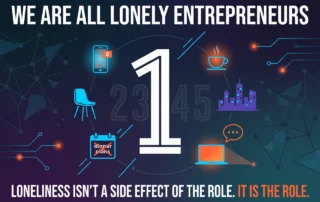
The New 80/20 Rule: Dermer’s Law for AI in 20262026-08-17T15:19:42-04:00
22 Jul, 2026

Solopreneur Income 2026: What One-Person Firms Earn

2026-08-17T15:19:53-04:00
Solopreneur income reality 2026 — how one-person businesses actually make money
★ The Lonely Entrepreneur · Solopreneur Economy 2026

The Solopreneur Income Reality: What a One-Person Business Actually Earns in 2026

There are 29.8 million solopreneurs in America generating $1.7 trillion — yet the average one earns just $39,273 and 48% have gone a month with no income. The middle is vanishing. Here's the real distribution, in six charts, and how to land on the right side of it.

The solopreneur economy stopped being a side story a while ago. Nearly 30 million Americans now run a business entirely on their own, and together they generate about 6.8% of U.S. economic output. But the size isn't the interesting part anymore. The interesting part is what one person can now build — and how brutally uneven the outcomes have become.

Because underneath the "business of one" hype is a distribution that splits in two directions. On one end, someone earning $39K treating it as side income, cycling in and out of solo work. On the other, a small but fast-growing group clearing six and even seven figures by stacking AI tools and staying intentionally lean. The middle — the comfortable "lifestyle business" that pays like a good salary — is thinning out. This is the data on which side you land, and why.

The old "lifestyle business" framing is breaking down. In 2026, a business of one is either genuinely lightweight or seriously scalable — and the gap between them is widening.

Where solopreneur money actually comes from.

Solo income isn't one thing. It's a stack — services and consulting still dominate, but product sales, digital goods, and mixed models are where the leverage lives. Tap any block to see what it means for building.

Chart 1 — Revenue mix
How solopreneurs make their money
Share of solopreneurs whose income leans on each model. Tap a block.
Tap any block to see how that revenue model tends to behave for a business of one.

Source: Founder Reports, Solopreneur Statistics (2026); QuickBooks / Gusto self-employment data.

The pattern hidden in that mix is leverage. Services pay first and pay reliably, but they cap out at the number of hours you can sell. Products and digital goods are slower to start and harder to sell, but they keep earning while you sleep. The solopreneurs pulling away from the pack almost always add a second, non-hourly stream on top of their services — the same durability lesson we keep coming back to.

The income distribution is brutally skewed.

The average solopreneur earns $39,273 — but averages lie when the curve is this lopsided. More than a third make under $25K, a fast-growing 20% now clear $100K–$300K, and just 3.6% break a million. Hover any bar.

Chart 2 — The income curve
Solopreneur annual earnings, by band
Share of U.S. solopreneurs in each income band. Hover the bars.

Source: Founder Reports (2026); Collective / LinkedIn solopreneur trends analysis (2026).

Sit with the gap between two numbers: solopreneurs say they need to earn $219,000 a year to feel successful, but the typical one takes home $39,273. That's not a rounding error — it's a $180K chasm between the dream and the median reality. It's also why 34% have considered giving up, with inconsistent income cited by 72% of them as the reason.

Solopreneurs say it takes $219K a year to feel successful. The typical one earns $39K. That gap is the whole psychological weight of going solo.

The climb from side hustle to real income.

Very few solopreneurs start where they want to end. This is the ladder most walk — from launched, to profitable, to primary income, to genuinely comfortable — and where the drop-off happens. Tap a stage.

Chart 3 — The income ladder
From launch to a living
Share of solopreneurs reaching each stage. Tap any bar.
Tap any stage to see what actually separates the people who climb from the people who stall.

Source: Founder Reports (2026); Gusto new-business formation data. Stages illustrative of reported milestones.

The funnel's most encouraging step is also its most surprising: 77% hit profitability in year one. That's far higher than employer businesses, and it's structural — 84% start with their own money and nearly half launch with under $5,000, so there's almost no overhead to dig out from under. The hard part isn't becoming profitable. It's turning a profitable side project into a reliable primary income, which only 41% manage.

The lean-launch advantage, in three numbers.

Solo businesses win on economics before they win on revenue. Low cost to start, fast profitability, and near-total self-funding are the quiet reasons the model works at all. Hover any dial.

Chart 4 — Why solo works
The lean-launch economics
Selected 2026 solopreneur formation indicators

Sources: Gusto (2026); Founder Reports (2026).

Those three dials explain the whole boom. When it costs almost nothing to start and most people are profitable inside a year, the risk of trying collapses. AI has pushed this even further — a full solopreneur tech stack now runs $3,000–$12,000 a year, a 95–98% cut versus hiring people for the same functions, and 73% of solopreneurs now use AI to run core operations. The barrier to becoming a business of one has never been lower.

Side income vs. full-time: the outcomes split.

The single biggest predictor of solopreneur income isn't industry or age — it's commitment. Full-time solopreneurs consistently out-earn part-timers and are far likelier to make it their primary income. Hover the points to see the gap.

Chart 5 — The commitment gap
Part-time vs. full-time solopreneurs
Two outcomes, two commitment levels. The slope is the story.

Source: Founder Reports (2026); QuickBooks self-employment trends. Full/part-time figures illustrative of reported patterns.

The lesson isn't "quit your job tomorrow." It's that treating a solo business like a real business — deliberate hours, a real tax structure, an operational stack — is what moves the needle, not the number of hours alone. The data no longer supports the casual "lifestyle business" framing. The value in 2026 is going to the people who run their business of one like an actual company.

The reality check nobody puts on the landing page.

For all the upside, the solo path carries real fragility — thin savings, income gaps, and higher stress than owners with employees. Know these numbers before you leap. They count up as you scroll.

Chart 6 — The fragility
The part the highlight reel skips
Selected 2026 solopreneur risk indicators

Sources: Founder Reports (2026); QuickBooks; Simply Business solopreneur report.

Put the six charts together and a playbook falls out. The economics of going solo have never been friendlier — cheap to start, fast to profit, and AI can now do the work of a small team. But the income curve is splitting, and which side you land on comes down to a handful of deliberate choices.

What this means if you're building

Add a non-hourly income stream early — services pay the bills, but products, digital goods, and recurring revenue are what break you out of the trading-time-for-money trap. Build a cash buffer before you need one, because 68% of solopreneurs have under six months of savings and half have already survived a month with zero income; a runway is what turns a scary gap into a manageable one. Treat it like a real business, not a hobby — a proper tax structure, a real financial plan, and an AI-powered operational stack are exactly what separate the six-figure solopreneurs from the ones cycling in and out. And guard against the isolation, because solo owners report higher stress and lower satisfaction than those with employees, and going it alone shouldn't mean going through it alone.

The infrastructure to build a real business of one has never been better. The people winning aren't working more hours — they're making better choices with the ones they have.

Build a business of one — without doing it alone.

The economics favor solopreneurs like never before. What most are missing isn't tools — it's a plan and a room of people who've been there. 250,000+ builders use The Lonely Entrepreneur to build lean businesses that actually last.

Join the Learning Community

A room of 250,000+ builders turning solo businesses into durable income — so you never have to figure out every function alone.

Find your people →

Work with Sidekick

Your AI-powered partner to plan revenue streams, price your offers, and run the back office — the operational stack of a team, for a business of one.

Get a Sidekick →

Keep reading

Frequently asked questions

'+d.v+'%
'; }).join(''); var rows=box.querySelectorAll('.c3f-row'); rows.forEach(function(r,i){ function pick(){note.innerHTML=data[i].note;rows.forEach(function(x){x.classList.remove('sel');x.classList.add('c3f-dim');});r.classList.remove('c3f-dim');r.classList.add('sel');} r.addEventListener('click',pick);r.addEventListener('mouseenter',pick); r.addEventListener('mouseleave',function(){rows.forEach(function(x){x.classList.remove('c3f-dim');});}); }); reveal('pC3',function(){rows.forEach(function(r,i){setTimeout(function(){r.querySelector('.c3f-fill').style.width=data[i].w+'%';},i*130);});}); })(); /* CHART 4: GAUGES */ (function(){ var data=[ {pct:77,lab:'Profitable in year one',sub:'far above employer businesses',c:'#f75008',suf:'%'}, {pct:84,lab:'Self-funded at launch',sub:'used their own money, no loans',c:'#f7a008',suf:'%'}, {pct:50,lab:'Started under $5,000',sub:'nearly half launched this lean',c:'#5b8def',suf:'%',disp:'~50'} ]; var box=root.querySelector('#c4gauges'); box.innerHTML=data.map(function(d,i){ var r=52,circ=2*Math.PI*r; return '
0%
'+d.lab+'
'+d.sub+'
'; }).join(''); var gauges=box.querySelectorAll('.t-gauge'); reveal('pC4',function(){ gauges.forEach(function(g,i){ var d=data[i],r=52,circ=2*Math.PI*r,ring=g.querySelector('.gring'),num=g.querySelector('.t-gnum'); setTimeout(function(){ ring.style.transition='stroke-dashoffset 1.3s cubic-bezier(.2,.7,.2,1)'; ring.style.strokeDashoffset=circ*(1-d.pct/100); var t0=null,dur=1300; function step(ts){if(!t0)t0=ts;var pr=Math.min((ts-t0)/dur,1);num.textContent=(d.disp&&pr>=1?d.disp:Math.round(pr*d.pct))+d.suf;if(pr<1)requestAnimationFrame(step);} requestAnimationFrame(step); },i*180); }); }); })(); /* CHART 5: DUMBBELL / SLOPE */ (function(){ var svg=root.querySelector('#c5svg'),tip=root.querySelector('#c5tip'); var W=640,H=320,xL=170,xR=470,yTop=50,yBot=250,vMax=70; function Y(v){return yBot-v/vMax*(yBot-yTop);} [70,50,30,10].forEach(function(v){ svg.appendChild(el('line',{x1:xL,y1:Y(v),x2:xR,y2:Y(v),stroke:'rgba(255,255,255,.08)'})); var t=el('text',{x:xL-12,y:Y(v)+4,fill:'#a9b6d6','font-size':11,'text-anchor':'end'});t.textContent=v+'%';svg.appendChild(t); }); [['Part-time',xL],['Full-time',xR]].forEach(function(h){var t=el('text',{x:h[1],y:36,fill:'#eaf0ff','font-size':13,'font-weight':800,'text-anchor':'middle'});t.textContent=h[0];svg.appendChild(t);}); var series=[ {n:'Earning over $100K',a:9,b:33,c:'#f75008'}, {n:'It\u2019s their primary income',a:22,b:64,c:'#5b8def'} ]; series.forEach(function(s){ var y1=Y(s.a),y2=Y(s.b); var ln=el('line',{x1:xL,y1:y1,x2:xL,y2:y1,stroke:s.c,'stroke-width':3,'stroke-linecap':'round'});svg.appendChild(ln); [[xL,y1,s.a,'Part-time',-1],[xR,y2,s.b,'Full-time',1]].forEach(function(p){ var c=el('circle',{cx:p[0],cy:p[1],r:6,fill:s.c,stroke:'#fff','stroke-width':2,opacity:0,style:'cursor:pointer'});svg.appendChild(c); var lab=el('text',{x:p[0]+p[4]*14,y:p[1]+4,fill:s.c,'font-size':13,'font-weight':800,'text-anchor':p[4]<0?'end':'start',opacity:0});lab.textContent=p[2]+'%';svg.appendChild(lab); function show(){tip.innerHTML=s.n+' · '+p[3]+': '+p[2]+'%';tip.style.left=(p[0]/W*100)+'%';tip.style.top=(p[1]/H*100)+'%';tip.style.opacity=1;} c.addEventListener('mouseenter',show);c.addEventListener('mousemove',show); c.addEventListener('mouseleave',function(){tip.style.opacity=0;}); c.addEventListener('touchstart',function(e){e.preventDefault();show();},{passive:false}); setTimeout(function(){c.style.transition=lab.style.transition='opacity .5s';c.setAttribute('opacity',1);lab.setAttribute('opacity',1);},900); }); var nm=el('text',{x:(xL+xR)/2,y:Math.min(y1,y2)-14,fill:s.c,'font-size':12,'font-weight':800,'text-anchor':'middle',opacity:0});nm.textContent=s.n;svg.appendChild(nm); reveal('pC5',function(){ ln.style.transition='all 1.1s cubic-bezier(.2,.7,.2,1)';ln.setAttribute('x2',xR);ln.setAttribute('y2',y2); nm.style.transition='opacity .6s .5s';setTimeout(function(){nm.setAttribute('opacity',.95);},50); }); }); })(); /* CHART 6: BIG STAT CARDS */ (function(){ var data=[ {v:68,suf:'%',lab:'have less than 6 months of savings'}, {v:48,suf:'%',lab:'have gone at least a month with no income'}, {v:35,suf:'%',lab:'report high stress — vs. 26% of owners with employees'} ]; var box=root.querySelector('#c6cards'); box.innerHTML=data.map(function(d,i){return '
0'+d.suf+'
'+d.lab+'
';}).join(''); var nums=box.querySelectorAll('.num'); reveal('pC6',function(){ nums.forEach(function(n,i){ var d=data[i],t0=null,dur=1300; function step(ts){if(!t0)t0=ts;var pr=Math.min((ts-t0)/dur,1);var val=pr*d.v;n.textContent=(d.v%1?val.toFixed(1):Math.round(val))+d.suf;if(pr<1)requestAnimationFrame(step);} setTimeout(function(){requestAnimationFrame(step);},i*140); }); }); })(); /* RELATED + FAQ */ root.querySelector('#relatedGrid').innerHTML=[ {k:'The blueprint',t:'How to Build a Creator Business (2026)',d:'The revenue stack, the dozen roles, and the durability test.',u:'https://lonelyentrepreneur.com/how-to-build-a-creator-business-2026/'}, {k:'Founder life',t:'The Loneliness Tax: Founder Mental Health 2026',d:'87.7% struggle, most have no support — the data, in six charts.',u:'https://lonelyentrepreneur.com/founder-mental-health-2026/'}, {k:'Leverage',t:'Small Business AI Statistics 2026',d:'The tools cutting solo operating costs by up to 98%.',u:'https://lonelyentrepreneur.com/small-business-ai-statistics-2026/'}, {k:'Where wealth sits',t:'Founder Wealth & Retirement Statistics 2026',d:'Rich on paper, exposed in real life — where the money really is.',u:'https://lonelyentrepreneur.com/founder-wealth-retirement-statistics-2026/'} ].map(function(r){return ''+r.k+'

'+r.t+'

'+r.d+'

';}).join(''); root.querySelector('#tFaq').innerHTML=[ ['How much does the average solopreneur make in 2026?','The average U.S. solopreneur earns about $39,273 a year, but the distribution is highly skewed: roughly 36% make under $25,000, 20% now earn $100K\u2013$300K, and just 3.6% clear $1 million. Solopreneurs say they\u2019d need about $219,000 a year to feel successful.'], ['How many solopreneurs are there in the U.S.?','There are about 29.8 million solopreneurs in the United States, generating roughly $1.7 trillion in revenue \u2014 around 6.8% of U.S. economic output. About 81.9% of all U.S. small businesses have no employees.'], ['Are solopreneur businesses profitable?','Yes, and faster than you\u2019d expect: about 77% of solopreneurs are profitable in their first year, largely because overhead is so low \u2014 84% self-fund and nearly half start with under $5,000.'], ['What are the biggest challenges for solopreneurs?','Time management (41%), marketing and customer acquisition (34%), and cash flow (29%) top the list. Financially, 68% have under six months of savings and 48% have gone at least a month with no income.'], ['How is AI changing solo businesses in 2026?','Dramatically. About 73% of solopreneurs use AI to run core operations, and a full solo tech stack now costs $3,000\u2013$12,000 a year \u2014 a 95\u201398% reduction versus hiring staff for the same functions, which is why one-person businesses can now scale revenue without adding headcount.'] ].map(function(f){return '
'+f[0]+'

'+f[1]+'

';}).join(''); })();

Solopreneur Income 2026: What One-Person Firms Earn2026-08-17T15:19:53-04:00
21 Jul, 2026

Founder Mental Health 2026: The Loneliness Tax in Data

2026-08-17T15:19:58-04:00
Founder mental health 2026 — the loneliness tax of building a business
★ The Lonely Entrepreneur · Founder Wellbeing 2026

The Loneliness Tax: What the 2026 Founder Mental-Health Data Really Costs

Nearly 9 in 10 founders now report at least one mental-health struggle — and the ones who need help most are the least likely to have anyone to call. Here's the data, in six charts, and what to actually do about it.

Every founder knows the highlight reel: the raise, the launch, the win. The data underneath tells a quieter story. Across recent 2026 surveys of entrepreneurs and startup founders, the same pattern keeps surfacing — building a company is one of the most isolating things a person can do, and almost nobody talks about it until it breaks them.

We pulled the numbers from two of the most-cited recent studies: a global survey of 227 entrepreneurs across 46 countries and a 138-founder European startup survey. Different samples, same gravity. The headline isn't that founders struggle — it's that most don't even know a resource built for people like them exists. That gap is the whole game.

The loneliness tax isn't the stress itself. It's the silence around it — and silence is the part we can actually fix.

Almost nobody is doing this untouched.

When entrepreneurs were asked to check every mental-health issue they personally face from a list of twelve, only 12.3% selected "none of the above." The other 87.7% carry at least one — and 58.6% say they now worry more about their mental health than their physical health.

Chart 1 — The universal struggle
Share of founders facing ≥1 mental-health issue
Global survey of 227 founders across 46 countries. Hover the ring.

Source: Founder Reports, Entrepreneur Mental Health Survey (227 respondents, 46 countries, 2026).

What's actually eating founders.

Anxiety and stress lead — but notice what's tied for sixth: loneliness sits level with a poor work-life balance, and it's the one founders are least likely to say out loud. Tap any bar to isolate it.

Chart 2 — The 12 struggles, ranked
The most common founder struggles
% who selected each issue (multiple selections allowed)

Source: Founder Reports (2026). Bars scaled to a 55% ceiling.

A quarter of founders naming loneliness as a live struggle sounds almost mild until you sit with it: that's the same share who cite a broken work-life balance, and it's the issue this publication exists to fight. It also under-reports itself — "stressed" is socially acceptable in a way that "lonely" still isn't, so the true number is almost certainly higher.

Founders who considered quitting cited the same trio again and again: high stress, loneliness, and too much invested for too little back. Isolation shows up before the decision to walk away.

The gap runs down gender lines.

Men and women don't struggle equally, or in the same ways. Women carry more financial worry and impostor syndrome; men carry more burnout and depression — and, tellingly, men are far less likely to have anyone to talk to. Tap a row for detail.

Chart 3 — Where the sexes diverge
Men vs. women founders
Share reporting each, by gender
Women Men

Source: Founder Reports gender breakdown (2026).

Only 52.5% of male founders say they have a support system to talk openly about mental health — versus 70.6% of women. That 18-point gap maps almost exactly onto their higher burnout and depression rates. The people most likely to burn out are the least likely to have a lifeline. It's not that men struggle more; it's that they struggle more alone.

The burnout year, by the numbers.

Zoom in on early-stage startup founders specifically and it gets sharper. In a single 12-month window, a majority hit the wall — and only 6% escaped mental-health issues entirely. Hover any dial.

Chart 4 — The wall
Founders reporting each in the last 12 months
Sifted survey of 138 startup founders

Source: Sifted Founder Mental Health Survey (138 founders, 2026).

The mechanics behind those dials aren't mysterious. Sixty-seven percent of founders work 50+ hours a week; 72% made fewer social plans this year and 61% took fewer holidays. Isolation isn't an accident that befalls busy people — it's a schedule they build for themselves, one skipped dinner and cancelled trip at a time. The nervous system keeps the receipt even when the calendar doesn't.

Rest isn't a reward you earn after the company succeeds. It's the maintenance that keeps the company's most important asset online.

Young founders are lonelier; older founders are more anxious.

Age reshapes the struggle rather than removing it. Founders 34 and under report the most loneliness; those 35+ report the most anxiety. Support structures — family, networks, experience — seem to shift the burden from one shoulder to the other. Hover a point.

Chart 5 — The age crossover
Under-35 vs. 35+ founders
Two struggles, two age groups. Slope shows the shift.

Source: Founder Reports age breakdown (2026).

The crossover is a clue about what actually helps. Younger founders often lack the network that older founders have quietly accumulated, so they feel the isolation more acutely. Older founders have the people but carry heavier stakes — mortgages, families, reputations — so the pressure reshapes as anxiety. Neither gets a free pass; the medicine is the same at both ends, and it's a person.

The support gap — the part we can fix.

Here's the uncomfortable middle of the data. The struggle is near-universal, but the scaffolding is almost absent. This is the loneliness tax made concrete — where founders are simply left on their own.

Chart 6 — The scaffolding that isn't there
Where founders are left alone
Selected 2026 support-gap indicators. Numbers count up on scroll.

Sources: Founder Reports (2026); Sifted (2026).

Put the six charts together and the strategy writes itself. The cheapest, highest-leverage intervention in all of this data isn't a supplement, an app, or a productivity system — it's another human being who gets it. Women's 18-point advantage in having someone to talk to buys them measurably lower burnout. A single honest conversation each week is a legitimate operating expense, not a luxury.

What this means if you're building

Treat feeling alone as a dashboard metric, not a mood — it's a leading indicator of the decision to quit, and it shows up early enough to act on. With 56% of founders getting zero mental-health support from investors, the real support system was always going to be peers, so go build one on purpose rather than waiting for it to appear. And protect the basics ruthlessly: the founders who let sleep, food, and movement slip below the red line are the same ones reporting insomnia and burnout. None of this is soft. It's the operating maintenance that keeps you in the game long enough to win it.

You were never supposed to do this alone. The founders who last aren't the toughest — they're the least isolated.

You were never supposed to build alone.

The Lonely Entrepreneur exists for exactly the gap this data exposes: real peers, real conversations, and tools built for how founders actually feel. 250,000+ builders use it to stay in the game.

Join the Learning Community

A room of 250,000+ builders who close the loneliness gap the data exposes — so you never carry the whole company on your own.

Find your people →

Work with Sidekick

Your AI-powered partner to think through the hard calls, offload the noise, and protect your headspace — so the pressure never sits on you alone.

Get a Sidekick →

Keep reading

Frequently asked questions

';}).join(''); reveal('pC1',function(){ arc.style.transition='stroke-dashoffset 1.4s cubic-bezier(.2,.7,.2,1)'; arc.style.strokeDashoffset=circ*(1-87.7/100); var t0=null,dur=1400; function step(ts){if(!t0)t0=ts;var pr=Math.min((ts-t0)/dur,1);num.textContent=(pr*87.7).toFixed(1)+'%';if(pr<1)requestAnimationFrame(step);} requestAnimationFrame(step); }); })(); /* CHART 2: RANKED HORIZONTAL BARS */ (function(){ var data=[ {n:'Anxiety',v:50.2},{n:'High stress',v:45.8},{n:'Financial worries',v:39.2}, {n:'Burnout',v:34.4},{n:'Impostor syndrome',v:31.7},{n:'Poor work-life balance',v:26.9}, {n:'Loneliness / isolation',v:26.9,hot:1},{n:'Insomnia / sleep',v:21.6},{n:'Depression',v:19.8}, {n:'Relationship strain',v:13.7},{n:'Hopelessness',v:12.3},{n:'No direction / purpose',v:11.9} ]; var max=55,box=root.querySelector('#c2rows'); box.innerHTML=data.map(function(d,i){ return '
'+d.n+''+d.v.toFixed(1)+'%
'; }).join(''); var rows=box.querySelectorAll('.c2-row'); rows.forEach(function(r){ r.addEventListener('click',function(){ var sel=r.classList.contains('sel'); rows.forEach(function(x){x.classList.remove('sel','c2-dim');}); if(!sel){r.classList.add('sel');rows.forEach(function(x){if(x!==r)x.classList.add('c2-dim');});} }); }); reveal('pC2',function(){rows.forEach(function(r,i){setTimeout(function(){r.querySelector('.c2-fill').style.width=(data[i].v/max*100)+'%';},i*70);});}); })(); /* CHART 3: DIVERGING (women left / men right) */ (function(){ var data=[ {n:'Financial worries',w:44.1,m:37.1,note:'Women report notably more financial anxiety than men.'}, {n:'Impostor syndrome',w:41.2,m:27.8,note:'The widest gap in the data — women feel it far more.'}, {n:'Has a support system',w:70.6,m:52.5,note:'Women are 18 points more likely to have someone to talk to.'}, {n:'Burnout',w:30.9,m:36.1,note:'Men tip over into burnout more often.'}, {n:'Depression',w:14.7,m:22.2,note:'Men report depression at a markedly higher rate.'} ]; var max=72,box=root.querySelector('#c3rows'); box.innerHTML=data.map(function(d,i){ return '
'+d.w+'%
'+d.n+'
'+d.m+'%
'; }).join(''); var rows=box.querySelectorAll('.c3-row'); rows.forEach(function(r){r.addEventListener('click',function(){rows.forEach(function(x){x.classList.remove('sel');});r.classList.add('sel');});}); reveal('pC3',function(){ rows.forEach(function(r,i){ setTimeout(function(){r.querySelectorAll('.c3-fill').forEach(function(f){f.style.width=f.getAttribute('data-w')+'%';});},i*110); }); }); })(); /* CHART 4: GAUGES */ (function(){ var data=[ {pct:83,lab:'Reported high stress',sub:'in the last 12 months',c:'#f75008'}, {pct:75,lab:'Reported anxiety',sub:'in the last 12 months',c:'#f7a008'}, {pct:54,lab:'Reported burnout',sub:'only 6% reported no issues at all',c:'#5b8def'} ]; var box=root.querySelector('#c4gauges'); box.innerHTML=data.map(function(d,i){ var r=52,circ=2*Math.PI*r; return '
0%
'+d.lab+'
'+d.sub+'
'; }).join(''); var gauges=box.querySelectorAll('.t-gauge'); reveal('pC4',function(){ gauges.forEach(function(g,i){ var d=data[i],r=52,circ=2*Math.PI*r,ring=g.querySelector('.gring'),num=g.querySelector('.t-gnum'); setTimeout(function(){ ring.style.transition='stroke-dashoffset 1.3s cubic-bezier(.2,.7,.2,1)'; ring.style.strokeDashoffset=circ*(1-d.pct/100); var t0=null,dur=1300; function step(ts){if(!t0)t0=ts;var pr=Math.min((ts-t0)/dur,1);num.textContent=Math.round(pr*d.pct)+'%';if(pr<1)requestAnimationFrame(step);} requestAnimationFrame(step); },i*180); }); }); })(); /* CHART 5: SLOPE / DUMBBELL */ (function(){ var svg=root.querySelector('#c5svg'),tip=root.querySelector('#c5tip'); var W=640,H=320,xL=150,xR=490,yTop=50,yBot=250,vMax=60; function Y(v){return yBot-v/vMax*(yBot-yTop);} [60,40,20,0].forEach(function(v){ svg.appendChild(el('line',{x1:xL,y1:Y(v),x2:xR,y2:Y(v),stroke:'rgba(255,255,255,.08)'})); var t=el('text',{x:xL-12,y:Y(v)+4,fill:'#a9b6d6','font-size':11,'text-anchor':'end'});t.textContent=v+'%';svg.appendChild(t); }); var head=[['Under 35',xL],['35 and over',xR]]; head.forEach(function(h){var t=el('text',{x:h[1],y:36,fill:'#eaf0ff','font-size':13,'font-weight':800,'text-anchor':'middle'});t.textContent=h[0];svg.appendChild(t);}); var series=[ {n:'Loneliness / isolation',a:30.7,b:21.2,c:'#f75008'}, {n:'Anxiety',a:47.2,b:54.5,c:'#5b8def'} ]; series.forEach(function(s){ var y1=Y(s.a),y2=Y(s.b); var ln=el('line',{x1:xL,y1:y1,x2:xL,y2:y1,stroke:s.c,'stroke-width':3,'stroke-linecap':'round'});svg.appendChild(ln); [[xL,y1,s.a,'Under 35',-1],[xR,y2,s.b,'35+',1]].forEach(function(p){ var c=el('circle',{cx:p[0],cy:p[1],r:6,fill:s.c,stroke:'#fff','stroke-width':2,opacity:0,style:'cursor:pointer'});svg.appendChild(c); var lab=el('text',{x:p[0]+p[4]*14,y:p[1]+4,fill:s.c,'font-size':13,'font-weight':800,'text-anchor':p[4]<0?'end':'start',opacity:0});lab.textContent=p[2]+'%';svg.appendChild(lab); function show(){tip.innerHTML=s.n+' · '+p[3]+': '+p[2]+'%';tip.style.left=(p[0]/W*100)+'%';tip.style.top=(p[1]/H*100)+'%';tip.style.opacity=1;} c.addEventListener('mouseenter',show);c.addEventListener('mousemove',show); c.addEventListener('mouseleave',function(){tip.style.opacity=0;}); c.addEventListener('touchstart',function(e){e.preventDefault();show();},{passive:false}); setTimeout(function(){c.style.transition=lab.style.transition='opacity .5s';c.setAttribute('opacity',1);lab.setAttribute('opacity',1);},900); }); var nm=el('text',{x:(xL+xR)/2,y:Math.min(y1,y2)-14,fill:s.c,'font-size':12,'font-weight':800,'text-anchor':'middle',opacity:0});nm.textContent=s.n;svg.appendChild(nm); reveal('pC5',function(){ ln.style.transition='all 1.1s cubic-bezier(.2,.7,.2,1)';ln.setAttribute('x2',xR);ln.setAttribute('y2',y2); nm.style.transition='opacity .6s .5s';setTimeout(function(){nm.setAttribute('opacity',.95);},50); }); }); })(); /* CHART 6: BIG STAT CARDS (count-up) */ (function(){ var data=[ {v:56,suf:'%',lab:'of founders get zero mental-health support from investors'}, {v:81.5,suf:'%',lab:'are unaware any founder-specific resource exists'}, {v:67,suf:'%',lab:'work 50+ hours a week — social plans get cut first'} ]; var box=root.querySelector('#c6cards'); box.innerHTML=data.map(function(d,i){return '
0'+d.suf+'
'+d.lab+'
';}).join(''); var nums=box.querySelectorAll('.num'); reveal('pC6',function(){ nums.forEach(function(n,i){ var d=data[i],t0=null,dur=1300; function step(ts){if(!t0)t0=ts;var pr=Math.min((ts-t0)/dur,1);var val=pr*d.v;n.textContent=(d.v%1?val.toFixed(1):Math.round(val))+d.suf;if(pr<1)requestAnimationFrame(step);} setTimeout(function(){requestAnimationFrame(step);},i*140); }); }); })(); /* RELATED + FAQ */ root.querySelector('#relatedGrid').innerHTML=[ {k:'Founder life',t:'Why 50% of CEOs Suffer in Silence',d:'The loneliness epidemic at the top — and what actually fixes it.',u:'https://lonelyentrepreneur.com/entrepreneur-loneliness-why-50-of-ceos-suffer-in-silence-and-what-actually-fixes-it/'}, {k:'Where wealth sits',t:'Founder Wealth & Retirement Statistics 2026',d:'Rich on paper, exposed in real life — where the money really is.',u:'https://lonelyentrepreneur.com/founder-wealth-retirement-statistics-2026/'}, {k:'The blueprint',t:'How to Build a Creator Business (2026)',d:'The revenue stack, the dozen roles, and the durability test.',u:'https://lonelyentrepreneur.com/how-to-build-a-creator-business-2026/'}, {k:'Trends',t:'The 2026 Creator Shakeup',d:'The TikTok deal, the ad-spend surge, and the new creator middle class.',u:'https://lonelyentrepreneur.com/creator-economy-2026-shakeup/'} ].map(function(r){return ''+r.k+'

'+r.t+'

'+r.d+'

';}).join(''); root.querySelector('#tFaq').innerHTML=[ ['What percentage of entrepreneurs struggle with mental health?','In a 2026 global survey of 227 founders across 46 countries, 87.7% reported at least one mental-health issue, with anxiety (50.2%), high stress (45.8%), financial worries (39.2%), burnout (34.4%) and impostor syndrome (31.7%) most common.'], ['How lonely are entrepreneurs, really?','About 26.9% of entrepreneurs name loneliness or isolation as an active struggle, rising to 30.7% among founders 34 and under. It\u2019s frequently under-reported because it carries more stigma than "stress."'], ['Do men and women founders struggle differently?','Yes. Women report more financial worry (44.1% vs 37.1%) and impostor syndrome (41.2% vs 27.8%); men report more burnout (36.1% vs 30.9%) and depression (22.2% vs 14.7%). Women are also far more likely to have a support system (70.6% vs 52.5%).'], ['How many founders experience burnout?','Among early-stage startup founders, 54% reported burnout in the past 12 months, 83% reported high stress, 75% reported anxiety, and only 6% reported no mental-health issues at all.'], ['Where can founders get support?','Only 18.5% of founders are aware of resources built specifically for entrepreneurs, and 56% get zero support from investors. Peer communities, founder-specific coaching, and consistent personal relationships consistently correlate with lower burnout.'] ].map(function(f){return '
'+f[0]+'

'+f[1]+'

';}).join(''); })();
Founder Mental Health 2026: The Loneliness Tax in Data2026-08-17T15:19:58-04:00
21 Jul, 2026

Creator Economy 2026: TikTok Deal & the $44B Surge

2026-08-17T15:20:06-04:00
Creator economy 2026 shakeup — the TikTok deal, rising ad spend, and the new creator middle class
★ The Lonely Entrepreneur · Creator Economy 2026

The 2026 Creator Shakeup: The TikTok Deal, the Ad-Spend Surge & the New Creator Middle Class

The creator economy 2026 just went through its biggest structural year yet: the TikTok ownership question finally resolved on January 22, brand budgets are climbing toward $44 billion, and — quietly — a real creator "middle class" has emerged. Here's what actually changed, and what it means if you're building.

For half a decade, the loudest story in the creator economy was fear. Fear that the biggest short-form platform in America would vanish overnight. Fear that AI would flood every feed and drown out human creators. Fear that the whole thing was a lottery where a handful won and everyone else worked for exposure. In 2026, a few of those fears finally got answers — and the answers are more interesting than the panic ever was.

The TikTok deal closed. On January 22, 2026, TikTok's U.S. operations were divested into a newly incorporated entity, TikTok USDS, ending the on-again, off-again ban that had loomed since early 2025. A consortium of American investors — including Oracle, Silver Lake, and MGX — took majority ownership, with ByteDance retaining under 20%. For creators who had spent a year quietly building backup audiences on RedNote and Instagram "just in case," the ground stopped moving. And that stability arrived at the exact moment brand money started pouring back in.

That's the real headline underneath the drama: uncertainty is expensive, and 2026 removed a huge chunk of it. Brands don't like betting media budgets on a platform that might be gone by summer. With the ownership question settled, the money that had been sitting on the sidelines finally had somewhere to go — and it went to creators.

The creator economy didn't just survive its scariest year. It got more boring — and boring, for a business, is bullish.

What the creator economy 2026 numbers are really measuring.

The headline figure from the IAB's latest report is that U.S. annual creator-economy ad spend reached $37.1 billion in 2025 and is forecast to hit $43.9 billion in 2026 — an 18% jump in a single year. That's not hype money chasing the next MrBeast. It's budget reallocated out of traditional advertising into creator partnerships, because the measurement finally works.

Chart 1 — Ad-spend surge
The ad-spend surge: 2025 → 2026
U.S. creator-economy ad spend, in billions (USD). Hover the points.
Direct partnerships & production Paid amplification & adjacencies

Source: IAB / Advertiser Perceptions, U.S. Creator Economy ad-spend forecast (via Digiday, 2026).

The most telling part isn't the total — it's the mix. The fastest-growing slice isn't the money paid directly to creators to make content. It's the money brands spend amplifying that content: taking a creator's organic post and putting paid media behind it. That reframes what a creator actually sells. You're not just renting your audience for one post; you're producing the raw material that a brand will then invest media dollars into. The next chart breaks down exactly where the roughly $6.8 billion of net-new 2026 spend is landing.

Where the 2026 growth is coming from.

Amplification — not one-off content fees — is where spend is accelerating fastest. Tap any bar to isolate it.

Chart 2 — Growth by category
Where the 2026 growth is coming from
U.S. creator ad spend by category — 2025 vs 2026 forecast (USD billions)
2025 actual 2026 forecast

Source: IAB / Advertiser Perceptions (via Digiday, 2026). Bars scaled to a $20B category ceiling.

The creator middle class is finally real.

For years the honest data point was brutal: nearly half earned almost nothing, a tiny elite earned everything, and there was very little in between. The 2026 numbers show that gap starting to fill in. In The Influencer Marketing Factory's January 2026 survey of 1,000 U.S. creators, 48.7% still earn under $10,000 a year — but 45.6% now earn $10K–$100K, and 5.7% clear six figures. More than half (51.5%) grew their earnings year over year.

Chart 3 — Earnings distribution
The emerging creator middle class
Share of U.S. creators by annual earnings band, 2026. Tap a column.
Tap any column to see what that earnings band means for building a real business.

Source: The Influencer Marketing Factory, 2026 Creator Economy Report (survey of 1,000 U.S. creators, Jan 2026).

A middle class matters because it changes who can treat this as a real occupation rather than a lottery ticket. It's the difference between "become famous or quit" and "build a modest, diversified business that pays the bills." And the survey shows creators behaving accordingly: product and merch sales plus affiliate marketing now make up 21.2% of creator income, and 44.9% of creators say they value stable, long-term brand relationships over one-off viral campaigns. That's the mindset of an operator, not a hobbyist.

The winners of 2026 aren't the creators chasing one viral moment. They're the ones building five small income streams that don't depend on any single algorithm.

Where the attention — and the budgets — are going next.

Marketers still name TikTok and Instagram as their top choices, but creators themselves are spreading out. Per Epidemic Sound's data, 45% of full- and part-time creators plan to expand onto YouTube in 2026 — and a quarter now plan to expand onto Snapchat thanks to its improved unified monetization program. Hover any bar for detail.

Chart 4 — Platform priority
Which platforms creators are expanding into
Share of full & part-time creators planning to expand onto each platform in 2026

Source: Epidemic Sound, Future of the Creator Economy Report (via Digiday, 2026).

The platform spread is a survival instinct, not a fashion. Every creator who lived through the TikTok scare learned the same lesson in real time: a business that lives on one platform is a business that can be switched off by someone else's decision. Expanding onto a second and third platform isn't about chasing more reach — it's about buying insurance. The next chart shows why that instinct is about to matter even more.

The flood is coming: 1.1 billion creators by 2032.

AI is lowering the barrier to entry so fast that MiDiA projects the global creator population could surpass 1.1 billion by 2032. Cheaper to start, far harder to stand out. Hover the line to see the trajectory.

Chart 5 — Population growth
Global creator population, 2024 → 2032 (projected)
Estimated creators worldwide, in millions. Hover the points.

Source: MiDiA Research global creator-population projection (via The Influencer Marketing Factory, 2026). Intermediate years interpolated for illustration.

Read that curve as both a threat and an opportunity. The threat is obvious: a billion creators means the average post gets buried even deeper than it does today, when 76% of TikToks and 59% of long-form YouTube videos already get under 1,000 views. But the opportunity is the flip side of the same coin. When supply explodes, the scarce thing isn't content — it's trust, consistency, and a real relationship with an audience. Those are exactly the assets that don't scale with a prompt.

How creators and marketers actually feel about AI.

AI isn't a rumor in this economy anymore — it's a budget line. On the demand side, marketers are pouring money into AI-generated creator content; on the supply side, most creators expect it to reshape their work. Here's the sentiment, at a glance.

Chart 6 — AI sentiment
The AI adoption & sentiment gauges
Selected 2026 creator-economy AI indicators. Hover any dial.

Sources: Billion Dollar Boy (marketer AI spend), The Influencer Marketing Factory (creator AI expectations), 2026.

Put the two sides together and the strategy writes itself. Marketers will keep shifting budget toward AI-assisted content because it's cheaper and faster to produce. That means the human creator's edge can't be "I can make a video" — a machine can do that now. The edge has to be the things AI can't fake at scale: a specific point of view, a community that trusts you, and a body of work that compounds over years. That's a double-edged sword, and it cuts toward durability.

What this means if you're building

The through-line from all six charts is the same lesson we keep coming back to: the fragile creator depends on a single platform's algorithm and a single revenue stream. The durable one treats creation like a business with a P&L. In 2026, the tailwinds finally favor the builders — the ban uncertainty is resolved, brand budgets are climbing 18%, a real middle class exists to grow into, and diversified income is no longer optional advice but the observed behavior of the people actually making it.

So don't optimize for the viral hit. Optimize for the machine behind it. Own an audience you can reach without a platform's permission — an email list, a community, a membership. Build two or three income streams before you need them, while the brand money is flowing. Expand onto a second platform as insurance, not vanity. And treat AI as a production assistant that frees your time for the one thing it can't replace: being a specific, trusted human that an audience actually wants to hear from. The opportunity of 2026 isn't to go viral. It's to build something that survives the next algorithm change, the next platform scare, and the next wave of AI competition.

The opportunity of 2026 isn't to go viral. It's to build something that survives the next algorithm change, the next platform scare, and the next wave of AI.

Build your creator machine — with people who've built one.

Turn the 2026 creator-economy shift into a durable business: income you own, systems that scale, and people who've been there. 250,000+ builders use The Lonely Entrepreneur to do exactly that.

Join the Learning Community

A room of 250,000+ builders turning creator-economy trends into durable businesses instead of grinding out every role alone.

Find your people →

Work with Sidekick

Your AI-powered partner to plan revenue streams, test offers, and stay ahead of platform shifts — so you never build the machine alone.

Get a Sidekick →

Keep reading

Frequently asked questions

$'+d.v26+'B
'; }).join(''); var rows=box.querySelectorAll('.c2-row'); rows.forEach(function(r){ r.addEventListener('click',function(){ var sel=r.classList.contains('sel'); rows.forEach(function(x){x.classList.remove('sel','c2-dim');}); if(!sel){r.classList.add('sel');rows.forEach(function(x){if(x!==r)x.classList.add('c2-dim');});} }); }); reveal('pC2',function(){rows.forEach(function(r,i){var d=data[i];setTimeout(function(){r.querySelector('.c2-b25').style.width=d.w25+'%';r.querySelector('.c2-b26').style.width=d.w26+'%';},i*120);});}); })(); /* CHART 3: PYRAMID */ (function(){ var data=[ {p:'48.7%',h:90,c:'linear-gradient(180deg,#5f6f8f,#3f4d6a)',cap:'Under
$10K',note:'Under $10K (48.7%). Still the largest group \u2014 mostly hobbyists and part-timers. The goal here isn\u2019t fame; it\u2019s building one repeatable income stream to climb into the middle band.'}, {p:'45.6%',h:85,c:'linear-gradient(180deg,#f7a008,#f75008)',cap:'$10K\u2013$100K
(the middle)',note:'$10K\u2013$100K (45.6%) \u2014 the new middle class. These creators rarely rely on one viral hit. They stack recurring brand deals, a product or membership, affiliate income, and platform payouts. Unglamorous and durable.'}, {p:'5.7%',h:14,c:'linear-gradient(180deg,#5b8def,#3f6ad0)',cap:'$100K+',note:'$100K+ (5.7%). The professional tier. Almost always a full business \u2014 multiple channels, a team, and owned audience. The exception, not the rule, but a real destination now.'} ]; var grid=root.querySelector('#c3grid'),note=root.querySelector('#c3note'); grid.innerHTML=data.map(function(d,i){return '
'+d.p+'
'+d.cap+'
';}).join(''); var cols=grid.querySelectorAll('.t-c3col'); cols.forEach(function(col,i){function pick(){note.innerHTML=data[i].note;}col.addEventListener('click',pick);col.addEventListener('mouseenter',pick);}); reveal('pC3',function(){cols.forEach(function(col,i){setTimeout(function(){col.querySelector('.t-c3bar').style.height=data[i].h+'%';},i*160);});}); })(); /* CHART 4: METERS */ (function(){ var data=[ {n:'YouTube',v:45,w:90,hot:1,note:'Top expansion target \u2014 the monetization king, strong ad revenue, improving Shorts engagement.'}, {n:'Instagram',v:41,w:82,note:'Video-first pivot: Reels volume rising while static posts decline.'}, {n:'TikTok',v:41,w:82,note:'Post-deal stability plus the most consistent short-form engagement across audience sizes.'}, {n:'Facebook',v:35,w:70,note:'Meta positioning it as an underrated creator platform with cross-posting from Instagram.'}, {n:'Snapchat',v:25,w:50,note:'The surprise riser \u2014 its unified monetization program is winning creator attention in 2026.'} ]; var box=root.querySelector('#c4rows'); box.innerHTML=data.map(function(d){return '
'+d.n+''+d.v+'%
';}).join(''); var rows=box.querySelectorAll('.c4-row'); reveal('pC4',function(){rows.forEach(function(r,i){setTimeout(function(){r.querySelector('.c4-fill').style.width=data[i].w+'%';},i*110);});}); })(); /* CHART 5: GROWTH CURVE */ (function(){ var svg=root.querySelector('#c5svg'),tip=root.querySelector('#c5tip'); var W=640,H=320,x0=60,x1=600,yTop=40,yBot=260,vMax=1200; var pts=[{yr:'2024',v:250},{yr:'2026',v:400},{yr:'2028',v:620},{yr:'2030',v:860},{yr:'2032',v:1100}]; function X(i){return x0+i/(pts.length-1)*(x1-x0);} function Y(v){return yBot-v/vMax*(yBot-yTop);} [1200,900,600,300,0].forEach(function(v){ svg.appendChild(el('line',{x1:x0,y1:Y(v),x2:x1,y2:Y(v),stroke:'rgba(255,255,255,.10)'})); var t=el('text',{x:x0-8,y:Y(v)+4,fill:'#a9b6d6','font-size':11,'text-anchor':'end'});t.textContent=v+'M';svg.appendChild(t); }); var dArea='M'+X(0)+','+yBot;pts.forEach(function(p,i){dArea+=' L'+X(i)+','+Y(p.v);});dArea+=' L'+X(pts.length-1)+','+yBot+' Z'; var grad=el('linearGradient',{id:'c5g',x1:0,y1:0,x2:0,y2:1}); grad.appendChild(el('stop',{offset:0,'stop-color':'#f75008','stop-opacity':.55})); grad.appendChild(el('stop',{offset:1,'stop-color':'#f75008','stop-opacity':0})); var defs=el('defs',{});defs.appendChild(grad);svg.appendChild(defs); var area=el('path',{d:dArea,fill:'url(#c5g)',opacity:0});svg.appendChild(area); var dLine='';pts.forEach(function(p,i){dLine+=(i?' L':'M')+X(i)+','+Y(p.v);}); var line=el('path',{d:dLine,fill:'none',stroke:'#f7a008','stroke-width':3.5,'stroke-linecap':'round'});svg.appendChild(line); var len=line.getTotalLength();line.style.strokeDasharray=len;line.style.strokeDashoffset=len; pts.forEach(function(p,i){ var c=el('circle',{cx:X(i),cy:Y(p.v),r:5.5,fill:'#f75008',stroke:'#fff','stroke-width':2,opacity:0,style:'cursor:pointer'});svg.appendChild(c); var xl=el('text',{x:X(i),y:284,fill:'#eaf0ff','font-size':12,'font-weight':700,'text-anchor':'middle'});xl.textContent=p.yr;svg.appendChild(xl); function show(){tip.innerHTML=p.yr+': '+p.v+'M creators';tip.style.left=(X(i)/W*100)+'%';tip.style.top=(Y(p.v)/H*100)+'%';tip.style.opacity=1;} c.addEventListener('mouseenter',show);c.addEventListener('mousemove',show); c.addEventListener('mouseleave',function(){tip.style.opacity=0;}); c.addEventListener('touchstart',function(e){e.preventDefault();show();},{passive:false}); setTimeout(function(){c.style.transition='opacity .5s';c.setAttribute('opacity',1);},900+i*120); }); reveal('pC5',function(){area.style.transition='opacity 1.2s .3s';area.setAttribute('opacity',1);line.style.transition='stroke-dashoffset 1.6s cubic-bezier(.2,.7,.2,1)';line.style.strokeDashoffset=0;}); })(); /* CHART 6: GAUGES */ (function(){ var data=[ {pct:79,lab:'Marketers boosting AI-content spend',sub:'plan to increase generative-AI creator spend in 2026',c:'#f75008'}, {pct:77,lab:'Marketers shifting budget to AI',sub:'diverting spend from traditional to AI-generated content',c:'#f7a008'}, {pct:56,lab:'Creators expecting big AI change',sub:'believe AI will significantly reshape their work',c:'#5b8def'} ]; var box=root.querySelector('#c6gauges'); box.innerHTML=data.map(function(d,i){ var r=52,circ=2*Math.PI*r; return '
0%
'+d.lab+'
'+d.sub+'
'; }).join(''); var gauges=box.querySelectorAll('.t-gauge'); reveal('pC6',function(){ gauges.forEach(function(g,i){ var d=data[i],r=52,circ=2*Math.PI*r,ring=g.querySelector('.gring'),num=g.querySelector('.t-gnum'); setTimeout(function(){ ring.style.transition='stroke-dashoffset 1.3s cubic-bezier(.2,.7,.2,1)'; ring.style.strokeDashoffset=circ*(1-d.pct/100); var t0=null,dur=1300; function step(ts){if(!t0)t0=ts;var pr=Math.min((ts-t0)/dur,1);num.textContent=Math.round(pr*d.pct)+'%';if(pr<1)requestAnimationFrame(step);} requestAnimationFrame(step); },i*180); }); }); })(); /* RELATED + FAQ */ root.querySelector('#relatedGrid').innerHTML=[ {k:'The reality',t:'Influencer Economy Statistics 2026',d:'50M creators, a $250B market — yet 48.7% earn under $10K a year.',u:'https://lonelyentrepreneur.com/influencer-economy-statistics-2026/'}, {k:'The blueprint',t:'How to Build a Creator Business (2026)',d:'The revenue stack, the dozen roles, and the durability test.',u:'https://lonelyentrepreneur.com/how-to-build-a-creator-business-2026/'}, {k:'Where wealth sits',t:'Founder Wealth Statistics 2026',d:'Rich on paper, exposed in real life — where the money really is.',u:'https://lonelyentrepreneur.com/founder-wealth-retirement-statistics-2026/'}, {k:'Leverage',t:'Small Business AI Statistics 2026',d:'58% use AI, only 27% feel ready — crossing from explorer to operator.',u:'https://lonelyentrepreneur.com/small-business-ai-statistics-2026/'} ].map(function(r){return ''+r.k+'

'+r.t+'

'+r.d+'

';}).join(''); root.querySelector('#tFaq').innerHTML=[ ['What happened with the TikTok ban in 2026?','The long-running U.S. ban ended when TikTok\u2019s U.S. operations were divested into a new entity, TikTok USDS, in a deal that closed on January 22, 2026. American investors including Oracle, Silver Lake, and MGX took majority ownership, while ByteDance retained under 20%.'], ['How big is the creator economy ad market in 2026?','U.S. creator-economy ad spend reached roughly $37.1 billion in 2025 and is forecast to hit $43.9 billion in 2026, an 18% increase. The fastest-growing segments are paid amplification of creator content, on social (+48%) and beyond it (+56%).'], ['Is there really a creator "middle class" now?','Yes. In a January 2026 survey of 1,000 U.S. creators, 48.7% still earned under $10K a year, but 45.6% now earn $10K\u2013$100K, and 5.7% earn six figures. More than half grew their earnings year over year.'], ['How is AI affecting creators in 2026?','AI is expanding both sides of the market. Around 79% of marketers plan to increase spend on AI-generated creator content, while AI lowers the barrier to entry so much that the global creator population could exceed 1.1 billion by 2032.'], ['Which platforms should creators prioritize in 2026?','Creators are spreading out: 45% plan to expand onto YouTube, Instagram and TikTok at 41% each, Facebook at 35%, and a rising 25% onto Snapchat. The durable strategy is to own the audience relationship rather than depend on any single platform.'] ].map(function(f){return '
'+f[0]+'

'+f[1]+'

';}).join(''); })();

Creator Economy 2026: TikTok Deal & the $44B Surge2026-08-17T15:20:06-04:00
20 Jul, 2026

Influencer Economy Statistics 2026: Half Earn Under $10K

2026-08-17T15:20:19-04:00
Influencer economy statistics 2026: a solo creator building a media business from a phone and a camera
★ The Lonely Entrepreneur · 2026 Creator Economy Report

The Influencer Economy: The Most Wanted Job, and the Loneliest Paycheck

More than half of Gen Z say they want to be a creator. Roughly 50 million people already are, inside a market worth over $250 billion. Yet nearly half of American creators earn under $10,000 a year, the algorithm hides most of what they make, and the job carries measurably higher rates of anxiety and burnout. The story of one dog photographer who built a real business "one dog at a time" is the whole economy in miniature — here's what the 2026 data reveals, and what it actually takes to last.

The income ladder almost no aspiring creator wants to see.

The dream sells the top of this chart. The reality lives at the bottom. Both are true at once — and the distance between them is the entire story. Tap play to climb the ladder.

Interactive · Chart 1 — Income ladder
How US creator earnings are actually distributed
Share of creators in each annual-earnings band. Tap play.
Under $10K
48.7%
$10K–$25K
19.2%
$25K–$50K
16.1%
$50K–$100K
10.2%
$100K–$250K
3.8%
$250K+
2.0%

Source: The Influencer Marketing Factory, January 2026 survey of 1,000 US creators (18–65); cross-referenced with CreatorIQ State of Creator Compensation 2026. Only ~5.8% clear six figures.

There's a comforting story we tell about creators and money: you find the thing you love, you post about it, and one day it pays off in a way a normal job never could. And the top-line data seems to back it up — the creator economy really is enormous, worth more than $250 billion globally, with roughly 50 million people earning something from it. On paper, the influencer is winning.

Then you look under the hood, and a very different picture appears. That money is concentrated at the very top, while the typical creator's paycheck is threadbare. The Influencer Marketing Factory's January 2026 survey found that 48.7% of American creators earn under $10,000 a year, and only about 5.8% clear six figures. CreatorIQ puts the average at $44,293 — but the median campaign pays just $3,000, and 56% of full-time creators still earn below the US living wage. Averages lie in this economy because a handful of eight-figure stars drag the mean far above what a typical creator ever sees. This is the paradox at the heart of the most-wanted job in the world.

Elias Friedman — better known as The Dogist — is candid about where he sits on that ladder. "I live comfortably in a very expensive city, Manhattan, in Chelsea, in a one-bedroom with one dog and my wife," he says. "A nice Japanese car, a Subaru." Not enough to retire on. "You've got to keep working." He's been doing it fourteen years — and he's one of the success stories.

Half of Gen Z wants this job because they see the top of the chart. Nearly half of the people already doing it earn under $10,000 a year. The dream is real. So is the distance between the dream and the median.
— Michael Dermer

So how does someone actually cross that distance? Elias's answer starts with timing — and why the door he walked through in 2013 is barely open now.

The wall between good work and getting seen.

When Elias started, every follower saw every post. That world is gone. Today the algorithm hides most work by default — being good is no longer enough to be seen. Tap play to fill the gauges.

Interactive · Chart 2 — Visibility gauges
Share of posts that get fewer than 1,000 views
By platform. Tap play to fill each dial.
0%
TikTok
0%
YouTube (long-form)
0%
Instagram

Source: The Influencer Marketing Factory / Gigapay creator earnings analysis, 2026. Figures reflect the share of posts on each platform receiving under 1,000 views.

Why "just make great content" is the most misleading advice in the creator economy

Here's the trap, and almost every aspiring creator falls into some version of it. The advice sounds airtight: make great content consistently, and the audience will find you. It was mostly true in 2013. It is mostly false now. "If I tried to start it now, it would be much harder," Elias says flatly. "Back when I started, every post — every person in my audience saw them. Now some people see them." The gatekeeper changed from your own follower count to an algorithm that shows most posts to almost no one.

The numbers are brutal: 76% of TikToks, 59% of long-form YouTube videos, and 46% of Instagram posts get under 1,000 views. Quality is now necessary but nowhere near sufficient. That's why Elias had to do the one thing he never planned — step out from behind the camera. "There was an inflection point where I had to come out from behind the curtain. It wasn't just me as a photographer, but me as a person. Do you like me, or is it just my dog pictures?" The shy kid who grew up hiding behind a lens had to become a personality, because the platform demanded it. The same all-in-on-the-craft instinct that traps creators is a cousin of the avoidable startup failures we analyzed, where believing the product alone will win blinds founders to everything else the market actually requires.

"Just make great content" is the four most expensive words in the creator economy. Elias made the best dog photos on the internet — and still had to become a personality, learn the hook, and adapt to an algorithm that hides most of what you make.
— Michael Dermer

And that constant pressure to be seen, to perform, to be liked as a person — it takes a toll the highlight reel never shows. The next chart measures it.

The hidden cost of the always-on job.

Behind the fun of walking a park with a camera is a job with measurably higher rates of strain than the general population. This is the part the dream never accounts for. Tap play to reveal the toll.

Interactive · Chart 3 — The strain bars
Share of digital creators reporting each strain
Per the Creators 4 Mental Health / Harvard study. Tap play.
Anxiety or depression tied to work
65%
Feel burnt out
62%
Report unstable income
~70%
Work-related suicidal thoughts
10%

Source: Creators 4 Mental Health & Lupiani Insights, reported via Harvard T.H. Chan School of Public Health, 2025. Work-related suicidal ideation was roughly double the general US adult rate. If any of this resonates personally, please reach out for support — resources are noted at the end of this article.

Why creators burn out — and why it isn't a weakness problem

Sit with the mental-health data and it's tempting to conclude creators are just fragile. The evidence says the opposite. These are people disciplined enough to post every single day for years — the issue isn't resilience, it's isolation and a job structure that was never built for human sustainability. There's no manager, no team standing beside you, no separation between "you" and "the product," because in this job you are the product. Every metric is a public referendum on your worth, refreshed by the hour. The Harvard research links the strain directly to financial pressure, obsession over content performance, constant toxicity, and — the one that names this company — isolation.

Elias reframes the pressure rather than denying it. "It can be a lot of pressure, but that pressure is a privilege, and you learn to have fun with it." He's also honest about rejection: people say no about one in ten times, "and you don't get to see that, because they said no." Learning to metabolize rejection, unstable income, and being perceived by millions is its own full-time skill — the same decision-in-isolation weight behind the founder mental-health crisis we covered, where the pressure is real but invisible from the outside. The creator with a peer group, a mentor, or even one trusted collaborator is the one who lasts. The one going it entirely alone is the one the burnout statistics eventually claim. What most creators lack isn't talent. It's someone in the room — which is exactly what the Learning Community is built to provide.

Creators don't burn out because they're weak — they're some of the most relentless people alive. They burn out because they are the product, the metrics never stop, and no one is in the room to remind them they're more than their view count.
— Michael Dermer

Which raises the question every creator eventually faces whether they've prepared or not: if the algorithm and the brand deals are this unstable, where does durable income actually come from? The final chart shows where the money really sits.

Where creator income actually comes from.

Brand deals dominate the paycheck — and that's exactly the vulnerability. The creators who last are quietly shifting toward revenue they own. Tap a segment to see the detail.

Interactive · Chart 4 — Income ring
The 2026 creator income mix
Share of total creator earnings by source. Tap any ring segment.
59% from brand deals

Source: eMarketer 2026 creator income breakdown, via The Influencer Marketing Factory. Owned income — communities, memberships, products — is projected to pass half of total earnings for many full-time creators by year-end.

How to build a creator business that lasts — starting this week

The most encouraging thing about the creator data is that the highest-leverage moves are cheap, available now, and don't require a viral moment. The first move is to build income you actually own. Brand deals are the largest slice — Elias confirms it: "Partnering with a big company that wants to invest in their marketing is generally the most lucrative." But brand money is volatile and the algorithm isn't yours to control. Memberships, an email list, a community, digital products, a book — these are assets no platform can throttle overnight. Elias has stacked exactly this: books, apparel, a podcast, and last year a YouTube show with celebrity guests.

The second move is to treat it like a business, not a hobby that got lucky. Elias runs a real operation: "I have a team that supports me — management, literary agents, assistants, social managers. No one full-time. I couldn't do it without them, because it is a lot of work." That's the same leverage principle behind the small-business AI data — the gap between dabbling and mastery is guidance and systems, not raw effort. The third move is the one the data quietly proves matters most and creators skip most: don't do it alone. The isolation that drives the burnout numbers is the same thing that keeps creators from ever getting the honest feedback, the "diversify now" warning, the "you're more than your metrics" reminder that turns a fragile solo grind into a durable business. If the high-stakes calls — what to monetize, when to pivot, how to not burn out — are exactly what the grind never leaves time for, that's what Sidekick was designed to think through with you.

You don't build a lasting creator business by posting harder — that just deepens the dependence on an algorithm you don't control. You build it by owning your income, running it like a business, and refusing to face the whole thing alone.
— Michael Dermer

The failure mode here isn't laziness or lack of talent — creators pour everything into the craft precisely because they love it. It's tunnel vision disguised as passion: mistaking "post more, chase the algorithm" for a strategy, when the data shows the durable creators built assets they own and a bench of people around them. Effort spent only on the next post concentrates the risk. Effort spent diversifying income, building systems, and getting help is what turns years of creating into a career you actually get to keep.

What the creator data is really measuring

Zoom out from the earnings figures and the numbers are measuring something the creator world rarely says out loud: that the person doing the most emotionally exposed work is often the least protected from it. The corporate employee gets a system built to buffer them — a team, a manager, a salary that arrives whether or not this week's project "performed." The creator gets a higher ceiling and no floor, their income and their self-worth both tied to metrics that reset every morning. That's not a story about who's more talented; it's a story about who the system was built to protect, and creators were left out. The 48.7%-under-$10K figure, the visibility-ceiling figure, the burnout figures all point at the same gap — not a gap in ability, but a gap in structure and support.

And here's the reframe that matters: your stability isn't a distraction from making great work — it's what lets you make it without desperation. A creator who owns their income and has people around them makes bolder, freer, more original work than one secretly terrified that one bad month erases everything. Diversifying and getting support isn't disloyalty to the craft; it's what keeps the craft from becoming a trap. Elias put it best without meaning to: "I feel like I've been retired in some way. I really thoroughly enjoy what I do." That's what security buys — not escape from the work, but the freedom to love it. The creator paradox isn't inevitable. It's just what happens when you build alone. That's the whole reason this company has a name.

You can build the dream. Just don't build it alone.

The 2026 data is blunt: creating is the most-wanted job in the world, yet nearly half of American creators earn under $10,000, the algorithm hides most of what they make, and the job carries real mental-health costs. Read one way, that's a warning. Read another way, it's the most fixable problem in the creator economy — because the tools are cheap, the moves are simple, and the only thing standing between a fragile grind and a durable business is the decision to own your income, treat it like a business, and stop doing it alone. The dream is real. Whether you get to keep it is up to you, and who you build it with.

You get one day to believe the algorithm and the brand deals will take care of you. The next day, you find out most creators believed that too — and the ones still standing simply stopped building alone.
— Michael Dermer

Don't build your creator business — or carry the pressure — alone.

Nearly half of creators earn under $10,000, and the job carries measurably higher burnout, because too many build in isolation. 250,000+ builders use The Lonely Entrepreneur to make the biggest decisions of their careers with people who've been there.

Join the Learning Community

A room of 250,000+ builders who ask each other the uncomfortable questions — like "what happens if the algorithm turns on you?" — early enough to actually act on the answer.

Find your people →

Work with Sidekick

Your AI-powered partner for the high-stakes calls creating never leaves time for — from diversifying your income to protecting your energy — so you never face the big decisions with no one to think them through.

Get a Sidekick →

Keep reading

Frequently asked questions

This article is general information, not financial, career, or medical advice — everyone's situation is different. Being a creator can also carry a heavy emotional weight; if it's affecting you personally — chronic anxiety, burnout, or thoughts of self-harm — please reach out to a professional or a trusted person in your life. In the US, you can call or text 988 to reach the Suicide & Crisis Lifeline, 24/7.

Influencer Economy Statistics 2026: Half Earn Under $10K2026-08-17T15:20:19-04:00
19 Jul, 2026

Founder Wealth Statistics 2026: Rich on Paper, Broke Now

2026-08-17T15:20:25-04:00
Founder wealth statistics 2026: an entrepreneur reviewing personal finances and retirement savings
★ The Lonely Entrepreneur · 2026 Founder Wealth Report

The Founder Wealth Paradox: Rich on Paper, Exposed in Real Life

Business owners build more net worth than almost anyone — the average tops $1.6 million before you even count the business. Yet nearly 1 in 5 have zero retirement savings, most have under $50,000 set aside, and 83% have no plan for the one event that's supposed to fund the rest of their life: the exit. The wealth is real. It's just trapped in a single, illiquid, unplanned-for asset. Here's what the 2026 data reveals — and how to stop being one bad year away from starting over.

The retirement number almost no founder wants to see.

Set aside the business for a moment and look only at what's saved outside it. For a huge share of owners, the answer is alarmingly little — even those near retirement age. Tap a segment to see the detail.

Interactive · Chart 1 — Distribution ring
What small business owners have saved for retirement
Share of owners in each savings band. Tap any ring segment.
18% have $0 saved

Source: 2025 WealthRabbit Small Business Retirement Report (800+ U.S. owners, ≤100 employees). Nearly 1 in 5 (≈18%) have $0 saved; the majority have under $50,000. Middle bands are illustrative estimates between those verified anchors.

There's a comforting story we tell about entrepreneurs and money: you take the risk, you build the thing, and one day it pays off in a way a salary never could. And the top-line data seems to back it up — business owners really do build more wealth than the average employee. The Federal Reserve's Survey of Consumer Finances shows business ownership roughly doubles a household's net worth: families owning a business with 2–5 employees average $1.6 million, and those with more than five average $4.1 million — before counting the value of the business itself. On paper, the founder is winning.

Then you look under the hood, and a very different picture appears. That wealth is almost entirely locked inside one asset — the business — while the founder's actual safety net is threadbare. The 2025 WealthRabbit report, surveying more than 800 small business owners, found that nearly 1 in 5 have no retirement savings at all, and the majority have less than $50,000 set aside. The most common amount saved by owners aged 45 to 55 is just $50,000 — at an age when financial planners recommend more than $1 million. Meanwhile the average corporate employee the same age holds $152,000 to $200,000 in their 401(k) alone. This is the paradox Michael Dermer has watched play out for years: founders who look wealthy and feel one bad quarter away from ruin — a cousin of the founder mental-health crisis we covered earlier, where the pressure is real but invisible from the outside.

The founder net worth number is a mirage if it's all trapped in the business. You can be a millionaire on the balance sheet and still be one bad year away from starting over. That's not wealth — it's exposure wearing wealth's clothes.
— Michael Dermer

So how does someone who builds real value end up so financially exposed? The next chart traces the gap between founders and the employees they left behind — and it's wider than almost anyone expects.

The founder vs. the employee they used to be.

The person who took the leap often ends up with a smaller safety net than the colleague who stayed. Watch the two paths diverge across a career — same start, wildly different destinations. Tap play to draw the lines.

Interactive · Chart 2 — Slope comparison
Retirement savings over a career: founder vs. corporate employee
Typical amount saved outside the business, by age. Tap play.
$200K $100K $0 Age 25–34 Age 35–44 Age 45–55
Corporate employee (avg 401k) Founder (typical saved)

Sources: WealthRabbit 2025 (owner savings) and Fidelity 2024 (corporate 401(k) balances by age). Founder figures reflect the most common (modal) amounts; corporate figures are average balances.

Why "the business is my retirement plan" is the most dangerous line in entrepreneurship

Here's the trap, and almost every founder falls into some version of it. When you ask why they haven't saved outside the business, the answer is remarkably consistent: "The business is my retirement plan. When I sell it, that's my nest egg." It sounds rational. Every extra dollar reinvested into the company you control feels smarter than parking it in an index fund. The problem is that this reasoning bets your entire future on a single, illiquid asset selling for a good price at exactly the right time — and the data on how that actually goes is brutal.

Start with the exit itself. 83% of business owners have no formal exit plan, and only 20–30% of businesses that go to market actually sell. Among owners, 70% say income from the business is essential just to maintain their current lifestyle — meaning they can't easily pull money out even now. Add the structural disadvantage: only 34% of small businesses offer any retirement plan, and roughly 55 million Americans in small businesses lack access to an employer-sponsored plan entirely. The same all-in-on-the-business instinct drives the solopreneur cash-flow squeeze we documented, where 68% of solo owners hold under six months of savings. The system that automatically builds wealth for corporate employees — the payroll-deducted, employer-matched 401(k) — simply doesn't exist for most founders. So "the business is my retirement plan" isn't a strategy. It's the absence of one, dressed up as confidence.

"The business is my retirement plan" is the four most expensive words in entrepreneurship. You're betting your entire future on one asset selling, at the right price, at the right time — when 70% of businesses that try to sell never do.
— Michael Dermer

That concentration of everything into one basket is the real risk hiding inside the founder wealth paradox. The next chart makes it impossible to unsee.

Where the founder's wealth actually sits.

This is the number that should keep every owner up at night. Picture a typical owner's entire net worth as one bar. Look how little of it is anything they could actually reach in a hurry. Tap any segment for the detail.

Interactive · Chart 3 — 100% allocation bar
The wealth-concentration problem
One bar = a typical owner's total net worth. Tap any segment.
Liquid & reachable: ~22% Locked in the business: ~78%
A diversified retiree spreads risk across many assets. The typical founder does the opposite — nearly everything in one illiquid business. Great when it sells; catastrophic when it doesn't.

Illustrative allocation based on WealthRabbit (2025) savings data and Federal Reserve SCF net-worth composition for business-owning households. Proportions are directional to show concentration, not a fixed figure for every owner.

Why founders end up here — and why it isn't a discipline problem

Sit with the concentration data and it's tempting to conclude founders are just bad with money. The evidence says the opposite. These are people disciplined enough to build a business from nothing — the issue isn't willpower, it's isolation and a system that was never built for them. There's no HR department auto-enrolling them in a 401(k), no employer match quietly compounding in the background, no benefits advisor walking them through options each open-enrollment season. Every financial decision that happens automatically for an employee is a decision the founder has to make deliberately, alone, on top of running the entire company. And when you're that busy, "later" wins every time. 63% of owners say it's simply too early to plan; 45% say they're too busy.

This is where the wealth story meets the reason The Lonely Entrepreneur exists. The founder wealth paradox is, at its core, a decision-in-isolation problem — the same root cause behind the avoidable startup failures we analyzed, where founders too alone to hear hard truths in time run out of runway. The owner who has a peer group, a mentor, or a trusted advisor is the one who gets asked the uncomfortable question — "what happens to you if the business doesn't sell?" — early enough to do something about it. The owner going it alone never gets asked, so they never answer, and the concentration quietly compounds until the exit arrives and the market says no. The reassuring truth in the data is that this is entirely fixable, and cheaply: accessible retirement vehicles for the self-employed now start around $29 a month, and the single highest-leverage move — starting to build liquid wealth outside the business — costs nothing but the decision to stop putting it off. What most founders lack isn't money. It's someone in the room asking the question in time — which is exactly what the Learning Community is built to provide.

Founders don't end up exposed because they're careless — they're some of the most disciplined people alive. They end up exposed because no one was in the room to ask "what's your plan if this doesn't sell?" while there was still time to build one.
— Michael Dermer

Which raises the question every owner eventually faces whether they've prepared or not: how ready are you, actually, for the exit that's supposed to fund everything? The final chart shows where founders fall short.

Exit-readiness: where the plan falls apart.

The exit is supposed to be the payoff for years of risk — yet most owners arrive at it unprepared. Each layer of the funnel narrows as founders drop off. Tap a layer to see how many make it that far, and what stops the rest.

Interactive · Chart 4 — Conversion funnel
The exit-readiness funnel
Each layer's width = share of owners reaching that stage. Tap a layer.
Tap a layer to see what it means — and what keeps founders from reaching the next one.

Sources: Exit Planning Institute (2023 State of Owner Readiness), Gallup (2024), ideas42 (2025), Luke Turner/CFP aggregate. ~49% plan to exit within 5 years; ~17% have a formal written plan; only 20–30% of businesses that go to market actually sell; ~75% of owners who sell report post-exit regret.

How to fix the paradox — starting this week

The most encouraging thing about the founder wealth data is that the highest-leverage moves are cheap, available now, and don't require selling the business or slowing its growth. The first move is to start building liquid wealth outside the business — even a small, automatic amount. The barrier used to be real: traditional 401(k)s carried thousands in setup fees and heavy paperwork. That excuse is gone. Self-employed and small-business retirement accounts — SEP-IRAs, SIMPLE IRAs, solo 401(k)s — now start around $29 a month, and the tax advantages often make them cheaper than not using them. The point isn't the specific vehicle; it's breaking the all-in-one-basket concentration before an exit you can't control forces the issue.

The second move is to plan the exit long before you need it. 83% of owners have no formal plan, yet businesses that prepare — getting a real valuation, cleaning up financials, building a transition team — are dramatically more likely to actually sell, and to sell for more. Start years early, not months. The third move is the one the data quietly proves matters most and founders skip most: don't make these decisions alone. Just as the small-business AI data showed that the gap between dabbling and mastery is guidance rather than tools, the gap between financial exposure and security is having people in the room. The Exit Planning Institute found the single most trusted advisor for exit planning is a financial advisor — but 78% of owners who sought advice still had no formal team. A peer group of founders who've been through it, a mentor, and a trusted advisor together are what turn "I'll figure it out someday" into an actual plan. If building that plan is exactly the kind of high-stakes call you never have time for, that's what Sidekick was designed to think through with you. Given that roughly 75% of owners who do sell report regret afterward — usually about money left on the table or a life they hadn't planned for — the cost of navigating this alone isn't hypothetical. It's the difference between an exit that funds your future and one that leaves you starting over.

You don't fix the wealth paradox by working harder on the business — that just deepens the concentration. You fix it by building something outside the business, planning the exit years early, and refusing to make the biggest financial decisions of your life alone.
— Michael Dermer

The failure mode here isn't greed or carelessness — founders pour everything into the business precisely because they believe in it. It's tunnel vision disguised as commitment: mistaking "all-in on the company" for a financial strategy, when the data shows it's the single biggest risk to the founder's own future. Effort spent only inside the business concentrates the risk. Effort spent diversifying, planning, and getting help is what turns years of building into wealth you actually get to keep.

What the founder wealth data is really measuring

Zoom out from the savings figures and the numbers are measuring something the entrepreneurial world rarely says out loud: that the person who takes the greatest financial risk is often the least protected from it. The corporate employee gets a system built to quietly enrich them — auto-enrollment, matching, default diversification. The founder gets a higher ceiling and no floor. That's not a story about who's better with money; it's a story about who the financial system was designed to serve, and founders were left out. The 1-in-5-with-nothing figure, the 83%-no-exit-plan figure, the wealth-concentration figure all point at the same gap — not a gap in ability, but a gap in structure and support.

And here's the reframe that matters: your personal financial security isn't a distraction from building the business — it's what lets you build it without desperation. A founder who knows they'll be okay regardless of the exit makes bolder, clearer, better decisions than one secretly terrified that a bad year erases their entire life's work. Diversifying isn't disloyalty to the dream; it's what keeps the dream from becoming a trap. A world where every founder built wealth outside the business, planned the exit early, and did it with people around them isn't just a wealthier world — it's one with braver, freer builders, because security is what makes real risk-taking possible. The wealth paradox isn't inevitable. It's just what happens when you build alone. That's the whole reason this company has a name.

You built the value. Now make sure you get to keep it.

The 2026 data is blunt: founders build more net worth than almost anyone, yet nearly 1 in 5 have nothing saved outside the business, most have under $50,000, 83% have no exit plan, and most who sell wish they'd done it differently. Read one way, that's a crisis. Read another way, it's the most fixable problem in entrepreneurship — because the tools are cheap, the moves are simple, and the only thing standing between exposure and security is the decision to stop putting it off and stop doing it alone. The wealth is real. Whether you get to keep it is up to you, and who you build your plan with.

You get one day to believe the business alone will take care of you. The next day, you find out most founders believed that too — and the ones who ended up secure simply stopped planning their future alone.
— Michael Dermer

Don't build your wealth — or plan your exit — alone.

Nearly 1 in 5 founders have nothing saved outside the business, because no one was in the room to ask the hard questions in time. 250,000+ builders use The Lonely Entrepreneur to make the biggest decisions of their lives with people who've been there.

Join the Learning Community

A room of 250,000+ founders who ask each other the uncomfortable questions — like "what's your plan if the business doesn't sell?" — early enough to actually act on the answer.

Find your people →

Work with Sidekick

Your AI-powered partner for the high-stakes calls building doesn't leave time for — from diversifying your wealth to preparing an exit — so you never face the big money decisions with no one to think them through.

Get a Sidekick →

Keep reading

Frequently asked questions

This article is general information, not financial, tax, or legal advice — everyone's situation is different, and you should consult a qualified financial advisor, accountant, or attorney before making decisions about retirement accounts, investments, or exit planning. Financial stress is also a heavy weight to carry; if it's affecting you personally — chronic anxiety, burnout, or thoughts of self-harm — please reach out to a professional or a trusted person in your life. In the US, you can call or text 988 to reach the Suicide & Crisis Lifeline, 24/7.

Founder Wealth Statistics 2026: Rich on Paper, Broke Now2026-08-17T15:20:25-04:00
19 Jul, 2026

Small Business AI Statistics 2026: 58% Use It, 27% Ready

2026-08-17T15:20:32-04:00
Small business AI statistics 2026: a founder using AI tools to run a lean business
★ The Lonely Entrepreneur · 2026 Small Business AI Report

Everyone's "Using AI." Almost No One Feels Ready. That Gap Is the Whole Story.

58% of small businesses now use generative AI — the fastest technology uptake since social media — and 91% of them say it boosts revenue. Yet only 27% feel confident they're using it well, and half describe themselves as "explorers" still poking at tools without commitment. The winners in 2026 aren't the ones with the best AI. They're the ones who stopped experimenting alone and actually put it to work. Here's what the data says — and how to cross that gap.

The fastest adoption curve since social media.

In three years, generative AI went from a novelty to something more than half of small businesses use. The U.S. Chamber calls it the fastest technology uptake it has tracked since social media. Tap play to watch the climb.

Interactive · Chart 1
Small business generative-AI adoption
Share of small businesses using generative AI, by year. Tap play.

Source: U.S. Chamber of Commerce, "Empowering Small Business" (Aug 2025) — 23% (2023), 40% (2024), 58% (2025). Note: the U.S. Census BTOS production-only definition is far stricter (8.8%); these figures reflect broad self-reported gen-AI use.

There's a version of the AI story that's all hype and headlines — trillion-dollar valuations, robots taking jobs, breathless predictions. And then there's the version happening quietly inside actual small businesses: a solo founder drafting emails in half the time, a two-person shop finally keeping up with social posts, an owner running numbers that used to take a whole weekend. That second version is the one the 2026 data captures, and it's both more mundane and more important than the hype. 58% of small businesses now use generative AI — up from 40% a year earlier and just 23% two years before that.

And it's working. 91% of small businesses using AI say it boosts revenue, 90% say it makes operations more efficient, and 58% of AI users save more than 20 hours a month — roughly half a full-time employee's capacity handed back to the owner. Two-thirds report saving $500 to $2,000 a month. For the first time in a decade, small business owners are describing a technology that genuinely levels the playing field against bigger, better-funded rivals. This is exactly the kind of leverage Michael Dermer has long argued matters most for the solo and small-team builder: not working more hours, but reclaiming the ones you're losing to work a machine can do.

The point of AI for a small business isn't to be impressive. It's to hand you back the twenty hours a month you're spending on work that doesn't need you — so you can spend them on the work that does.
— Michael Dermer

So if the benefits are this clear and this consistent, why isn't everyone all-in? The next chart shows where AI is actually landing first — and it's not where the hype says it should.

Where AI actually lands first in a small business.

Forget the sci-fi. AI shows up first in the boring, high-volume tasks that eat a founder's week — analysis, content, customer replies. Toggle between what small businesses use today and what they plan to add next.

Interactive · Chart 2
Top AI use cases in small business
Share of AI-using small businesses. Toggle the view.

Source: U.S. Chamber of Commerce & Salesforce SMB Trends (2024–2025). "Using today" reflects current AI-using small businesses; "planning to add" reflects stated 12-month intent.

Why "just try some AI tools" is quietly failing most founders

Here's the trap. The default advice is encouraging and useless: "just start playing with AI." So founders do — they open ChatGPT, run a few prompts, feel a flicker of possibility, and then… nothing changes. The data explains exactly why. 51% of small business owners describe themselves as "AI explorers" — testing tools without full commitment — and only 8% ever reach advanced adoption. The problem isn't access. Tools are cheap and everywhere. The problem is that experimenting alone rarely turns into a working habit, and most founders get stuck in the poking-around phase indefinitely.

The confidence numbers make the trap explicit. Only 27% of small businesses feel confident about adopting AI effectively, versus 82% of mid-sized firms. Among the very smallest firms, 82% say they simply don't believe AI applies to their business — which the SBA flags not as a real incompatibility but as an awareness and education gap. And here's the kicker: only 12% of small businesses invest in any AI training, even though 29% name lack of training as their single biggest obstacle. The bottleneck to AI value isn't the technology. It's the lonely, unguided way most founders are trying to adopt it.

Telling a founder to "go try AI" is like handing someone a gym membership and calling it fitness. The tool was never the hard part. Turning it into a habit — with someone showing you what actually works — is.
— Michael Dermer

That gap between adopting AI and actually feeling capable with it is the most important number in the entire dataset. The next chart puts it side by side.

The silent gap: using AI, but not feeling ready.

Here's the tension in one comparison. More than half of small businesses use AI — but barely a quarter feel confident they're doing it well. That distance, not the technology, is what separates explorers from operators. Watch the gap open up.

Interactive · Chart 3
The adoption-vs-confidence gap
Two numbers that reveal the real barrier.
Adoption is now mainstream. Confidence is still rare. That distance — not access to tools — is what keeps most founders stuck as "explorers" instead of operators.

Sources: U.S. Chamber of Commerce (58% adoption, Aug 2025); Forbes / SMB Group (27% feel confident adopting AI effectively vs 82% of mid-sized firms).

Why the confidence gap — not the tech gap — is the real divide

Sit with those two numbers: 58% using AI, 27% confident they're using it well. That gap is the whole ballgame. It means the majority of small businesses "using AI" are doing it tentatively, unsure whether they're getting it right, quietly suspecting everyone else has cracked a code they haven't. And that suspicion is corrosive in a specific way: 80% of AI-using small businesses believe AI is now common among their peers, but only a third of non-users agree. In other words, the founders furthest behind are the ones most convinced they're not — a blind spot that lets the gap widen unseen.

This is where the AI story meets the reason The Lonely Entrepreneur exists. The confidence gap is, at root, an isolation problem. A founder poking at AI alone has no one to tell them "yes, that's the right use case," "no, don't waste time on that," "here's the prompt that actually works." So they stay stuck as explorers — not because they lack the tool or the intelligence, but because they lack the one thing that turns experimentation into capability: someone a step ahead who can show them the path. The reassuring truth in the data is that this gap has nothing to do with talent or company size in principle. It closes the moment a founder stops learning AI in a vacuum and starts learning it alongside people who've already made it work.

The founders who feel behind on AI usually aren't behind on the technology — they're behind on having anyone to learn it with. Capability isn't downloaded. It's borrowed from people a few steps ahead of you.
— Michael Dermer

Which reframes the whole challenge. The goal isn't to "adopt AI" — most already have. It's to make the journey from explorer to operator. The final chart shows exactly where founders get stuck on that path.

From explorer to operator: where founders get stuck.

Adoption isn't a switch — it's a staircase, and most small businesses are stalled on the bottom steps. Tap each stage to see how many founders make it that far, and what stops the rest.

Interactive · Grid 1
The AI adoption staircase
Bar width = share of small businesses reaching each stage. Tap a stage.
Tap a stage to see what it looks like — and what keeps founders from reaching the next one.

Source: Forbes / SMB Group & Salesforce (2024–2025) — ~96% plan to adopt some emerging tech, 58% use gen-AI, 63% of users embed it in daily workflow, 51% still self-describe as "explorers," only 8% reach advanced adoption.

How to become an AI operator — starting this week

The most encouraging thing about the data is that the leap from explorer to operator doesn't require technical skill, a big budget, or a computer-science degree. It requires focus and support — both available now. The first move is to pick one high-volume task, not ten. The use-case data is clear: analysis, content, and customer replies are where small businesses see the fastest, most measurable returns, precisely because they're repetitive and high-frequency. Pick the single task eating the most of your week and automate that one thing well before touching anything else. Depth beats dabbling every time.

The second move is to build the habit into your actual workflow instead of treating AI as a novelty you visit occasionally. Notice that 63% of AI users have embedded it in daily operations — that's the line between explorers and operators, and it's a habit, not a purchase. The third move is the one the data proves matters most and founders skip most: don't learn it alone. Only 12% invest in any training even though lack of training is the number-one obstacle, and the confidence gap between solo dabblers and supported operators is enormous. A peer group, a mentor, a community of founders swapping what actually works will collapse your learning curve faster than any tool. Given that 77% of AI-using small businesses now say losing AI access would hurt their growth, the cost of staying a tentative explorer isn't neutral — it's a widening disadvantage against the peers who crossed the gap.

You don't cross the AI gap by buying a better tool — you cross it by picking one task, making it a habit, and learning it next to people who've already done it. The technology was always the easy part. The company is what makes it stick.
— Michael Dermer

The failure mode here isn't a lack of curiosity — small business owners are among the most resourceful people alive, and 96% plan to adopt emerging tech. It's isolation disguised as self-sufficiency: trying to figure out a fast-moving, unfamiliar capability entirely alone, and stalling out in the explorer phase because there's no one to say "you're on the right track." Effort spent dabbling solo evaporates. Effort spent going deep on one task, with people around you, compounds into a genuine edge.

What the small business AI data is really measuring

Zoom out from the adoption percentages and the numbers are measuring something more human than a technology trend: the difference between a founder who has help and a founder who doesn't. The tools are the same for everyone now — that's the whole point of the "level playing field" language showing up across every survey. What's not the same is who has someone to learn alongside. The 27%-confidence figure, the 51%-explorer figure, the 12%-training figure all point at the same thing: the bottleneck to AI value in small business isn't compute or capital. It's connection and guidance, the two things a solo founder is least likely to have and most likely to need.

And here's the reframe that matters: the AI gap isn't a verdict on whether you're technical enough or smart enough. It's a map of who got support and who tried to go it alone. A world where every small business owner knew AI applies to them (not the 82% of micro-firms who assume it doesn't), picked one task, built the habit, and learned it with people around them isn't just a more productive world — it's one where the "level playing field" is actually level, because the deciding factor stops being who can afford a team and becomes who's willing to stop building alone. The AI won't be the thing that separates the founders who thrive from the ones who stall. Whether they crossed the gap alone or in company will. That's the whole reason this company has a name.

Everyone has the tools. Almost no one has the company. That's the edge.

The 2026 data is blunt and hopeful at once: 58% of small businesses use AI, 91% of them see revenue gains, and half a full-time employee's worth of hours is being handed back every month — yet only 27% feel confident, half are stuck exploring, and just 8% ever go deep. Read one way, that's a gap to fear. Read another way, it's the clearest opportunity in a decade — because the thing separating operators from explorers isn't the technology everyone already has. It's focus, habit, and refusing to learn it alone. The tools chose no one. What you do with them, and who you do it with, is entirely yours.

You get one day to believe everyone else has AI figured out and you're the only one still guessing. The next day, you find out most founders are guessing too — and the ones pulling ahead simply stopped guessing alone.
— Michael Dermer

Stop exploring AI alone. Start operating.

Half of small businesses are stuck poking at AI without ever making it work — because they're doing it by themselves. 250,000+ builders use The Lonely Entrepreneur to cross the gap from explorer to operator, together.

Join the Learning Community

A room of 250,000+ founders swapping what actually works with AI — so you skip the lonely explorer phase and go straight to the habits that reclaim 20+ hours a month.

Find your people →

Work with Sidekick

Your AI-powered partner built for the business of one — the fastest way to turn "I should use AI" into a working habit, with guidance instead of guesswork.

Get a Sidekick →

Frequently asked questions

Keeping up with fast-moving technology while running a business can feel overwhelming. If the pressure is affecting you personally — chronic stress, burnout, anxiety, or thoughts of self-harm — please reach out to a mental-health professional or a trusted person in your life; you don't have to carry it alone. In the US, you can call or text 988 to reach the Suicide & Crisis Lifeline, 24/7.

'+ '
'+d.yr+'
'; colsWrap.appendChild(col); }); var climbed=false; function climbPlay(){if(climbed)return;climbed=true; colsWrap.querySelectorAll('.cbar').forEach(function(b,i){ setTimeout(function(){b.style.height=b.dataset.h+'%';},i*220); }); } root.querySelector('#climbPlay').addEventListener('click',climbPlay); /* ---- ELEMENT 2: USE-CASE TOGGLE ---- */ var useData=[ [ // using today {n:'Data analysis / reporting',v:62,c:'#f75008'}, {n:'Content generation',v:55,c:'#f7a008'}, {n:'Marketing tools',v:54,c:'#5b8def'}, {n:'Customer engagement / chatbots',v:46,c:'#3fd08a'}, {n:'Recruitment / hiring',v:19,c:'#8a7dff'} ], [ // planning to add {n:'Marketing automation',v:27,c:'#f75008'}, {n:'Customer engagement / chatbots',v:24,c:'#3fd08a'}, {n:'Data analysis / forecasting',v:22,c:'#f7a008'}, {n:'Content generation',v:20,c:'#5b8def'}, {n:'Recruitment / hiring',v:16,c:'#8a7dff'} ] ]; var useRace=root.querySelector('#useRace'),useNote=root.querySelector('#useNote'), useBtns=root.querySelectorAll('#useToggle .t-tbtn'); function renderUse(g){ var d=useData[g]; useRace.innerHTML=d.map(function(s){ return '
'+s.n+'
'+ '
'+s.v+'%
'; }).join(''); useNote.innerHTML= g===0 ? 'Today, AI lands first in the boring, high-volume work \u2014 analysis, content, and customer replies. These are the lowest-barrier, highest-frequency tasks, which is exactly why they pay off fastest.' : 'Next up, marketing automation leads intent (27%). Notice the pattern: founders plan to deepen the same practical use cases, not chase exotic ones. Depth, not novelty, is the winning move.'; requestAnimationFrame(function(){ useRace.querySelectorAll('.rfill').forEach(function(f){f.style.width=f.dataset.w+'%';}); }); } useBtns.forEach(function(b){ b.addEventListener('click',function(){ useBtns.forEach(function(x){x.classList.remove('active');}); b.classList.add('active');renderUse(+b.dataset.g); }); }); /* ---- ELEMENT 3: ADOPTION-VS-CONFIDENCE ---- */ var gap=root.querySelector('#gapViz'); gap.innerHTML= '
Small businesses using generative AI58%
'+ '
Feel confident using AI effectively27%
'; /* ---- ELEMENT 4: EXPLORER-OPERATOR STACK ---- */ var journey=[ {n:'Plan to adopt some AI/tech',v:96,c:'#5b8def',note:'96% plan to adopt emerging tech. Intent is nearly universal \u2014 the will to use AI isn\u2019t the bottleneck. What happens after the intent is where founders diverge.'}, {n:'Actually using generative AI',v:58,c:'#3fd08a',note:'58% are actively using gen-AI. A big drop from intent to action \u2014 more than a third who plan to adopt haven\u2019t yet crossed into real use.'}, {n:'Embedded AI in daily workflow',v:63,c:'#f7a008',note:'63% of AI users have embedded it in daily operations. This is the real line between a novelty and a habit \u2014 and the first true marker of an "operator."'}, {n:'Still self-describe as "explorers"',v:51,c:'#e0405a',note:'51% still call themselves "explorers." Testing without commitment. Most founders get stuck exactly here \u2014 not for lack of tools, but for lack of guidance and habit.'}, {n:'Reach advanced adoption',v:8,c:'#f75008',note:'Only 8% reach advanced adoption. The rare operators who built AI deeply into the business. The gap between here and "explorer" is closed by focus and support \u2014 not budget.'} ]; var stack=root.querySelector('#journeyStack'),jNote=root.querySelector('#journeyNote'); journey.forEach(function(s){ var el=document.createElement('div');el.className='t-step'; el.innerHTML='
'+ ''+s.n+''+s.v+'%
'; el.addEventListener('click',function(){jNote.innerHTML=s.note;}); stack.appendChild(el); }); function fillStack(){ stack.querySelectorAll('.sinner').forEach(function(s,i){ setTimeout(function(){s.style.width=s.dataset.w+'%';},i*150); }); } /* ---- reveal-on-scroll ---- */ if('IntersectionObserver' in window){ var seen={}; var io=new IntersectionObserver(function(e){ e.forEach(function(x){ if(!x.isIntersecting)return;var id=x.target.id; if(id==='useRace'&&!seen.u){seen.u=1;renderUse(0);} if(id==='gapViz'&&!seen.g){seen.g=1;gap.querySelectorAll('.gfill').forEach(function(f){f.style.width=f.dataset.w+'%';});} if(id==='journeyStack'&&!seen.j){seen.j=1;fillStack();} }); },{threshold:.3}); io.observe(useRace);io.observe(gap);io.observe(stack); } else { renderUse(0); gap.querySelectorAll('.gfill').forEach(function(f){f.style.width=f.dataset.w+'%';}); fillStack(); } /* ---- FAQ ---- */ var faqs=[ ['What percentage of small businesses use AI in 2026?','It depends on the definition. Broad self-reported surveys (U.S. Chamber of Commerce) put generative-AI use at about 58% of small businesses in 2025, up from 40% in 2024 and 23% in 2023. The U.S. Census Bureau\u2019s stricter, production-only measure is far lower at 8.8% \u2014 because it excludes AI accessed indirectly through everyday software. Both are accurate; they measure different things.'], ['Does AI actually help small businesses make money?','The reported impact is strong and consistent. 91% of AI-using small businesses say it boosts revenue, 90% say it improves efficiency, 58% save more than 20 hours per month, and roughly two-thirds save $500\u2013$2,000 monthly. Small businesses investing in AI are nearly twice as likely to report year-over-year growth than non-adopters.'], ['What do small businesses use AI for most?','The top use cases are practical and high-volume: data analysis and reporting (62%), content generation (55%), marketing tools (54%), and customer engagement / chatbots (46%). These are the lowest-barrier, highest-frequency tasks \u2014 which is exactly why they deliver the fastest, most measurable returns.'], ['Why do so many small businesses struggle to get value from AI?','Access isn\u2019t the problem \u2014 confidence and follow-through are. Only 27% of small businesses feel confident using AI effectively (vs 82% of mid-sized firms), 51% remain tentative "explorers," and only 8% reach advanced adoption. Meanwhile just 12% invest in any AI training despite lack of training being the top-cited obstacle. The bottleneck is guidance and habit, not tools.'], ['How can a small business actually get good at using AI?','Pick one high-volume task and automate it well before adding more, build AI into your daily workflow rather than treating it as a novelty (63% of successful users have), and don\u2019t learn it alone \u2014 a peer group or mentor closes the confidence gap far faster than any tool. If keeping up with all of it feels overwhelming, reach out for support; in the US you can call or text 988.'] ]; root.querySelector('#tFaq').innerHTML=faqs.map(function(f){return '
'+f[0]+'

'+f[1]+'

';}).join(''); })();
Small Business AI Statistics 2026: 58% Use It, 27% Ready2026-08-17T15:20:32-04:00
18 Jul, 2026

Startup Failure Statistics 2026: The 90% Myth, Debunked

2026-08-17T15:20:37-04:00
Startup survival statistics 2026: a first-time founder deciding whether to build
★ The Lonely Entrepreneur · 2026 Startup Survival Report

The Odds Nobody Explains: Why "9 Out of 10 Startups Fail" Is a Lie That's Scaring You Off

You've heard it on every stage and in every bio: 90% of startups fail. It's wrong — or at least, it's measuring a game you're probably not playing. The real 2026 data is more hopeful and more useful: about 1 in 5 businesses close in year one, half by year five, and the single biggest cause of death is one you can fix before you spend a dollar. Here's what the numbers actually say — and how to end up on the right side of them.

The truth about survival: it's a slope, not a cliff.

Most founders picture failure as a single wall you either clear or hit. The BLS data — every private-sector business in America — tells a gentler story. Tap play to watch how survival actually declines over a decade.

Interactive · Chart 1
How many businesses are still alive
Share surviving at year 1, 5, and 10. Tap play.
100% 55% 10% Start Year 1 Year 5 Year 10

Source: U.S. Bureau of Labor Statistics, Business Employment Dynamics (2024), all private-sector establishments. Survival = 100% minus cumulative failure rate (79.6% at year 1, 50.6% at year 5, 34.7% at year 10).

There's a number that greets every would-be founder before they've written a line of code or made a single sale: nine out of ten startups fail. It shows up in accelerator slides, pitch-deck disclaimers, and the quiet voice at 2 a.m. asking who you think you are. And it does real damage — because it convinces thousands of capable people that the odds are hopeless before they even check whether the odds apply to them. The truth, per the 2026 data, is both more nuanced and far more encouraging.

That 90% figure comes from the Startup Genome study — and it measures a very specific thing: venture-backed startups failing to deliver 10x venture returns. By that definition, a profitable company doing $5 million a year is a "failure" if it raised a big Series A. But most people building something aren't playing the venture-returns game. They're trying to build something real that pays them and lasts. For them, the honest number is the BLS one: about 20% of all businesses close in year one, roughly 50% by year five. Hard, but nowhere near hopeless. This is exactly the distinction Michael Dermer has spent years making — that the story we tell founders about their odds shapes whether they ever start at all.

The "90% fail" number isn't a fact you need to accept — it's a game you may not even be playing. Most founders aren't trying to be a unicorn. They're trying to not go broke. Those are completely different odds.
— Michael Dermer

So the first act of building isn't hustle. It's knowing which game you're in — and then knowing what actually kills the businesses that don't make it. Because the cause of death, it turns out, is remarkably consistent.

Your industry sets the baseline before you start.

Not all odds are equal. The spread between the safest and riskiest sectors is enormous — 26 points at the ten-year mark. Toggle between a lower-risk and a higher-risk industry to see how much the starting line moves.

Interactive · Chart 2
Failure rate by industry, over time
Tap a button to switch the sector.

Source: BLS Business Employment Dynamics (2024), analyzed by Commerce Institute. All-industry average: 20.4% (yr 1), 49.4% (yr 5), 65.3% (yr 10).

Why "just build it" is the most expensive advice in startups

Here's the trap. The founder instinct is to treat building as the point — get the product out, ship fast, figure out demand later. It feels like momentum. The data says it's the single most expensive mistake a founder can make. When CB Insights studied 431 failed venture-backed companies, the headline finding wasn't that they lacked money — those 431 companies had raised a combined $17.5 billion, with a median of $11 million each. They had money. What they lacked was evidence that anyone wanted what they were building.

That's why the top-cited cause of failure — "ran out of capital," at 70% — is misleading. Running out of cash is almost never the root problem; it's the final symptom of the real one: poor product-market fit (43%). The Startup Genome data drives it home: 74% of failed startups scaled prematurely — hiring and spending on marketing before confirming that anyone wanted the product. The move that separates survivors from statistics isn't working harder or raising more. It's validating demand before building, the discipline that repeat founders learn the expensive way and first-timers can simply borrow.

These companies didn't die because they ran out of money. They ran out of money because they never confirmed anyone wanted what they were building. That's a fixable mistake — but only before you make it.
— Michael Dermer

So if cash is the symptom and fit is the disease, the next chart is the one every founder should sit with — because it separates what kills you from what you can actually control.

The cause vs. the symptom: what actually kills startups.

"Ran out of money" tops every list — but it's the symptom, not the disease. The root causes underneath it are the ones you can address before you spend a dollar. Watch the split.

Interactive · Chart 3
Why startups actually fail
Share of failed startups citing each. Toggle the view.
Percentages exceed 100% because failed startups cite multiple causes. "Ran out of capital" is the symptom; the rest are the disease.

Source: CB Insights 2024 study of 431 failed venture-backed companies. Percentages reflect share citing each cause.

Why the odds feel lonelier than they are

Sit with the founder-experience data and something quietly hopeful emerges. First-time founders succeed about 18% of the time; repeat founders who've succeeded before hit 30%. That 12-point gap is real — but here's the part that matters: a prior failure barely moves the needle at all (20% versus 18%). Experience isn't magic, and failure isn't a scarlet letter. What repeat founders actually carry forward is a single learned discipline — they stop assuming demand and start testing it. And that discipline is completely transferable. You don't need to fail expensively to learn it; you can borrow it on day one.

This is where the numbers meet the reason The Lonely Entrepreneur exists. The 90%-fail myth doesn't just misinform — it isolates. It convinces every first-time founder that they're staring down odds that everyone else somehow beats, that their doubt is a signal they're not cut out for this. The data says the opposite: nearly everyone struggles with the same handful of problems, most of them solvable, and the founders who make it aren't the ones who felt no fear — they're the ones who didn't face it alone. When a founder learns that the "brilliant" repeat founder mostly just knew to validate first, the intimidation drops away. The gap between making it and becoming a statistic is smaller, and more learnable, than the mythology admits.

A prior failure barely changes your odds — which means failing once isn't the end of anything. What actually separates the founders who make it isn't talent or luck. It's whether they had someone to learn the hard lessons from before they cost everything.
— Michael Dermer

Which raises the practical question: if the odds are more beatable than they seem, what does actually beating them look like? The founder-type data points straight at the answer.

Experience helps. Borrowed experience helps almost as much.

First-time founders succeed 18% of the time. Repeat founders who've won before hit 30%. But a prior failure barely changes anything — proof that the lesson, not the scar, is what matters. Tap a dial for the detail.

Interactive · Grid 1
Success rate by founder type
Ring fill = success rate. Tap any dial.
Tap a dial to see what each founder type is really carrying.

Source: Failory / BLS aggregate — first-time founders 18%, repeat founders with prior success 30%, repeat founders with prior failure 20%.

How to beat the odds — starting before you build

The most encouraging thing about the failure data is that the highest-leverage move costs almost nothing and happens before you commit real money. The number-one root cause of failure — poor product-market fit (43%) — is the one cause you can fully address in advance. So the first move is simple and hard: validate demand before you build. Talk to real potential customers, check search volume, look at whether competitors are actually making money. The founders who skip this aren't braver; they're just paying to learn a lesson they could have gotten for free.

The second move is to resist the premature-scale trap. Startup Genome found that 74% of failed startups scaled too early — hiring, spending, and building teams before confirming anyone wanted the product. Stay lean until the evidence says otherwise; a small business with proof of demand beats a well-funded one running on hope. And the third move is the one the data can't show you but every founder feels: don't do it in isolation. The single learnable edge repeat founders have is transferable, which means the fastest way to close the experience gap is to borrow it — from a mentor, a peer group, a community of people who've made the mistakes you're about to make. That's not a soft nicety. Given that a prior failure barely dents your odds, the real risk isn't failing; it's failing alone with no one to help you extract the lesson and go again.

It's not enough to tell a founder "the odds are better than you think" — that's just a nicer statistic. You hand them the one discipline that separates winners from statistics, and a room of people who've already made the mistakes, and suddenly the odds are genuinely theirs to beat.
— Michael Dermer

The failure mode here isn't a lack of talent — first-time founders are among the most driven people alive. It's isolation disguised as independence: believing you have to figure it all out yourself, when the data shows the whole difference is a lesson someone else already learned. Effort spent building in the dark burns the runway. Effort spent validating first and building with support is what puts you in the 18% — and then, over time, moves you toward the 30%.

What the survival data is really measuring

Zoom out from the percentages and the numbers are measuring something the startup world rarely admits: that the odds every founder quotes are averages across everyone — including the majority who did zero validation and built entirely on assumption. When CB Insights notes that the median failed company was "walking dead" for three-plus years before officially closing, and that most founders knew something was wrong long before they admitted it, you're not looking at a story about bad luck. You're looking at a story about isolation — founders too alone, or too proud, to hear the truth early enough to act on it.

And here's the reframe that matters: the survival statistics aren't a verdict on whether you're good enough. They're a map of the mistakes that are avoidable and the ones that aren't. Bad timing (29%) is largely outside your control; poor product-market fit (43%) is almost entirely inside it. A world where every first-time founder knew that the odds are more beatable than the mythology claims, validated before building, and did it with people around them instead of alone isn't just a kinder world for founders — it's one with more businesses that survive, because more of the people building them make the one move that actually matters. The odds of entrepreneurship will always be humbling. The loneliness of facing them doesn't have to be part of the deal. That's the whole reason this company has a name.

The odds are real. They're also more beatable than you've been told.

The 2026 data is blunt but hopeful: the "90% fail" number measures a game most founders aren't playing; the honest rate is closer to 1 in 5 in year one and half by year five; the top killer is a fixable one you can address before spending a dollar; and a prior failure barely dents your future odds. Read one way, that's a warning. Read another way, it's permission — because the difference between making it and becoming a statistic isn't talent or luck. It's validating before you build, staying lean until the proof arrives, and refusing to do any of it alone. The odds choose no one. What you do about them, and who you do it with, is entirely yours.

You get one day to believe the odds are stacked against you and you alone. The next day, you find out the game is more winnable than they said — and you stop playing it by yourself.
— Michael Dermer

You don't have to beat the odds alone.

Most first-time founders think everyone else somehow has it figured out. They don't — they just have people around them. 250,000+ builders use The Lonely Entrepreneur to borrow the lessons that separate survivors from statistics.

Join the Learning Community

A room of 250,000+ people who've made the mistakes you're about to make — so you can borrow the validation discipline that repeat founders learned the expensive way.

Find your people →

Work with Sidekick

Your AI-powered partner for the hard, high-stakes calls of building something real — so you never have to guess whether anyone wants it, or face the tough decisions alone.

Get a Sidekick →

Frequently asked questions

Building a business, and facing the possibility of failure, can take a real toll. If you're personally dealing with chronic stress, burnout, anxiety, or thoughts of self-harm, please reach out to a mental-health professional or a trusted person in your life — you don't have to carry it alone. In the US, you can call or text 988 to reach the Suicide & Crisis Lifeline, 24/7.

'+ '
'+ '
'+r.v+'%
'; }).join(''); indNote.innerHTML=d.note; requestAnimationFrame(function(){ var fills=indBars.querySelectorAll('.sbfill'); d.rows.forEach(function(r,i){fills[i].style.width=r.v+'%';}); }); } indBtns.forEach(function(b){ b.addEventListener('click',function(){ indBtns.forEach(function(x){x.classList.remove('active');}); b.classList.add('active');renderInd(+b.dataset.g); }); }); /* ---- ELEMENT 3: CAUSE-VS-SYMPTOM RACE ---- */ var causeData=[ [ // all causes {n:'Ran out of capital (symptom)',v:70,c:'#e0405a'}, {n:'Poor product-market fit',v:43,c:'#f75008'}, {n:'Bad timing / macro',v:29,c:'#f7a008'}, {n:'Unsustainable unit economics',v:19,c:'#5b8def'} ], [ // root causes only {n:'Poor product-market fit',v:43,c:'#f75008'}, {n:'Bad timing / macro',v:29,c:'#f7a008'}, {n:'Unsustainable unit economics',v:19,c:'#5b8def'} ] ]; var causeRace=root.querySelector('#causeRace'),causeNote=root.querySelector('#causeNote'), causeBtns=root.querySelectorAll('#causeToggle .t-tbtn'); function renderCause(g){ var d=causeData[g]; causeRace.innerHTML=d.map(function(s){ return '
'+s.n+'
'+ '
'+s.v+'%
'; }).join(''); causeNote.innerHTML= g===0 ? 'Percentages exceed 100% because failed startups cite multiple causes. "Ran out of capital" is the symptom; the rest are the disease.' : 'Strip out the symptom and you\u2019re left with the real killers \u2014 and the biggest one, product-market fit, is fixable before you spend a dollar.'; requestAnimationFrame(function(){ causeRace.querySelectorAll('.rfill').forEach(function(f){f.style.width=f.dataset.w+'%';}); }); } causeBtns.forEach(function(b){ b.addEventListener('click',function(){ causeBtns.forEach(function(x){x.classList.remove('active');}); b.classList.add('active');renderCause(+b.dataset.g); }); }); /* ---- ELEMENT 4: FOUNDER-ODDS DIALS ---- */ var founders=[ {lab:'First-time founder',v:18,c:'#5b8def',note:'First-time founders succeed about 18% of the time. The good news: the gap to experienced founders is a learnable discipline \u2014 validate demand before building \u2014 not innate talent.'}, {lab:'Repeat (prior success)',v:30,c:'#3fd08a',note:'Repeat founders who\u2019ve won before succeed 30% of the time. What they carry forward isn\u2019t magic \u2014 it\u2019s the habit of testing demand instead of assuming it.'}, {lab:'Repeat (prior failure)',v:20,c:'#f7a008',note:'Repeat founders whose last venture failed succeed 20% of the time \u2014 barely above first-timers. Proof that failing once isn\u2019t a scarlet letter; the lesson is what counts.'} ]; var dials=root.querySelector('#founderDials'),fNote=root.querySelector('#founderNote'); var R=46,C=2*Math.PI*R; founders.forEach(function(f){ var wrap=document.createElement('div');wrap.className='t-dial'; wrap.innerHTML= ''+ ''+ ''+ ''+f.v+'%'+ ''+ '
'+f.lab+'
'; wrap.addEventListener('click',function(){fNote.innerHTML=f.note;}); dials.appendChild(wrap); }); function fillDials(){ dials.querySelectorAll('.t-dial').forEach(function(w,i){ var ring=w.querySelector('.dring'); setTimeout(function(){ring.style.strokeDashoffset=C-(C*founders[i].v/100);},i*180); }); } /* ---- reveal-on-scroll ---- */ if('IntersectionObserver' in window){ var seen={}; var io=new IntersectionObserver(function(e){ e.forEach(function(x){ if(!x.isIntersecting)return;var id=x.target.id; if(id==='indBars'&&!seen.i){seen.i=1;renderInd(0);} if(id==='causeRace'&&!seen.cs){seen.cs=1;renderCause(0);} if(id==='founderDials'&&!seen.f){seen.f=1;fillDials();} }); },{threshold:.3}); io.observe(indBars);io.observe(causeRace);io.observe(dials); } else { renderInd(0);renderCause(0);fillDials(); } /* ---- FAQ ---- */ var faqs=[ ['Do 90% of startups really fail?','Not in the way most people mean. The 90% figure comes from the Startup Genome Project and measures venture-backed startups failing to hit 10x venture returns \u2014 a profitable company can count as a \u201cfailure\u201d by that definition. For all U.S. businesses, the BLS puts closure at about 20.4% in year one and 49.4% by year five. The honest answer depends entirely on which game you\u2019re playing.'], ['What percentage of startups fail in the first year?','According to U.S. Bureau of Labor Statistics data, about 20.4% of all businesses fail within their first year, and roughly 49.4% within five years. Industry matters a lot: the information/tech sector runs higher (25.1% year one, 70.9% by year ten), while agriculture is lowest (12.5% year one).'], ['What is the number one reason startups fail?','In CB Insights\u2019 study of 431 failed startups, \u201cran out of capital\u201d was cited most (70%) \u2014 but that\u2019s the symptom. The top root cause is poor product-market fit (43%), followed by bad timing (29%) and unsustainable unit economics (19%). The companies studied had raised $17.5 billion combined; what they lacked was proof anyone wanted what they built.'], ['Are first-time founders more likely to fail?','Somewhat. First-time founders succeed about 18% of the time versus 30% for repeat founders who\u2019ve succeeded before. But a prior failure barely changes the odds (20% vs 18%), which means the edge experienced founders have is a learnable discipline \u2014 validating demand before building \u2014 not innate talent.'], ['How can I improve my startup\u2019s odds of survival?','Validate demand before you build (poor product-market fit is the #1 fixable cause), stay lean and resist scaling before you have proof (74% of failed startups scaled prematurely), and don\u2019t build in isolation \u2014 borrow the lessons of people who\u2019ve done it. If the pressure is affecting you personally, reach out for support; in the US you can call or text 988.'] ]; root.querySelector('#tFaq').innerHTML=faqs.map(function(f){return '
'+f[0]+'

'+f[1]+'

';}).join(''); })();
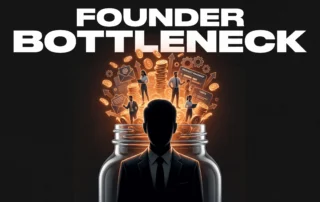
Startup Failure Statistics 2026: The 90% Myth, Debunked2026-08-17T15:20:37-04:00
18 Jul, 2026

Solopreneur Statistics 2026: 29.8M Now Build Alone

2026-08-17T15:20:44-04:00
Solopreneur statistics 2026: one person running an entire business alone from a home office
★ The Lonely Entrepreneur · 2026 Business of One Report

The Business of One: 29.8 Million Strong, and Quietly Overwhelmed

29.8 million Americans now run a business entirely alone, generating $1.7 trillion a year — yet most earn a fraction of what they say they'd need to feel successful, and one in three has seriously thought about quitting. Freedom is booming. So is the weight of carrying everything yourself. Here's what the 2026 solopreneur data actually says — and how to build without breaking.

A trillion-dollar movement — with most people near the bottom.

The average solopreneur earns $39,273 a year, but averages lie when the curve is this steep. More than a third make under $25,000, while a tiny sliver clears seven figures. Tap play to see where solopreneurs actually land.

Interactive · Chart 1
Where solopreneur income actually falls
Share of solopreneurs in each income band. Tap play.

Sources: Comparably (average earnings $39,273), QuickBooks & Leapmesh (36% under $25K, 3.6% over $1M). Middle bands are illustrative distribution estimates between those verified endpoints.

For most of business history, the plan was to grow: hire people, build a team, add layers. In 2026, a different plan has quietly become the default. Nearly 82% of all U.S. small businesses now have zero employees. The "business of one" isn't the exception anymore — statistically, it is the small business. And it's not small: collectively, America's 29.8 million solopreneurs generate $1.7 trillion in revenue, about 6.8% of total economic output.

The barrier to entry has collapsed. Nearly half of solopreneurs launched with less than $5,000, 84% used their own money instead of investors or loans, and 77% turn a profit in their very first year. On paper, it's the most accessible path to building something that's ever existed. But the same data that celebrates the freedom also exposes the cost — and the cost isn't only financial. This is the exact reality Michael Dermer built an entire company around naming: you can be your own boss, your own team, and your own everything, and still feel profoundly alone doing it.

Going solo gives you total freedom and total weight in the same breath. The freedom is what everyone sees. The weight is what you carry alone at 11 p.m.
— Michael Dermer

Read one way, that's the American dream, decentralized. Read another way, it's 29.8 million people quietly carrying more than they signed up for. The next chart shows why "solo" and "alone" turn out to be very different things.

Going solo is quietly harder on your head.

Counterintuitively, having employees seems to reduce stress rather than add to it — because there's someone to share the weight. Toggle between the two groups to see how the burden shifts when you build with a team versus entirely alone.

Interactive · Chart 2
Solopreneur vs. owner with a team
Tap a button to switch the group.

Sources: QuickBooks / Simply Business — solopreneurs report 35% high stress vs 26% for owners with employees, and 35% high satisfaction vs 44%. Comparison values marked "~" are directional context estimates.

Why "just grind harder" is the wrong lever — and what the data proves

Here's the trap. The default solopreneur response to falling short is to treat it as a personal failing to be overpowered: work longer, wear every hat better, don't let anyone see the cracks. That instinct feels like discipline. The data says it's the opposite — it's the mechanism that turns a hard season into a health crisis. Because the two problems at the center of the picture, stress and isolation, don't respond to effort. You cannot out-work being the only person in the building. Every extra solo hour makes the isolation worse, not better.

And the numbers show the toll isn't abstract. 35% of solopreneurs report high stress versus 26% of owners with employees, only 35% report high satisfaction versus 44%, and 34% have seriously considered giving up — with 72% of those citing financial stress and inconsistent income. Beneath all of it, 13% report feeling lonely or isolated working without colleagues. The variable that best predicts whether a solopreneur endures isn't how many hats they can wear. It's whether they have anyone to share the weight with.

You cannot out-work isolation — every solo hour at the desk deepens it. The move isn't to grind harder. It's to stop building it entirely by yourself.
— Michael Dermer

So if the workload isn't really the enemy, what is? The most revealing number in the dataset is the gap between what solopreneurs earn and what they believe they need.

The silent gap: they earn $39K, they say they need $219K.

This is the number that stops people. Solopreneurs report needing an average of $219,000 a year to feel successful — more than five times what the typical solo business actually brings in. Watch the gap open up.

Interactive · Chart 3
The earn-vs-feel-successful gap
Two numbers that shouldn't be this far apart.
The typical solopreneur reaches roughly 18% of their own definition of success. Add that 68% have under six months of savings and 48% have gone a month without income, and the "freedom" starts to look a lot like pressure.

Sources: Comparably (average earnings $39,273), QuickBooks (perceived-success income $219,000; 68% under six months savings; 48% have gone a month with no income).

Why the expectation gap — not the income — is the real enemy

Sit with those two numbers side by side: $39,273 earned, $219,000 needed to feel successful. That gap is the whole ballgame. It means the overwhelming majority of solopreneurs, even the profitable ones, are quietly measuring a one-person business against a whole-company definition of success — and losing that comparison every single day. They assume the shortfall is a private defect rather than the near-universal condition the data proves it to be. And that assumption is self-reinforcing: the more you believe everyone else has it figured out, the less likely you are to say the truth out loud, which keeps everyone else believing the same lie.

This is Dermer's core insight rendered in survey data. The Lonely Entrepreneur exists precisely because the pressure of building is both nearly universal and almost never discussed — a combination that makes it uniquely corrosive. When a solopreneur finally hears that a third of their peers have thought about quitting too, that most earn far less than the number in their head, the relief isn't small; it's structural. The shame that kept the struggle private loses its grip. The problem was never that they aren't working hard enough. It's that the entire culture of entrepreneurship rewards the performance of thriving, and almost no one admits how heavy the "freedom" actually is.

The first time a solopreneur hears that most others fall short of the number too, something breaks open. Shame can't survive company. That's the entire premise.
— Michael Dermer

Closing that gap doesn't require earning $219K overnight. It requires two things solopreneurs can act on this week: knowing the pressure is normal, and building leverage so you're not doing every job alone. Which is exactly where the most hopeful data in the set comes in.

The winners aren't working harder. They're borrowing a team.

Here's the hopeful thread. Solopreneurs are rapidly using AI and selective outsourcing to scale their output without adding headcount — effectively building the team they never hired. Tap a circle for the number.

Interactive · Grid 1
How solopreneurs build leverage
Bubble size = share who use it. Tap any circle.
Tap a circle to see the exact percentage.

Source: Gusto new-business-formation report (2025) — 64% use generative AI for marketing, 37% for customer service, 36% for sales, and 1 in 3 have hired at least one contractor.

How to build without breaking — starting this week

The most hopeful thing about the solopreneur data is that the two biggest levers — leverage and connection — are also the most available. You don't need to hire a team to stop doing every job alone; you need to treat "solo" as an ownership structure, not a do-everything-yourself mandate. The first move is the simplest: automate the repetitive. 64% of solopreneurs already use AI for marketing — the ones pulling ahead push it further, into customer service, admin, and sales, freeing their own hours for the work only they can do.

The second move is to build connection into the structure of your week instead of hoping it happens by accident. The stress and satisfaction gaps between solo and team-based owners are, at root, a gap in who you can share the weight with — and that's closeable without hiring anyone. A standing call with other founders, a peer group, a community built for people running a business of one: these address the actual problem, and they're the ones missing from most solopreneurs' routines. The third move is to protect the number that quietly decides who survives — runway. With 68% of solopreneurs holding under six months of savings and 48% having gone a month with no income, predictable cash flow isn't a nicety; it's the maintenance that keeps the person running the business from becoming another statistic.

It's not enough to tell a solopreneur to "work smarter" — a better to-do list doesn't touch the isolation. You give them leverage so they're not doing every job alone, and one room of people who get it, and the weight starts to lift.
— Michael Dermer

The failure mode here isn't laziness — solopreneurs are, by definition, among the most self-reliant people alive. It's isolation disguised as independence: mistaking the refusal to build leverage or ask for help as toughness, when the data shows it's the single biggest predictor of who burns out. Effort spent proving you can do it all alone burns the person out. Effort spent building leverage and real connection is what lets a solopreneur carry the weight for the long haul.

What the solopreneur data is really measuring

Zoom out from the percentages and the numbers are measuring something the entrepreneurial world has been structurally unwilling to admit: that the cost of building alone is paid in the body and mind of the builder, and we've built a culture that celebrates the freedom while hiding the weight. The fact that solopreneurs are more stressed and less satisfied than owners with teams — yet keep choosing solo — tells you the demand for autonomy is enormous, but the support for sustaining it is almost nonexistent. That's not 29.8 million personal failings. It's a systemic blind spot.

And here's the reframe that matters: taking care of the person behind the business of one isn't a soft add-on — it's the infrastructure the business runs on. A depleted, isolated, underpaid solopreneur makes worse decisions, sells worse, and quits sooner; that's the 34% who've considered giving up. The data on leverage and connection isn't a wellness nicety; it's a survival strategy for the enterprise itself. A world where solopreneurs knew the pressure was normal, built leverage instead of grinding, and wired connection into their weeks isn't just a kinder world — it's one with more businesses that make it, because more of the people building them do. The freedom of the business of one isn't going away. The loneliness of it can. That's the whole reason this company has a name.

The freedom is real. So is the weight. You don't carry it alone.

The 2026 data is blunt: 29.8 million solopreneurs generating $1.7 trillion, 77% profitable in year one — and yet most earn a fraction of what they say they need, a third have thought about quitting, and 13% feel genuinely alone. Read one way, that's a pressure cooker. Read another way, it's the most solvable problem in entrepreneurship — because the thing making it worse is the myth that you have to do it all yourself, and that myth breaks the moment one solopreneur tells another the truth. The difference between one who burns out and one who endures isn't how many hats they can wear. It's whether they build leverage, and whether they build alone.

You get one day to believe you're the only one carrying this much. The next day, you find out millions of us are too — and you stop building alone.
— Michael Dermer

You were never meant to build this alone.

29.8 million people are running a business of one — and most think the pressure is theirs alone to carry. 250,000+ builders use The Lonely Entrepreneur to trade the isolation for a community that actually understands what you're holding.

Join the Learning Community

A room of 250,000+ people who get it — where the weight of building solo finally has company, and the frameworks to run your business of one without running yourself into the ground.

Find your people →

Work with Sidekick

Your AI-powered second brain for the business of one — built to give you the leverage the top solopreneurs already use, so you're never carrying every job alone.

Get a Sidekick →

Frequently asked questions

Building a business alone can take a real toll. If you're personally dealing with chronic stress, burnout, anxiety, or thoughts of self-harm, please reach out to a mental-health professional or a trusted person in your life — you don't have to carry it alone. In the US, you can call or text 988 to reach the Suicide & Crisis Lifeline, 24/7.

'+ '
'+s.v+'%
'; race.appendChild(row); }); var raced=false; function racePlay(){if(raced)return;raced=true;race.querySelectorAll('.rfill').forEach(function(f){f.style.width=Math.min(f.dataset.w,100)+'%';});} root.querySelector('#incomePlay').addEventListener('click',racePlay); /* ---- ELEMENT 2: SOLO-VS-TEAM TOGGLE ---- */ var cmpData=[ { // solopreneur note:'Solopreneurs carry more stress and less satisfaction than owners with teams. Fewer people to manage — but no one to share the weight with. 34% have seriously considered giving up, and 13% report feeling genuinely lonely.', rows:[ {lab:'High stress',v:35,c:'#e0405a'}, {lab:'High satisfaction',v:35,c:'#3fd08a'}, {lab:'Considered quitting',v:34,c:'#f7a008'}, {lab:'Feel lonely / isolated',v:13,c:'#8a7dff'} ] }, { // owner with team note:'Owners with a team report lower stress (26%) and higher satisfaction (44%). Managing people adds work — but sharing the weight, and having colleagues in the building, appears to buffer the isolation solopreneurs feel.', rows:[ {lab:'High stress',v:26,c:'#e0405a'}, {lab:'High satisfaction',v:44,c:'#3fd08a'}, {lab:'Considered quitting',v:22,c:'#f7a008'}, {lab:'Feel lonely / isolated',v:4,c:'#8a7dff'} ] } ]; var cmpBars=root.querySelector('#cmpBars'),cmpNote=root.querySelector('#cmpNote'), cmpBtns=root.querySelectorAll('#cmpToggle .t-tbtn'); function renderCmp(g){ var d=cmpData[g]; cmpBars.innerHTML=d.rows.map(function(r){ return '
'+r.lab+'
'+ '
'+ '
'+r.v+'%
'; }).join(''); cmpNote.innerHTML=d.note; requestAnimationFrame(function(){ var fills=cmpBars.querySelectorAll('.sbfill'); d.rows.forEach(function(r,i){fills[i].style.width=r.v+'%';}); }); } cmpBtns.forEach(function(b){ b.addEventListener('click',function(){ cmpBtns.forEach(function(x){x.classList.remove('active');}); b.classList.add('active'); renderCmp(+b.dataset.g); }); }); /* ---- ELEMENT 3: SUCCESS GAP ---- */ var gap=root.querySelector('#gapViz'); gap.innerHTML= '
Income solopreneurs say they need to feel successful$219K
'+ '
What the average solopreneur actually earns$39.3K
'; /* ---- ELEMENT 4: AI-LEVERAGE BUBBLES ---- */ var lever=[ {n:'AI for marketing',v:64,c:'#f75008'}, {n:'AI for customer service',v:37,c:'#f7a008'}, {n:'AI for sales',v:36,c:'#5b8def'}, {n:'Hired a contractor',v:33,c:'#3fd08a'} ]; var bubbles=root.querySelector('#leverBubbles'),leverNote=root.querySelector('#leverNote'); lever.forEach(function(b){ var size=60+b.v*1.6; // px diameter var el=document.createElement('div');el.className='t-bubble'; el.style.width=size+'px';el.style.height=size+'px';el.style.background=b.c; el.innerHTML=''+b.n+''; el.addEventListener('click',function(){leverNote.innerHTML=''+b.n+' — used by '+b.v+'% of solopreneurs to build leverage without adding headcount.';}); bubbles.appendChild(el); }); /* ---- reveal-on-scroll ---- */ if('IntersectionObserver' in window){ var seen={}; var io=new IntersectionObserver(function(e){ e.forEach(function(x){ if(!x.isIntersecting)return;var id=x.target.id; if(id==='cmpBars'&&!seen.c){seen.c=1;renderCmp(0);} if(id==='gapViz'&&!seen.g){seen.g=1;gap.querySelectorAll('.gfill').forEach(function(f){f.style.width=f.dataset.w+'%';});} if(id==='leverBubbles'&&!seen.b){seen.b=1;bubbles.classList.add('play');} }); },{threshold:.3}); io.observe(cmpBars);io.observe(gap);io.observe(bubbles); } else { renderCmp(0); gap.querySelectorAll('.gfill').forEach(function(f){f.style.width=f.dataset.w+'%';}); bubbles.classList.add('play'); } /* ---- FAQ ---- */ var faqs=[ ['How many solopreneurs are there in the US?','There are approximately 29.8 million solopreneurs in the United States \u2014 business owners operating with zero employees. They collectively generate about $1.7 trillion in revenue, roughly 6.8% of total economic output, and 81.9% of all US small businesses now have no employees.'], ['How much does the average solopreneur earn?','The average solopreneur earns about $39,273 per year, but the distribution is heavily skewed. Around 36% earn under $25,000 while only 3.6% bring in more than $1 million. Notably, solopreneurs say they\u2019d need to earn roughly $219,000 a year to feel successful \u2014 more than five times the actual average.'], ['Is solopreneurship profitable?','Often, yes \u2014 77% of solopreneurs are profitable in their first year, helped by very low startup costs (nearly half start with under $5,000, and 84% use their own money). But profitability doesn\u2019t equal security: 68% have less than six months of savings and 48% have gone at least a month without income.'], ['Is being a solopreneur lonely or stressful?','The data says yes, more than running a team. 35% of solopreneurs report high stress versus 26% of owners with employees, only 35% report high satisfaction versus 44%, 34% have considered giving up, and 13% feel lonely or isolated. Fewer people to manage \u2014 but no one to share the weight with.'], ['How can solopreneurs build without burning out?','The two biggest levers are the most available: build leverage and build connection. Use AI and selective outsourcing so you\u2019re not doing every job alone (64% already use AI for marketing), wire regular peer connection into your week, and protect your runway. If you\u2019re personally in crisis, reach out to a professional; in the US you can call or text 988.'] ]; root.querySelector('#tFaq').innerHTML=faqs.map(function(f){return '
'+f[0]+'

'+f[1]+'

';}).join(''); })();
Solopreneur Statistics 2026: 29.8M Now Build Alone2026-08-17T15:20:44-04:00
17 Jul, 2026

Founder Loneliness & Mental Health: 87.7% Struggle in 2026

2026-08-17T15:20:50-04:00
★ The Lonely Entrepreneur · 2026 Founder Wellbeing Report

The Loneliest Job in America: 87.7% of Founders Are Silently Struggling

Nearly nine in ten entrepreneurs struggle with at least one mental health issue — anxiety, high stress, burnout, isolation — yet only 18.5% even know that founder-specific support exists. The people building everything are the least likely to ask for help, and the most likely to feel alone while surrounded by their own teams. This is the exact problem The Lonely Entrepreneur was built to solve. Here's what the 2026 data actually says — and how to stop suffering in silence.

It's not one thing. It's a stack of them.

When 227 founders across 46 countries were asked which mental-health issues they face, 87.7% named at least one — and most named several. Tap play to see how the burden stacks up.

Interactive · Chart 1
What founders actually struggle with
Share reporting each issue. Tap play.

Source: Founder Reports Entrepreneur Mental Health Survey (227 entrepreneurs, 46 countries). Respondents could select multiple issues; 87.7% selected at least one, only 12.3% selected none.

There's a cropped version of entrepreneurship that shows up on stage and in headlines: the raise, the launch, the exit. And then there's the version that plays out at 11 p.m. when everyone's gone home and the founder is still at the desk, carrying decisions no one else can make and worries no one else can see. The 2026 data on founder mental health is a portrait of that second version — and it's far more common than the first. 87.7% of entrepreneurs struggle with at least one mental health issue. Only 12.3% report none at all.

The specifics are sobering. Half of all founders — 50.2% — struggle with anxiety, a rate that dwarfs the roughly 31% lifetime prevalence in the general adult population. 45.8% carry high stress, 39.2% financial worries, 34.4% burnout, 31.7% impostor syndrome. And running quietly beneath all of it, 26.9% report loneliness and isolation — the one issue nobody puts on a pitch deck. This is the founder's reality that Michael Dermer built an entire company around naming: you are surrounded by people, responsible for people, and still, somehow, profoundly alone.

The world sees the business. It never sees the person carrying it. Loneliness isn't a lack of people around you — it's a lack of anyone who understands what you're holding.
— Michael Dermer

Read one way, that's a mental-health crisis hiding in plain sight. Read another way, it's the single most fixable problem in entrepreneurship — because the thing making it worse isn't the workload. It's the silence.

Loneliness hits the young. Anxiety hits the seasoned.

The struggle isn't the same at every stage. Younger founders are far more likely to feel isolated; older founders carry more anxiety. Toggle between the two groups to see how the burden shifts with experience.

Interactive · Chart 2
Founder struggles by age group
Tap a button to switch the cohort.

Source: Founder Reports 2026. Under-35 founders: 30.7% loneliness, 47.2% anxiety. 35+ founders: 21.2% loneliness, 54.5% anxiety. Other values shown are the survey-wide rates for context.

Why "just push through" is the wrong lever — and what the data proves

Here's the trap. The default founder response to struggle is to treat it as a personal failing to be overpowered: work harder, sleep less, don't let anyone see the cracks. That instinct feels like discipline. The data says it's the opposite — it's the mechanism that turns a hard season into a health crisis. Because the issue at the center of the whole picture, loneliness, doesn't respond to effort. You cannot out-work isolation. Every extra hour alone at the desk makes it worse, not better.

And loneliness isn't a side effect — it's an amplifier. A founder who's anxious and connected has someone to reality-test the fear with; a founder who's anxious and isolated spirals. The same stressor lands completely differently depending on whether anyone else knows you're carrying it. That's why the support-system data is the most important finding in the entire survey: 70.6% of female founders report having a support system to talk openly about mental health, versus just 52.5% of men — and men are correspondingly more likely to report burnout and depression. The variable that best predicts how a founder weathers the storm isn't how tough they are. It's whether they're carrying it alone.

You cannot out-work loneliness — every hour alone at the desk deepens it. The move isn't to push harder. It's to stop carrying it by yourself.
— Michael Dermer

So if connection is the antidote, why don't more founders reach for it? The answer is the most damning number in the whole dataset.

The silent gap: struggling everywhere, help nowhere.

Here's the tragedy in one comparison. Almost nine in ten founders are struggling — but fewer than one in five even knows that founder-specific mental-health support exists. Watch the gap open up.

Interactive · Chart 3
The struggle-to-support gap
Two numbers that shouldn't be this far apart.
The problem is nearly universal. The awareness of a solution is nearly absent. That distance — not the struggle itself — is what keeps founders suffering alone.

Source: Founder Reports 2026 — 87.7% struggle with ≥1 mental health issue; only 18.5% are aware of mental-health resources built specifically for entrepreneurs (56.4% unaware, 25.1% "somewhat").

Why the awareness gap — not the workload — is the real enemy

Sit with those two numbers side by side: 87.7% struggling, 18.5% aware help exists for them. That gap is the whole ballgame. It means the overwhelming majority of founders in pain don't know there's a door, let alone where to find it. They assume what they're feeling is unique to them, a private defect rather than the near-universal condition the data proves it to be. And that assumption is self-reinforcing: the more you believe you're the only one struggling, the less likely you are to say it out loud, which keeps everyone else believing the same lie.

This is Dermer's core insight rendered in survey data. The Lonely Entrepreneur exists precisely because the loneliness of building is both nearly universal and almost never discussed — a combination that makes it uniquely corrosive. When a founder finally hears that 87.7% of their peers are carrying something too, the relief isn't small; it's structural. The shame that kept the struggle private loses its grip. The problem was never that founders are weak. It's that the entire culture of entrepreneurship rewards the performance of invincibility, and 56.4% of founders have never even encountered the idea that support built for their specific reality is out there.

The first time a founder realizes 87.7% of others feel it too, something breaks open. Shame can't survive company. That's the entire premise.
— Michael Dermer

Closing that gap doesn't require a breakthrough in psychology. It requires two things founders can act on this week: knowing the struggle is normal, and knowing where to bring it. But before that, it's worth looking honestly at what founders currently do to cope — because some of it helps, and some of it just delays the reckoning.

How founders actually cope.

When asked what they do to take care of themselves, founders lean on movement, rest, and reading. Notice what's near the bottom: the connection-based practices that actually address the loneliness. Tap a circle for the number.

Interactive · Grid 1
Self-care practices founders use
Bubble size = share who use it. Tap any circle.
Tap a circle to see the exact percentage.

Source: Founder Reports 2026 — light workout 64.3%, rest/relaxation 56.8%, reading 48%, intense workout 42.7%, TV 38.8%, meditation 38.3%, breathing 32.6%, prayer 27.3%. Solo activities dominate; peer connection is notably absent from the list.

How to stop suffering in silence — starting this week

The most hopeful thing about the founder mental-health data is that the single biggest lever — connection — is also the most available. You don't need a clinical breakthrough to move the needle on isolation; you need people who understand what you're carrying. The first move is the simplest and the hardest: say it out loud to one person who gets it. Not your investors, not your team, but a peer, a coach, or a therapist. The support-system gap between founders who thrive and founders who crater is almost entirely a gap in who they can talk to honestly — and that gap is closeable in a single conversation.

The second move is to build connection into the structure of your week instead of hoping it happens by accident. Notice from the self-care data that founders overwhelmingly cope alone — workouts, reading, TV — all valuable, none of which touch the loneliness. A standing call with other founders, a peer group, a community built for people doing exactly what you're doing: these are the practices that address the actual problem, and they're the ones missing from most founders' routines. The third move is to protect the basics the data shows founders neglecting — 21.6% report sleep disorders, and the "push through" culture treats rest as optional. It isn't. Rest, sleep, and a genuine off-switch aren't indulgences; they're the maintenance that keeps the person running the business from becoming another statistic.

It's not OK to just tell a founder to "practice self-care" — a solo workout doesn't touch isolation. You give them one honest conversation and one room of people who get it, and the loneliness starts to lift.
— Michael Dermer

The failure mode here isn't weakness — founders are, by definition, among the most resilient people alive. It's isolation disguised as strength: mistaking the refusal to ask for help as toughness, when the data shows it's the single biggest predictor of who breaks. Effort spent performing invincibility burns the person out. Effort spent building real connection is what lets a founder carry the weight for the long haul.

What the founder mental-health data is really measuring

Zoom out from the percentages and the survey is measuring something the entrepreneurial world has been structurally unwilling to admit: that the cost of building is paid in the body and mind of the builder, and that we've built a culture designed to hide that cost. The fact that 58.6% of founders are more concerned about their mental health than their physical health — and yet only 18.5% know where to turn — tells you the demand for support is enormous and the supply of awareness is almost nonexistent. That's not a personal failing playing out 227 times. It's a systemic blind spot.

And here's the reframe that matters: taking care of the founder isn't a soft add-on to building a business — it's the infrastructure the business runs on. A depleted, isolated, anxious founder makes worse decisions, leads worse, and quits sooner. The data on connection isn't a wellness nicety; it's a survival strategy for the enterprise itself. A world where founders knew the struggle was normal, knew where to bring it, and built connection into their weeks isn't just a kinder world — it's one with more businesses that make it, because more of the people building them do. The loneliness of entrepreneurship isn't going away. The silence around it can. That's the whole reason this company has a name.

The struggle is nearly universal. The silence is a choice.

The 2026 data is blunt: 87.7% of founders struggle with their mental health, half battle anxiety, more than a quarter feel profoundly alone, and fewer than one in five know that help built for them even exists. Read one way, that's a crisis. Read another way, it's the most solvable problem in entrepreneurship — because the thing making it worse is silence, and silence breaks the moment one founder tells another the truth. The difference between a founder who burns out and one who endures isn't how much they can carry. It's whether they carry it alone. The loneliness chooses no one. You choose whether to face it in silence — or in company.

You get one day to believe you're the only one who feels this way. The next day, you find out 87.7% of us do too — and you stop building alone.
— Michael Dermer

You were never meant to build this alone.

87.7% of founders are struggling — and most think they're the only one. 250,000+ builders use The Lonely Entrepreneur to trade the silence for a community that actually understands what you're carrying.

Join the Learning Community

A room of 250,000+ people who get it — where the loneliness of building finally has company, and honest conversations are the norm, not the exception.

Find your people →

Work with Sidekick

Your AI-powered partner for the hard, lonely calls of building something real — so you never have to face a tough decision with no one to talk it through.

Get a Sidekick →

Frequently asked questions

Mental health is a sensitive topic, and founder struggles are real. If you're personally dealing with anxiety, depression, burnout, or thoughts of self-harm, please reach out to a mental-health professional or a trusted person in your life — you don't have to carry it alone. In the US, you can call or text 988 to reach the Suicide & Crisis Lifeline, 24/7.

'+ '
'+s.v+'%
'; race.appendChild(row); }); var raced=false; function racePlay(){if(raced)return;raced=true;race.querySelectorAll('.rfill').forEach(function(f){f.style.width=f.dataset.w+'%';});} root.querySelector('#issuePlay').addEventListener('click',racePlay); /* ---- ELEMENT 2: AGE-SPLIT TOGGLE ---- */ var ageData=[ { // under 35 note:'Founders under 35 feel the isolation most sharply — 30.7% report loneliness, the highest of any group. Younger founders are more likely to be single and building without a family support system at home.', rows:[ {lab:'Loneliness / isolation',v:30.7,c:'#8a7dff'}, {lab:'Anxiety',v:47.2,c:'#e0405a'}, {lab:'High stress',v:45.8,c:'#f7a008'}, {lab:'Burnout',v:34.4,c:'#5b8def'} ] }, { // 35+ note:'Founders 35 and over carry more anxiety (54.5%) but feel less isolated (21.2%) — many have families and longer-standing support networks, which buffer the loneliness even as the weight of responsibility grows.', rows:[ {lab:'Loneliness / isolation',v:21.2,c:'#8a7dff'}, {lab:'Anxiety',v:54.5,c:'#e0405a'}, {lab:'High stress',v:45.8,c:'#f7a008'}, {lab:'Burnout',v:34.4,c:'#5b8def'} ] } ]; var ageBars=root.querySelector('#ageBars'),ageNote=root.querySelector('#ageNote'), ageBtns=root.querySelectorAll('#ageToggle .t-tbtn'); function renderAge(g){ var d=ageData[g]; ageBars.innerHTML=d.rows.map(function(r){ return '
'+r.lab+'
'+ '
'+ '
'+r.v+'%
'; }).join(''); ageNote.innerHTML=d.note; // animate widths next frame requestAnimationFrame(function(){ var fills=ageBars.querySelectorAll('.sbfill'); d.rows.forEach(function(r,i){fills[i].style.width=r.v+'%';}); }); } ageBtns.forEach(function(b){ b.addEventListener('click',function(){ ageBtns.forEach(function(x){x.classList.remove('active');}); b.classList.add('active'); renderAge(+b.dataset.g); }); }); /* ---- ELEMENT 3: AWARENESS GAP ---- */ var gap=root.querySelector('#gapViz'); gap.innerHTML= '
Struggling with ≥1 mental health issue87.7%
'+ '
Aware founder-specific help exists18.5%
'; /* ---- ELEMENT 4: SELF-CARE BUBBLES ---- */ var care=[ {n:'Light workout',v:64.3,c:'#f75008'}, {n:'Rest / relax',v:56.8,c:'#f7a008'}, {n:'Reading',v:48,c:'#5b8def'}, {n:'Intense workout',v:42.7,c:'#3fd08a'}, {n:'Television',v:38.8,c:'#8a7dff'}, {n:'Meditation',v:38.3,c:'#e0405a'}, {n:'Breathing',v:32.6,c:'#5b8def'}, {n:'Prayer',v:27.3,c:'#3fd08a'} ]; var bubbles=root.querySelector('#careBubbles'),careNote=root.querySelector('#careNote'); care.forEach(function(b){ var size=54+b.v*1.35; // px diameter var el=document.createElement('div');el.className='t-bubble'; el.style.width=size+'px';el.style.height=size+'px';el.style.background=b.c; el.innerHTML=''+b.n+''; el.addEventListener('click',function(){careNote.innerHTML=''+b.n+' — used by '+b.v+'% of founders as a self-care practice.';}); bubbles.appendChild(el); }); /* ---- reveal-on-scroll ---- */ if('IntersectionObserver' in window){ var seen={}; var io=new IntersectionObserver(function(e){ e.forEach(function(x){ if(!x.isIntersecting)return;var id=x.target.id; if(id==='ageBars'&&!seen.a){seen.a=1;renderAge(0);} if(id==='gapViz'&&!seen.g){seen.g=1;gap.querySelectorAll('.gfill').forEach(function(f){f.style.width=f.dataset.w+'%';});} if(id==='careBubbles'&&!seen.c){seen.c=1;bubbles.classList.add('play');} }); },{threshold:.3}); io.observe(ageBars);io.observe(gap);io.observe(bubbles); } else { renderAge(0); gap.querySelectorAll('.gfill').forEach(function(f){f.style.width=f.dataset.w+'%';}); bubbles.classList.add('play'); } /* ---- FAQ ---- */ var faqs=[ ['What percentage of entrepreneurs struggle with mental health?','87.7% of entrepreneurs struggle with at least one mental health issue, according to a Founder Reports survey of 227 entrepreneurs across 46 countries. Only 12.3% reported none. The most common issues are anxiety (50.2%), high stress (45.8%), financial worries (39.2%), burnout (34.4%) and impostor syndrome (31.7%).'], ['Do entrepreneurs really feel lonely?','Yes. 26.9% of entrepreneurs report struggling with loneliness and isolation — and it\u2019s often overlooked because founders are surrounded by people yet functionally alone in the decisions they carry. It\u2019s most acute among founders under 35 (30.7%) and those running remote or online businesses.'], ['Why is founder loneliness so common?','Founders carry decisions and pressures no one else on the team fully shares, and entrepreneurial culture rewards the appearance of invincibility. The result is people who are surrounded by others but have no one to be honest with. Crucially, only 18.5% of founders are even aware that mental-health support built for entrepreneurs exists.'], ['Is entrepreneurship worse for mental health than a regular job?','The data suggests the specific pressures are more intense. Anxiety affects about 50% of entrepreneurs versus roughly 31% lifetime prevalence in the general adult population, and depression appears more common among founders than in the general population. The combination of financial risk, isolation, and always-on responsibility is a particularly heavy load.'], ['How can founders cope with loneliness and burnout?','The single most effective lever is connection: talk honestly to one peer, coach, or therapist, and build regular peer connection into your week rather than coping alone. The self-care data shows founders lean heavily on solo activities (workouts, reading) that don\u2019t address isolation. Also protect the basics \u2014 sleep, rest, and a real off-switch. If you\u2019re in crisis, reach out to a professional; in the US you can call or text 988.'] ]; root.querySelector('#tFaq').innerHTML=faqs.map(function(f){return '
'+f[0]+'

'+f[1]+'

';}).join(''); })();
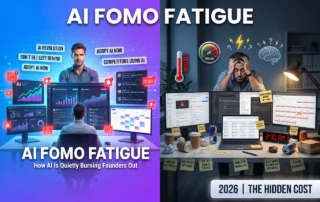
Founder Loneliness & Mental Health: 87.7% Struggle in 20262026-08-17T15:20:50-04:00
17 Jul, 2026

Freelance Economy Statistics 2026: 72.9M Now Work Solo

2026-08-17T15:20:56-04:00
Freelance economy 2026: an independent worker using AI tools to run a one-person business
★ The Lonely Entrepreneur · 2026 Independent Work Report

The Freelance Economy: 72.9 Million Americans Now Work for Themselves

The independent workforce isn't a side story anymore — it's 72.9 million Americans, a record 5.6 million of them earning six figures, and $1.5 trillion in skilled-freelancer earnings. But the real headline of 2026 isn't the size. It's the split: freelancers are adopting AI faster than employees, capturing every saved hour as their own, and repricing their skills in weeks instead of annual review cycles. Here's what the data actually says — and how to end up on the right side of the divide it's opening.

"How many freelancers?" has three right answers.

The single biggest trap in gig-economy data is the definition. Depending on who's counting — and what they count — the answer swings by more than 6×. Tap a bar to see exactly what it measures.

Interactive · Chart 1
US independent workforce, by definition
Millions of people. Tap a bar.
Tap any bar to see what that source actually counts.

Sources: MBO Partners State of Independence (Sept 2025) — 72.9M; Upwork Future Workforce Index (Apr 2025) — ~20M skilled knowledge workers; US BLS Contingent Work Supplement (July 2023 wave, pub. Nov 2024) — 11.9M independent contractors. Three definitions, all correct for what they measure.

The most important number in American work isn't the unemployment rate — it's the one that says 72.9 million people no longer wait for a paycheck to arrive from someone else. That's MBO Partners' 2025 count of US independent workers, the 15th consecutive year they've measured it, and it's up again from 72.7 million in 2024. Within that total, 27.6 million work independently full-time, while 37.4 million earn independent income at least monthly. However you slice it, tens of millions of Americans are running a business of one.

But the headline everyone repeats — "half of America will freelance by 2027" — is a zombie stat, a 2017 projection that never came true and should be retired. The real story in 2026 is quieter and far more interesting: the independent workforce is growing slowly in headcount but rapidly in value. A record 5.6 million independents now earn $100,000 or more, up 19% in a single year and nearly double the 3 million of 2020. Skilled freelancers collectively earned $1.5 trillion. This is the two-track economy Michael Dermer keeps naming, showing up as a genuine, growing path to ownership — not a gig-work consolation prize.

The question stopped being "can you survive on your own." For millions of people, working for yourself now pays better than the job you left.
— Michael Dermer

Read one way, that's just a bigger gig economy. Read another way, it's the largest voluntary migration into entrepreneurship in modern history — millions of people learning to find clients, price work, and deliver on their own terms. And a new force is deciding who thrives in it.

The six-figure independent is no longer rare.

The top of the freelance market is growing fastest. The number of US independents earning $100k+ has nearly doubled since 2020 — and jumped 19% in just the last year. Tap play to watch it climb.

Interactive · Chart 2
US independents earning $100,000+ per year
In millions of people. Tap play.

Source: MBO Partners 2025 State of Independence (Sept 2025, vendor-reported): 3.0M ($100k+) in 2020, 4.7M in 2024, 5.6M in 2025 (+19% YoY). Intermediate years are interpolated for the trend line.

Why "more clients" is the wrong lever — and what the data proves

Here's the trap the six-figure curve hides. The default freelance playbook is linear: need more money, take more clients, work more hours. But an hour billed is still an hour spent — freelancers hit the exact same ceiling employees do, just without the salary floor. The independents pulling away from the pack aren't the ones cramming in more billable hours. They're the ones who changed what an hour produces. And in 2026, the single biggest multiplier on an independent's hour is AI.

The numbers are stark. Demand for AI-tagged freelance skills grew 109% year over year on Upwork's marketplace, comparing full-year 2025 earnings against 2024. That's not a headcount number — it's an earnings-weighted signal that clients are pouring money into exactly these skills. Independents who can wire AI into a client's systems, generate and edit AI video, or build chatbots aren't competing on hourly rate anymore; they're pricing scarce, surging capability. This is the leverage principle rendered in freelance economics: a generic hour is worth one generic hour, but an hour of scarce, in-demand skill keeps commanding a premium that rises faster than inflation.

Taking more clients is not a strategy — it's a faster treadmill with no salary underneath it. The move is to make one hour worth more, not to find a twenty-fifth hour to sell.
— Michael Dermer

So which skills are actually repricing fastest — and by how much? The marketplace data sorts them cleanly.

The AI skills clients are paying up for.

Inside that 109% aggregate surge, some categories are exploding. These are earnings-weighted demand signals — meaning client spending on each skill, not the number of freelancers doing it. Tap play to run the race.

Interactive · Chart 3
AI freelance skill demand growth · 2025 vs 2024
Year-over-year earnings growth. Tap play.

Source: Upwork In-Demand Skills 2026 (Feb 4, 2026, vendor-reported, US-originated earnings, $100k minimum category). These measure client spending growth, not freelancer headcount — "+329%" means spending on AI video work more than quadrupled, not that 329% more people do it.

Why independents are winning the AI race — and employees aren't

Look at who's actually adopting these tools and a decisive gap appears. MBO Partners found 74% of independents used generative AI in 2025, up from 65% a year earlier — and ahead of the 69% rate among traditionally employed workers. Upwork found 54% of skilled freelancers rate themselves advanced or expert with AI, and 62% use it several times a week versus 53% of full-time employees. Fiverr's survey found 76% of its freelancers use AI, and 98% of those plan to keep. Every source that measures both populations finds the same thing: independents are out-adopting employees.

The reason isn't that freelancers are smarter or younger. It's that they capture the value directly. When an employee saves nine hours a week with AI, that time mostly evaporates into more meetings or someone else's backlog — the salary is the same either way. When an independent saves those same nine hours (and MBO says AI-using independents save an average of nine hours weekly), it becomes their gain: more billable capacity, faster turnaround, higher margins, or simply a shorter work week. The incentive is pure and immediate, and it shows up in behavior. This is Dermer's "playground where nobody else is playing" — the freelancer who leans into AI isn't fighting a crowd, because the incentive to do so is strongest exactly where the org chart is thinnest.

An employee who saves nine hours hands them back to the company. An independent who saves nine hours keeps every one — that's the whole game.
— Michael Dermer

The stakes compound brutally. A freelancer who ignores AI for three years competes on the same hourly rate as everyone else, in a race to the bottom. A freelancer who spent those years building an AI-augmented workflow can deliver in a fraction of the time, take on more work, and charge for outcomes instead of hours. Same profession, same starting point — a canyon of difference in trajectory. Here's exactly how the two populations compare, head to head.

Independents vs employees, head to head.

On every measure that touches AI, autonomy, and satisfaction, the independent workforce is pulling ahead. Tap any row to expand the detail behind the number.

Interactive · Grid 1
The independent advantage, by the numbers
Independents vs traditional employees. Tap a row.

Sources: MBO Partners 2025 (gen-AI use 74% vs 69%; 86% happier; 67% more financially secure); Upwork FWI 2025 (advanced AI 54%; several-times-weekly AI use 62% vs 53%; pay satisfaction 78% vs 64%). Vendor-reported.

How to end up on the right side of the divide — starting this week

The comforting thing about the freelance economy in 2026 is that the barrier isn't credentials or capital — it's a decision about where you point your hours. Nearly 80% of independents plan to stay independent or grow their business, and only 10% want to return to full-time work, while 36% of skilled employees are considering going independent. The flow is almost entirely one direction. The people already on the independent side aren't leaving; the question for everyone else is how to build a foothold that compounds instead of a hustle that just rents your time.

The first move is to pick one AI-adjacent skill that's repricing and go deep, not wide. The data hands you the shortlist: AI integration (+178%), AI data work (+154%), AI video and image (+329% and +95%), chatbot development (+71%). You don't need all of them — you need one that a client will pay a premium for, built on top of a craft you already have. The second move is to capture the hours AI saves you as an asset, not just free time: turn a repeatable client deliverable into a productized service, a template, or a small system you can sell again. The third move is to protect the boring infrastructure that keeps an independent business alive — a tax buffer, a client pipeline, and rest — because the freelancers who burn out are almost always the ones who mistook a busy month for a stable business.

It's not OK to just tell someone to "learn AI" — that's handing them a homework assignment. You give them one skill that's repricing and one system to sell twice, and the freelancing becomes a business.
— Michael Dermer

The failure mode here isn't laziness — independents are, by definition, self-starters. It's staying generic: competing on hourly rate in a crowded lane while the premium quietly migrates to the AI-augmented specialists next door. Effort spent selling undifferentiated hours burns you out. Effort spent building a scarce, in-demand capability compounds into pricing power — and pricing power is what turns a freelancer into a founder.

What the freelance boom is really measuring

Zoom out from the survey percentages and the freelance boom is measuring a structural shift in how work itself gets packaged. For most of the last century, the unit of work was the job: a bundle of tasks assigned to one person, one employer, one salary. What the 2026 data shows is that bundle coming apart. Upwork found 77% of business leaders say AI is increasing their need for specialized, fractional talent rather than full-time roles — work is being re-scoped into projects before it's re-posted as jobs. The independent workforce isn't growing in spite of that; it's growing because of it.

And here's the part that should reframe how you see it: the leadership pipeline already runs through independent work. Upwork found 63% of C-level leaders have freelanced at some point, and 42% of CEOs have done skilled freelance work in their own field. Independent work isn't the runner-up to a "real" career — for a growing share of people it is the career, and increasingly the on-ramp to running something bigger. A country where 72.9 million people already know how to earn outside a paycheck, adopt new tools faster than institutions can, and keep every hour of leverage they create, is a country one deliberate step away from a wave of real, AI-augmented businesses. The pressure isn't going away. The question is whether you use the tools it handed you to build a treadmill or a foundation.

The independent economy is real. Whether it frees you is a decision.

The 2026 data is blunt: 72.9 million Americans work independently, 5.6 million of them clear six figures, skilled freelancers earned $1.5 trillion, and demand for AI skills more than doubled in a single year. Read one way, that's a bigger gig economy. Read another way, it's the largest reservoir of entrepreneurial skill and AI-native leverage this country has ever assembled — waiting to be pointed at something that lasts. The difference between a treadmill and a foundation isn't more clients or more hours. It's a decision to build one scarce skill and one system you can sell twice, and to keep every hour of leverage you create. The economy chooses no one. You choose what your independence becomes.

You get one day to feel small next to the 72.9 million. The next day, you pick one skill, build one system, and become one of them — on your own terms.
— Michael Dermer

Turn independence into a foundation — not a faster treadmill.

72.9 million Americans already know how to earn outside a paycheck. 250,000+ builders use The Lonely Entrepreneur to turn that hard-won independence into a real, AI-augmented business that compounds instead of burning them out.

Join the Learning Community

The one-stop foundation of what it actually takes to build — with 250,000+ people creating value on their own terms.

Find your people →

Work with Sidekick

Your AI-powered guide for the day-to-day calls of building something real — so the hours AI saves you build an asset instead of just disappearing.

Get a Sidekick →

Frequently asked questions

'+d.lab+'
'; col.addEventListener('click',function(){defNote.innerHTML=d.why;}); barBox.appendChild(col); }); function drawBars(){ barBox.querySelectorAll('.bbar').forEach(function(b,i){ b.style.height=(defs[i].v/maxDef*100)+'%'; }); } /* ---- ELEMENT 2: GROWTH LINE ---- */ var svg=root.querySelector('#growSvg'); var yrs=['2020','2021','2022','2023','2024','2025']; var vals=[3.0,3.4,3.9,4.3,4.7,5.6]; // millions, $100k+ var X0=62,X1=596,Y0=40,Y1=260,MAX=6; function px(i){return X0+(X1-X0)*(i/(yrs.length-1));} function py(v){return Y1-(Y1-Y0)*(v/MAX);} var gdefs=mk('defs',{}); gdefs.innerHTML=''; svg.appendChild(gdefs); [0,2,4,6].forEach(function(v){ var y=py(v); svg.appendChild(mk('line',{class:'grid',x1:X0,y1:y,x2:X1,y2:y})); var t=mk('text',{class:'axl',x:X0-34,y:y+4});t.textContent=v+'M';svg.appendChild(t); }); svg.appendChild(mk('line',{class:'axis',x1:X0,y1:Y1,x2:X1,y2:Y1})); svg.appendChild(mk('line',{class:'axis',x1:X0,y1:Y0,x2:X0,y2:Y1})); yrs.forEach(function(yr,i){var t=mk('text',{class:'axl',x:px(i)-14,y:Y1+20});t.textContent=yr;svg.appendChild(t);}); var d='M'+px(0)+','+py(vals[0]); for(var i=1;i'+ '
+'+s.v+'%
'; race.appendChild(row); }); var raced=false; function racePlay(){ if(raced)return;raced=true; race.querySelectorAll('.rfill').forEach(function(f){f.style.width=f.dataset.w+'%';}); } root.querySelector('#racePlay').addEventListener('click',racePlay); /* ---- ELEMENT 4: COMPARISON GRID ---- */ var cmp=[ {m:'Use generative AI',ind:74,emp:69,det:'74% of independents used gen AI in 2025 (up from 65% in 2024), ahead of the 69% rate among traditionally employed workers. MBO Partners, Sept 2025.'}, {m:'Use AI several times a week',ind:62,emp:53,det:'62% of skilled freelancers use AI tools several times a week, versus 53% of full-time employees. Upwork Future Workforce Index, April 2025.'}, {m:'Satisfied with their pay',ind:78,emp:64,det:'78% of skilled freelancers report pay satisfaction, versus 64% of full-time employees. Independent full-timers out-earn employee counterparts in writing, design, and IT. Upwork, 2025.'}, {m:'Advanced/expert AI skill',ind:54,emp:34,det:'54% of skilled freelancers self-report advanced or expert AI-tool proficiency, well ahead of full-time employees. Employee figure is directional. Upwork, April 2025.'}, {m:'Happier working this way',ind:86,emp:0,det:'86% of independents say they are happier working independently and 67% feel more financially secure. No directly comparable employee figure exists \u2014 shown as an independent-only stat. MBO Partners, 2025.'} ]; var grid=root.querySelector('#cmpGrid'); grid.innerHTML='
IndependentsEmployees
'; cmp.forEach(function(c){ var empTxt=c.emp>0?c.emp+'%':'—'; var el=document.createElement('div');el.className='t-cmp'; el.innerHTML='
'+c.m+'
'+ '
'+c.ind+'%vs'+empTxt+'
'+ '
'+ '
'+c.det+'
'; el.addEventListener('click',function(){el.classList.toggle('open');}); grid.appendChild(el); }); function drawCmp(){grid.querySelectorAll('.t-cmp-ib').forEach(function(b){b.style.width=b.dataset.w+'%';});} /* ---- reveal-on-scroll for the non-button charts ---- */ if('IntersectionObserver' in window){ var seen={}; var io=new IntersectionObserver(function(e){ e.forEach(function(x){ if(!x.isIntersecting)return; var id=x.target.id; if(id==='defBars'&&!seen.d){seen.d=1;drawBars();} if(id==='cmpGrid'&&!seen.c){seen.c=1;drawCmp();} }); },{threshold:.3}); io.observe(barBox);io.observe(grid); } else { drawBars();drawCmp(); } /* ---- FAQ ---- */ var faqs=[ ['How many freelancers are there in the US in 2026?','It depends on the definition. The broadest credible count is MBO Partners: 72.9 million US independent workers in 2025, of whom 27.6 million work independently full-time. Upwork\u2019s narrower measure finds ~20 million skilled knowledge workers freelancing, and the official BLS count is 11.9 million independent contractors (2023 wave). Always check what a source counts before citing it.'], ['How much do freelancers actually earn?','Skilled freelancers collectively earned $1.5 trillion in 2024 (Upwork). Full-time skilled freelancers report a median income of $85,000, and a record 5.6 million US independents earned $100,000+ in 2025 \u2014 up 19% year over year and nearly double the 2020 figure. Earnings vary enormously by skill and market.'], ['Is the "50% of workers will freelance by 2027" stat true?','No \u2014 that\u2019s a zombie stat. It traces to a 2017 Upwork/Freelancers Union projection based on 2017 growth rates that never materialized. Current data shows about 28% of skilled knowledge workers freelance. Treat it as a historical projection, not a live forecast.'], ['Are freelancers really using AI more than employees?','Yes, consistently. MBO Partners found 74% of independents used gen AI in 2025 (vs 69% of employees), and Upwork found 62% of freelancers use AI several times a week (vs 53% of employees). The reason is incentive: an independent keeps every hour AI saves them, while an employee\u2019s salary stays the same either way.'], ['How do I turn freelancing into a real business?','Pick one AI-adjacent skill that\u2019s repricing (AI integration, video, data work, chatbots), go deep on it, and capture the hours AI saves you as an asset \u2014 a productized service, template, or small system you can sell more than once. Then protect the boring infrastructure: a tax buffer, a client pipeline, and rest.'] ]; root.querySelector('#tFaq').innerHTML=faqs.map(function(f){return '
'+f[0]+'

'+f[1]+'

';}).join(''); })();
Freelance Economy Statistics 2026: 72.9M Now Work Solo2026-08-17T15:20:56-04:00
16 Jul, 2026

AI Agents Replacing SaaS 2026: 35% of Your Stack Is Done

2026-08-17T15:21:03-04:00
AI agents replacing SaaS software tools in 2026: an entrepreneur watching autonomous software do the work
★ The Lonely Entrepreneur · 2026 Software Report

The Agent Takeover: 35% of Your Software Stack Won't Survive the Decade

For fifteen years the deal was simple: you had a job to do, so you bought software to do it — one subscription at a time. AI agents are quietly rewriting that deal. Task-specific agents will sit inside 40% of enterprise apps by 2026, organizations report up to 70% cost cuts versus equivalent SaaS spend, and the average company is already juggling 291 apps. This isn't a feature update. It's a change in what you're actually paying for — and which tools survive.

From under 5% to 40% in a single year.

Gartner projects task-specific AI agents will sit inside 40% of enterprise apps by 2026 — up from less than 5% in 2025 — then keep climbing as agents get absorbed into the tools you already use. Tap play to build the curve.

Interactive · Chart 1
AI agent adoption inside enterprise apps
Share of apps with embedded task agents. Tap play.

Sources: Gartner (Aug 2025) for 2025→2026; Deloitte/Gartner TMT Predictions 2026 and IDC (2025–26) for later years. Post-2027 points (~75% by 2030) are analyst projections, not measured adoption.

The single most important shift in business software isn't a new app — it's the death of the app as we knew it. For a decade and a half, the model was fixed: identify a task, buy a tool for it, learn its interface, pay per seat, repeat. Do that enough times and you end up where the average enterprise sits today — juggling 291 separate SaaS subscriptions, up from 110 in 2020. Small businesses aren't far behind. Every one of those tools makes you do the work inside it.

An AI agent flips that. Instead of handing you a form to fill out, it takes the goal, breaks it into steps, calls the tools itself, and comes back with the result. One is a spreadsheet. The other is a co-worker who never sleeps. That's why Gartner expects task-specific agents inside 40% of enterprise apps by 2026 and why analysts project roughly 35% of point-product SaaS tools will be replaced or absorbed into agent ecosystems by 2030. The two-track economy Michael Dermer keeps naming is showing up in software too — the tools that give you leverage, and the ones that just rent you an interface.

Seat-based pricing charges you for headcount. Agent economics charge you for outcomes. Once you feel that difference, you can't unfeel it.
— Michael Dermer

Read one way, that's a threat to a stack you've spent years assembling. Read another way, it's the biggest cost-and-leverage opportunity to hit small business in a decade. The question isn't whether to adopt agents — it's which tools to keep, which to pilot, and which to let go.

The disruption isn't spread evenly.

The categories most exposed all share one trait: they exist to run a narrow, repeatable workflow on structured data — exactly what an agent does cheaply. Here's how five common SaaS categories score across the three forces driving replacement. Tap a cell to read it.

Interactive · Grid 1
Where the replacement pressure lands
Higher = more exposed. Tap any cell.
Tap a cell to see why it scores the way it does.

Directional scoring synthesized from Gartner (Aug 2025) and Deloitte TMT Predictions 2026 category-risk analysis. Illustrative, not a vendor-level rating.

Why "just add another tool" is the wrong lever — and what the data proves

Here's the trap the heat-grid exposes. The default response to a new business need has always been linear: new problem, buy new software. That's how a company ends up with 291 apps, a tangle of subscriptions that don't talk to each other, and a monthly bill that scales with every hire. Each tool solves one slice and leaves the stitching to a human — usually you. The cost isn't just the subscriptions; it's the hours spent moving data between tools that were never designed to cooperate.

Agents attack exactly that seam. Instead of a tenth tool, one agent can read from your existing systems, do the multi-step work a human used to do by hand, and write the result back — no new interface to learn, no per-seat tax that grows with your team. This is the leverage principle rendered in software: a SaaS seat is worth exactly one seat, every time, and its cost climbs with headcount. An agent that automates a whole workflow keeps paying off as you scale, because its cost is roughly flat. Same problem, radically different economics.

Adding another app is not a strategy — it's a subscription you'll forget you're paying. The move is to make one workflow run itself, not to buy a tenth tool to babysit.
— Michael Dermer

So how does the money actually shake out when you put a per-seat tool next to a single agent doing the same job? Slide the numbers yourself.

What is your SaaS stack really costing you?

PwC found organizations report up to a 70% cost reduction versus equivalent SaaS spend. Drag the sliders to put per-seat pricing next to a single agent running the same workflow — and see where the lines cross for a team your size.

Interactive · Calculator
The build-vs-buy calculator
A directional model, not financial advice.
Team size (seats): 25
SaaS cost per seat / year: $1,000
Workflows moved to an agent: 1
$25,000 SaaS: annual, scales with seats
$8,000 Agent: annual, roughly flat
$17,000 estimated annual saving

Model: SaaS = seats × per-seat cost. Agent = ~$5k build + ~$3k/yr run (LLM API + maintenance) per workflow. Actuals vary widely — see PwC AI Agent Survey (Apr 2025, n=308 US execs) and MarketsandMarkets (2025).

Why the "boring, ownable" workflow beats the shiny new tool

Run the calculator up to a mid-size team and a quiet inversion appears: the per-seat tool that felt cheap at three people becomes the most expensive line item at fifty, while the agent barely moves. The tools most exposed to replacement are the crowded, single-purpose ones — CRM data entry, tier-1 support, weekly reporting — precisely because they automate a well-defined task that everyone runs the same way. The resilient layers are the boring, foundational ones: your database, your cloud, your identity system. Agents don't replace those; they run on top of them and make them more valuable.

This is Dermer's "playground where nobody else is playing" rendered in software economics. The barrier to capturing agent leverage isn't technical genius — it's the willingness to spend a few unglamorous hours mapping one high-volume workflow and piloting an agent on it, instead of reflexively buying the next tool. Most teams skip that step because buying is instant and building takes a week. That urgency is understandable, and it's also the exact mechanism that keeps companies trapped under 291 subscriptions. The businesses that pull ahead are the ones that protect a little time to build the thing that runs itself.

Everyone buys the tool that ships today. The advantage goes to whoever spends one week building the workflow that runs itself next year.
— Michael Dermer

The stakes compound. A company that keeps stacking per-seat tools has a bill that grows with every hire and nothing that scales without more humans. A company that moves its highest-volume workflows to agents has infrastructure that gets cheaper per unit of work as it grows. Same problems, same effort — a canyon of difference in outcome. So before you renew, it's worth knowing exactly which tools are safe and which are on the clock.

The SaaS exposure scorecard.

Not every tool is at equal risk. Some exist to run a repeatable task an agent can absorb; others are foundational layers agents depend on. Tap any column header to sort — and watch which categories rise when you sort by risk instead of by how common they are.

Interactive · Table 1
2026 SaaS categories, ranked by exposure
Tap a header to sort. "Risk by 2030" = how much of the tool's value an agent can absorb.
Category ▾ Cost cut Risk by 2030 Verdict

Categories & mechanics: Gartner (Aug 2025), Deloitte TMT Predictions 2026. Cost-cut range: PwC AI Agent Survey (Apr 2025). Risk % is a directional synthesis to compare structure, not a single published figure.

How to move from a bloated stack to an agent foundation — starting this week

The good news is you don't have to rip anything out on Monday. The teams that fail at this attempt a big-bang replacement and drown; the ones that win go one workflow at a time. Start with an audit: list your tools and, next to each, write the actual workflow it runs. Most of the 291-app sprawl turns out to be a handful of genuinely load-bearing systems plus a long tail of single-purpose tools automating narrow, repeatable tasks — and that long tail is exactly where agents pay off first.

The second move is to pick your first hill: the one workflow that's high-volume, well-defined, and expensive to run with humans — think CRM data entry, tier-1 support triage, or weekly reporting. Run an agent on it in parallel with your existing tool for 30 days, measure the result honestly, and only then phase out the subscription. The third move is to protect the foundation: don't touch your database, identity, or cloud layers — those are what your agents will run on, and they get more valuable, not less. Audit, pilot, scale. That's the whole playbook, and it's boring on purpose, because boring is what survives contact with a real business.

It's not OK to just tell someone to "adopt AI" — that's handing them a buzzword. You give them one workflow to automate this month, and the stack starts working for them instead of billing them.
— Michael Dermer

The failure mode here isn't caution — being deliberate is right. It's paralysis: staring at 291 subscriptions, deciding it's too big to touch, and renewing everything for another year. Effort spent maintaining a bloated stack burns money and hours. Effort spent moving one workflow at a time to agents compounds into a business that scales without scaling its software bill.

What the agent shift is really measuring

Zoom out from the adoption curves and the agent shift is measuring a structural change, not a passing hype cycle. For most of the SaaS era, software was sold as access: you rented a place to do the work, and the work stayed yours to do. The fact that agents can now take the goal and do the work end-to-end signals that the "rent an interface" model has quietly stopped being the ceiling of what software can be. That's the disruptive reading, and it's real. But underneath runs a more hopeful current: for the first time, a solo founder or a five-person shop can command the kind of operational leverage that used to require a whole operations team.

Every agent you deploy is, whether you'd use the word or not, a hire that doesn't churn, doesn't need a seat license, and doesn't cost more as you grow. That reframe is why the agent shift, disruptive as it is, is genuinely fertile ground for small business specifically. The incumbents with 291 apps and thousands of seats have the most to unwind; the small, nimble builder has almost nothing to unlearn and everything to gain. The pressure on the old model isn't going away. The question is whether you use it to build a foundation that scales — or keep paying per seat for the privilege of doing the work yourself.

The shift is real. Whether it frees you is a decision.

The 2026 data is blunt: agents inside 40% of apps this year, roughly 35% of point-product SaaS on track to be replaced or absorbed by 2030, up to 70% cost cuts reported, and an average stack of 291 tools quietly billing you every month. Read one way, that's a threat to everything you've built your operations on. Read another way, it's the largest leverage opportunity small business has ever been handed — the chance to run like a company ten times your size. The difference between a bloated stack and an agent foundation isn't a bigger budget. It's a decision to pick one workflow you already run and let it start running itself. The shift chooses no one. You choose what it becomes.

You get one day to feel behind on AI. The next day, you pick one workflow, pilot one agent, and turn the shift into the first step of something that's yours.
— Michael Dermer

Turn the agent shift into a foundation — not a faster subscription.

The shift from SaaS to agents is the biggest leverage opportunity small business has seen in a decade. 250,000+ builders use The Lonely Entrepreneur to figure out which tools to keep, pilot, and drop — and to make their software work for them instead of billing them.

Join the Learning Community

Deciding which tools to keep, pilot, or cut is a lonely call. Get a room of 250,000+ founders who've made it.

Find your people →

Work with Sidekick

Your AI-powered partner for the day-to-day calls of building something real — start with one workflow and see the math for yourself.

Get a Sidekick →

Frequently asked questions

'+cols.join('
')+'
'; heatRows.forEach(function(r,ri){ var name=document.createElement('div');name.className='rl';name.textContent=r.c;heat.appendChild(name); r.v.forEach(function(v,ci){ var cell=document.createElement('div');cell.className='cell'; cell.style.background=col[v];cell.textContent=lbl[v]; cell.style.transitionDelay=(ri*0.07+ci*0.04)+'s'; cell.addEventListener('click',function(){ heatNote.innerHTML=''+r.c+' — '+r.why; }); heat.appendChild(cell); }); }); heatKey.innerHTML=[[3,'High exposure'],[2,'Medium'],[1,'Low / resilient']].map(function(k){ return '
'+k[1]+'
'; }).join(''); // reveal heat if it scrolls into view first if('IntersectionObserver' in window){ var io=new IntersectionObserver(function(e){e.forEach(function(x){if(x.isIntersecting){heat.classList.add('play');io.disconnect();}});},{threshold:.3}); io.observe(heat); } else { heat.classList.add('play'); } /* ---- ELEMENT 3: CALCULATOR ---- */ var tRange=root.querySelector('#calcTeamRange'),sRange=root.querySelector('#calcSeatRange'),fRange=root.querySelector('#calcFlowsRange'), tLab=root.querySelector('#calcTeam'),sLab=root.querySelector('#calcSeat'),fLab=root.querySelector('#calcFlows'), outSaas=root.querySelector('#outSaas'),outAgent=root.querySelector('#outAgent'),outSave=root.querySelector('#outSave'), calcMsg=root.querySelector('#calcMsg'); var BUILD=5000, RUN=3000; // per workflow, yr1 function money(n){return '$'+Math.round(n).toLocaleString();} function calc(){ var team=+tRange.value, seat=+sRange.value, flows=+fRange.value; tLab.textContent=team;sLab.textContent=money(seat);fLab.textContent=flows; var saas=team*seat; var agent=flows*(BUILD+RUN); outSaas.textContent=money(saas); outAgent.textContent=money(agent); var save=saas-agent; var msg; if(save>0){ outSave.textContent=money(save); var pct=Math.round(save/saas*100); if(pct>=50)msg='This is the escape zone. At '+team+' seats, per-seat pricing is now '+pct+'% more expensive than running the same work through an agent — and that gap only widens with every hire.'; else msg='The lines have crossed. The agent is now '+pct+'% cheaper than per-seat pricing at this size, and it stays roughly flat while your SaaS bill keeps climbing.'; } else { outSave.textContent=money(0); msg='At this small size, the per-seat tool is still cheaper than building — that\u2019s normal. Slide team size up and watch the moment the agent overtakes it.'; } calcMsg.innerHTML=msg; } [tRange,sRange,fRange].forEach(function(r){r.addEventListener('input',calc);}); calc(); /* ---- ELEMENT 4: EXPOSURE TABLE ---- */ var rows=[ {name:'CRM data entry / pipeline',save:70,risk:80,verdict:'At risk'}, {name:'Customer support (tier 1–2)',save:65,risk:75,verdict:'At risk'}, {name:'Data analysis & reporting',save:60,risk:70,verdict:'At risk'}, {name:'Content operations',save:55,risk:60,verdict:'Exposed'}, {name:'Project mgmt automation',save:45,risk:50,verdict:'Exposed'}, {name:'Databases / cloud / identity',save:0,risk:15,verdict:'Resilient'} ]; var tbody=root.querySelector('#expTable tbody'), note=root.querySelector('#tableNote'), headers=root.querySelectorAll('#expTable th'); function riskPill(n){ var cls=n>=70?'t-lev-hi':n>=45?'t-lev-mid':'t-lev-lo'; return ''+n+'%'; } function render(data){ tbody.innerHTML=data.map(function(r){ var sv=r.save>0?r.save+'%':'—'; return ''+r.name+''+sv+''+riskPill(r.risk)+''+r.verdict+''; }).join(''); } var sortState={key:'risk',dir:-1}; function sortBy(key,type){ if(sortState.key===key)sortState.dir*=-1;else{sortState.key=key;sortState.dir=-1;} rows.sort(function(a,b){ var av=a[key],bv=b[key]; if(type==='txt')return sortState.dir*(''+av).localeCompare(''+bv); return sortState.dir*(av-bv); }); headers.forEach(function(h){h.classList.toggle('sorted',h.dataset.key===key);}); render(rows); if(key==='risk'&&sortState.dir===-1) note.innerHTML='Sorted by risk: the single-purpose workflow tools (CRM entry, tier-1 support, reporting) rise to the top, while your foundational layers — databases, cloud, identity — sit safely at the bottom.'; else if(key==='save'&&sortState.dir===-1) note.innerHTML='Sorted by cost cut: the tools where agents save the most are exactly the repetitive, seat-heavy ones. The foundational layers show no cut because you keep them.'; else note.innerHTML='Tap Risk by 2030 to see which tools an agent can absorb — and which foundational layers are safe.'; } headers.forEach(function(h){h.addEventListener('click',function(){sortBy(h.dataset.key,h.dataset.type);});}); sortBy('risk','num'); // initial /* ---- FAQ ---- */ var faqs=[ ['Will AI agents completely replace SaaS?','Not entirely, and not overnight. Analysts (Gartner via Deloitte) project roughly 35% of point-product SaaS tools will be replaced or absorbed into agent ecosystems by 2030. Foundational platforms — cloud, databases, identity — are largely safe. The exposed tools are single-purpose apps automating a narrow, repeatable workflow.'], ['What\u2019s the difference between an AI agent and a SaaS tool?','A SaaS tool gives you a fixed interface you adapt your workflow around. An AI agent takes a goal, plans the steps, calls the tools, acts, and revises based on the result. The agent adapts to your task; SaaS makes you adapt to it — and that gap compounds at scale.'], ['How much can agents actually save versus SaaS?','PwC\u2019s April 2025 survey of 308 US executives found organizations report up to a 70% cost reduction versus equivalent SaaS spend, with an average ROI of 171% and 74% seeing returns within the first year. A focused pilot replacing one tool can often be built for under $5,000.'], ['Which SaaS categories are most at risk?','CRM data entry and pipeline management, tier-1/2 customer support, data analysis and reporting, content operations, and project-management automation — anything built to run a narrow, repeatable workflow on structured data.'], ['Should I rip out my whole stack now?','No. The teams that fail attempt a big-bang replacement. The ones that win go Audit → Pilot → Scale: map tools to workflows, pick the highest-volume well-defined one, run an agent in parallel for 30 days, then phase out the subscription only after the ROI is proven.'] ]; root.querySelector('#tFaq').innerHTML=faqs.map(function(f){return '
'+f[0]+'

'+f[1]+'

';}).join(''); })();
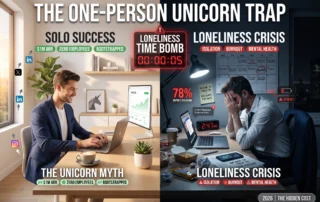
AI Agents Replacing SaaS 2026: 35% of Your Stack Is Done2026-08-17T15:21:03-04:00
16 Jul, 2026

Side Hustle Statistics 2026: Half of America Works Two Jobs

2026-08-17T15:21:09-04:00
The side hustle economy 2026: an American worker running a second business after hours from a home desk
★ The Lonely Entrepreneur · 2026 Work Report

The Side Hustle Economy: Half of America Is Now Working Two Jobs

Nearly one in two Americans earned side income this year — and for most of them it isn't a passion project. It's survival. 53% say they couldn't cover essential expenses without it, 65% report burnout, and the median hustler works 13 extra hours a week for about $1,275 a month. But buried inside a story about financial strain is the largest wave of accidental entrepreneurship in decades. Here's what the 2026 data actually says — and how to turn a survival hustle into something that compounds.

This isn't a passion economy. It's a pressure economy.

The Penny Hoarder surveyed 1,000 side-hustling US adults in February 2026. The top reasons aren't "follow my dream" — they're rent, savings, and debt. Tap a slice to see the number.

Interactive · Chart 1
Why Americans run a side hustle in 2026
Primary stated reason. Tap a segment.
29%to cover living expenses

Source: The Penny Hoarder 2026 Side Hustle Survey (1,000 US adults, Feb 2026): 29% cover living expenses, 21% build emergency savings, 12% pay down debt, 38% other/mixed goals including fulfillment.

The single most revealing fact about work in 2026 isn't buried in a labor report — it's in your neighbor's evenings. Nearly one in two Americans now earns income from a side hustle, and depending on how the question is asked, the number lands somewhere between 40% and 47%. However you count it, tens of millions of people are running a second economy after hours. And the reason they're doing it has almost nothing to do with the "follow your passion" gospel the hustle-culture influencers sell.

They're doing it because the math of a single paycheck stopped working. Household expenses now run upward of $85,000 a year while median full-time earnings sit just above $62,000 — a gap of more than $20,000 that a second income is quietly filling. So 29% of hustlers say their main reason is simply covering living expenses, 21% are building emergency savings, and 12% are paying down debt. More than 75% say inflation directly increased their reliance on side income over the past year. This is the two-track economy Michael Dermer keeps naming, showing up not as ambition but as necessity.

When half a country takes a second job to make the first one work, that's not a trend. That's a signal about the ground everyone's standing on.
— Michael Dermer

Read one way, that's a bleak picture of financial strain. Read another way, it's the largest involuntary entrepreneurship experiment in modern history — millions of people accidentally learning to sell, price, and deliver on their own. The question is whether the hustle stays a treadmill or becomes a foundation.

The hidden invoice: 65% are burning out.

The extra income shows up in a bank account. The cost shows up in the body. Only 1 in 10 hustlers never experience burnout — the other 90% feel it on a spectrum. Here's how the 1,000 respondents actually break down.

Interactive · Chart 2
Burnout among side hustlers
Share reporting each level. Hover or tap a band.

Source: The Penny Hoarder 2026 Side Hustle Survey — 65% report burnout at least sometimes; only ~10% never do. Band split is illustrative of that distribution. Related: only 44% feel "somewhat" financially secure.

Why "more hours" is the wrong lever — and what the data proves

Here's the trap the burnout number exposes. The default side-hustle playbook is linear: need more money, work more hours. The median hustler already works 13 extra hours a week — that's 676 hours a year, the equivalent of 17 additional full-time weeks stacked on top of a full-time job. And a quarter of hustlers have been doing it for more than five years. Over a working life, that's more than a decade of extra labor. Yet only 44% feel even "somewhat" financially secure. The hours went up. The security didn't follow.

That's because trading time for money has a hard ceiling: you run out of hours long before you run out of expenses. The hustlers who break out of the treadmill aren't the ones working the most hours — they're the ones who change what an hour produces. This is the leverage principle rendered in gig data. A rideshare hour is worth exactly one rideshare hour, every time. But an hour spent building an audience, a product, a repeatable service, or a skill that commands a higher rate keeps paying after the hour ends. Same effort, radically different trajectory.

Working more hours is not a strategy — it's a countdown. The move is to make one hour worth more, not to find a twenty-fifth hour in the day.
— Michael Dermer

So which hustles actually convert effort into leverage, and which just rent your time back to you? The data sorts them cleanly.

The side hustle scorecard.

Not all hustles are built the same. Some cap your income at your available hours; others build an asset that keeps earning. Tap any column header to sort — and watch which ones rise when you sort by leverage instead of by how common they are.

Interactive · Table 1
2026 side hustle types, ranked
Tap a header to sort. "Leverage" = does it earn while you sleep?
Side hustle ▾ % of hustlers Typical $/mo Leverage

Sources: The Penny Hoarder 2026 (share of hustlers: transport/delivery 25%, creative services 25%, e-commerce 21%; median all-hustle income $1,275/mo). Pay ranges and leverage scores are directional estimates to compare structure, not guaranteed earnings.

Why the "boring, ownable" hustle beats the popular one

Look closely at the table when it's sorted by leverage and a quiet inversion appears. The most common hustles — rideshare, delivery — sit at the bottom, because they're pure time-for-money with a hard ceiling and no asset left behind when you stop. The less crowded ones — a productized service, a small e-commerce line, a digital product, an owned audience — sit at the top, because each hour of work leaves something behind that can earn again. The crowd is concentrated in exactly the hustles with the least leverage, which is precisely why they're crowded: they require no building, so everyone can start tomorrow.

This is Dermer's "playground where nobody else is playing" rendered in gig economics. The barrier to a leveraged hustle isn't talent — it's the willingness to spend the first few unpaid hours building the asset instead of immediately renting your time. Most people skip that step because the pressure is immediate: rent is due now, and a delivery shift pays tonight. That urgency is completely understandable, and it's also the exact mechanism that keeps people on the treadmill. The hustlers who escape are usually the ones who carve even two or three hours a week away from the time-for-money grind and point them at something that compounds.

Everyone rushes to the hustle that pays tonight. The business gets built by the person who protects two hours a week for the thing that pays next year.
— Michael Dermer

The stakes of this choice compound brutally. A worker doing pure time-for-money hustles for five years has five years of income and nothing to show once they stop. A worker who spent those same years building an audience or a product has an asset that can eventually replace the day job entirely. Same hours, same effort — a canyon of difference in outcome. So before you add hours, it's worth doing the math on what those hours are actually buying you.

What are your extra hours really worth?

The average hustler puts in 13 extra hours a week. Drag the sliders to see your real hourly rate — and how the same hours perform if even part of them go into a leveraged asset instead of pure time-for-money.

Interactive · Calculator
The hours-to-leverage calculator
A directional model, not financial advice.
Extra hours per week: 13
Monthly side income: $1,275
Share of hours put into a leveraged asset: 0%
$22.65 your real hourly rate now
$15,300 this year, at this pace
$15,300 projected year 3 with leverage

Model: real rate = income ÷ (hours × 4.33). "Leverage" hours are assumed to build a compounding asset modeled at ~35% annual growth over 3 years; time-for-money hours stay flat. Illustrative only — real results vary widely.

How to turn a survival hustle into a foundation — starting this week

The comforting thing about the side hustle economy is that half the country has already done the hardest part: they started. Nearly one in two Americans has proven they can earn money outside a paycheck — that's a skill most people never test in a lifetime. The smartest read of the 2026 data isn't "stop hustling," which for most people isn't an option anyway. It's "convert the hustle you already have into one that compounds." Start by protecting a small, non-negotiable slice of your side-hustle hours — even two or three a week — for building something ownable rather than renting your time.

The second move is to point those protected hours at an asset, not just an activity. An audience, an email list, a productized service you can repeat, a digital product, a repeatable process — anything that keeps earning after the hour ends. The 62% who treat their hustle as job-loss insurance are right to want a backup, but a leveraged asset is a far better backup than a delivery app that vanishes the moment you stop driving. The third move is to protect yourself the way you'd protect any business: with 65% of hustlers reporting burnout and 1 in 5 not setting aside anything for taxes, the boring infrastructure — rest, a tax buffer, a real plan — is what keeps the hustle from quietly destroying the person running it.

It's not OK to just tell someone to "hustle harder" — that's handing them a faster treadmill. You give them a way to build an asset, and the hustle becomes a business instead of a sentence.
— Michael Dermer

The failure mode here isn't laziness — side hustlers are, by definition, the hardest-working people in the economy. It's aimlessness: pouring 676 hours a year into activities that leave nothing behind, instead of steering even a fraction of them toward something that accumulates. Effort spent renting your time burns you out. Effort spent building an asset compounds into freedom.

What the side hustle boom is really measuring

Zoom out from the survey percentages and the side hustle boom is measuring a structural shift, not a passing mood. For most of the last century, a single job was designed to be sufficient — one employer, one income, one career. The fact that half the country now needs a second income to make the first one work is the clearest possible signal that the single-paycheck model has quietly stopped being enough for millions of people. That's the alarming reading, and it's true. But underneath it runs a second, more hopeful current: the same pressure that forced people into side hustles also handed them the exact skills entrepreneurship requires.

Every side hustler is, whether they'd use the word or not, running a tiny business. They're finding customers, setting prices, delivering work, handling their own taxes, and managing their own time — the full curriculum of building something, learned under real conditions with real money on the line. That reframe is why the side hustle economy, strained as it is, is genuinely fertile ground. A country where half the workforce already knows how to earn outside a paycheck is a country one deliberate step away from a wave of real, owned businesses. The pressure isn't going away. The question is whether people use the skills it forced on them to build a treadmill or a foundation.

The hustle is real. Whether it frees you is a decision.

The 2026 data is blunt: nearly half of America is working a second job, 53% couldn't cover essentials without it, 65% are burning out, and the median hustler trades 13 hours a week for about $1,275 a month. Read one way, that's a portrait of financial strain. Read another way, it's the largest reservoir of entrepreneurial skill this country has ever assembled — waiting to be pointed at something that lasts. The difference between a treadmill and a foundation isn't more hours. It's a decision to protect a few of the hours you're already working and aim them at something you own. The hustle chooses no one. You choose what it becomes.

You get one day to resent the second job. The next day, you dust yourself off and turn it into the first step of something that's yours.
— Michael Dermer

Turn the hustle into a foundation — not a faster treadmill.

Half of America already knows how to earn outside a paycheck. 250,000+ builders use The Lonely Entrepreneur to turn that hard-won skill into a real, owned business that compounds instead of burning them out.

Join the Learning Community

The one-stop foundation of what it actually takes to build — with 250,000+ people creating value on their own terms.

Find your people →

Work with Sidekick

Your AI-powered guide for the day-to-day calls of building something real — so your extra hours build an asset instead of just renting your time.

Get a Sidekick →

Frequently asked questions

'; }).join(''); function focusSlice(i){ circles.forEach(function(c,j){c.classList.toggle('dim',j!==i);}); center.innerHTML=''+slices[i].val+'%'+slices[i].lab.toLowerCase()+''; } function resetSlice(){circles.forEach(function(c){c.classList.remove('dim');}); center.innerHTML='29%to cover living expenses';} circles.forEach(function(c,i){c.addEventListener('click',function(){focusSlice(i);});}); legend.querySelectorAll('.t-leg').forEach(function(l){ l.addEventListener('click',function(){focusSlice(+l.dataset.i);}); }); /* ---- CHART 2: BURNOUT STACK ---- */ var bands=[ {lab:'Often',val:28,color:'#e0405a'}, {lab:'Sometimes',val:37,color:'#f75008'}, {lab:'Rarely',val:25,color:'#5b8def'}, {lab:'Never',val:10,color:'#3fd08a'} ]; var stack=root.querySelector('#burnStack'),key=root.querySelector('#burnKey'); stack.innerHTML=bands.map(function(b){ return '
'+b.val+'%
'; }).join(''); key.innerHTML=bands.map(function(b){ return '
'+b.lab+' — '+b.val+'%
'; }).join(''); /* ---- ELEMENT 3: SORTABLE TABLE ---- */ var rows=[ {name:'Rideshare / delivery',share:25,pay:'$900–$1,600',payN:1250,lev:2}, {name:'Creative services (freelance)',share:25,pay:'$800–$3,000',payN:1900,lev:6}, {name:'E-commerce / reselling',share:21,pay:'$500–$4,000',payN:2250,lev:8}, {name:'Content creation / audience',share:14,pay:'$0–$5,000+',payN:2500,lev:9}, {name:'Tutoring / coaching',share:9,pay:'$600–$2,500',payN:1550,lev:5}, {name:'Digital products / courses',share:6,pay:'$0–$6,000+',payN:3000,lev:10} ]; var tbody=root.querySelector('#hustleTable tbody'), note=root.querySelector('#tableNote'), headers=root.querySelectorAll('#hustleTable th'); function levPill(n){ var cls=n>=8?'t-lev-hi':n>=5?'t-lev-mid':'t-lev-lo'; var txt=n>=8?'High':n>=5?'Medium':'Low'; return ''+txt+' ('+n+'/10)'; } function render(data){ tbody.innerHTML=data.map(function(r){ return ''+r.name+''+r.share+'%'+r.pay+''+levPill(r.lev)+''; }).join(''); } var sortState={key:'share',dir:-1}; function sortBy(key,type){ if(sortState.key===key)sortState.dir*=-1;else{sortState.key=key;sortState.dir=-1;} var sortKey=(key==='pay')?'payN':key; rows.sort(function(a,b){ var av=a[sortKey],bv=b[sortKey]; if(type==='txt')return sortState.dir*(''+av).localeCompare(''+bv); return sortState.dir*(av-bv); }); headers.forEach(function(h){h.classList.toggle('sorted',h.dataset.key===key);}); render(rows); if(key==='lev'&&sortState.dir===-1) note.innerHTML='Sorted by leverage: the popular hustles (rideshare, delivery) fall to the bottom, and the ownable ones — digital products, audience, e-commerce — rise to the top. The crowd is in the low-leverage lane.'; else if(key==='share'&&sortState.dir===-1) note.innerHTML='Sorted by popularity: the most common hustles are pure time-for-money. Now tap "Leverage" and watch the ranking flip.'; else note.innerHTML='Tap Leverage to see which hustles keep earning after the hour ends — the ones worth building toward.'; } headers.forEach(function(h){h.addEventListener('click',function(){sortBy(h.dataset.key,h.dataset.type);});}); sortBy('share','num'); // initial /* ---- ELEMENT 4: CALCULATOR ---- */ var hRange=root.querySelector('#calcHrsRange'),iRange=root.querySelector('#calcIncRange'),lRange=root.querySelector('#calcLevRange'), hLab=root.querySelector('#calcHrs'),iLab=root.querySelector('#calcInc'),lLab=root.querySelector('#calcLev'), outRate=root.querySelector('#outRate'),outYear=root.querySelector('#outYear'),outFuture=root.querySelector('#outFuture'), calcMsg=root.querySelector('#calcMsg'); function calc(){ var hrs=+hRange.value, inc=+iRange.value, lev=+lRange.value/100; hLab.textContent=hrs;iLab.textContent='$'+inc.toLocaleString();lLab.textContent=Math.round(lev*100)+'%'; var rate=inc/(hrs*4.33); var year=inc*12; // leveraged portion compounds ~35%/yr for 3 yrs; flat portion stays var flat=year*(1-lev); var levPart=year*lev*Math.pow(1.35,3); var future=Math.round((flat+levPart)/100)*100; outRate.textContent='$'+rate.toFixed(2); outYear.textContent='$'+year.toLocaleString(); outFuture.textContent='$'+future.toLocaleString(); var msg; if(lev===0)msg='Every hour here is pure time-for-money — the income stops the moment you do. Slide "leverage" up and watch year 3 pull away from where you are now.'; else if(lev<0.5)msg='Now you\u2019re building. Even '+Math.round(lev*100)+'% of your hours aimed at an ownable asset lifts your 3-year trajectory well above the flat treadmill line.'; else msg='This is the escape path. With most hours building something that compounds, your year-3 income separates dramatically from a pure time-for-money hustle — same effort, a foundation instead of a treadmill.'; calcMsg.innerHTML=msg; } [hRange,iRange,lRange].forEach(function(r){r.addEventListener('input',calc);}); calc(); /* ---- FAQ ---- */ var faqs=[ ['How many Americans have a side hustle in 2026?','Estimates range from about 40% to 47% depending on the survey. Intuit\u2019s 2026 Entrepreneurship Study found nearly one in two Americans (47%) earned side income this year, while other trackers put it closer to 36–40%. However it\u2019s counted, tens of millions of people are running a second income stream.'], ['How much does a side hustle pay?','The median side hustler earns about $1,275 a month, or roughly $15,000 a year, according to The Penny Hoarder\u2019s 2026 survey. For a household at the ~$62,000 US median income, that adds about 25% to annual earnings — though earnings vary enormously by hustle type.'], ['Why are so many people side hustling?','Mostly necessity. 29% do it to cover living expenses, 21% to build emergency savings, and 12% to pay down debt. More than 75% say inflation increased their reliance on side income, and 53% say they couldn\u2019t cover essentials without it.'], ['Is side hustling causing burnout?','Yes, widely. 65% of side hustlers report burnout at least sometimes, and only about 1 in 10 never experience it. The median hustler works 13 extra hours a week — roughly 17 additional full-time weeks a year — yet only 44% feel even somewhat financially secure.'], ['How do I turn a side hustle into a real business?','Protect a small, fixed slice of your hustle hours for building something ownable — an audience, a product, a repeatable service — instead of only renting your time. Assets keep earning after the hour ends; time-for-money hustles don\u2019t. Then add the boring infrastructure: rest, a tax buffer, and a plan.'] ]; root.querySelector('#tFaq').innerHTML=faqs.map(function(f){return '
'+f[0]+'

'+f[1]+'

';}).join(''); })();
Side Hustle Statistics 2026: Half of America Works Two Jobs2026-08-17T15:21:09-04:00