

 Founder Data Report
Who You Sell To Barely Changes Your Biggest Problems. It Moves Card Fees From 14th to 62nd
Join us Fridays at 12 PM ET to ask TLE CEO Michael Dermer your questions live.
NFIB asked about 2,500 owners to rate 75 problems, and asked who their main customer is. The top of the list hardly moves with the answer. The middle does.
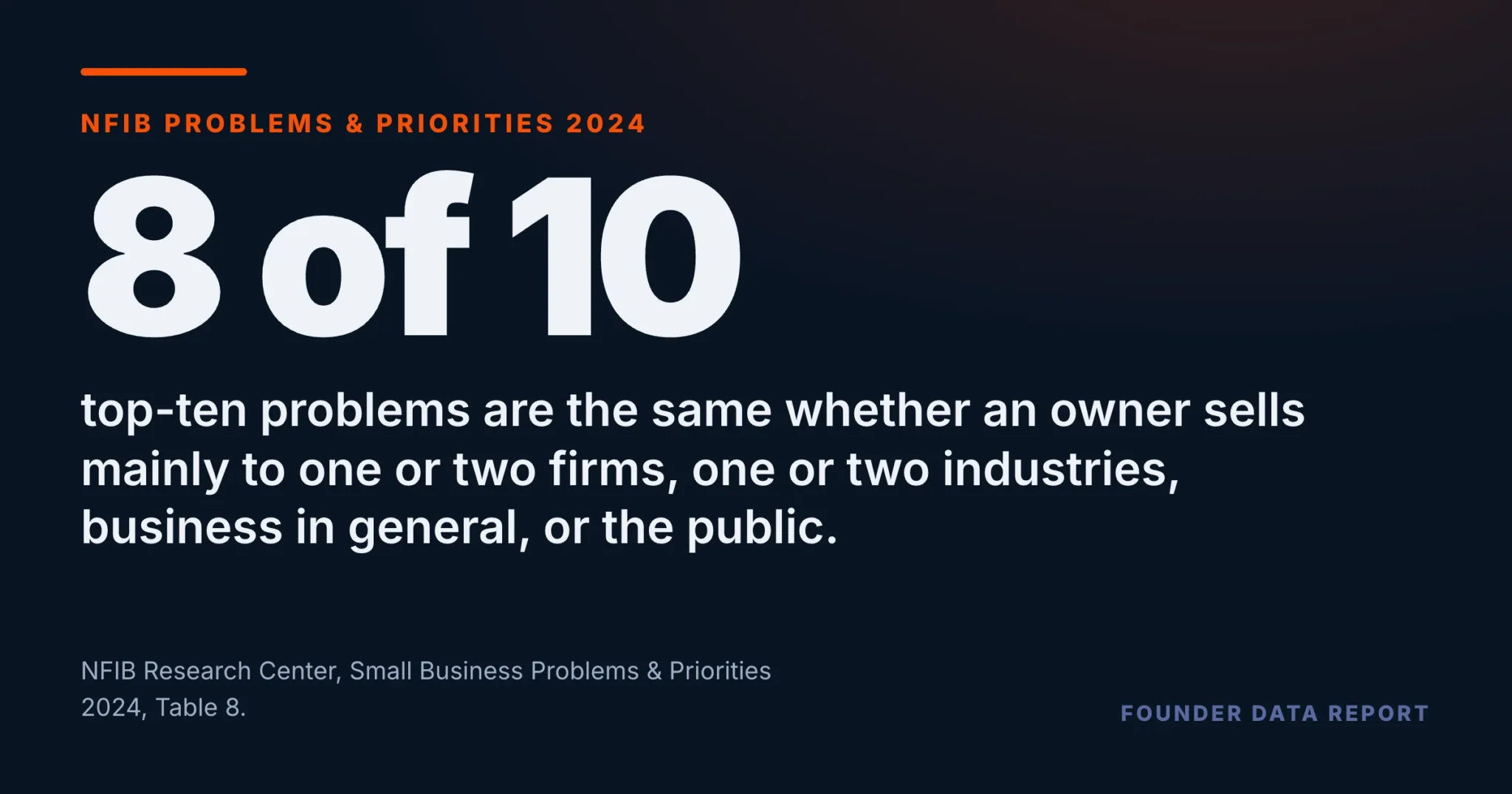
In NFIB’s 2024 Small Business Problems & Priorities survey, 8 of the top 10 problems are the same for owners who sell mainly to one or two firms, to one or two industries, to business in general, or to the public, and the cost of health insurance ranks first for all of them. What moves is further down. Credit card processing costs rank 14th for owners who sell mainly to the public and 62nd for owners who sell mainly to one or two firms. Several regulation problems move the other way.
- Health insurance, supplies, economic uncertainty, federal income tax, finding qualified employees, fuel, regulations and uncertainty over government actions make the top ten for all four customer groups.
- Health insurance is first in every group. Owners selling to the public rate it critical 43.8% of the time, against 31.6% for those selling to one or two firms.
- Card processing costs: 14th for the public, 37th for business in general, 58th for one or two industries, 62nd for one or two firms.
- Health and safety regulations rank 23rd for owners selling to one or two firms and 44th for those selling to the public; environmental rules 26th against 49th.
- NFIB publishes no margins of error; every difference named here passes our own test on the published figures.
The question behind the list
Every few years the NFIB Research Center asks a large sample of its small-business members to rate 75 possible problems, from ‘critical’ to ‘not a problem’, and ranks them by the average answer. The 2024 edition, the eleventh, had about 2,500 owners. It also asked each one who their main customer is: one or two firms, one or two industries, business in general, the public, or government. More than half of those who answered sell mainly to the public.
That is a big difference in how a business sells. So you might expect the problem lists to look different too. At the top, they do not. Eight problems make the top ten for all four groups large enough to compare, and the cost of health insurance is first for every one of them. Further down, a few problems change place by twenty, thirty, even forty-eight ranks.
Numbered by the problem’s rank among all owners. The text gives the highest and lowest rank the problem holds across owners selling mainly to one or two firms, one or two industries, business in general and the public. Bar length: its lowest rank in any of the four, on a top-ten scale. The government group (74 owners) is too small to compare.
NFIB Research Center, Small Business Problems & Priorities, 2024 (11th edition), Table 8: measures of small business problem importance by primary customer. Retrieved from nfib.com on October 13, 2026.
Where the list splits: card fees
The biggest single move is credit card processing costs. For owners who sell mainly to the public it ranks 14th out of 75, and 22.9% call it critical. For owners selling to business in general it is 37th. For owners selling mainly to one or two industries it is 58th, and for those selling to one or two firms it is 62nd, with 3.6% calling it critical.
Advertising moves the same direction. Being able to advertise cost-effectively ranks 33rd for owners selling to the public and 64th for those selling to one or two firms. Both rank higher for owners selling to the public.
Share answering ‘critical’ on NFIB’s scale. Owners selling to one or two firms: 190; one or two industries: 309; business in general: 493; the public: 1,402. Each group’s share separates from the public’s. Bars on a 0 to 30% scale.
NFIB Research Center, Small Business Problems & Priorities, 2024 (11th edition), Table 8: measures of small business problem importance by primary customer. Retrieved from nfib.com on October 13, 2026.
The top of the list belongs to every owner. The middle belongs to how you sell.
Where it splits the other way: the rules
Some problems sit higher for owners selling to a few business customers. Finding out about regulatory requirements ranks 20th for owners selling mainly to one or two firms and 35th for those selling to the public. Health and safety regulations, such as OSHA’s, rank 23rd against 44th. Environmental regulations rank 26th against 49th, and traffic, highways, roads and bridges 34th against 53rd.
Each of those gaps passes a test on the average scores, not just on the ranks. The survey does not say what kind of work these owners do, so it cannot say whether the rules follow the customer or the trade that tends to serve that customer. NFIB’s own breakdown by industry is a separate table.
Rank 1 is the most serious problem; the track runs from rank 1 at the left to 75 at the right. For every row, the two groups’ average scores separate on our test.
NFIB Research Center, Small Business Problems & Priorities, 2024 (11th edition), Table 8: measures of small business problem importance by primary customer. Retrieved from nfib.com on October 13, 2026.
What to take from this if you run a small one
If you are deciding what to work on first, the top of NFIB’s list is the same for nearly everybody: health insurance, the cost of what you buy, the economy, taxes and people. Who you sell to does not change that. It does change the next tier. If most of your sales are to the public, the card bill and the cost of advertising are problems your peers rank well above where business-to-business owners put them. If you sell to one or two firms, regulation is the tier to watch. Ranking your own list against the peers who sell the way you sell is a better check than ranking it against everyone.
Three limits worth holding. NFIB surveys its own members, so this is a sample of owners who belong to NFIB, not of all small businesses. NFIB publishes no margins of error; the separation test used here is our own, applied to the published averages. And the survey cannot say why a problem ranks where it does for a group, only how that group’s owners rated it.
NFIB Research Center, Small Business Problems & Priorities, 2024, Table 8.
Frequently Asked Questions
What is the biggest problem for small businesses that sell to other businesses?
In NFIB's 2024 Small Business Problems & Priorities survey, the cost of health insurance ranks first for owners selling mainly to one or two firms, to one or two industries and to business in general, just as it does for owners selling to the public.
Do credit card fees matter more to businesses that sell to the public?
Yes. Credit card processing costs rank 14th of 75 problems for owners selling mainly to the public, with 22.9% calling them critical, and 62nd for owners selling mainly to one or two firms.
Which problems rank higher for business-to-business sellers?
Regulation problems. Health and safety regulations rank 23rd for owners selling mainly to one or two firms against 44th for those selling to the public, and environmental regulations 26th against 49th.
How many of the top ten problems are the same across customer types?
Eight of ten: health insurance, supplies and inventories, economic uncertainty, federal taxes on business income, locating qualified employees, fuel costs, unreasonable government regulations and uncertainty over government actions.
Where does the data come from?
NFIB Research Center, Small Business Problems & Priorities, 2024 (11th edition), Table 8, which breaks out about 2,500 member owners' ratings of 75 problems by their primary customer.
Published by The Lonely Entrepreneur — the community and coaching platform for entrepreneurs who are building alone. lonelyentrepreneur.com
This article is for educational purposes and is not a substitute for professional financial or legal advice.