

 Founder Data Report
Fuel Costs Rank 25th Among Urban Small-Business Owners’ Problems. For Rural Owners They Rank 2nd
Join us Fridays at 12 PM ET to ask TLE CEO Michael Dermer your questions live.
NFIB asked about 2,500 owners to rate 75 problems and recorded how built-up the place they work is. The priority at the top of the list is the same everywhere. Below it, the priorities split.
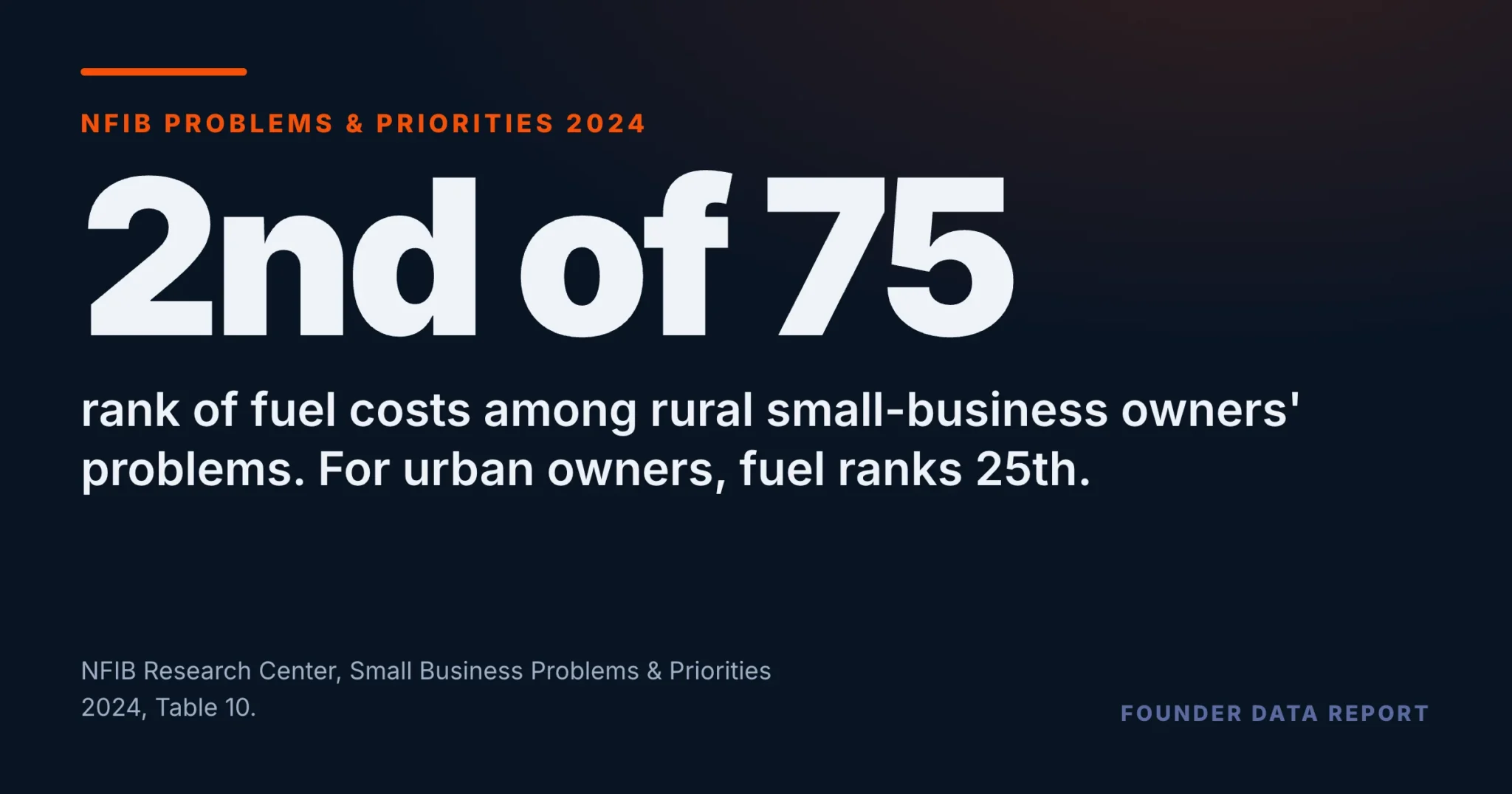
In NFIB’s 2024 Small Business Problems & Priorities survey, the cost of health insurance is the first priority problem for owners in urban, fringe urban, small-town and rural areas alike, and six problems make the top ten in all four. Below that the lists split. The cost of fuel ranks 25th for urban owners and 2nd for rural owners. Employee turnover moves the other way: 23rd in urban areas, 58th in rural ones.
- Health insurance, supplies, economic uncertainty, federal income tax, government regulations and uncertainty over government actions make the top ten in all four kinds of place.
- Health insurance ranks first everywhere. 42.0% of rural owners and 44.8% of small-town owners rate it critical, against 31.1% of urban owners.
- Fuel: 25th urban, 9th fringe urban, 5th small city or town, 2nd rural.
- Rank higher in urban areas: employee turnover (23rd against 58th), unemployment compensation, hiring and firing rules. Rank higher in rural areas: property taxes, real estate values, environmental regulations.
- NFIB publishes no margins of error; every difference named here passes our own test on the published figures.
The question behind the list
Every few years the NFIB Research Center asks a large sample of its small-business members to rate 75 possible problems, from ‘critical’ to ‘not a problem’, and ranks them by the average answer. The 2024 edition, the eleventh, had about 2,500 owners. It also classed each business by how built-up its location is: highly urban, urban, fringe urban, small city or town, and rural. Almost half of the owners who were classed sit in a small city or town.
The top of the list barely notices. The cost of health insurance is first in every one of the five, and six problems make the top ten for all four groups large enough to compare. The highly urban group (99 owners) is too small to rank against the others. What changes with the place is how hard the top problem bites: 42.0% of rural owners and 44.8% of small-town owners call health insurance critical, against 31.1% of urban owners.
Numbered by the problem’s rank among all owners. The text gives the highest and lowest rank the problem holds across the four groups. Bar length: its lowest rank in any of the four, on a top-ten scale. The highly urban group (99 owners) is too small to compare.
NFIB Research Center, Small Business Problems & Priorities, 2024 (11th edition), Table 10: measures of small business problem importance by population density. Retrieved from nfib.com on October 13, 2026.
Where the list splits: fuel
The biggest move into the top ten is the cost of fuel: natural gas, propane, gasoline, diesel and fuel oil. For urban owners it ranks 25th of 75. In fringe urban areas it is 9th, in small cities and towns 5th, and for rural owners 2nd, behind only health insurance. 30.4% of rural owners call it critical, against 15.2% of urban owners.
Share answering ‘critical’ on NFIB’s scale. Urban: 298 owners; fringe urban: 219; small city or town: 989; rural: 581. On our test the urban share separates from the small-town and rural shares, and the fringe urban share from the rural one; the other pairs do not separate. Bars on a 0 to 40% scale.
NFIB Research Center, Small Business Problems & Priorities, 2024 (11th edition), Table 10: measures of small business problem importance by population density. Retrieved from nfib.com on October 13, 2026.
The first priority is the same in the city and the country. Further down, the list depends on where you are.
People problems in town, land problems in the country
Three problems about employees sit higher for urban owners. Employee turnover ranks 23rd for urban owners and 58th for rural owners, the largest gap between the two on any problem whose average scores separate. Unemployment compensation ranks 17th against 47th, and hiring, firing and employment regulations 32nd against 57th.
Three problems about land and property sit higher for rural owners. Property taxes rank 8th for rural owners and 14th for urban owners, real estate values 21st against 50th, and environmental regulations 26th against 57th. Finding workers splits differently: locating qualified employees ranks 4th for owners in small cities and towns and 13th for rural owners. Urban owners rank it 3rd, but that gap to rural owners does not separate on our test.
The survey does not say what kind of business each owner runs in each place, so it cannot separate where a business is from what it does. NFIB’s breakdown by industry is a separate table, covered in our piece on your trade’s own list.
Rank 1 is the most serious problem; the track runs from rank 1 at the left to 75 at the right. For every row, the two groups’ average scores separate on our test.
NFIB Research Center, Small Business Problems & Priorities, 2024 (11th edition), Table 10: measures of small business problem importance by population density. Retrieved from nfib.com on October 13, 2026.
What to take from this if you run a small one
If you are deciding which problem to put first, the top of NFIB’s list is the same in the city and the country: health insurance, the cost of what you buy, the economy, taxes and government. Where you are changes the next tier. Rural owners rank fuel and property taxes in their top ten, and land problems higher than urban owners do. Urban owners rank turnover and employment rules higher. Ranking your own priorities against owners in the same kind of place is a better check than ranking them against everyone.
Three limits worth holding. NFIB surveys its own members, so this is a sample of owners who belong to NFIB, not of all small businesses. NFIB publishes no margins of error; the separation test used here is our own, applied to the published averages. And the survey cannot say why a problem ranks where it does for a group, only how that group’s owners rated it. Separately, one row of the published table is misprinted, so two problems, poor sales and obtaining licenses and permits, are left out of every comparison here.
NFIB Research Center, Small Business Problems & Priorities, 2024, Table 10.
Frequently Asked Questions
What is the biggest problem for rural small businesses?
In NFIB's 2024 Small Business Problems & Priorities survey, the cost of health insurance ranks first for rural owners, as it does for owners everywhere else. Fuel costs rank 2nd.
Do fuel costs matter more to rural businesses?
In this survey, yes. Fuel ranks 2nd of 75 problems for rural owners, with 30.4% calling it critical, and 25th for urban owners, with 15.2%.
Which problems rank higher for urban small businesses?
Employee problems. Employee turnover ranks 23rd for urban owners against 58th for rural owners, and unemployment compensation 17th against 47th.
How many top-ten problems are the same in cities and rural areas?
Six problems make the top ten for urban, fringe urban, small-town and rural owners: health insurance, supplies and inventories, economic uncertainty, federal taxes on business income, unreasonable government regulations and uncertainty over government actions.
Where does the data come from?
NFIB Research Center, Small Business Problems & Priorities, 2024 (11th edition), Table 10, which breaks out member owners' ratings of 75 problems by how built-up their location is.
Published by The Lonely Entrepreneur — the community and coaching platform for entrepreneurs who are building alone. lonelyentrepreneur.com
This article is for educational purposes and is not a substitute for professional financial or legal advice.