

 Founder Data Report
Losing One Good Employee Costs More Than Hiring Two
Join us Fridays at 12 PM ET to ask TLE CEO Michael Dermer your questions live.
The resignation feels like a staffing problem. The invoice arrives over the following nine months, and almost none of it appears on a line item you can point to.
Quick answer: Replacing an employee typically costs six to nine months of their salary (SHRM), and Gallup puts the range at 50% to 200% of annual salary depending on seniority. On an $80,000 role that is $40,000 to $160,000 — most of it invisible, spread across an empty seat, a slower team, and a replacement who takes a quarter to reach full speed. Gallup estimates voluntary turnover costs US businesses roughly $1 trillion a year.
- SHRM: replacing someone commonly costs six to nine months of their salary.
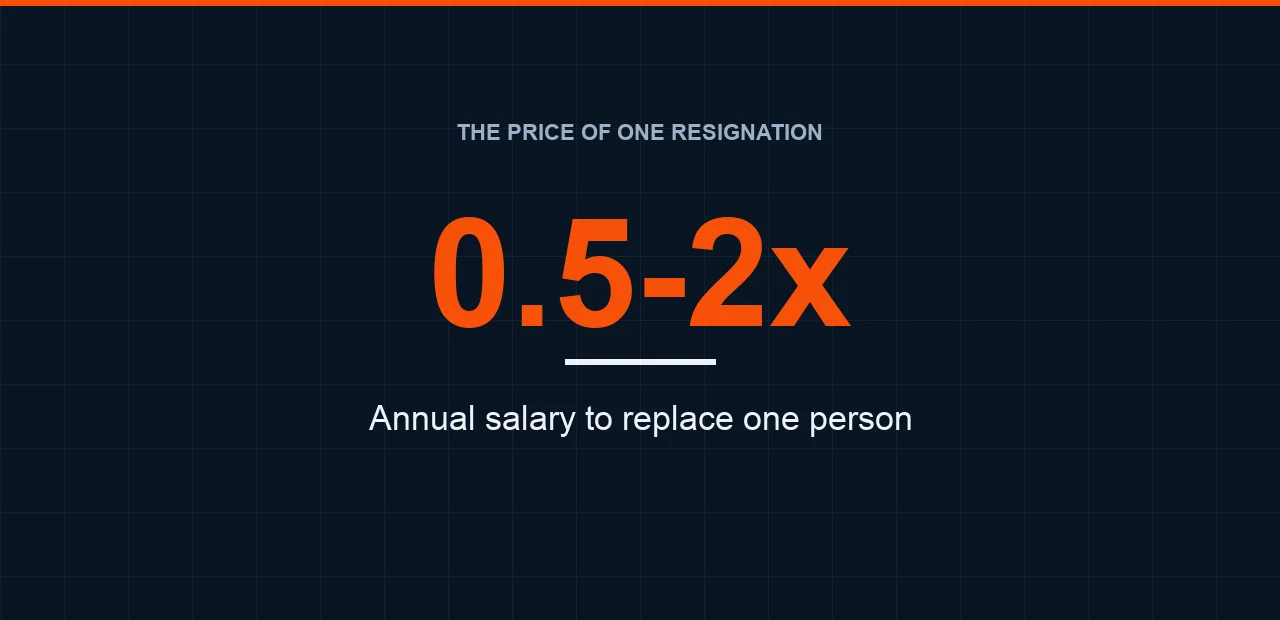
- Gallup: 0.5x to 2x annual salary, rising sharply with seniority.
- On an $80,000 role that is $40,000 to $160,000 to get back to where you were.
- Direct recruiting is only $4,683 of it — the rest is vacancy, ramp and lost output.
- Senior and client-facing departures sit at the top of the range, not the middle.
- Retention is not a soft programme. It is the cheapest cost control you have.
The cost you never see on an invoice
Someone good resigns. You are disappointed for an afternoon, then you get practical: post the role, ask around, cover the work in the meantime. It reads as an inconvenience with a hiring task attached. Almost no one sits down and prices it, because there is no invoice to price.
But the money leaves anyway. It leaves through the weeks the seat sits empty and the work does not get done. Through the colleagues absorbing that work instead of their own. Through a replacement who is capable but does not yet know your clients, your systems or the twenty things nobody wrote down. And through whatever the departing person knew that walked out with them.
Source: Gallup — replacement cost of 0.5x to 2x annual salary depending on role; voluntary turnover estimated at ~$1 trillion a year in the US. Applied to an $80,000 salary.
Read the top bar again. Losing one senior person can cost twice their annual salary — which is to say, more than hiring two people at that level would have cost you in year-one compensation. That is the arithmetic behind the headline, and it is why turnover among your best people is not an HR issue. It is a P&L event.
Where the money actually goes
When founders do price it, they price the recruiting — the advertising, the screening, maybe a fee. That is the smallest piece. SHRM’s average direct cost per hire is $4,683, which against a $80,000 role is around six percent of the total. The rest is operational and almost entirely invisible.
Source: SHRM — replacement commonly cited at six to nine months of salary; average direct cost per hire $4,683. Source: Gallup — replacement cost of 0.5x to 2x annual salary depending on role; voluntary turnover estimated at ~$1 trillion a year in the US. Illustrative allocation of a mid-level 1x-salary replacement cost.
You would never approve an $80,000 expense without a conversation. A resignation is that expense — it just never comes to you for approval.
Why it lands harder on a smaller company
A thousand-person company loses a person and loses a fraction of a percent of its capability. You lose a person and you might lose the only one who knows how the billing works, or the relationship holding your second-largest account together. The percentages in the research are the same. The concentration is not.
That is the part the national numbers hide. In a business between five and twenty-five million, key people are load-bearing. Their departure does not shave output — it removes a function. And you, the founder, absorb it, which is how a resignation quietly turns into three months of you back inside work you had finally climbed out of.
Source: SHRM — replacement commonly cited at six to nine months of salary; average direct cost per hire $4,683. Source: Gallup — replacement cost of 0.5x to 2x annual salary depending on role; voluntary turnover estimated at ~$1 trillion a year in the US.
The cheapest cost control you have
Set against these numbers, the things that keep good people are almost embarrassingly cheap. A raise that felt uncomfortable is a fraction of one replacement. So is the flexibility you hesitated over, the title you were not sure they had earned yet, or the hour a month you should have spent asking how they are actually doing.
None of that is softness. It is the highest-return spending available to you, and it is the only cost line where doing nothing is the expensive option. If you want one question to carry into next week, make it this: which two people leaving would genuinely hurt — and when did either of them last hear from you that they matter here?
Source: Gallup — replacement cost of 0.5x to 2x annual salary depending on role; voluntary turnover estimated at ~$1 trillion a year in the US. Source: SHRM — replacement commonly cited at six to nine months of salary; average direct cost per hire $4,683.
Frequently Asked Questions
How much does it cost to replace an employee?
SHRM commonly cites six to nine months of the employee's salary. Gallup puts the range at 50% to 200% of annual salary depending on the role, so replacing an $80,000 employee typically costs $40,000 to $160,000.
Why is turnover so expensive when recruiting costs so little?
Direct recruiting averages $4,683 per hire, roughly six percent of the total on a mid-level role. The rest is the vacancy period, the output lost while colleagues cover, the quarter or so a replacement needs to reach full productivity, and the knowledge that leaves with the person.
Which roles cost the most to replace?
Senior, specialist and client-facing roles sit at the top of Gallup's range at up to 2x salary, because their knowledge and relationships take longest to rebuild.
How much does turnover cost US businesses overall?
Gallup estimates voluntary departures cost US businesses roughly $1 trillion a year.
Is it cheaper to retain someone than to replace them?
Almost always. A retention raise, added flexibility or a promotion typically costs a fraction of one replacement, and it avoids the vacancy and ramp costs entirely.
Published by The Lonely Entrepreneur — the community and coaching platform for entrepreneurs who are building alone. lonelyentrepreneur.com
This article is for educational purposes and is not a substitute for professional financial or legal advice.