

 Founder Data Report
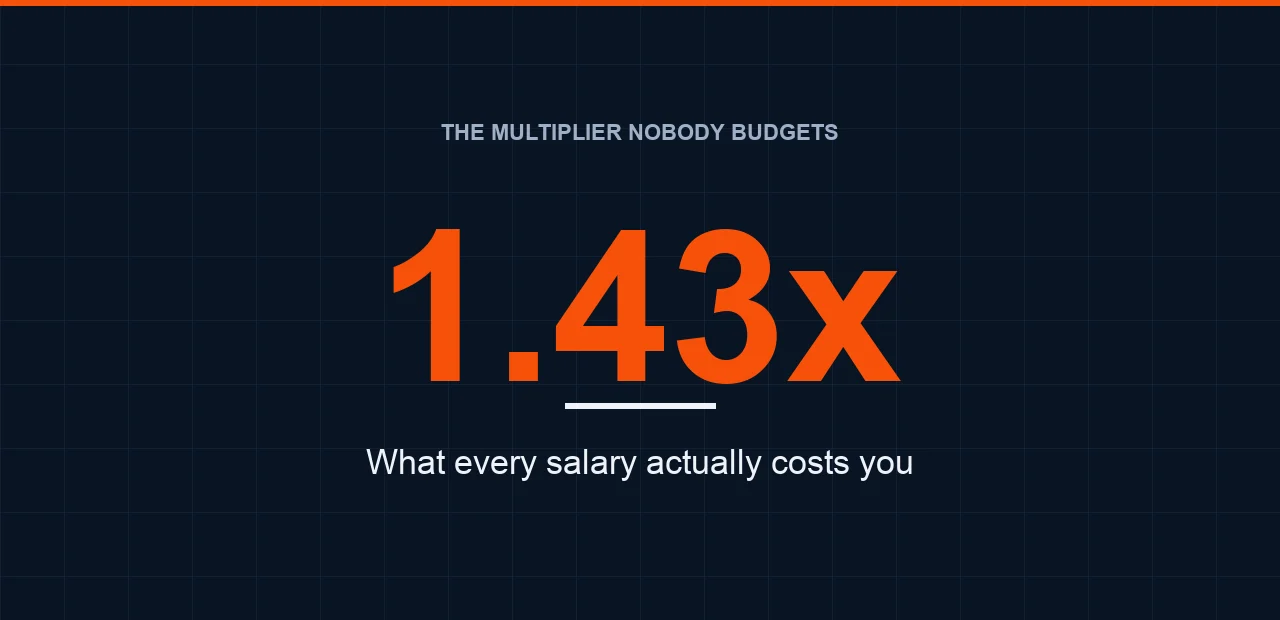
Your First Hire Costs 43% More Than the Salary You Offered
Join us Fridays at 12 PM ET to ask TLE CEO Michael Dermer your questions live.
You budgeted a salary. The tax code, the insurance carrier and eight weeks of ramp budgeted something else. This is the number that actually leaves your account.
Quick answer: Wages are only 69.9% of what an employee costs an employer — benefits and employer taxes are the other 30.1% (BLS, March 2026). Measured against the salary itself, that is a 43% add-on: a $70,000 offer costs about $100,000 a year in compensation alone. Add SHRM’s average $4,683 cost per hire and your real first-year number is closer to $105,000. Nothing here is optional or avoidable. It is simply the part nobody puts in the plan.
- Wages are 69.9% of employer cost; benefits and taxes are 30.1% (BLS, March 2026).
- Against salary that is a 43% add-on — a $70,000 offer is a ~$100,000 commitment.
- SHRM puts average direct cost per hire at $4,683, before anyone does any work.
- Nobody produces at full rate in month one, and that ramp is real money.
- The mistake is not hiring. The mistake is hiring against the offer-letter number.
- Decide from the loaded number and the same hire becomes a much clearer call.
The number on the offer letter is not the number
Every founder I talk to has done this arithmetic at least once, and almost all of them have done it wrong. You look at the money coming in, you look at what you think you can pay someone, and you land on a figure that feels survivable. Seventy thousand. You can carry seventy thousand. So you make the offer.
Then the first full quarter closes and the account does not look the way the spreadsheet said it would. Nothing went wrong. No one overspent. The number was simply never seventy thousand — it was the salary plus the employer’s half of payroll tax, plus whatever health coverage costs this year, plus paid time off, plus the retirement match, plus the laptop and the seat licences. The federal government measures this every quarter, and the ratio is remarkably stable.
Source: U.S. Bureau of Labor Statistics, Employer Costs for Employee Compensation, March 2026 (private industry). Source: SHRM Human Capital Benchmarking, average cost per hire. Year-one total applies the BLS benefits-to-wages ratio to a $70,000 salary.
That last column is the number to run your decision against. Not because the hire is a bad idea — often it is the best money you will spend all year — but because a founder who commits to $105,000 believing it is $70,000 has quietly removed their own margin for error. And margin for error is the only thing standing between a slow quarter and a layoff.
The ratio holds at every salary level
This is not a quirk of entry-level roles. The BLS figure is an average across private industry, and the multiplier travels with the salary. Whatever number you are considering, multiply it by roughly 1.43 and you have the compensation cost.
Source: U.S. Bureau of Labor Statistics, Employer Costs for Employee Compensation, March 2026 (private industry). Loaded figures apply the BLS benefits-to-wages ratio (1.43x) to each salary.
You are not deciding whether you can pay someone $70,000. You are deciding whether that role can generate more than $105,000 of value in twelve months.
The gap between what you budgeted and what you owe
Put the two numbers side by side and the size of the miss becomes obvious. This is the single most common budgeting error I see in companies between five and twenty-five million in revenue — not extravagance, not bad hiring, just a plan built on the wrong figure.
Derived from BLS March 2026 ratios and SHRM average cost per hire.
And ramp is still not in there. A new person is rarely at full output in month one, and for anything requiring judgment or client relationships it can be a full quarter. That is not a criticism of the hire. It is the cost of onboarding a human being into a business only you fully understand — which is exactly the cost most founders forget to carry.
What to do before you post the job
Run the loaded number first. Then ask the only question that matters: what has to be true for this role to clear it? If you cannot name the revenue it protects, the hours it returns to you, or the work it takes off your plate that is currently costing you more than $105,000 in opportunity, you do not have a hiring decision yet. You have a wish.
When the answer is clear, hire quickly and stop apologising for the cost. When it is not, the honest move is to wait — or to buy the outcome some other way. Both are respectable. What is not respectable is finding out in Q4 that you committed to a number you never actually calculated.
Source: U.S. Bureau of Labor Statistics, Employer Costs for Employee Compensation, March 2026 (private industry). Source: SHRM Human Capital Benchmarking, average cost per hire.
Frequently Asked Questions
How much does an employee really cost beyond salary?
For private-industry employers, wages are 69.9% of total compensation cost and benefits are 30.1% (BLS, March 2026). Measured against the salary, benefits and employer taxes add roughly 43%, so a $70,000 salary costs about $100,000 in compensation.
What is the multiplier for employee cost?
Roughly 1.43x the salary for compensation alone, based on the BLS March 2026 benefits-to-wages ratio for private industry. Recruiting costs and ramp time sit on top of that.
What is included in the 30.1% of benefit costs?
Employer-paid insurance, legally required benefits such as Social Security, Medicare and unemployment insurance, paid leave, retirement contributions and supplemental pay. The BLS tracks these as employer costs per hour worked.
How much does it cost to recruit someone?
SHRM's benchmarking puts average direct cost per hire at $4,683. That covers advertising, screening and administration — not the productivity lost while the role sits empty or while the new person ramps.
Does this mean I should not hire?
No. It means you should decide against the loaded number rather than the salary. A role that clearly clears $105,000 of value is a good hire; one you can only justify at $70,000 was never really affordable.
Published by The Lonely Entrepreneur — the community and coaching platform for entrepreneurs who are building alone. lonelyentrepreneur.com
This article is for educational purposes and is not a substitute for professional financial or legal advice.