

 Founder Data Report
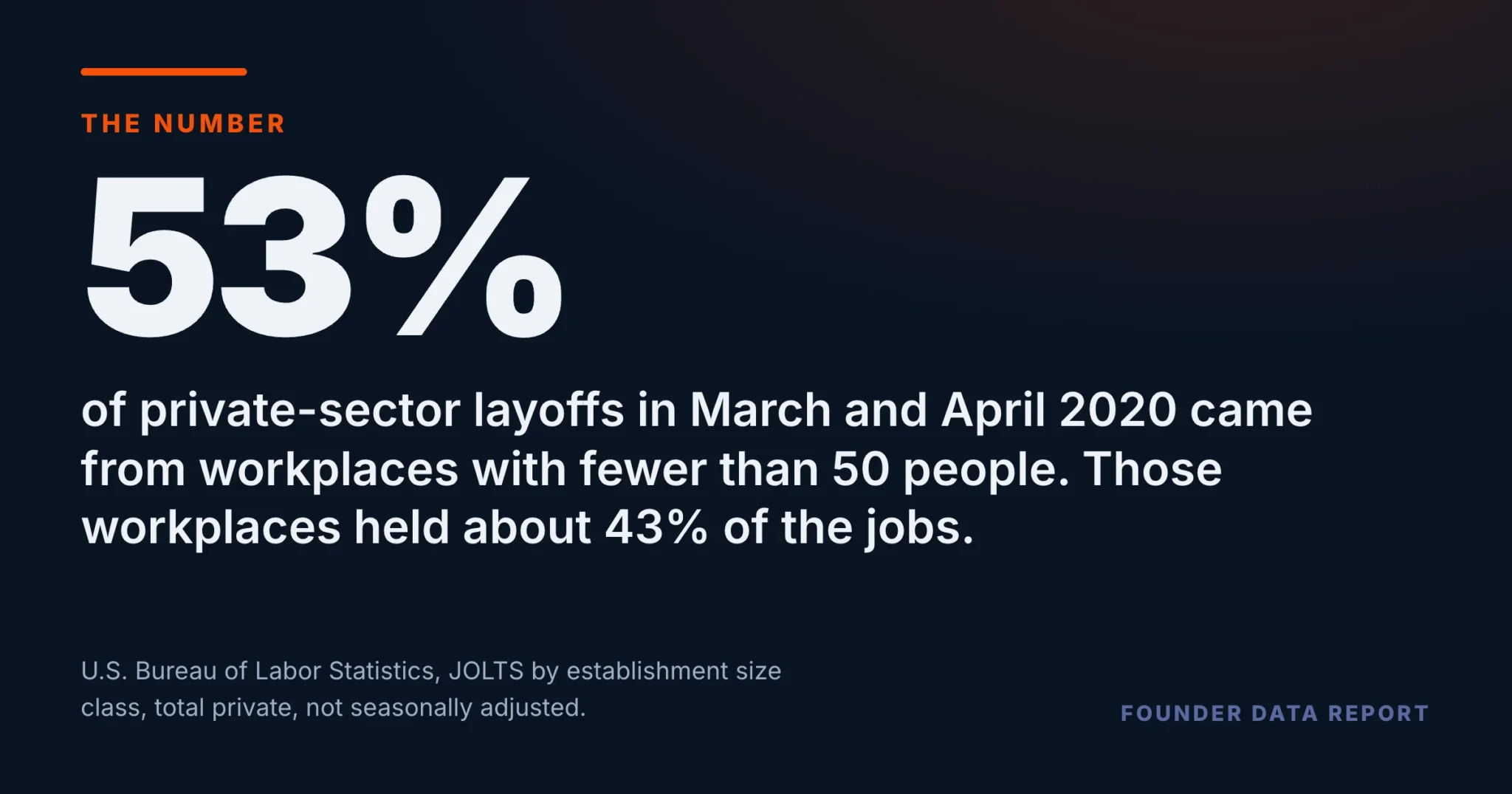
Workplaces Under 50 People Held 43% of Private Jobs Before the 2020 Shock. They Made 53% of the Layoffs.
Join us Fridays at 12 PM ET to ask TLE CEO Michael Dermer your questions live.
When the 2020 shutdowns hit, the layoffs did not land evenly. The small workplaces took more than their share of the cut — and the smallest of them made the most ground back by the end of the year.
In March and April 2020, private employers laid off or discharged 21.3 million people — 6.9 times as many as in the same two months of 2019. Workplaces with fewer than 50 employees held about 43% of private jobs in February, and they made 52.9% of those layoffs. Workplaces with 10 to 49 people were hit hardest: their spring layoffs equalled about 22% of February’s employment. But the recovery ran the same way. By December, workplaces under ten people had made up about half of their extra layoffs in extra hiring; workplaces of 50 to 249 had made up about one in seven.
- March-April 2020: 21.3 million private-sector layoffs and discharges, 6.9 times the same months of 2019.
- Workplaces under 50 people: about 43% of private jobs in February, 52.9% of the spring layoffs.
- The hardest-hit band was 10 to 49 employees — layoffs equal to about 22% of its February staff. Under ten: about 19%. 5,000 or more: about 2%.
- May-December, measured against the same months of 2019, workplaces under ten hired 1,602 thousand more people than usual — about half of their 3,048 thousand extra layoffs.
- Across all private employers the make-up was about 28 in 100. Workplaces under 50 did more than three-quarters of the extra hiring.
The cut landed on the small workplaces
The Job Openings and Labor Turnover Survey counts layoffs by the size of the workplace, and it sets that size by the most people the workplace employed over the previous year. So a 30-person restaurant that cut to eight in April 2020 still counts as a 10-to-49 workplace — the shock does not shuffle anyone into a smaller band. On that footing, the spring of 2020 fell hardest on the small. Workplaces under 50 people held about 43% of private jobs in February and made 52.9% of the layoffs in March and April. The 10-to-49 band alone made 36.7% of them, more than any other. Above 250 employees, every band gave fewer layoffs than its share of jobs; the workplaces of 5,000 or more made 0.3%.
Slate is each band’s share of private employment in February 2020; orange is its share of layoffs and discharges in March and April. The job shares are derived from published counts and one-decimal rates and are accurate to about a point either way. Both bars use one scale.
U.S. Bureau of Labor Statistics, Job Openings and Labor Turnover Survey (JOLTS), layoffs and discharges, hires and quits by establishment size class, total private, not seasonally adjusted, 2019-2020, retrieved from the BLS public data API on October 4, 2026. Size class is set by a workplace’s highest employment over the prior 12 months and held for a year.
Workplaces with 10 to 49 people laid off about 22% of their February staff in eight weeks.
Ten to 49 employees was the hardest place to be
Measured against each band’s February employment, the spring layoffs ran to about 22% at workplaces of 10 to 49, about 19% under ten, and about 18% at 50 to 249. They fell off steeply after that: about 12% at 250 to 999, about 8% at 1,000 to 4,999 and about 2% at 5,000 or more. The very smallest workplaces were not the worst hit. The band just above them was.
Orange marks the two bands under 50 employees. Bars share one scale. February employment is derived from published counts and rates, so the shares are shown to the whole percent. The same two months of 2019 ran at 3% or less in every band.
U.S. Bureau of Labor Statistics, Job Openings and Labor Turnover Survey (JOLTS), layoffs and discharges, hires and quits by establishment size class, total private, not seasonally adjusted, 2019-2020, retrieved from the BLS public data API on October 4, 2026. Size class is set by a workplace’s highest employment over the prior 12 months and held for a year.
The smallest made the most ground back
JOLTS cannot say whether a new hire is the same person who was let go — its hire count includes recalls without naming them. What it can show is how much more hiring each band did than usual. From May to December 2020, against the same months of 2019, workplaces under ten people hired 1,602 thousand more people than normal — about half of their 3,048 thousand extra layoffs in the spring. At 10 to 49 it was about a third. From 50 employees up it was about 15 in 100 or less. Quits fell in every band through 2020, which means less of the usual replacement hiring, so if anything this measure understates the rebuilding. Workplaces under 50 did more than three-quarters of all the extra hiring in the private sector that year.
‘Extra’ means above the same months of 2019. Orange marks the two bands under 50 employees. Workplaces of 5,000 or more are left out: their extra layoffs were about 36 thousand, too few for the ratio to mean anything, and their hiring ran below 2019. Hires include recalls of laid-off workers but do not identify them.
U.S. Bureau of Labor Statistics, Job Openings and Labor Turnover Survey (JOLTS), layoffs and discharges, hires and quits by establishment size class, total private, not seasonally adjusted, 2019-2020, retrieved from the BLS public data API on October 4, 2026. Size class is set by a workplace’s highest employment over the prior 12 months and held for a year.
What to do with this if you run a small business
The 2020 numbers make a hard point about small employers: when that shock arrived, the cut at small workplaces went deeper than their share of jobs — and they also rebuilt harder. The lesson is not to avoid the cut. It is to decide, before you ever need to, how you would make it and how you would come back from it: which roles you would protect, who you would call first when work returned, and how many weeks of payroll you could carry while you decided.
Four limits worth holding. JOLTS counts workplaces, not companies — a nine-person branch of a chain sits in the under-ten band. The size-class series are not seasonally adjusted, which is why every comparison here is to the same months of 2019. The Bureau notes that survey response is much lower in the larger size classes and that size-class estimates are not reviewed for outliers. And ‘extra hiring’ is a comparison to a normal year, not a count of people rehired.
U.S. Bureau of Labor Statistics, JOLTS by establishment size class, total private, not seasonally adjusted, 2019-2020.
Frequently Asked Questions
Did small workplaces lay off more workers in 2020?
Yes, relative to their size. In the Bureau of Labor Statistics' JOLTS survey, workplaces with fewer than 50 employees held about 43% of private jobs in February 2020 and made 52.9% of the 21.3 million layoffs and discharges in March and April 2020.
Which workplace size was hit hardest in spring 2020?
Workplaces with 10 to 49 employees. Their March-April 2020 layoffs equalled about 22% of February employment, against about 19% at workplaces under ten and about 2% at workplaces of 5,000 or more.
Did small workplaces hire back harder after the 2020 layoffs?
They hired back harder. From May to December 2020, workplaces under ten hired 1,602 thousand more people than in the same months of 2019 — about half of their extra spring layoffs. Workplaces of 50 to 249 made up about one in seven. JOLTS hires include recalls but do not identify them.
How does JOLTS decide a workplace's size?
By the highest employment the workplace reported over the previous 12 months, fixed for a year when the sample is drawn. A workplace that shrank during 2020 stayed in its earlier size band, so the shock does not move workplaces between bands.
Is this about companies or workplaces?
Workplaces. JOLTS counts establishments, so a small branch of a large company is counted with other small workplaces. The figures describe where layoffs happened, not which size of company made them.
Published by The Lonely Entrepreneur — the community and coaching platform for entrepreneurs who are building alone. lonelyentrepreneur.com
This article is for educational purposes and is not a substitute for professional financial or legal advice.