

 Founder Data Report
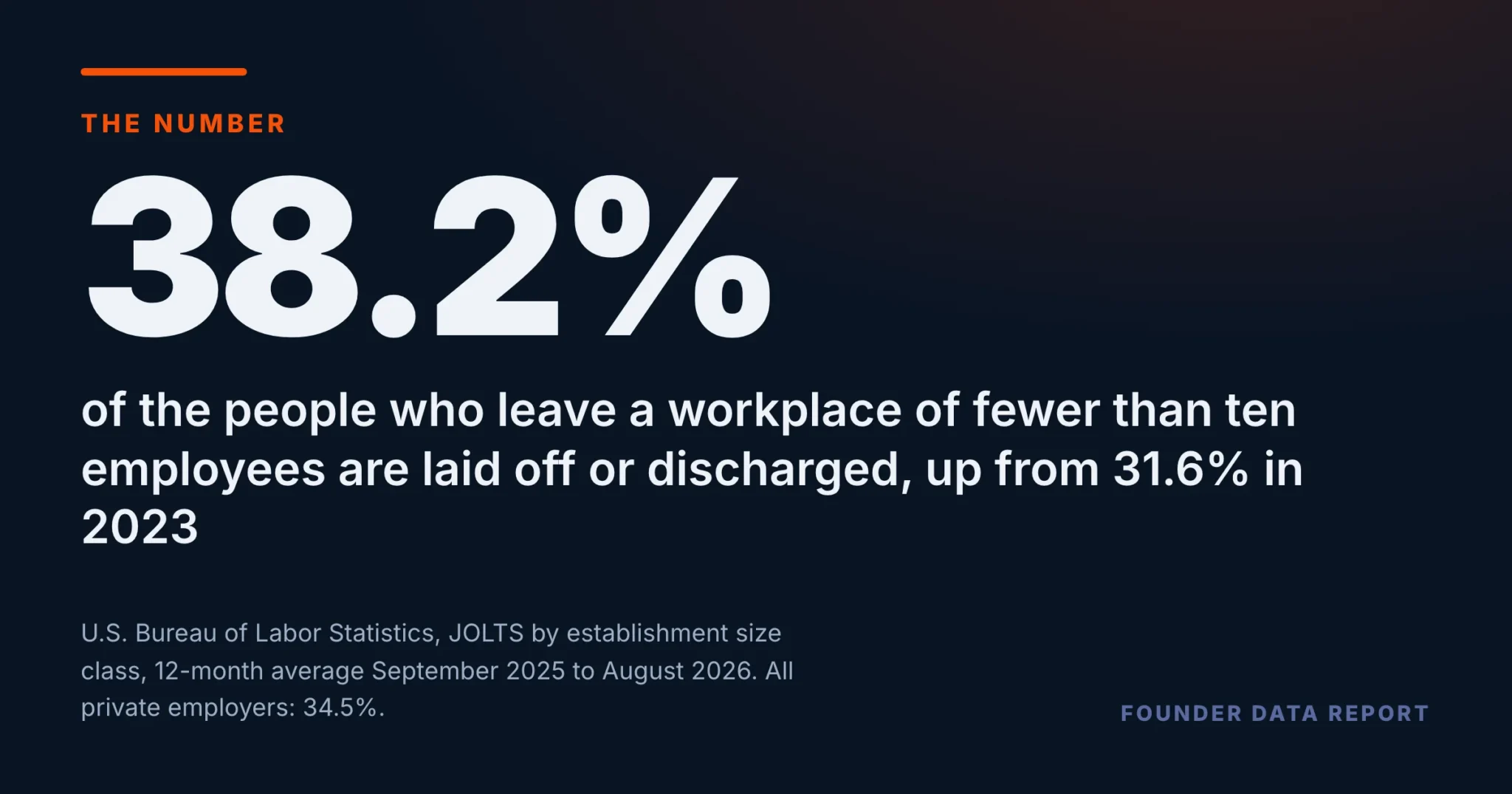
At Workplaces Under Ten People, 38.2% of Departures Are the Employer’s Call. In 2023 It Was 31.6%.
You can’t afford to risk your business without a Sidekick at your side.
Every month the Bureau of Labor Statistics counts how people leave their jobs: they quit, they are let go, or they leave for some other reason. At the smallest workplaces in the country, the mix has been moving toward the one the owner decides.
At American workplaces with fewer than ten employees, 38.2% of the people who left a job in the twelve months to August 2026 were laid off or discharged — the employer’s decision, not theirs. In 2023 that share was 31.6%. The owners did not start letting more people go: the layoff rate at these workplaces stayed between 1.14% and 1.28% of employment a month throughout. What changed is that fewer people chose to leave. The quit rate fell from 2.15% to 1.58%, so a bigger share of every departure is now a call the owner made.
- 38.2% of departures from workplaces under ten people are layoffs or discharges, against 34.5% across all private employers.
- That share has risen every year: 31.6% in 2023, 36.8% in 2024, 39.6% in 2025. It sat above the private-sector figure in each of them.
- The layoff rate at small workplaces is about the same as everyone else’s — 1.16% of employment a month against 1.23%. The quit rate is the part that moved, down 26% since 2023.
- On average 252,000 people a month were laid off or discharged from workplaces of one to nine employees over the period.
- These are establishments, single locations, not companies, and the series are not seasonally adjusted, so everything here is a twelve-month or calendar-year average.
When a small team gets smaller, it is increasingly because you decided
There is a particular weight to letting someone go when there are six of you. You hired them. You probably trained them. You will see the empty desk tomorrow, and so will the four people who are left. The Bureau’s Job Openings and Labor Turnover Survey splits every departure three ways — quits, which the employee chooses; layoffs and discharges, which the employer chooses; and other separations, which covers retirement, disability, death and transfers. At workplaces of one to nine people, the employer’s share has climbed from 31.6% to 38.2% in under three years. More of the hardest conversations in a small business are landing on the owner’s desk, and there is rarely anyone else to have them.
Share of all separations (quits, layoffs and discharges, and other separations) that were layoffs and discharges, computed from the level series, 12-month average. The bars are on a 0-50% axis. Orange marks the smallest band; the figure for all private employers is 34.5%. Workplaces of 250 to 999 are level with the smallest band, and the highest share is at 1,000 to 4,999.
U.S. Bureau of Labor Statistics, Job Openings and Labor Turnover Survey (JOLTS), series by establishment size class, total private, retrieved from the BLS public data API on September 29, 2026; latest reference month August 2026 (preliminary). Size-class series are published for total private only and are not seasonally adjusted, so every figure is a 12-month average (September 2025 through August 2026) or a calendar-year average. JOLTS counts establishments, single locations, not firms.
The owners did not start firing more people. Their people stopped leaving on their own.
The layoffs held flat. The quits are what fell.
It would be easy to read the rising share as small employers getting harder-nosed. The rates say otherwise. At workplaces under ten, layoffs and discharges ran at 1.14% of employment a month in 2023, 1.22% in 2024, 1.28% in 2025 and 1.16% over the latest twelve months — within a tenth of a point of the private-sector figure every time. Quits did the moving: 2.15% a month in 2023, 1.58% now. When people stop walking out of their own accord, the departures that remain are the ones somebody had to decide. The quit side of this is covered in more depth in our earlier piece on turnover by company size; what is new here is where that leaves the owner.
Both rates are a share of the same employment base, per month, and both bars in a row are drawn on the same 0 to 3% scale. Orange is layoffs and discharges; slate is quits. The colors name the measure, not which number is better. The lowest quit rate in the file is at workplaces of 5,000 or more.
U.S. Bureau of Labor Statistics, Job Openings and Labor Turnover Survey (JOLTS), series by establishment size class, total private, retrieved from the BLS public data API on September 29, 2026; latest reference month August 2026 (preliminary). Size-class series are published for total private only and are not seasonally adjusted, so every figure is a 12-month average (September 2025 through August 2026) or a calendar-year average. JOLTS counts establishments, single locations, not firms.
The shift shows up in every year of the series
A single year could be noise in a survey this size. This is not one year. In calendar 2023, 2024 and 2025 and in the latest twelve months, the layoff share at workplaces of one to nine sat above the figure for all private employers — 31.6% against 29.5% at the start, 38.2% against 34.5% now. Both lines rose, because quits cooled across the whole economy, but the smallest workplaces rose from a higher base. They also lose people to the third kind of departure — retirement, disability, death — at a higher rate than any other size band, and those exits are 9.0% of departures at workplaces under ten, against 5.2% overall. In a small business, every kind of exit lands on the same few people.
Calendar-year averages for 2023 to 2025 and the latest 12 months, from the level series. Each row sits on a track running from 20% to 45%, not from zero, so the gaps are drawn larger than they would be on a full scale. The printed percentages are the true ones. The latest-12-month row overlaps 2025 by eight months and is not a separate year.
U.S. Bureau of Labor Statistics, JOLTS, layoffs and discharges, quits and other separations, levels by establishment size class, total private, calendar-year averages 2023-2025 and the 12 months September 2025 through August 2026. Not seasonally adjusted.
What to take from it. If you run a business of under ten people, the odds that the next departure is one you have to initiate are higher than they were two years ago, and higher than across private employers as a whole. That argues for doing the preparation before you need it: clear expectations written down, a record of the conversations that came before, and a plan for the work the person was carrying. None of that makes the conversation easier. It makes it fair, and it makes the week after survivable.
Three limits worth holding. JOLTS counts establishments, not companies: a nine-person branch of a national chain sits in the same band as a nine-person independent business. The size-class series are published for total private only and are not seasonally adjusted, so nothing here is a single month. And the latest month, August 2026, is preliminary and will be revised; it is one of twelve in the average.
U.S. Bureau of Labor Statistics, JOLTS by establishment size class, total private, not seasonally adjusted.
Frequently Asked Questions
Do small businesses lay off more workers than large ones?
Not at a meaningfully different rate. Over the twelve months to August 2026, workplaces with one to nine employees laid off or discharged 1.16% of their employment a month, against 1.23% for all private employers, and the two have been within a tenth of a point of each other in every year since 2023. The difference is in quits: 1.58% a month at the smallest workplaces against 2.16% overall.
What share of employees who leave a small business are let go?
At workplaces with fewer than ten employees, 38.2% of all departures over the twelve months to August 2026 were layoffs or discharges, according to the Bureau of Labor Statistics' JOLTS survey. Across all private employers the figure was 34.5%.
Why has the share of layoffs gone up?
Because fewer people are quitting, not because more are being let go. At workplaces under ten, the quit rate fell from 2.15% a month in 2023 to 1.58%, while the layoff rate stayed between 1.14% and 1.28%. With fewer voluntary exits, layoffs make up more of what is left.
What counts as a layoff or discharge in JOLTS?
Any separation the employer initiates: layoffs with no intent to rehire, firings and other discharges for cause, and terminations of seasonal or temporary employees. Quits are separations the employee chooses. Retirements, transfers, disability and deaths are counted separately as other separations.
Does this data describe companies or locations?
Locations. JOLTS measures establishments, so the size bands describe how many people work at a single site. A small branch of a large company is counted with the small independents, and the Bureau publishes these size-class figures for the private sector only, without seasonal adjustment.
Published by The Lonely Entrepreneur — the community and coaching platform for entrepreneurs who are building alone. lonelyentrepreneur.com
This article is for educational purposes and is not a substitute for professional financial or legal advice.