

 Founder Data Report
In 2005, Over a Third of New Business Filings Named a First Payday in 41 States. In 2025, the Highest State Was at 14.0%.
Join us Fridays at 12 PM ET to ask TLE CEO Michael Dermer your questions live.
The national fall in filings that plan a payroll is already on the record. Split by state, it happened everywhere — and the order of the states barely survived it.
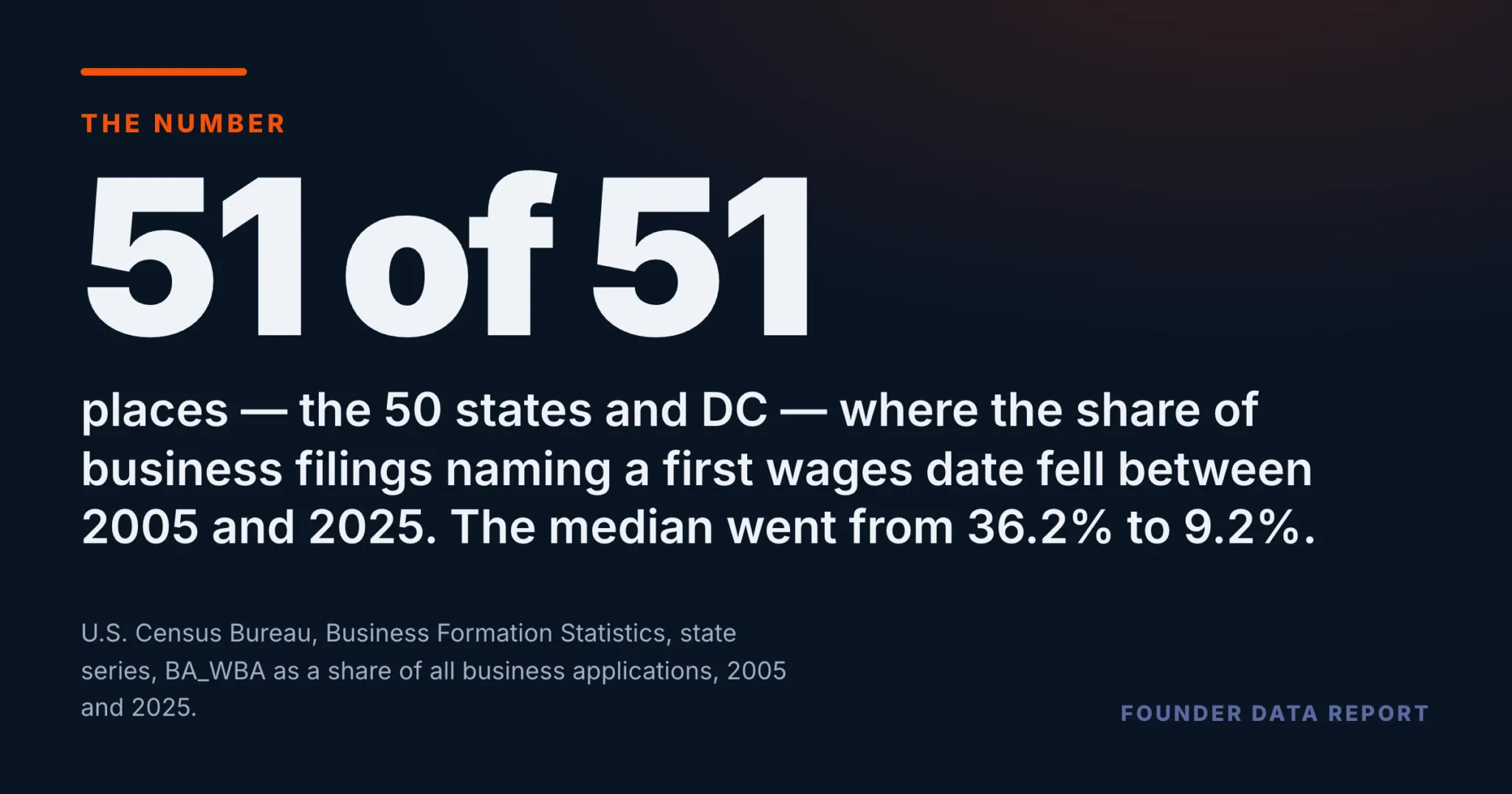
When someone files for a federal Employer Identification Number, the form asks for the date they expect to pay their first wages. In 2005, more than a third of business filings gave one in 41 states. By 2025, the highest share in any state was 14.0%, in North Dakota, and the lowest was 4.4%, in Wyoming. The share fell in all 50 states and the District of Columbia — the state median went from 36.2% to 9.2% — and it was lower in every one of them in 2019 than in 2005, and lower again in 2025. In 49 of the 51, the number of filings naming a payday fell too, not just the share.
- Nationally, 35.5% of business applications named a first wages date in 2005 and 8.8% in 2025. Every state and DC followed the same direction.
- The state median fell from 36.2% to 9.2%. In 2025, 17 places were at 10% or more; North Dakota was highest at 14.0%.
- It is not only that more people filed. The number of filings naming a payday fell in 49 of 51 places — nationally from 881,865 to 501,223, down 43%.
- Most of that national fall had happened by 2010. Since then the count has moved between about 476,000 and 638,000 a year while total filings kept climbing.
- The 2005 map barely predicts the 2025 one. Florida went from 19th to 50th; Rhode Island from 25th to 3rd.
It fell in every state, and in both halves of the twenty years
The national line is already well known: 35.5% of business applications named a first wages date in 2005, and 8.8% did in 2025. The Census Bureau publishes the same count for every state, and it leaves no exception. All 50 states and the District of Columbia ended lower than they started. Split the period at 2019 and the result holds in each half: every one of the 51 was lower in 2019 than in 2005, and lower again in 2025 than in 2019. That was not a straight line down — 48 of them rose in at least one year along the way — but none ended anywhere near where it started. In 2005, the lowest state, Nevada, was at 25.3%. In 2025, the highest state was at 14.0%.
Ranks are among the 50 states and the District of Columbia, highest share first. North Dakota, Maine and Rhode Island had the three highest shares in 2025; New Mexico, Florida and Wyoming the three lowest. Nevada was lowest in 2005. One scale, 0 to 50%.
U.S. Census Bureau, Business Formation Statistics, monthly state series (bfs_monthly.csv), BA_BA and BA_WBA, not seasonally adjusted, summed to calendar years. A business application is an IRS Form SS-4 filing for an Employer Identification Number; BA_WBA counts those that give a first date for paying wages.
In 2005, the lowest state was at 25.3%. In 2025, the highest was at 14.0%.
Fewer filings plan a payroll, not just a smaller share
A falling share can come from the top or the bottom of the fraction. Total business filings more than doubled nationally between 2005 and 2025, by 2.28 times, and that alone would shrink the share. But the top of the fraction fell as well. In 2005, 881,865 filings named a first wages date; in 2025, 501,223 did, 43% fewer. The count fell in 49 of the 51 places, by more than 40% in 31 of them. Florida fell furthest, from 106,413 to 42,120. Texas fell least, by 13%. The two exceptions, Delaware and Wyoming, are the two states where total filings multiplied fastest — 5.3 times and 14.6 times — and even there the share fell. The timing matters: nationally, most of the drop in the count had happened by 2010, when it stood at 533,549. Since then it has stayed in a band while total filings kept climbing.
Counts in brackets are the filings naming a first wages date in 2005 and 2025. Orange marks a fall and slate a rise — the colour names the direction, not whether it is good news. Delaware and Wyoming are the only two of 51 that rose. By 2019, the count was below its 2005 level in all 51. Bars share one scale, ±70%.
U.S. Census Bureau, Business Formation Statistics, monthly state series (bfs_monthly.csv), BA_BA and BA_WBA, not seasonally adjusted, summed to calendar years. A business application is an IRS Form SS-4 filing for an Employer Identification Number; BA_WBA counts those that give a first date for paying wages.
The 2005 order did not survive
If every state had fallen by the same proportion, they would have kept their places. They did not. Across the 51, a state’s 2005 share predicts its 2025 share only loosely — the correlation is 0.46. Seven of the ten highest in 2005 were still in the top ten in 2025. Elsewhere the order moved a long way. Florida was 19th in 2005, near the middle, and 50th in 2025, second from the bottom. Washington went from 8th to 34th. Rhode Island went the other way, from 25th to 3rd, and Nevada from last to 25th. Nothing in this file says why any state moved, and this article does not guess.
Orange bars are states; the slate bar is the national figure. Each state’s 2005 share is printed under its name. Bars share one scale.
U.S. Census Bureau, Business Formation Statistics, monthly state series (bfs_monthly.csv), BA_BA and BA_WBA, not seasonally adjusted, summed to calendar years. A business application is an IRS Form SS-4 filing for an Employer Identification Number; BA_WBA counts those that give a first date for paying wages.
What to do with this if you are filing, or just filed
A first wages date on the form is a plan, not a payroll. But it is the one line where a founder puts a date on hiring before there is anyone to hire, and in 49 of the 51 places fewer founders now fill it in. If you are building something you expect to staff, it is worth treating that date as a real decision: write down when the first hire happens and what has to be true first, before the business is busy enough to make the choice for you. The Census Bureau’s own state data, covered in an earlier piece, shows that states where more filings name a wages date also turn more of their likely-to-hire filings into employers. That is a correlation across states, not a promise to any one business.
Four limits worth holding. A business application is an EIN filing, not a business that opened. The wages date is what the filer wrote down, not whether anyone was ever paid. Every figure here is a calendar-year total of the Bureau’s unadjusted monthly counts. And most of the national fall in the count sits between 2006 and 2010, so a comparison anchored in 2005 is the long view, not a recent change — which is why the 2019 split and the 2010 count are shown as well.
U.S. Census Bureau, Business Formation Statistics, monthly state series, 2005 and 2025 calendar years, 50 states and the District of Columbia.
Frequently Asked Questions
Has the share of new businesses planning to hire fallen in every state?
By one measure, yes. The share of business applications naming a first wages date fell in all 50 states and the District of Columbia between 2005 and 2025, according to the Census Bureau's Business Formation Statistics. The state median fell from 36.2% to 9.2%.
Which state has the highest share of business filings planning a payroll?
In 2025, North Dakota, at 14.0%, followed by Maine (13.8%) and Rhode Island (12.8%). The lowest were Wyoming (4.4%), Florida (6.5%) and New Mexico (7.3%).
Is the share falling only because more people are filing?
No. Total filings more than doubled, but the number of filings naming a first wages date also fell, from 881,865 nationally in 2005 to 501,223 in 2025. It fell in 49 of the 51 places; Delaware and Wyoming are the exceptions.
When did the number of payroll-planning filings fall?
Mostly by 2010, when the national count was 533,549. Since 2010 it has stayed between about 476,000 and 638,000 a year, while total business filings rose.
Does naming a wages date mean a business will hire?
No. It is a date the filer writes on IRS Form SS-4 when applying for an Employer Identification Number. It shows intent at filing, not whether a payroll followed.
Published by The Lonely Entrepreneur — the community and coaching platform for entrepreneurs who are building alone. lonelyentrepreneur.com
This article is for educational purposes and is not a substitute for professional financial or legal advice.