

 Founder Data Report
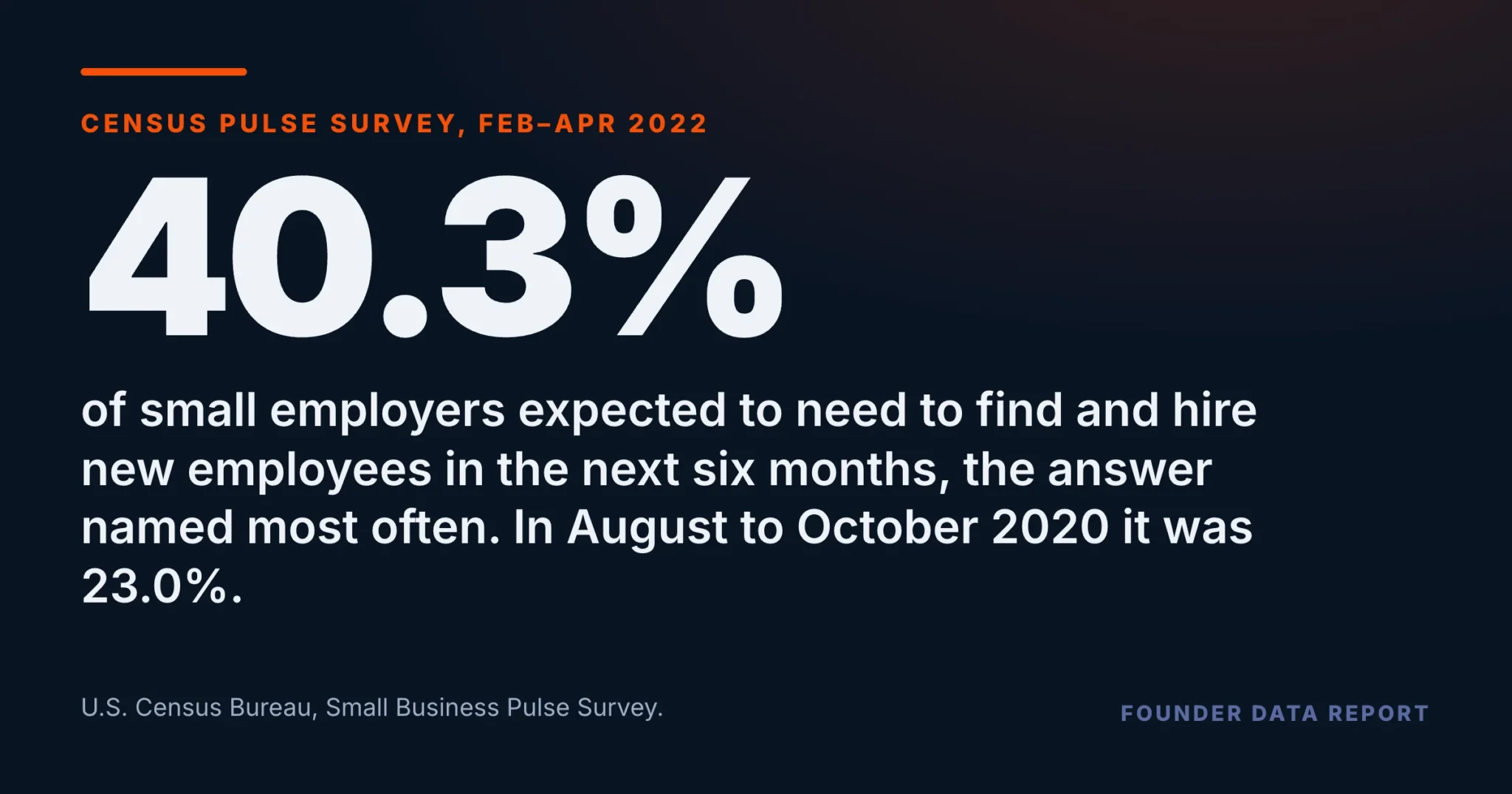
In Fall 2020, 23.0% of Small Employers Expected to Need New Hires. By Spring 2022 It Was 40.3%, Top of the List
Join us Fridays at 12 PM ET to ask TLE CEO Michael Dermer your questions live.
Through the pandemic, the Census Bureau asked small employers what they thought the business would need to do in the next six months. The list at the top changed.
In the U.S. Census Bureau’s Small Business Pulse Survey, the share of small employers who expected the business would need to find and hire new employees in the next six months rose from 23.0% in August to October 2020 to 40.3% in February to April 2022, the answer named most often. The share expecting to need financial assistance or more capital peaked at 28.5% in November 2020 to January 2021 and was 13.3% by the end. Firms with one to four employees still named marketing ahead of hiring.
- Find and hire new employees: 23.0% in August to October 2020, 35.8% in May to July 2021, 40.3% in February to April 2022.
- Financial assistance or more capital: 28.5% at the peak, 13.3% at the end.
- New supply chain options: 13.0% to 24.1%. Marketing or sales: 32.3% to 26.7%.
- By size at the end: 18.3% of firms with one to four employees expected to hire, 62.8% of firms with 20 or more.
- Owners could pick more than one answer, and these are expectations, not what the business went on to do.
One question, asked for two years
From April 2020 to April 2022 the Census Bureau ran the Small Business Pulse Survey, a short weekly questionnaire sent to nonfarm, single-location employer businesses with 1 to 499 employees. From August 2020 it asked: in the next six months, do you think this business will need to do any of the following? Owners could tick as many answers as applied, so the shares do not add up to 100. Six of the answers stayed on the list the whole time: get financial assistance or more capital, find new supply chain options, build online sales or a website, increase marketing or sales, find and hire new employees, and close the business for good.
The survey ran in phases of nine weekly rounds, and each figure here is a phase average. In August to October 2020 the need named most often was increase marketing or sales, at 32.3%. Financing was 23.7% and hiring 23.0%, and 36.1% ticked none of the answers. By February to April 2022 hiring was 40.3%, ahead of every other answer, and marketing was 26.7%.
Share of small employers naming each answer, average of the nine weekly rounds in each phase. Owners could name more than one, so the shares do not add up to 100. Only the six answers offered in every phase are shown. The track runs from 0 to 50%.
U.S. Census Bureau, Small Business Pulse Survey, weekly national and employment-size files, rounds of August 9, 2020 to April 17, 2022; retrieved October 26, 2026. Each value is the average of the nine weekly rounds in a survey phase.
Hiring climbed and financing fell
The hiring answer held near 23% through the first two phases (23.0%, then 22.5%). Then it rose: 30.2% in February to April 2021, 35.8% in May to July 2021 and 40.0% in August to October 2021, where it stayed through April 2022. From May to July 2021 on, hiring was the need small employers named most often, and from August 2021 more of them named it than ticked none of the answers.
Financing went the other way. It rose to 28.5% in November 2020 to January 2021, fell to 19.7% and then 14.2%, and stayed between 13.3% and 14.8% from then on. New supply chain options climbed from 13.0% to 24.1%, passing financing. The share expecting to close the business for good fell from 5.0% to 3.1%.
Each point is the average of the nine weekly rounds in one survey phase, labelled by the month the phase began. The Census Bureau refreshed its sample at the start of the February 2021 phase and removed businesses with inactive payroll accounts at the start of the August 2021 phase; the published figures cannot separate a move at either point from that change. The rise from February–April to May–July 2021 falls between those two changes.
U.S. Census Bureau, Small Business Pulse Survey, weekly national and employment-size files, rounds of August 9, 2020 to April 17, 2022; retrieved October 26, 2026. Each value is the average of the nine weekly rounds in a survey phase.
Two years in, the need small employers named most often was not money. It was people.
The smallest firms had a different list
The survey also published every answer by employment size, and the hiring answer depended heavily on it. In February to April 2022, 62.8% of firms with 20 or more employees expected to need to hire, 44.1% of firms with five to 19, and 18.3% of firms with one to four. All three were higher than in August to October 2020, when they were 36.7%, 25.0% and 11.1%.
For the smallest firms, hiring never became the need named most often. At one to four employees, increase marketing or sales (22.3%) was still named more often than hiring at the end, and 47.4% ticked none of the answers. From five employees up, hiring was named more often than anything else.
Share of small employers expecting the business to need each in the next six months, average of the final nine weekly rounds. Owners could name both. Both bars on one scale, 0 to 100%.
U.S. Census Bureau, Small Business Pulse Survey, weekly national and employment-size files, rounds of August 9, 2020 to April 17, 2022; retrieved October 26, 2026. Each value is the average of the nine weekly rounds in a survey phase.
What to take from this if you run a small one
The thing an owner expects to need next is not fixed. Over two years the need small employers named most often moved from selling more to finding people, and the share expecting to need money fell by more than half from its peak. For a firm with a handful of people the list looked different again. It is worth writing your own answer to the Census Bureau’s question down: in the next six months, what will this business need to do? Then check whether the way you spend your week matches it.
Three limits worth holding. These are expectations, the owner’s own view of the next six months, not a record of what the business went on to do. The survey cannot say why the answers moved, and twice it changed its sample at the start of a phase, in February 2021 and August 2021. And it covers single-location employers with 1 to 499 employees, so owners with no employees and chains are outside it.
U.S. Census Bureau, Small Business Pulse Survey.
Frequently Asked Questions
What did small businesses expect to need during the pandemic?
In the Census Bureau's Small Business Pulse Survey, the need named most often in August to October 2020 was increase marketing or sales (32.3%). By February to April 2022 it was find and hire new employees (40.3%).
How many small businesses expected to need financing in 2021 and 2022?
The share expecting to need financial assistance or more capital in the next six months peaked at 28.5% in November 2020 to January 2021 and was 13.3% in February to April 2022.
Did the smallest businesses expect to hire?
Less often. In February to April 2022, 18.3% of firms with one to four employees expected to need to hire, against 62.8% of firms with 20 or more. The smallest named marketing or sales more often.
Why did the answers change?
The survey does not say. It records what owners expected, and it changed its sample twice along the way, in February 2021 and August 2021.
Where does the data come from?
The U.S. Census Bureau's Small Business Pulse Survey, a weekly survey of nonfarm, single-location employer businesses with 1 to 499 employees that ran from April 2020 to April 2022. Figures here are averages of the nine weekly rounds in each survey phase.
Published by The Lonely Entrepreneur — the community and coaching platform for entrepreneurs who are building alone. lonelyentrepreneur.com
This article is for educational purposes and is not a substitute for professional financial or legal advice.