

 Founder Data Report
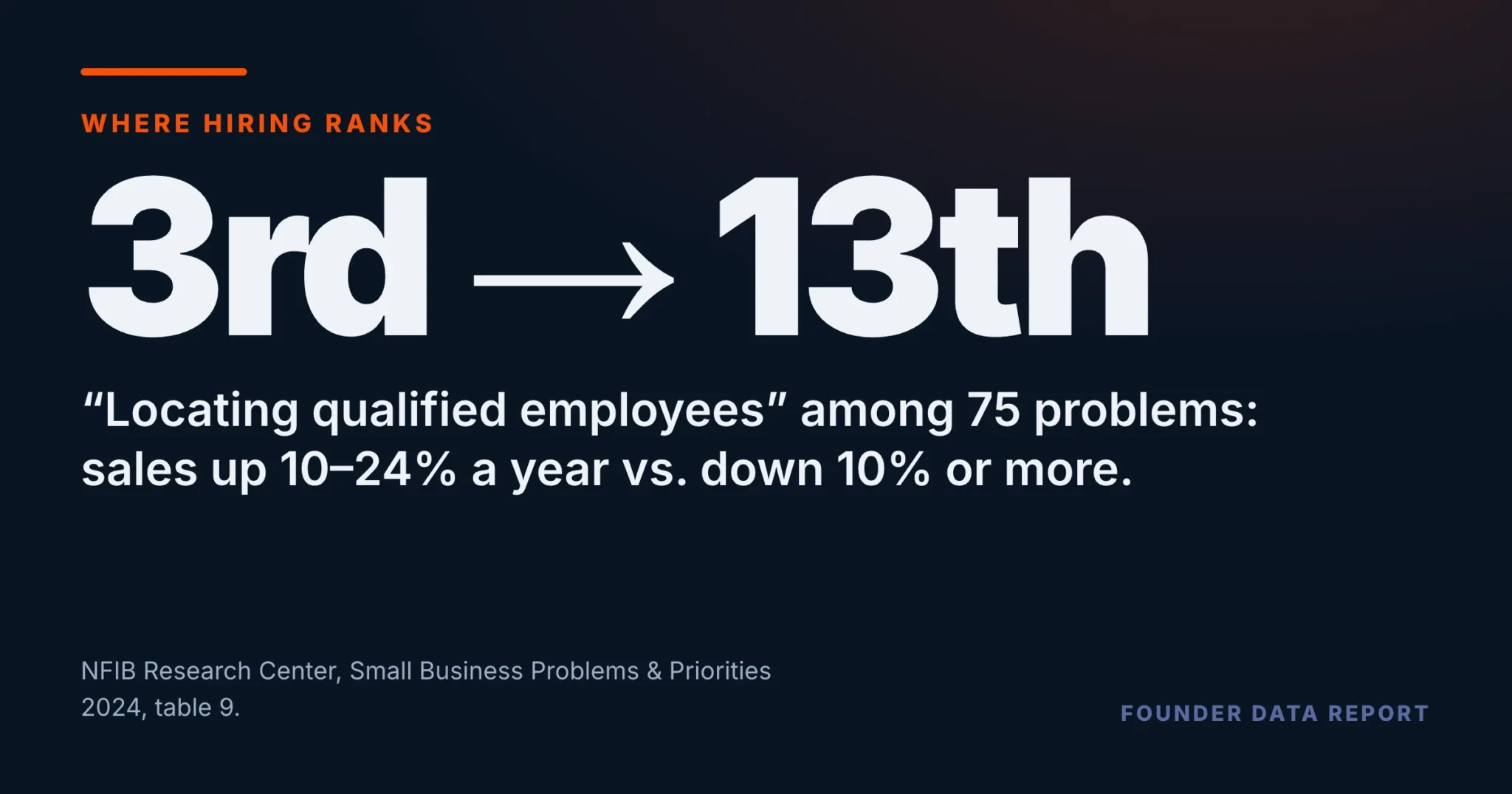
Owners Whose Sales Fell 10% or More a Year Rank Finding Qualified Staff 13th. Owners Growing 10–24% Rank It 3rd.
Join us Fridays at 12 PM ET to ask TLE CEO Michael Dermer your questions live.
NFIB’s 2024 problem survey, cut by sales trend: when sales fall, the money problems climb the list. The staffing problems drop down it without getting any smaller.
In NFIB’s 2024 Small Business Problems & Priorities survey, owners rated 75 possible problems. NFIB also split the answers by how each owner’s sales had moved over the last three years. Owners whose sales fell 10% or more a year ranked “locating qualified employees” 13th. Owners whose sales grew 10% to 24% a year ranked it 3rd. About as many in each group called it critical: 28.4% and 30.2%. For the owners with falling sales, 12 problems ranked above it, among them uncertainty over the economy, interest rates and poor earnings. The hiring problem was still there. It had been outranked.
- NFIB asked 2,873 member owners to rate 75 problems on a 1 to 7 scale, from critical to not a problem.
- Owners with sales down 10% or more a year rated 69 of the 75 as more severe than owners growing 10–24% a year did. On 31 the gap is wider than the survey’s noise. On none does it go the other way.
- Poor sales ranks 16th for the shrinking group and 64th for the growing one. Poor earnings: 12th and 46th. Cash flow: 22nd and 49th.
- Locating qualified employees drops from 3rd to 13th, but the share calling it critical does not differ by more than the noise (30.2% vs. 28.4%).
- Managing and training employees each drop 16 places, again with no real change in how severe owners rate them.
One survey, two different lists
NFIB has run Problems & Priorities since 1982. In the 2024 edition, member owners rated 75 problems from 1 (critical) to 7 (not a problem), and NFIB ranked them by average score. It also ranked them separately for owners grouped by their average yearly sales change over the last three years. The two biggest groups at either end are owners whose sales fell 10% or more a year (451 owners) and owners whose sales grew 10% to 24% a year (702). Their lists are not the same list. Uncertainty over economic conditions is 1st for the shrinking group and 6th for the growing one. Poor sales moves 48 places, poor earnings 34 and cash flow 27. The staff problems move the other way: locating qualified employees falls 10 places and managing and training employees 16 each.
Places gained or lost among 75 problems, comparing owners whose sales fell 10% or more a year (451 owners) with owners whose sales grew 10% to 24% a year (702). Bars to the right rank higher for the shrinking group, bars to the left lower. All bars on one scale, where a full half-width is 50 places.
NFIB Research Center, Small Business Problems & Priorities, 11th edition (2024), table 9: mail survey of NFIB member owners, February to April 2024, 2,873 usable responses; retrieved from nfib.com on October 13, 2026.
For owners with falling sales, the hiring problem was still there. It had been outranked.
The money problems climb the list
Some of this is close to built in. An owner whose sales are falling is more likely to call poor sales critical, and 19.0% of the shrinking group did, against 3.1% of the growing group. The wider pattern is the useful part. The shrinking group rated 69 of the 75 problems as more severe on average, and the gap clears the survey’s noise on 31 of them. After poor sales, the two biggest climbs on the list are about money coming in: poor earnings (22.9% critical against 7.0%) and cash flow (19.6% against 7.1%). Highly variable earnings climbs too (17.4% against 6.6%). Uncertainty over economic conditions takes first place, with 36.0% calling it critical.
Share rating each problem 1 (critical) on NFIB’s 1 to 7 scale, with its rank among 75 problems in that group. Drawn on the same scale as the staff-problems chart below. Every gap shown here is wider than the survey’s noise.
NFIB Research Center, Small Business Problems & Priorities, 11th edition (2024), table 9: mail survey of NFIB member owners, February to April 2024, 2,873 usable responses; retrieved from nfib.com on October 13, 2026.
The staff problems drop down the list without getting smaller
Locating qualified employees sits 3rd for owners with growing sales, with only 2 problems above it. For owners with falling sales it sits 13th, with 12 above it. Yet 28.4% of the shrinking group call it critical, against 30.2% of the growing group, a gap inside the survey’s noise. The same holds for finding and keeping skilled employees (9th against 20th), managing employees (34th against 50th) and training them (35th against 51st). On none of the four do the two groups differ by more than the noise, on the average score or on the share calling it critical. Two staff problems make the growing group’s top ten. None makes the shrinking group’s. The people problems did not shrink when sales fell. Everything around them got louder.
Share rating each problem 1 (critical) on NFIB’s 1 to 7 scale, with its rank among 75 problems in that group. Same scale as the chart above. None of these four gaps is wider than the survey’s noise: the ranks move, the severity does not.
NFIB Research Center, Small Business Problems & Priorities, 11th edition (2024), table 9: mail survey of NFIB member owners, February to April 2024, 2,873 usable responses; retrieved from nfib.com on October 13, 2026.
What to take from this when your sales are falling
When sales are falling, everything feels urgent, and the urgent problems are about money: the next sale, the next payroll, the next month. In this survey those problems climb the list, and it makes sense to focus there. The trap is what drops off. The staff problems did not become less severe for owners with falling sales. They sat lower on the list only as the problems around them were rated more severe. Hiring, keeping good people and training them are long-term problems, and they are the ones that decide what the business looks like when sales turn. Put one of them on the short list on purpose, even in a bad quarter: keep in touch with the two or three people you would hire first, and keep training the ones you have. The urgent list will look after itself.
Four limits worth holding. The respondents are NFIB members who returned a mail survey (2,873 of 40,000 mailed), and 2,479 of them reported a sales change. Sales change is the owner’s own estimate of their average yearly change over three years. The survey is one point in time: it compares different owners, not the same owner before and after sales fell, and it shows what each group rated, not why. NFIB publishes no margins of error; the comparisons here use the overall spread of answers for each problem and the size of each group, and only gaps well clear of that are reported as differences. And ranks are relative: a problem can fall down the list without changing at all.
NFIB Research Center, Small Business Problems & Priorities, 2024.
Frequently Asked Questions
What is NFIB's Problems & Priorities survey?
A mail survey the NFIB Research Center has run roughly every four years since 1982. The 2024 edition asked member owners to rate 75 possible problems from 1 (critical) to 7 (not a problem). 2,873 returned usable answers.
Which problems top the list for owners whose sales are falling?
For owners whose sales fell 10% or more a year, uncertainty over economic conditions ranks 1st, with 36.0% calling it critical, ahead of the cost of health insurance. Poor earnings ranks 12th, poor sales 16th and cash flow 22nd.
Is hiring less of a problem when sales fall?
Not in this survey. Locating qualified employees ranks lower for owners with falling sales (13th against 3rd), but 28.4% of them call it critical against 30.2% of owners growing 10% to 24% a year, a gap inside the survey's noise.
Do owners with falling sales rate everything as worse?
Nearly. They rated 69 of the 75 problems as more severe on average than owners growing 10% to 24% a year, and on 31 the gap is wider than the noise. None separated the other way.
Does this represent all small businesses?
Not exactly. The respondents are NFIB members who answered a mail survey. NFIB notes they lean toward interior states and include agriculture, which Census small-business counts leave out.
Published by The Lonely Entrepreneur — the community and coaching platform for entrepreneurs who are building alone. lonelyentrepreneur.com
This article is for educational purposes and is not a substitute for professional financial or legal advice.