

 Founder Data Report
Florida Has One in Ten U.S. Businesses With No Employees. It Added One in Five of the New Ones.
Get clarity — download the free Entrepreneur Survival Guide Summary.
The newest Census count added 1.56 million businesses with no paid employees in a year. Every state grew. But the growth was not spread like the businesses are — two states took a third of it.
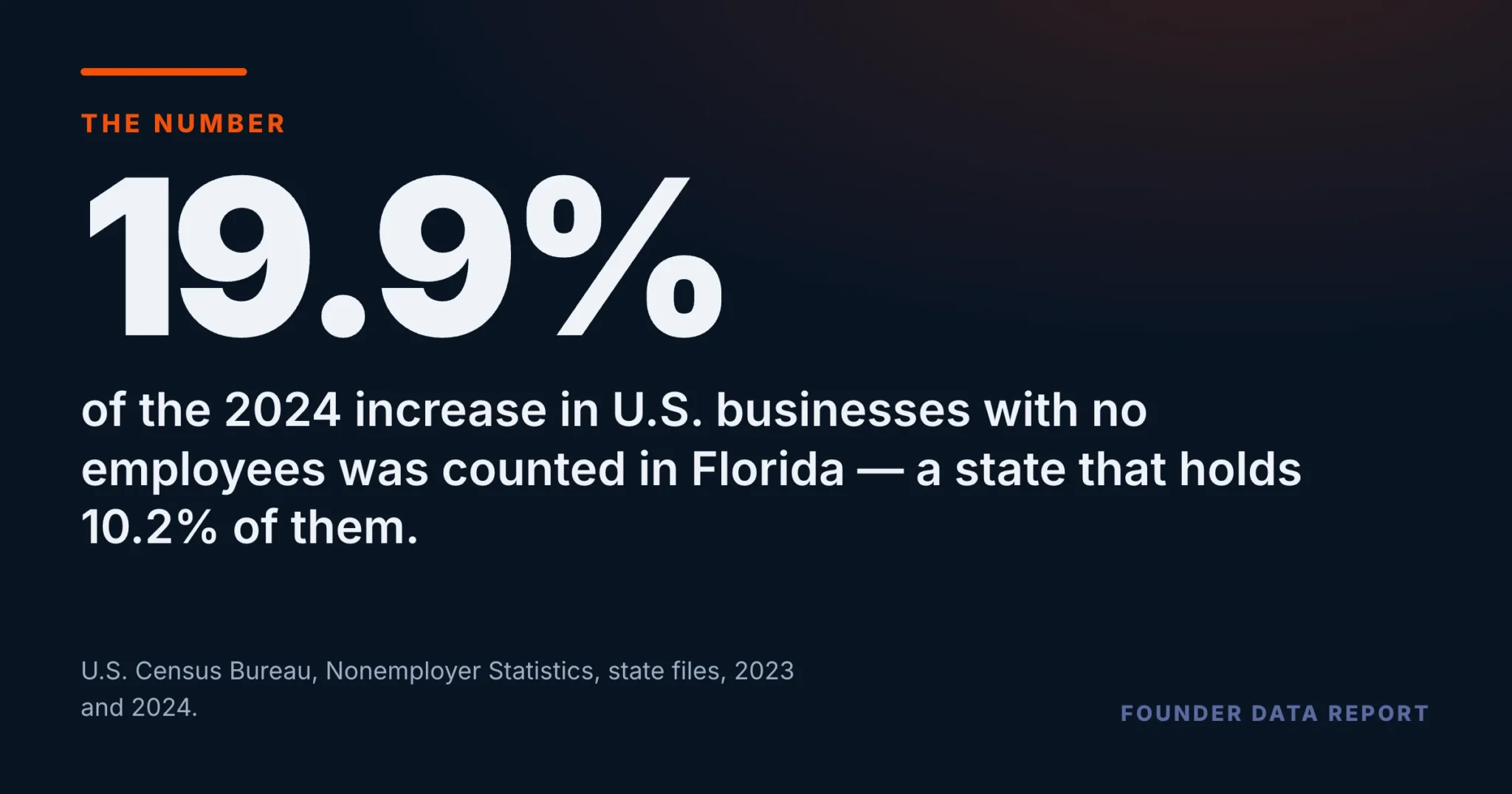
The Census Bureau counted 31,985,874 American businesses with no paid employees in 2024, up 1,558,066 from 2023. All 50 states and DC grew. Florida, which holds 10.2% of these businesses, added 310,014 — 19.9% of the national increase — and grew 9.9%, nearly twice the national 5.1%. Texas, with 10.2% of the count, added 14.5% of the increase. Together the two states hold about a fifth of these businesses and took about a third of the growth. California, the state with the most of these businesses, took less than its share.
- U.S. businesses with no employees: 30,427,808 in 2023, 31,985,874 in 2024, up 5.1%.
- All 51 places — the 50 states and DC — grew. Only 10 grew faster than the national rate.
- Florida: 10.2% of the count, 19.9% of the increase, up 9.9%.
- Florida and Texas together: 20.4% of the count, 34.4% of the increase.
- Leave out transportation and warehousing and Florida still grew 9.2%, more than twice the national 4.3%.
Every state grew, at very different speeds
Nonemployer Statistics counts businesses that have no paid employees and file taxes as a sole proprietorship, partnership or corporation — the freelancer, the one-truck hauler, the landlord with a single rental. The 2024 file, released September 29, 2026, puts the national count at 31,985,874, up 5.1% in a year. Every one of the 51 places grew, but the range is wide: Florida rose 9.9%, South Carolina 8.3% and Texas 7.3%, while the District of Columbia rose 0.3% and Alaska 0.5%. Only 10 of the 51 grew faster than the country as a whole — the national rate is pulled up by a few large, fast-growing states.
Percent change in the count, 2023 to 2024. The axis runs from 0% to 11%; the shortest bars are drawn at a minimum width so they stay visible. United States is shown in the middle for reference.
U.S. Census Bureau, Nonemployer Statistics, state files for 2023 (nonemp23st) and 2024 (nonemp24st, released September 29, 2026), all industries, all legal forms. Retrieved October 8, 2026.
One state holds one in ten of these businesses. It took one in five of the new ones.
Where the 1.56 million landed
A state’s share of the increase can be set beside its share of the existing count. If growth were spread evenly, the two would match. They do not. Florida held 10.2% of the 2023 count and took 19.9% of the increase, about double. Texas held 10.2% and took 14.5%. Georgia and North Carolina also took more than their share, and New York slightly more. California is the reverse: it holds the largest share of any state, 11.6%, and took 9.6% of the increase. Florida and Texas together hold 20.4% of these businesses and added 34.4% of the growth.
Slate is each state’s share of all U.S. businesses with no employees in 2023; orange is its share of the 2023-to-2024 increase. One scale throughout.
U.S. Census Bureau, Nonemployer Statistics, state files for 2023 (nonemp23st) and 2024 (nonemp24st, released September 29, 2026), all industries, all legal forms. Retrieved October 8, 2026.
It is not only the drivers
Transportation and warehousing — the sector that includes drivers and couriers — added more no-employee businesses than any other sector nationally, and it is Florida’s largest gain too, at 64,023. So the question is whether Florida’s lead is a delivery story. It is not. Take that sector out of both years and Florida still grew 9.2%, against 4.3% for the country, and 17 of its 18 sectors grew. South Carolina and Texas stay near the top. At the other end, Alaska’s count outside transportation fell 0.6% — the only state where it fell. The file records where these businesses are counted, not why they started there, and this article does not offer a reason.
Percent change in the count after removing transportation and warehousing from both years. The six fastest states, the United States, and the four slowest. The axis runs to 10% in each direction.
U.S. Census Bureau, Nonemployer Statistics, state files for 2023 (nonemp23st) and 2024 (nonemp24st, released September 29, 2026), all industries, all legal forms. Retrieved October 8, 2026.
What to do with this if you work on your own
If you are in Florida, Texas or another fast-growing state, the number of businesses run with no employees around you rose faster in 2024 than almost anywhere else. That is more potential partners and subcontractors, and more competition for the same customers. Know which one you are planning for. If you are in a slow-growing state, the field is not filling up as quickly — but the national number still rose by 1,558,066 in one year, so the crowd is growing everywhere.
Three limits worth holding. These are businesses, not people. This is a single year, 2023 to 2024, and one year is not a trend. And the file counts businesses without employees only — a business that hired its first worker in 2024 leaves this count, so a slow-growing state can also be one where more of them took that step.
U.S. Census Bureau, Nonemployer Statistics 2023 and 2024, state files.
Frequently Asked Questions
How many businesses with no employees are there in the US?
31,985,874 in 2024, according to the Census Bureau's Nonemployer Statistics, up 1,558,066 or 5.1% from 2023.
Which state added the most businesses with no employees?
Florida, with 310,014, or 19.9% of the national increase. Texas was second with 225,904.
Did any state lose businesses with no employees?
No. All 50 states and DC grew from 2023 to 2024. The slowest was the District of Columbia, at 0.3%.
Is Florida's growth just delivery drivers?
No. Outside transportation and warehousing, Florida's count still grew 9.2%, against 4.3% nationally, and 17 of its 18 sectors grew.
Does California have the most businesses with no employees?
Yes, 11.6% of the national count in 2023, but it took a smaller share of the 2024 increase, 9.6%.
Published by The Lonely Entrepreneur — the community and coaching platform for entrepreneurs who are building alone. lonelyentrepreneur.com
This article is for educational purposes and is not a substitute for professional financial or legal advice.