

 Founder Data Report
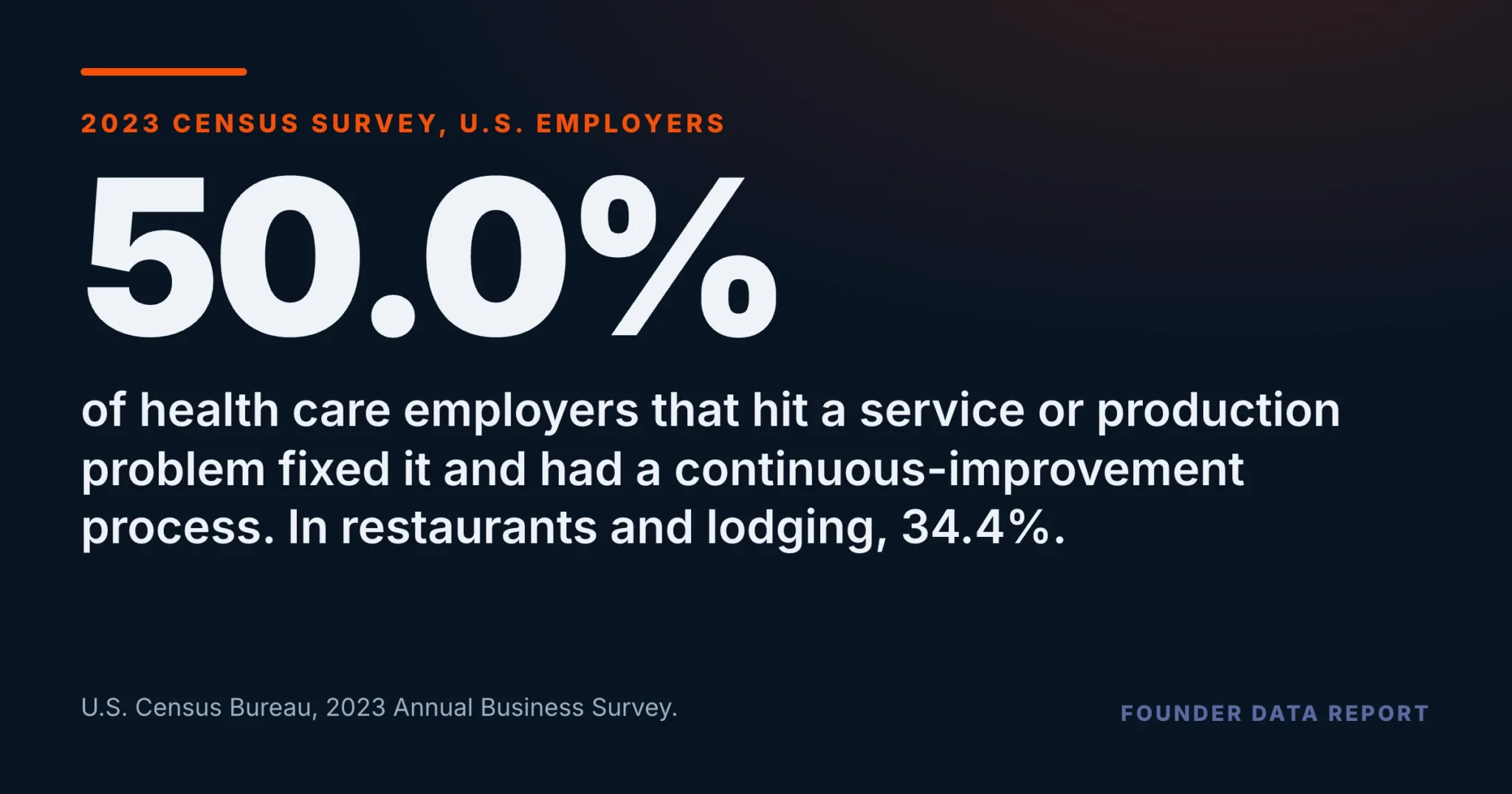
When Something Went Wrong, 50.0% of Health Care Employers Had a Continuous-Improvement Process. In Restaurants, 34.4%
You can’t afford to risk your business without a Sidekick at your side.
The Census Bureau asked U.S. employers what happened when a problem came up in their service or production. Whether the fix stopped at the fix depends on the trade.
In the Census Bureau’s 2023 Annual Business Survey, about half of employers in health care (50.0%), education (52.1%) and finance and insurance (51.3%) that hit a service or production problem fixed it and had a continuous-improvement process. In restaurants and lodging, retail, real estate, repair and personal services, and construction it was between 34.4% and 38.8%. In four of those trades about one employer in five with a problem fixed it and took no further action, or did not fix it.
- Fixed the problem and had a continuous-improvement process: 52.1% in education, 51.3% in finance, 50.0% in health care, 41.2% across all sectors.
- Restaurants, retail, real estate, repair and construction: 34.4% to 38.8%, and the survey cannot rank those five against each other.
- Fixed it and took no further action, or did not fix it: 21.4% in repair and personal services, 10.3% in education.
- Said no problem came up at all: 69.4% in real estate, 43.8% in restaurants and lodging.
- Shares are of firms that answered: between 37% and 59% of firms, depending on the trade.
What happened when something went wrong
The Annual Business Survey is the Census Bureau’s yearly survey of U.S. employer firms, and its 2023 edition asked a set of management questions. One was about problems in the work itself: when a problem came up in the business’s service or production, what best describes what happened? Five answers, one per firm: no problem came up; the business fixed it and did not take further action; it fixed it and took further action; it fixed it and had a continuous-improvement process; or it did not take action to fix it.
About half of firms answered (48% across all sectors). Of those, 45.7% said a problem had come up. Among them, 41.2% fixed it and had a continuous-improvement process, 42.5% fixed it and took further action, and 16.3% fixed it and stopped there or did not fix it. An earlier piece here sorted the same question by the size of the firm. This one sorts it by trade, for the 11 sectors where the estimates are tight enough to compare.
Where the fix came with a process
Three trades sat at about half. In education it was 52.1%, in finance and insurance 51.3% and in health care 50.0%. Each was higher than every one of five trades lower down: restaurants and lodging (34.4%), retail (35.2%), real estate (36.5%), repair and personal services (36.6%) and construction (38.8%). Those five could not be told apart from each other, so none of them is the bottom.
Share of employer firms that answered and said a problem came up. Bars on a 0 to 100% scale. Orange: the three trades whose ranges sit above restaurants, retail, real estate, repair and personal services, and construction. The 95% range under each trade is a conservative one.
U.S. Census Bureau, 2023 Annual Business Survey, Module Business Characteristics by sector (AB2300MCB01), question on service or production problems; U.S. employer firms, released January 2026, retrieved October 14, 2026.
Where the fix stopped at the fix
The other end of the answer list shows a similar divide. In repair and personal services 21.4% of firms with a problem fixed it and took no further action, or did not fix it. In retail it was 20.8%, in real estate 20.7% and in restaurants and lodging 19.8%: about one in five. In finance (13.1%), health care (12.7%), professional services (12.3%) and education (10.3%) it was 13.1% or less, lower than each of those four.
Share of employer firms that answered and said a problem came up. Bars on a 0 to 30% scale. Orange: the four trades whose ranges sit above finance, health care, professional services and education.
U.S. Census Bureau, 2023 Annual Business Survey, Module Business Characteristics by sector (AB2300MCB01), question on service or production problems; U.S. employer firms, released January 2026, retrieved October 14, 2026.
In four trades, about one employer in five that hit a problem fixed it and stopped there, or left it.
The first answer, that no problem came up, also split by trade: 69.4% in real estate, 65.5% in finance and 65.3% in arts and recreation, against 49.9% in construction and 43.8% in restaurants and lodging. That answer cannot separate a business where fewer things went wrong from one where fewer of them were noticed or named.
Share of employer firms that answered the question. Bars on a 0 to 100% scale. The survey cannot say whether a lower share means more went wrong or more was noticed.
U.S. Census Bureau, 2023 Annual Business Survey, Module Business Characteristics by sector (AB2300MCB01), question on service or production problems; U.S. employer firms, released January 2026, retrieved October 14, 2026.
What to take from this if you run a small one
If you are the one who fixes things when they go wrong, the question this survey asked is about what happens after the fix: does it stop there, or is there a way of working that catches the next one without you? In some trades about half of employers with a problem said they had a continuous-improvement process; in others it was closer to a third. The survey does not tell you which is right for your business. It is worth asking which of its five answers would be true for yours, and whether you would be happy saying it out loud.
Three limits worth holding. The survey cannot say why trades answer differently; it is one cross-section, and trades differ in many ways it does not measure. The answers are the firm’s own description of what happened, not an audit of it, and the survey’s answer labels are short, so this piece uses them as published. And the shares rest on the firms that answered, between 37% and 59% of firms by trade.
U.S. Census Bureau, 2023 Annual Business Survey.
Frequently Asked Questions
What do small businesses do when a problem comes up in their work?
In the Census Bureau's 2023 Annual Business Survey, of U.S. employer firms that answered and had a service or production problem, 41.2% fixed it and had a continuous-improvement process, 42.5% fixed it and took further action, and 16.3% fixed it and took no further action or did not fix it.
Which industries most often have a continuous-improvement process?
Education (52.1%), finance and insurance (51.3%) and health care (50.0%), each higher than restaurants, retail, real estate, repair and personal services, and construction.
Which industries most often fix a problem and stop there?
Repair and personal services (21.4%), retail (20.8%), real estate (20.7%) and restaurants and lodging (19.8%), counting firms that fixed it and took no further action or did not fix it.
If an employer says no problem came up, did less go wrong there?
Not necessarily. The survey cannot separate a business where fewer things went wrong from one where fewer of them were noticed.
Where does the data come from?
The U.S. Census Bureau's 2023 Annual Business Survey, management module, published by sector. Shares are of employer firms that answered the question.
Published by The Lonely Entrepreneur — the community and coaching platform for entrepreneurs who are building alone. lonelyentrepreneur.com
This article is for educational purposes and is not a substitute for professional financial or legal advice.