

 Founder Data Report
Six in Ten Small Firms That Borrowed From an Online Lender Say the Cost Came In Higher Than Expected. At Banks, About a Third
Get clarity — download the free Entrepreneur Survival Guide Summary.
Trust in a lender is built or lost on one thing: whether the deal you got is the deal you thought you were getting. The Federal Reserve asked thousands of small employers. The answers differed sharply by where they borrowed.
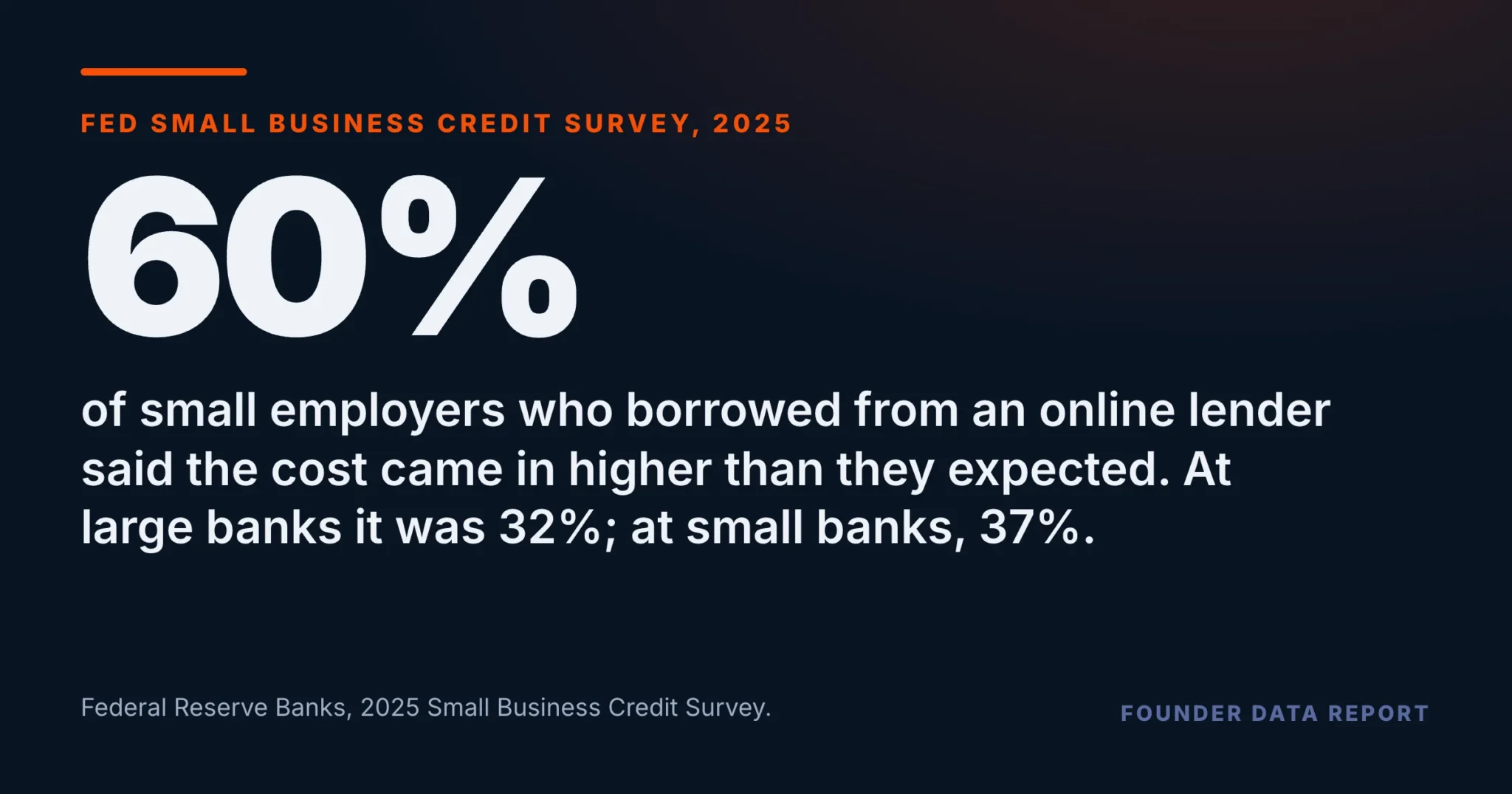
In the Federal Reserve Banks’ 2025 Small Business Credit Survey, 60% of employer firms that borrowed from an online lender said the cost came in higher than they expected. Among those who borrowed from a large bank it was 32%, and from a small bank 37%. Applicants at online lenders most often named the interest rate (61%) as a problem. Applicants at large banks named the process as often as the price: a difficult application, unclear approval criteria and long waits.
That gap is a trust gap. A loan that costs more than you were led to expect damages the relationship even when the money arrives. A loan that is slow and opaque to get damages it in a different way. The survey shows which kind of lender tends to produce which kind of disappointment.
- Borrowing cost came in higher than expected: online lenders 60%, finance companies 44%, small banks 37%, large banks 32%.
- Among owners with 1 to 4 employees: online lenders 54%, large banks 30%.
- At online lenders, 61% of applicants named a high interest rate and 38% unfavorable repayment terms.
- At large banks the process drew as many complaints as the price: interest rate 28%, difficult application 26%, unclear criteria 24%, long wait 21%.
- The survey records what owners experienced. It does not say why the lenders differ.
Two questions the Federal Reserve asked
The Small Business Credit Survey, run each year by the twelve Federal Reserve Banks, asks firms with fewer than 500 employees where they applied for a loan, line of credit or cash advance, and how it went. In the 2025 survey, 41% of applicants went to a large bank, 29% to an online lender and 28% to a small bank. Two of its questions are the subject here.
The first asks firms that borrowed from a lender whether the cost came in higher than expected, about the same, or lower. The second asks firms that applied to a lender what challenges they ran into, and lets them name more than one. The two questions go to different groups, so this piece never sets one against the other.
Firms that took a loan, line of credit or merchant cash advance from each type of lender. The credit union and CDFI samples are small and their ranges wide, so they are shown but not compared. Bars on a 0 to 100% scale.
Federal Reserve Banks, 2025 Small Business Credit Survey, 2026 Report on Employer Firms data appendix (published March 3, 2026): ‘Borrowing cost relative to expectations’ (loan, line of credit and cash advance borrowers at each source) and ‘Challenges at [source]’ (applicants at each source). Employer firms with fewer than 500 employees; weighted convenience sample.
At online lenders, the surprise is the price
60% of firms that borrowed from an online lender said the cost was higher than they expected, and 36% said it was about what they expected. At large banks those numbers were close to reversed: 32% higher, 61% about the same. The online-lender figure is clear of both banks in the survey’s own margins of error. It is not clear of finance companies, at 44%.
The challenge question points the same way. Among applicants at online lenders, 61% named a high interest rate and 38% unfavorable repayment terms, against 28% and 10% at large banks. Only 30% of online-lender applicants said they had no challenges at all, against 44% at large banks and 49% at small banks.
Share of applicants at each type of lender naming each challenge. Applicants could name more than one, so the shares do not add to 100. The track runs from 0 to 100%.
Federal Reserve Banks, 2025 Small Business Credit Survey, 2026 Report on Employer Firms data appendix (published March 3, 2026): ‘Borrowing cost relative to expectations’ (loan, line of credit and cash advance borrowers at each source) and ‘Challenges at [source]’ (applicants at each source). Employer firms with fewer than 500 employees; weighted convenience sample.
At an online lender the disappointment is the price. At a large bank, the process weighs as much as the price.
At large banks, the friction is also getting to yes
Large-bank applicants named a wider set of problems: 26% said the application was difficult, 24% that the approval criteria were unclear and 21% that they waited a long time for a decision or the money. Each is clear of the same complaint at online lenders, where it was 11%, 11% and 8%. At large banks the interest rate, at 28%, sat level with those three process complaints.
The smallest firms tell the same story. Among owners with 1 to 4 employees, 54% of online-lender borrowers said the cost came in higher than expected, against 30% at large banks. At online lenders 63% of these owners named the interest rate; at large banks 29% named unclear criteria.
Borrowers at each type of lender among firms with 1 to 4 employees. The online-lender share is clear of large banks in the survey’s margins of error, not of small banks. Bars on a 0 to 100% scale.
Federal Reserve Banks, 2025 Small Business Credit Survey, 2026 Report on Employer Firms data appendix (published March 3, 2026): ‘Borrowing cost relative to expectations’ (loan, line of credit and cash advance borrowers at each source) and ‘Challenges at [source]’ (applicants at each source). Employer firms with fewer than 500 employees; weighted convenience sample.
What to take from this before you sign
If you lead a small business, the kind of lender you choose is linked to which kind of surprise you are most likely to get. Speed and an easy application can come with a price you did not see coming. A large bank’s lower odds of a price surprise can come with a slower, less clear road to approval. Either way, it is worth writing down the total cost of the money and the repayment schedule before you sign, and checking them against what you actually pay in the first months.
Three limits worth holding. The survey is a weighted convenience sample of employer firms, not a random draw. It records what owners expected and experienced, not the terms they were offered. And it does not say why the lenders differ.
Federal Reserve Banks, 2025 Small Business Credit Survey.
Frequently Asked Questions
Do online business loans cost more than borrowers expect?
In the Federal Reserve Banks' 2025 Small Business Credit Survey, 60% of employer firms that borrowed from an online lender said the cost came in higher than expected, against 32% at large banks and 37% at small banks.
What do small businesses complain about at online lenders?
Mostly the price: 61% of applicants named a high interest rate and 38% unfavorable repayment terms.
What do they complain about at large banks?
At large banks, the process as much as the price: 28% named the interest rate, 26% named a difficult application, 24% unclear approval criteria and 21% a long wait.
Is it different for the smallest businesses?
Not in direction. Among owners with 1 to 4 employees, 54% of online-lender borrowers said the cost was higher than expected, against 30% at large banks.
Where does the data come from?
The 2025 Small Business Credit Survey of the twelve Federal Reserve Banks, from the data appendix to the 2026 Report on Employer Firms. It covers firms with 1 to 499 employees.
Published by The Lonely Entrepreneur — the community and coaching platform for entrepreneurs who are building alone. lonelyentrepreneur.com
This article is for educational purposes and is not a substitute for professional financial or legal advice.