

 Founder Data Report
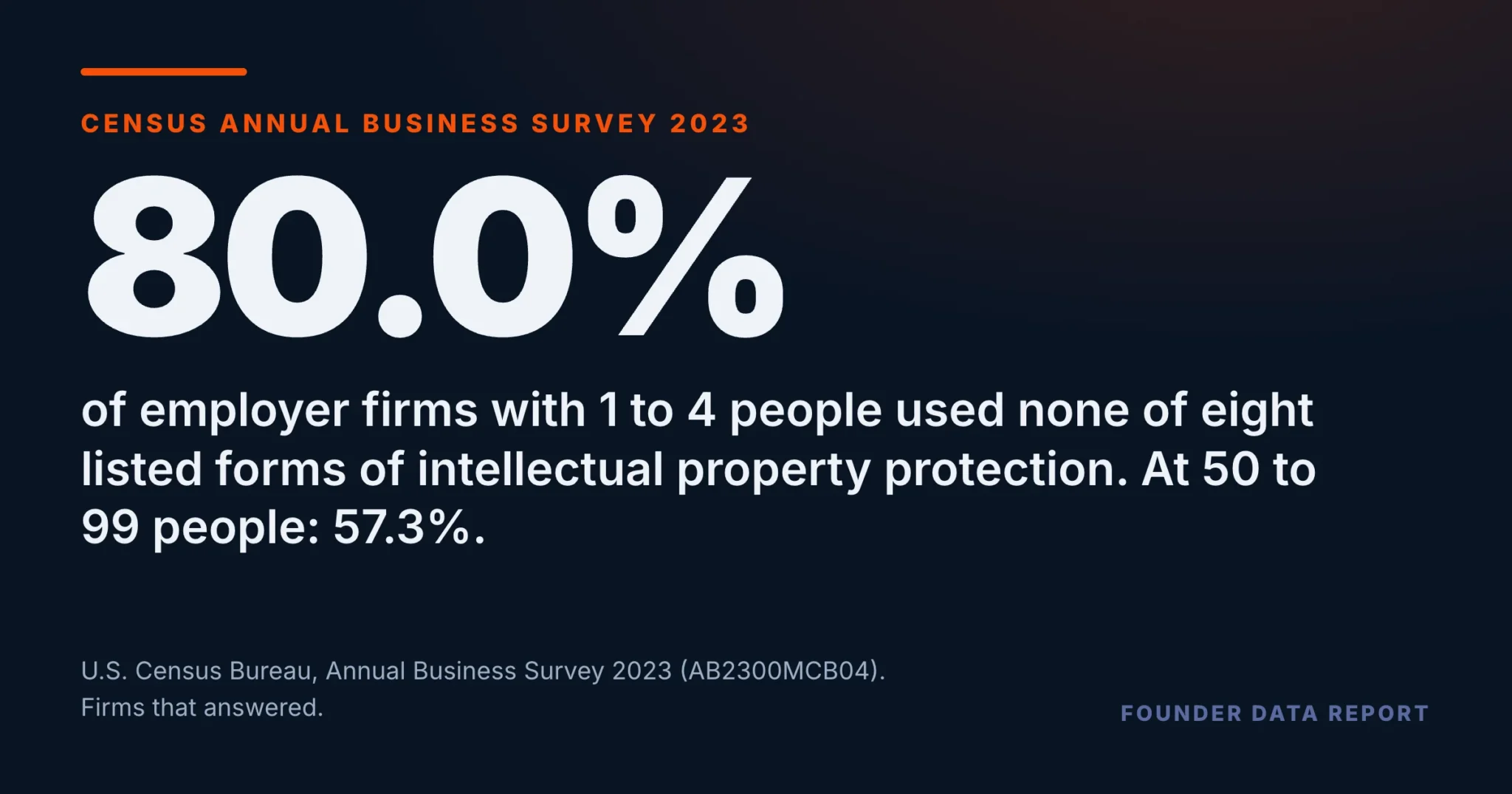
80.0% of Employers With 1 to 4 People Used None of Eight Ways to Protect Their Ideas. At 50 to 99: 57.3%
You can’t afford to risk your business without a Sidekick at your side.
The Census Bureau asked employers which of eight forms of protection they used for their intellectual property. At the smallest firms, four in five answered none of them.
In the U.S. Census Bureau’s 2023 Annual Business Survey, 80.0% of employer firms with 1 to 4 people said they used none of eight listed forms of intellectual property protection: no nondisclosure agreement or noncompete clause, no trade secret, no trademark, copyright or patent, and neither branding nor design complexity. The share falls with size, to 57.3% at 50 to 99 people. Of the forms small firms did name, nondisclosure agreements and noncompete clauses were second only to branding; patents were the rarest.
- 1 to 4 people: 80.0% of employer firms used none of the eight forms of protection the survey lists.
- 5 to 9: 75.8%. 10 to 19: 70.0%. 20 to 49: 64.3%. 50 to 99: 57.3%.
- At 1 to 4 people, branding and product image (11.7%) and nondisclosure agreements or noncompete clauses (9.7%) were the two most used. Utility patents: 1.2%.
- Nondisclosure agreements or noncompete clauses rose from 9.7% at 1 to 4 people to 27.1% at 50 to 99.
- Firms could name more than one form, and the shares are of the roughly half of firms that answered.
Most small employers named nothing
The Annual Business Survey asked employer firms about intellectual property protection and offered eight answers, from utility and design patents to trade secrets and nondisclosure agreements or noncompete clauses, plus a ninth: none of these. At firms with 1 to 4 people, 80.0% chose none. That is about 1.2 million of the 1.5 million such firms that answered. The share is lower in each larger size band: 75.8% at 5 to 9 people and 70.0% at 10 to 19, and reaches 57.3% at 50 to 99. Even at 500 people or more, 39.4% named none, though the margin of error there is about ten points either way.
Firms that answered the question, 48–54% of employer firms in each band. Orange: 1 to 4 employees. 95% ranges under each band. The steps from 1–4 to 5–9 and from 5–9 to 10–19 clear their margins; 10–19 and 20–49 do not separate from each other. Bars share one scale.
U.S. Census Bureau, Annual Business Survey 2023, Module Characteristics of Businesses by employment size of firm (AB2300MCB04), question on intellectual property protection, U.S. employer firms, all sectors; firms that answered the question; retrieved from census.gov on October 11, 2026.
Which forms they did use
Among firms with 1 to 4 people, the most used form was branding and product image, at 11.7%. Next came nondisclosure agreements or noncompete clauses, at 9.7%, clearly ahead of trademarks (6.6%), copyright (6.1%) and trade secrets (3.8%). Patents were the rarest: 1.2% named utility patents and 1.1% design patents. Through 20 to 49 people, utility patents stayed under 3%. At 20 to 49, nondisclosure agreements or noncompete clauses (22.0%) and branding (21.7%) were level.
Firms with 1 to 4 employees that answered the question. Firms could name more than one form, so shares do not add to 100. Orange: nondisclosure agreements or noncompete clauses. Bars share one scale, 0 to 13%.
U.S. Census Bureau, Annual Business Survey 2023, Module Characteristics of Businesses by employment size of firm (AB2300MCB04), question on intellectual property protection, U.S. employer firms, all sectors; firms that answered the question; retrieved from census.gov on October 11, 2026.
At the smallest employers, the agreements that set what staff and partners may do with what they know, NDAs and noncompetes, were used by 9.7%.
Firms of 50 to 99 used more of every form
Every form of protection on the list was used by a larger share of firms at 50 to 99 people than at 1 to 4. Nondisclosure agreements or noncompete clauses went from 9.7% to 27.1%; branding from 11.7% to 25.9%; trademarks from 6.6% to 21.2%; and trade secrets from 3.8% to 10.9%. For each of those four, the gap between the two sizes clears the survey’s margin of error.
Employer firms that answered the question. Slate: 1 to 4 employees. Orange: 50 to 99. The axis runs from 0 to 30%. For all four, the two sizes’ 95% ranges do not overlap.
U.S. Census Bureau, Annual Business Survey 2023, Module Characteristics of Businesses by employment size of firm (AB2300MCB04), question on intellectual property protection, U.S. employer firms, all sectors; firms that answered the question; retrieved from census.gov on October 11, 2026.
What to take from this if you run a small one
The survey does not say whether the firms that named nothing had anything worth protecting, or whether any of them came to regret it. What it does show is how much of a small business rests on trust. At most small employers, by this survey’s count, the people who know your pricing, your customers and how the work gets done have signed no nondisclosure agreement or noncompete. That can be the right call. It is worth making it on purpose. List the three things a departing employee, contractor or partner could take that would hurt most, and decide for each one whether a handshake is enough.
Three limits worth holding. Only about half of firms answered the question in each size band, and every share here is of those that did. Firms could name more than one form, so the tool shares do not add up to 100. And the survey covers employer firms only; owners with no employees are outside it. Nothing in the file links protection to how any firm fared.
U.S. Census Bureau, Annual Business Survey 2023, Module Characteristics of Businesses (AB2300MCB04).
Frequently Asked Questions
Do small businesses protect their intellectual property?
Most do not report doing so. In the Census Bureau's 2023 Annual Business Survey, 80.0% of employer firms with 1 to 4 people said they used none of eight forms of intellectual property protection, against 57.3% of firms with 50 to 99 people.
How many small businesses use NDAs or noncompete agreements?
9.7% of employer firms with 1 to 4 people reported using nondisclosure agreements or noncompete clauses, rising to 22.0% at 20 to 49 people and 27.1% at 50 to 99.
What is the most common way small businesses protect their ideas?
At firms with 1 to 4 people, branding and product image (11.7%), then nondisclosure agreements or noncompete clauses (9.7%). Patents were the least used.
How many small businesses use patents to protect their ideas?
Few: 1.2% of employer firms with 1 to 4 people named utility patents and 1.1% design patents, and utility patents stayed under 3% at every size up to 49 people.
Where does the data come from?
The U.S. Census Bureau's Annual Business Survey 2023, management and characteristics module by employment size of firm. Shares are of the employer firms that answered the question, about half in each size band.
Published by The Lonely Entrepreneur — the community and coaching platform for entrepreneurs who are building alone. lonelyentrepreneur.com
This article is for educational purposes and is not a substitute for professional financial or legal advice.