

 Founder Data Report
The Trust Gap in Paid Advice: The Cost of Accountants, Lawyers and Consultants Climbed From 34th to 23rd on Owners’ Problem List in 12 Years
Join us Fridays at 12 PM ET to ask TLE CEO Michael Dermer your questions live.
Every owner ends up relying on someone who knows what they don’t. NFIB has tracked what that costs in owners’ eyes for decades, and it’s climbing the list again.
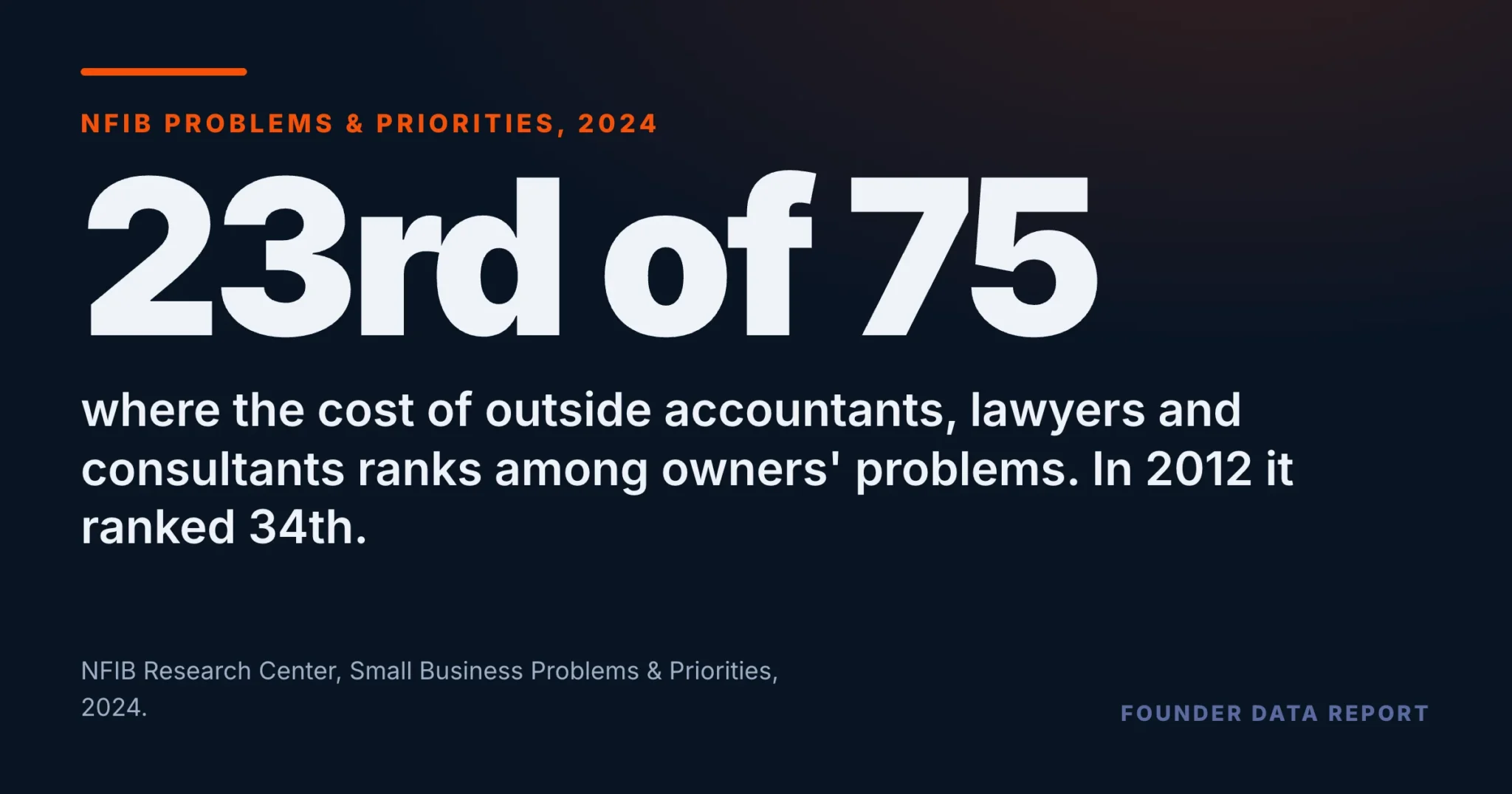
In NFIB’s 2024 survey of its small business members, the cost of outside business services, meaning accountants, lawyers and consultants, ranked 23rd of 75 problems. It ranked 29th in 2020 and 34th in 2012. Only 8.5% called it critical and only 11.0% said it was not a problem, which leaves about four owners in five somewhere in between.
No owner knows everything the business needs. So you pay people who know the tax code, the contract or the market, and you take much of what they say on trust, since you hired them for knowing what you don’t. That is the trust gap every owner lives with.
NFIB’s question doesn’t measure the trust. It measures the bill. But the bill is a part of that relationship NFIB has tracked for decades, and it says something about how much weight this dependence carries.
- Rank among 75 owner problems: 21st in 2000, 34th in 2012, 29th in 2020, 23rd in 2024.
- 8.5% of owners call the cost critical, 11.0% call it no problem, and owners agree on it more than on most of the list: 10th of 75 for consensus.
- Highly urban owners rank it 12th. Small town and rural owners rank it 26th and 27th. That gap holds on our test.
- Newer owners and bigger firms also rank it higher, but those gaps do not hold on the same test.
- The question asks about cost, not quality or trust. NFIB’s respondents are its members.
A problem that went away and came back
With the wording NFIB has used since 2000, this item started at 21st, held there in 2004, slid to 25th and then 34th. It has moved up in each edition since: 32nd, 29th, 23rd. It now sits two places from where it started.
A rank is relative, so part of any climb can be other problems falling away. NFIB doesn’t compare the dollars, and this does not tell you what anyone paid. It does tell you that, among everything competing for an owner’s worry, the outside bill has been gaining ground for twelve years.
Bar length shows position only: longer means higher on the list. Editions before 2000 used different wording, so they are left out.
NFIB Research Center, Small Business Problems & Priorities, 2024 (11th edition) and earlier editions, Table 5: rank of ‘Cost of Outside Business Services’ among 75 problems, 2000 to 2024. Earlier editions used different wording and are left out.
Most owners feel it, and few call it an emergency
The spread of answers is what stands out. 8.5% call the cost critical, well below tax complexity at 18.8%. But only 11.0% say it’s no problem, and owners give similar answers to one another: NFIB ranks it 10th of 75 for consensus, with a standard deviation of 1.78. Estate tax, at the other extreme, reads 2.25. This is a steady cost of doing business, one most owners feel and few get to ignore.
It also sits near other items owners often need help reading. Tax complexity, federal paperwork and dealing with tax agencies all rank close by. The survey doesn’t connect them to the adviser bill, and we won’t claim it does. But if you’ve ever paid someone to explain a form, you’ll recognize the neighborhood.
Only 11.0% of owners say the cost of outside advice is not a problem.
Share of NFIB member owners rating each item, 2024. Both bars on one scale, 0 to 25%. Grouping is ours, not NFIB’s.
NFIB Research Center, Small Business Problems & Priorities, 2024 (11th edition), Table 1. NFIB members, mail survey, February to April 2024. Owners rate each problem from 1, critical, to 7, not a problem.
Where it ranks higher, and how much of that holds
The clearest difference is geography. Highly urban owners rank it 12th, against 26th in small cities and towns and 27th in rural areas, and their mean score of 3.41 separates from both (4.02 and 3.97, where lower is more severe). Highly urban owners rate problems heavier on average, but this one also rises in their order. It’s a small group, 99 responses, and it does not separate from urban or fringe urban owners.
Other gaps look large and don’t hold. Owners of three years or fewer rank it 16th and owners of 21 years or more 28th, yet those means do not separate. Firms of 100 or more employees rank it 16th, on only 44 responses, and no size band separates from the 1 to 4 group. So don’t read a story about new owners or big firms into this.
Responses in brackets. Bar length shows position only. A gap in rank is not a difference: of the gaps tested here, only highly urban against small city and rural separates on means.
NFIB Research Center, Small Business Problems & Priorities, 2024 (11th edition), Tables 6, 7, 10 and 11, by size, industry, population density and years of ownership. Separation tests are our own, on the published figures.
What to take from this if you run one
Treat your advisers as a line you manage, not a bill that arrives. Once a year, ask what each one did that you couldn’t have done, what it cost and whether you’d hire them again today. You can’t judge all of their expertise, but you can judge whether their advice held up.
And notice whose advice has no bill riding on it. An accountant, a lawyer and a consultant can all be excellent and each still sees one slice of the business. It helps to have someone in the conversation who has run a business, sees all of it and has nothing to sell you when you’re deciding whom to believe.
Limits worth holding. The item asks about cost, not whether advisers are good or trusted, so nothing here measures trust directly. Respondents are NFIB members, not all small businesses. Ranks are relative to the other 74 problems and say nothing about dollars. And the survey does not say why the item has climbed or why the groups differ.
NFIB Research Center, Small Business Problems & Priorities, 2024.
Frequently Asked Questions
How much of a problem is the cost of accountants and lawyers for small businesses?
In NFIB's 2024 survey, the cost of outside business services ranked 23rd of 75 problems. 8.5% of member owners called it critical and 11.0% said it was not a problem.
Is the cost of outside advisers getting worse?
It's moving up the list. It ranked 34th in 2012, 32nd in 2016, 29th in 2020 and 23rd in 2024. A rank is relative to other problems, so this doesn't show what owners paid.
Do city businesses feel adviser costs more?
Highly urban owners rank it 12th, against 26th in small towns and 27th in rural areas, and those gaps hold on means. The highly urban group is small, at 99 responses.
Does this show owners don't trust their advisers?
No. The question asks about cost only. It says nothing about quality or trust, and we draw no conclusion about either from it.
Where does the data come from?
NFIB Research Center's Small Business Problems & Priorities, 2024 (11th edition), a mail survey of NFIB members from February to April 2024, plus earlier editions for ranks back to 2000.
Published by The Lonely Entrepreneur — the community and coaching platform for entrepreneurs who are building alone. lonelyentrepreneur.com
This article is for educational purposes and is not a substitute for professional financial or legal advice.