

 Founder Data Report
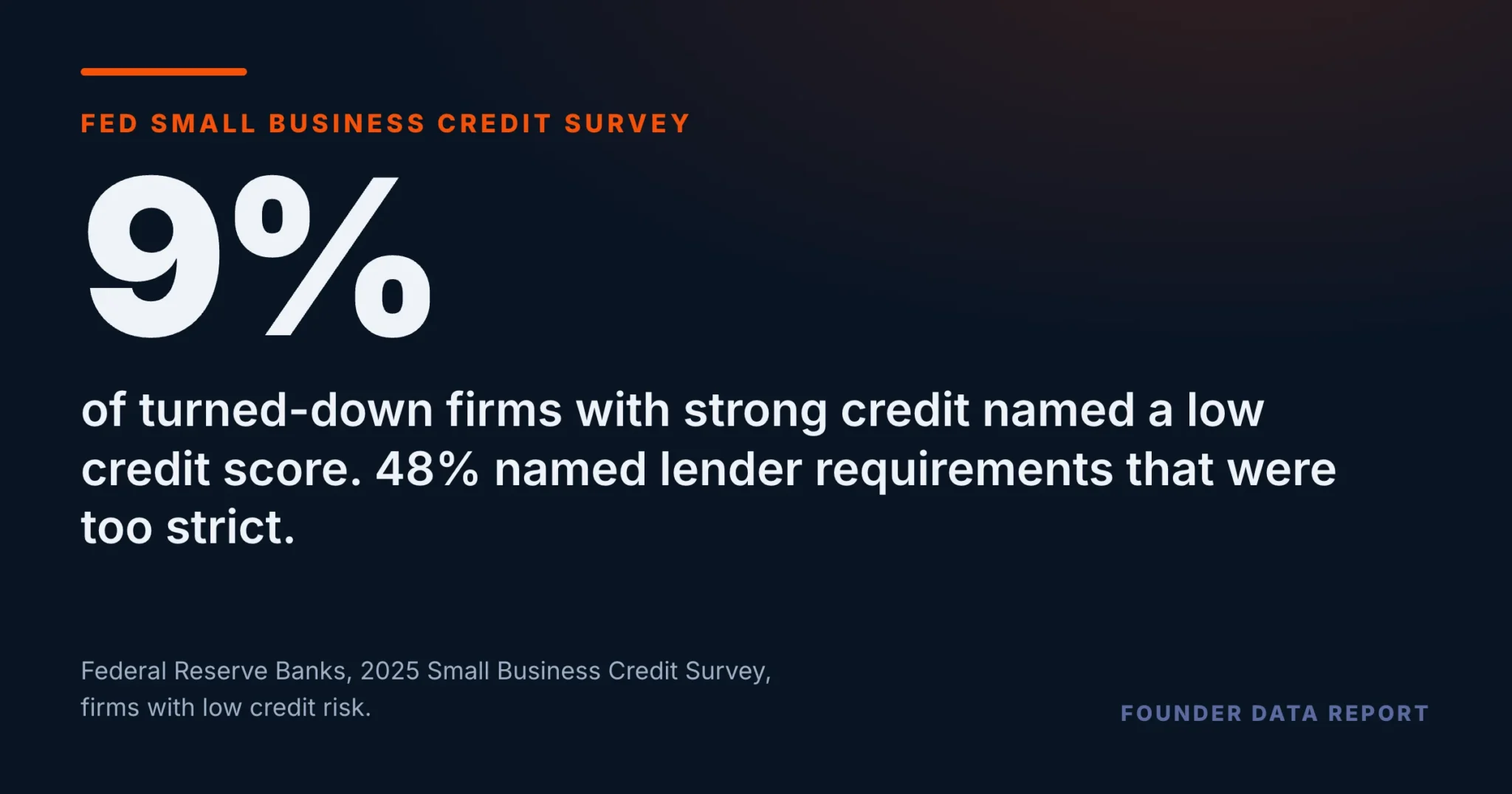
Trust Gap: Of Turned-Down Firms With Strong Credit, 9% Named Their Score. 48% Named Lender Requirements
You can’t afford to risk your business without a Sidekick at your side.
A no from a lender is hard to trust when the reason does not seem to be about you. The Federal Reserve asked owners who were turned down what the reasons were, and split the answers by credit score.
In the Federal Reserve Banks’ 2025 Small Business Credit Survey, 70% of employer firms report a strong credit score. Among those firms that applied and were not approved for at least some of the financing they sought, 9% named a low credit score as a reason. 48% named lender requirements that were too strict, and 35% said lenders do not approve financing for businesses like theirs.
Being turned down is one thing. Being turned down for a reason you cannot act on is another. If it comes down to your credit score, you know what to work on. If it comes down to the lender’s rules, or to a lender that does not lend to businesses like yours, what do you take back to your desk?
We have written about the owners who do not apply, expecting a no, and about which credit score a business uses. This piece takes the owners who did apply, were turned down, and had a strong score. What reasons did they report?
- Seven in ten employer firms report low credit risk: a personal score of 720 or more, or a business score of 80 to 100.
- Among those firms that were turned down for at least some financing, 48% named lender requirements that were too strict. That is the most-named reason, clear of every other.
- 35% said lenders do not approve financing for businesses like theirs. 9% named a low credit score.
- Among firms with a weak score, 73% named a low credit score. The share naming strict requirements is about level across the three credit groups.
- The survey records the reasons firms reported. It does not record what was in the lender’s file, and it does not say whether a reason was right.
Firms with strong credit that were turned down rarely named their score
The survey asks every firm that applied and was not approved for at least some of what it sought which reasons applied. Firms can name more than one, so the shares do not add up to 100. For firms with low credit risk, 441 firms answered.
48% named lender requirements that were too strict. That share is clear of every other reason on the list, once the survey’s margins of error are taken into account. Next come four reasons that sit level with each other: lenders do not approve businesses like mine (35%), too much debt already (31%), weak sales (28%) and insufficient collateral (26%).
A low credit score comes near the bottom, at 9%. Of the seven reasons listed, only missing documentation (4%) was named less often. For these firms, the score was rarely the reason they gave.
Bars on a 0 to 60% scale. Orange: the most-named reason and the credit-score reason. Firms could name more than one reason, so the shares do not add up to 100. Shares are whole numbers as published.
Federal Reserve Banks, 2025 Small Business Credit Survey (2026 Report on Employer Firms, data appendix, updated March 3, 2026). Reason for credit denial. Base: employer firms with low credit risk (self-reported score of 720+ personal or 80-100 business) that applied and were not approved for at least some financing, 441 firms. Firms could give more than one reason.
The score climbs with risk. The rules stay level
Now set the three credit groups side by side. The share naming a low credit score moves the way you would expect: 9% among firms with low credit risk, 38% at medium risk and 73% at high risk. Each step is wider than the margin of error.
The share naming strict lender requirements does not move like that. It is 48% at low risk, 48% at medium risk and 39% at high risk, and none of those three is clear of the others. The same holds for ‘lenders do not approve businesses like mine’: 35%, 29% and 24%, all within the margin of error.
So the reason that tracks the score is the score. Strict requirements were named about as often by owners with strong scores as by owners with weak ones. Across all employer firms that were turned down, 46% named strict requirements and 30% named a low score.
Slate: named lender requirements too strict. Orange: named a low credit score. Bars on a 0 to 80% scale. Credit risk is the firm’s own reported score: low is 720+ personal or 80-100 business, medium is 620-719 or 50-79, high is below 620 or 1-49.
Federal Reserve Banks, 2025 Small Business Credit Survey (2026 Report on Employer Firms, data appendix, updated March 3, 2026). Reason for credit denial, by credit risk. Base: applicants not approved for at least some financing. Credit risk is the firm’s self-reported credit score; firms could give more than one reason.
Strict requirements were named about as often by owners with strong credit as by owners with weak credit.
Strong credit does not mean a full yes. Some of the gap is the owner’s own call
Credit still shows in the outcome. Among firms with low credit risk that applied for a loan, line of credit or cash advance, 60% got all they sought, against 32% at medium risk and 30% at high risk. And 15% of the low-risk applicants got none of it.
The survey then asks firms that did not get everything they sought why not. Here the low-risk group looks different. 57% were not approved for at least some of it, against 92% of high-risk firms. But 41% of the low-risk firms said they did not accept some or all of the financing they were offered. At high risk it was 17%. Both gaps are wider than the margin of error.
Firms could give both answers, so the two shares overlap. The survey does not say why an owner turned an offer down. It may have been the price, the terms or the amount. What it does say is that for owners with strong credit, a fair part of the shortfall came from their own decision.
Slate: not approved for at least some of the financing. Orange: did not accept some or all of the financing offered. Firms could give both answers. Bars on a 0 to 100% scale. A third answer, applications still pending, is not shown.
Federal Reserve Banks, 2025 Small Business Credit Survey (2026 Report on Employer Firms, data appendix, updated March 3, 2026). Reasons applicant did not receive full amount of financing sought, by credit risk. Base: applicants that did not obtain all the financing they sought. Firms could give more than one reason.
What to take from this if you are asking for money
If your score is strong and you were turned down, you are not unusual, and the reason you would name is probably not your score. Close to half of owners in your position named the lender’s rules, and about a third named the kind of business they run. Neither of those says the lender is wrong. They do say the answer may depend on which lender you asked. Have you put the same request in front of more than one?
Three limits are worth holding. The survey records what firms reported, not the lender’s own reasons. It does not say whether a reason was right. And credit risk here is the score the owner reported, not one the survey checked. Within those limits the pattern is plain: for owners with good credit, a no is rarely put down to the number.
Federal Reserve Banks, 2025 Small Business Credit Survey (2026 Report on Employer Firms, data appendix, updated March 3, 2026). Employer firms.
Frequently Asked Questions
Why do small businesses with good credit get denied loans?
In the Federal Reserve Banks' 2025 Small Business Credit Survey, firms with low credit risk that were turned down for at least some financing most often named lender requirements that were too strict (48%). 35% said lenders do not approve financing for businesses like theirs, and 9% named a low credit score. Firms could name more than one reason.
How much does a credit score matter in a business loan denial?
It depends on the score. Among turned-down firms, a low credit score was named by 9% of low-risk firms, 38% of medium-risk firms and 73% of high-risk firms. The share naming strict lender requirements was about level across all three groups.
What counts as low credit risk in the Fed survey?
A self-reported personal credit score of 720 or more, or a business credit score of 80 to 100. If a firm uses both, the weaker one counts. Seven in ten employer firms fall in this group.
Do businesses with strong credit turn down loan offers?
Among low-risk firms that did not get all the financing they sought, 41% said they did not accept some or all of what they were offered. Among high-risk firms it was 17%. The survey does not say why an offer was turned down.
Where does the data come from?
The Federal Reserve Banks' 2025 Small Business Credit Survey, published in the 2026 Report on Employer Firms and its data appendix (updated March 3, 2026). Shares are of employer firms, are weighted, carry 95% confidence intervals and are published as whole numbers.
Published by The Lonely Entrepreneur — the community and coaching platform for entrepreneurs who are building alone. lonelyentrepreneur.com
This article is for educational purposes and is not a substitute for professional financial or legal advice.