

 Founder Data Report
In All 76 Survey Rounds Since 2023, Owners Expected Their Overstock to Shrink. Most of the Shortfall, They Expect to Keep.
Get clarity — download the free Entrepreneur Survival Guide Summary.
Every two weeks the Census Bureau asks American businesses to describe their inventory twice — once for today and once for six months out. One of the two inventory problems gets forecast away every single time. The other, the one small businesses actually have, mostly does not.
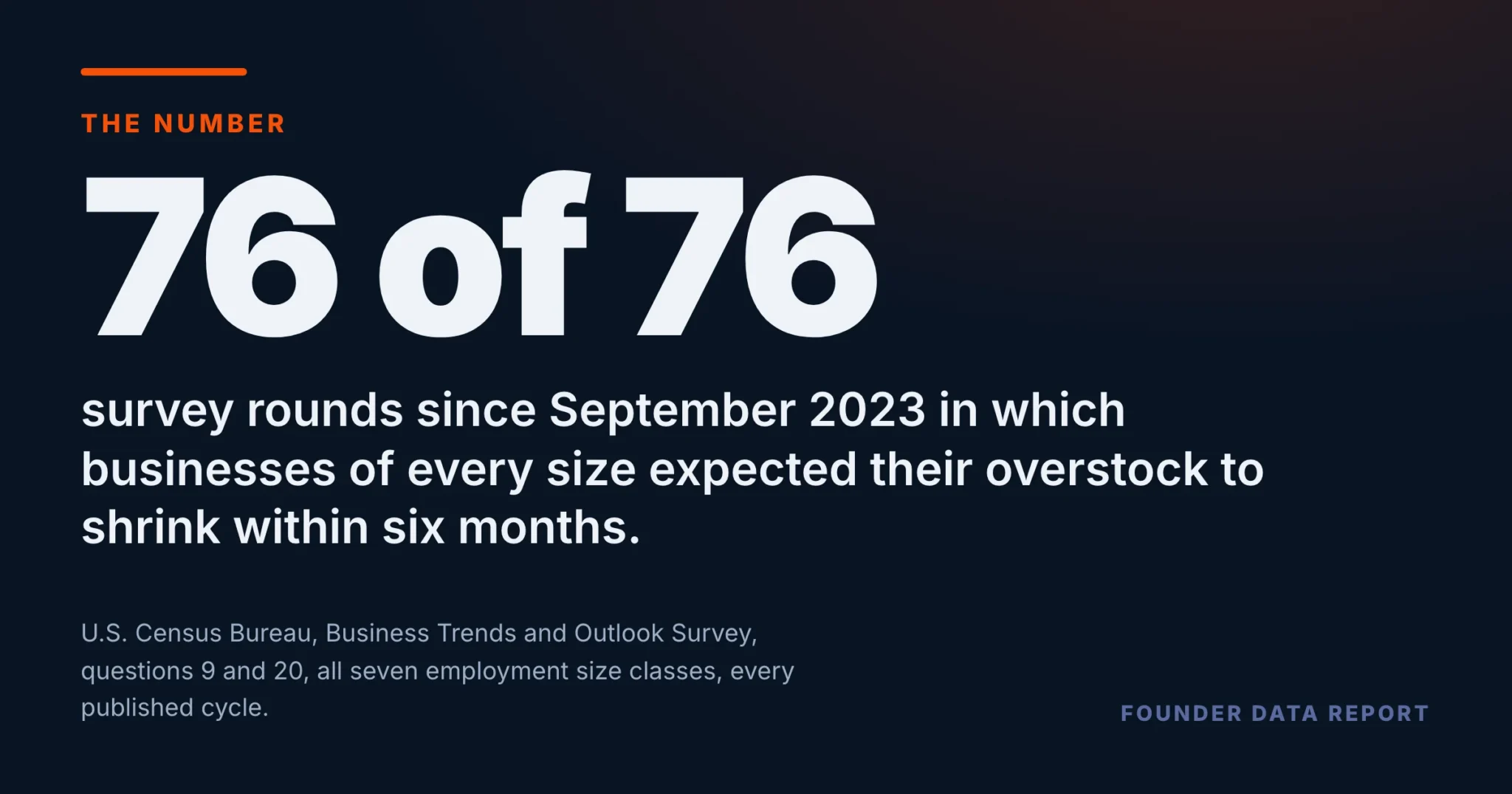
In every one of the 76 rounds of the Census Bureau’s Business Trends and Outlook Survey published since September 2023, the share of businesses describing their inventory as larger than optimal was lower in the six-month forecast than in the present tense — in all seven size classes, 532 readings out of 532. The typical forecast cut the overstock share by about 39%. The share describing their inventory as smaller than optimal was forecast to fall by a median of about 10%, and in the latest round it barely moved at all. Owners plan to work off the excess. They plan to live with the gap.
- In the latest round, collected September 7, 2026 to September 20, 2026, the overstock share is lower in the six-month forecast in all seven size classes, and the fall clears the survey’s own margin of error at 95% in six of them. The exception is the one-to-four class, where it is already 2.1%.
- At 250 or more employees, 7.7% of businesses call their inventory larger than optimal today and 3.3% expect to in six months — a cut of more than half.
- The shortfall share is inside the margin of error in six of the seven classes. The one measurable move is a fall of 1.4 points at one to four employees.
- Across all 76 rounds the overstock forecast is lower than today 532 times out of 532. The shortfall forecast is lower 416 times out of 532.
- These are businesses grading their own inventory against their own idea of optimal. Nothing here says whether the forecast came true.
The overstock owners expect to clear
Too much stock is a problem with an exit. You stop reordering, you discount, you let sales run it down, and the forecast reflects that. In the round collected September 7, 2026 to September 20, 2026, the share of businesses calling their inventory larger than optimal is lower in the six-month forecast at every size. At five to nine employees it goes from 3.6% to 2.2%. At 100 to 249 it goes from 7.9% to 4.2%, and at 250 or more from 7.7% to 3.3%. Six of those seven falls are larger than the survey’s margin of error. The seventh is the one-to-four class, where only 2.1% of businesses carry too much in the first place.
Both dots on a row come from the same businesses answering two questions with the same four answers in the same cycle, so the gap is a real difference and not two scales sharing an axis. Dots sit on a 0 to 10% track and the printed figures are the true ones. Orange is today and slate is the forecast; the colours name the question, not which number is better. Shares are of all businesses in the class, including those that hold no inventory.
U.S. Census Bureau, Business Trends and Outlook Survey, response estimates and standard errors by employment size class, downloaded from census.gov/hfp/btos/downloads/ on October 1, 2026. Question 9 asks how the business would describe its current inventories; question 20 asks how it thinks it will describe them six months from now. Both offer the same four answers and are asked in the same cycle of the same sample. Answer option ‘Larger than optimal’, collection cycle 202619 (September 7, 2026 to September 20, 2026).
532 readings out of 532. Every size, every round, the excess is forecast to shrink.
The shortfall owners expect to carry
Too little stock is the other problem, and for small businesses it is the bigger one. At five to nine employees, 14.5% of businesses say their inventory is smaller than optimal against 3.6% who say larger — about four to one, which is the gap covered in our earlier piece on understocking, linked below. Asked about six months from now, that same class answers 14.7%. At ten to nineteen it is 12.2% today and 12.2% in the forecast. In six of the seven size classes the shortfall forecast sits inside the margin of error of today’s answer. A shortfall has no exit you can simply decide on. It takes cash, credit or a supplier who will extend you terms, and the owners answering this survey do not forecast their way out of it.
Both bars in a row are drawn on the same 0 to 20% scale and the printed percentages are the true ones. Slate is today and orange is the six-month forecast. Only the one-to-four row shows a move larger than the 95% margin of error built from the two published standard errors; every other row is inside it.
U.S. Census Bureau, Business Trends and Outlook Survey, response estimates and standard errors by employment size class, downloaded from census.gov/hfp/btos/downloads/ on October 1, 2026. Question 9 asks how the business would describe its current inventories; question 20 asks how it thinks it will describe them six months from now. Both offer the same four answers and are asked in the same cycle of the same sample. Answer option ‘Smaller than optimal’, collection cycle 202619 (September 7, 2026 to September 20, 2026).
Not one round, every round
One survey round could be a mood. Seventy-six are a habit. The survey has published this pair of questions in every round since September 2023, and the comparison here is always made inside a single round — the same businesses, the same fortnight. In all 76 the overstock forecast is lower than the present tense in all seven size classes. The smallest forecast cut in any of those 532 readings is 10%; the median is about 39%. The shortfall forecast is lower than the present tense in 416 of the 532, with a median cut of about 10%, and the bigger the business the less reliably it is forecast to ease — in 49 of the 76 rounds at 250 or more employees, against 72 at one to four. In 522 of the 532 readings the overstock is forecast to shrink by more, proportionally, than the shortfall.
Each bar counts the survey rounds, out of the 76 published since September 2023, in which the six-month shortfall share was lower than the present-tense share for that size class. The overstock count is 76 of 76 in every row and is printed beneath each label. Each count compares two answers inside one round; no round is compared with another. The three rounds the 2025 funding lapse prevented are not in the file and are not counted.
U.S. Census Bureau, Business Trends and Outlook Survey, response estimates and standard errors by employment size class, downloaded from census.gov/hfp/btos/downloads/ on October 1, 2026. Question 9 asks how the business would describe its current inventories; question 20 asks how it thinks it will describe them six months from now. Both offer the same four answers and are asked in the same cycle of the same sample. Answer options ‘Smaller than optimal’ and ‘Larger than optimal’, every published cycle from 2023 cycle 19 to 2026 cycle 19.
What this means for the owner holding the stock
If you are short, you are not unusual, and you are not about to be rescued by the calendar. The businesses in this survey treat overstock as a problem they will solve and shortfall as a condition they will manage — and the smaller the business, the more of its inventory trouble is the second kind. That changes what deserves the next dollar and the next hour. A shortfall that is going to be there in six months is a supplier-terms problem, a credit-line problem and a which-lines-do-we-actually-carry problem, and none of those fix themselves by waiting. Three limits are worth stating plainly. ‘Optimal’ is the owner’s own judgement, not an accounting measure. The survey reaches businesses, not the same business twice, so nothing here follows one firm into the spring or tells you whether a forecast came true. And 61.6% of businesses with one to four employees answer that the question does not apply to them, so every share above is of all businesses, stockholding or not. Among the five-to-nine businesses that do hold inventory, 25.3% are short today.
U.S. Census Bureau, Business Trends and Outlook Survey, response estimates and standard errors by employment size class, downloaded from census.gov/hfp/btos/downloads/ on October 1, 2026. Question 9 asks how the business would describe its current inventories; question 20 asks how it thinks it will describe them six months from now. Both offer the same four answers and are asked in the same cycle of the same sample.
Frequently Asked Questions
Do small businesses expect their inventory problems to ease?
Only one of them. In the Census Bureau's Business Trends and Outlook Survey, the share of businesses calling their inventory larger than optimal is lower in the six-month forecast than today in every size class and every round since September 2023. The share calling it smaller than optimal is forecast to ease far less — at five to nine employees it is 14.5% today and 14.7% in the latest forecast.
Which is the bigger inventory problem for a small business?
Too little. At five to nine employees, 14.5% of businesses say their inventory is smaller than optimal and 3.6% say larger, about four to one. Overstock becomes the more common complaint only at 100 employees and above.
Did owners' overstock forecasts come true?
This survey cannot say. It does not follow the same business from one round to the next, and the Bureau redraws its sample once a year, so a forecast in one round cannot be scored against the answers given six months later. Every comparison here is between two answers given in the same round.
How reliable are these numbers?
Every figure is a published Census Bureau estimate with a published standard error. Each latest-round comparison has been tested against those errors at 95% confidence: the overstock fall clears it in six of seven size classes, and the shortfall change clears it only at one to four employees, where it is a fall of 1.4 points.
What does 'not applicable' mean in this survey?
The business does not hold inventory. It is the largest single answer at one to four employees, at 61.6%. The shares in this article are of all businesses in each size class, so the share of stockholding businesses that are short or over is higher than the printed figure — at five to nine employees, 25.3% of those holding inventory are short of it.
Published by The Lonely Entrepreneur — the community and coaching platform for entrepreneurs who are building alone. lonelyentrepreneur.com
This article is for educational purposes and is not a substitute for professional financial or legal advice.