

 Founder Data Report
Resilience When Cash Ran Short: 8.9% of the Smallest Employers Reported Missing Rent, Payroll or Other Bills
You can’t afford to risk your business without a Sidekick at your side.
In 2020 the Census Bureau asked small employers whether they had missed a payment since the shock began. Loan payments and other bills tell two different stories, and size matters less than many would guess.
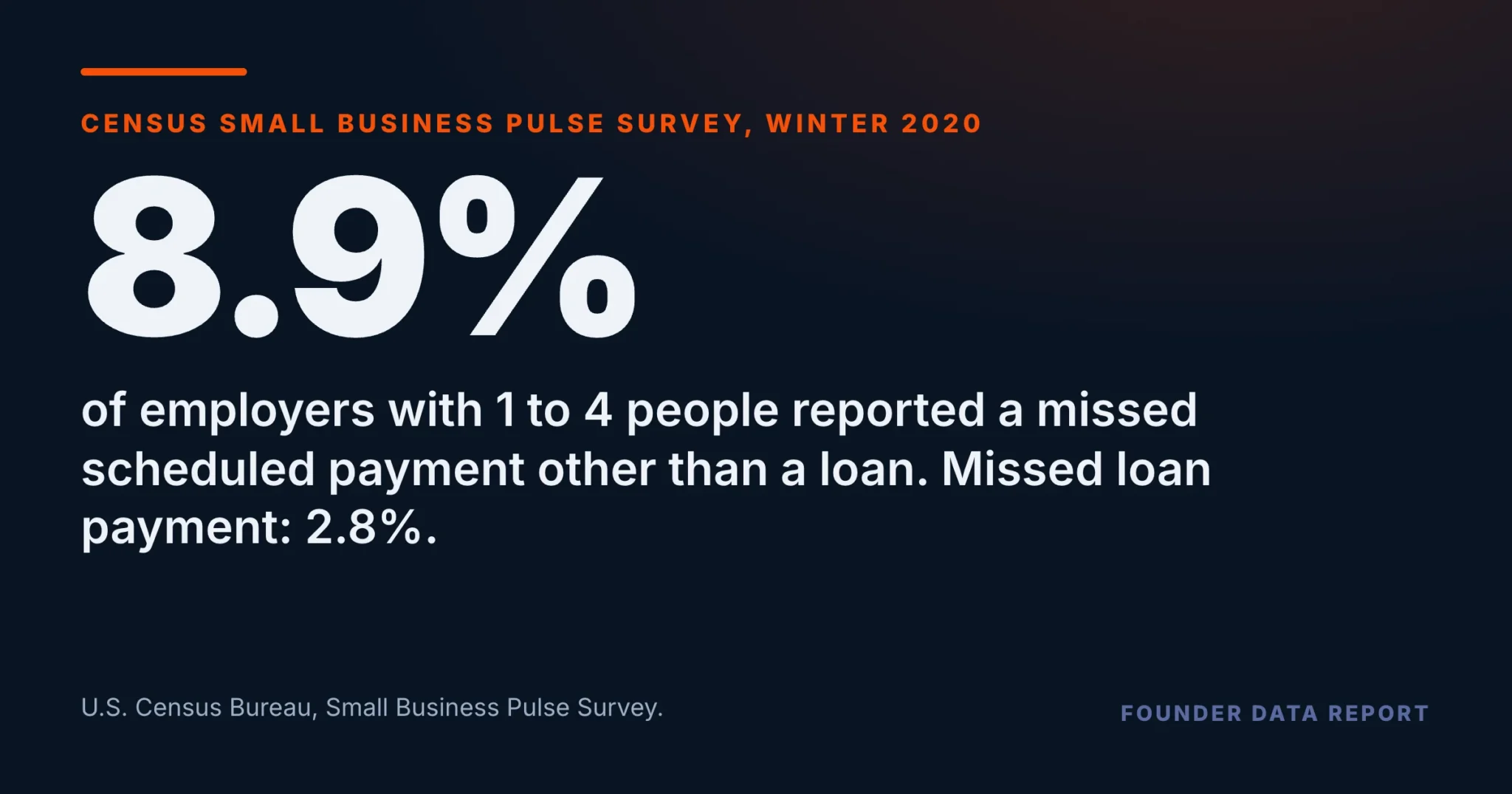
In the Census Bureau’s Small Business Pulse Survey, 8.9% of employers with 1 to 4 employees reported that they had missed a scheduled payment other than a loan since March 13, 2020, asked between November 2020 and January 2021. 2.8% reported a missed loan payment. Both shares were slightly higher at 5 to 19 employees: 9.9% and 3.2%.
When cash runs short, an owner ends up choosing which bill waits. A missed payment is the point where pressure inside the business reaches someone outside it: a landlord, a utility, a lender, an employee.
The Census Bureau asked about two kinds: loan payments, and other scheduled payments, with rent, utilities and payroll given as examples. Payments that had been forgiven or postponed were not to be counted as missed.
- Across small employers, 9.6% reported missing a scheduled payment other than a loan, and 3.1% a loan payment.
- At 1 to 4 employees the shares were 8.9% and 2.8%.
- At 5 to 19 they were 9.9% and 3.2%; at 20 or more, 10.3% and 3.3%.
- The smallest firms reported slightly less of both. The two larger groups are level with each other.
- The readings from late summer and from winter are level.
Other bills were missed far more often than loans
At all three sizes, the share reporting a missed non-loan payment was more than two and a half times the share reporting a missed loan payment. Across all small employers in the winter rounds it was 9.6% against 3.1%. The loan question went to every firm, including any with no loan to miss, so it is not a rate among borrowers.
Share of employers answering yes, mean of nine weekly panels, November 2020 to January 2021. Both bars on one scale, 0 to 12.5%. Two separate questions: a firm can appear in both.
U.S. Census Bureau, Small Business Pulse Survey, by employment size: ‘Since March 13, 2020, has this business missed any loan payments?’ and ‘any other scheduled payments, not including loans?’ Rounds of Nov. 9, 2020 to Jan. 10, 2021. Means of nine weekly panels. Nonfarm, single-location employers with 1 to 499 employees.
The smallest reported slightly less
It is easy to assume the smallest firms missed the most. In these answers they did not. At 1 to 4 employees, 8.9% reported a missed non-loan payment, against 9.9% at 5 to 19 and 10.3% at 20 or more. The gap is about a point, and it clears the survey’s margin of error in both periods. It does not show which group was in worse shape: firms differ in how many bills they have, and the survey counts only whether any was missed.
Share of employers answering yes, mean of nine weekly panels in each period. Both bars on one scale, 0 to 12.5%. Differences between the two periods are within the margin of error.
U.S. Census Bureau, Small Business Pulse Survey, by employment size: ‘Since March 13, 2020, has this business missed any other scheduled payments, not including loans?’ Rounds of Aug. 9 to Oct. 12, 2020 and Nov. 9, 2020 to Jan. 10, 2021. Means of nine weekly panels. Nonfarm, single-location employers with 1 to 499 employees.
A missed payment is where pressure inside the business reaches someone outside it.
Months apart, the same reading
The question asked about the whole period since March 13, 2020. Asked from August to October and again from November to January, the shares were level at every size. For loans at 1 to 4 employees: 2.7% and then 2.8%. These are separate weekly samples, so the survey does not follow the same firms from one period to the next.
Share of all employers answering yes, mean of nine weekly panels in each period. Bars share one scale, 0 to 5%. Orange: winter rounds. Differences between the two periods are within the margin of error.
U.S. Census Bureau, Small Business Pulse Survey, by employment size: ‘Since March 13, 2020, has this business missed any loan payments?’ Rounds of Aug. 9 to Oct. 12, 2020 and Nov. 9, 2020 to Jan. 10, 2021. Means of nine weekly panels. Nonfarm, single-location employers with 1 to 499 employees.
What to take from this if you run one
Decide the order before you need it. List your scheduled payments, mark which ones can be moved with a phone call, and note what each costs you if it is late. A calm list beats a late-night guess.
Then call before the due date. A landlord, supplier or lender who hears from you early has more room to work with you than one who finds out afterwards. You do not have to carry that conversation alone: a peer or adviser can help you prepare it.
Limits worth holding. Answers are self-reported. The survey records whether any payment was missed, not how many, how large or why. These readings come from 2020 and early 2021 and describe that period, not today.
U.S. Census Bureau, Small Business Pulse Survey, 2020 to 2021.
Frequently Asked Questions
How many small businesses missed payments in 2020?
In winter rounds of the Census Bureau's Small Business Pulse Survey, 9.6% of small employers reported a missed scheduled payment other than a loan since March 13, 2020, and 3.1% a missed loan payment.
Did the smallest businesses miss more payments?
No. At 1 to 4 employees the shares were 8.9% for other payments and 2.8% for loans, slightly below firms with 5 to 19 or 20 or more employees.
What counted as another scheduled payment?
The question gave rent, utilities and payroll as examples. Payments forgiven or postponed were not to be counted as missed.
Is the loan figure a default rate?
No. It is the share of all employers answering yes, including any without loans, and it records a missed payment, not a default.
Where does the data come from?
The U.S. Census Bureau's Small Business Pulse Survey of nonfarm, single-location employers with 1 to 499 employees. Figures are means of nine weekly panels per period.
Published by The Lonely Entrepreneur — the community and coaching platform for entrepreneurs who are building alone. lonelyentrepreneur.com
This article is for educational purposes and is not a substitute for professional financial or legal advice.