

 Founder Data Report
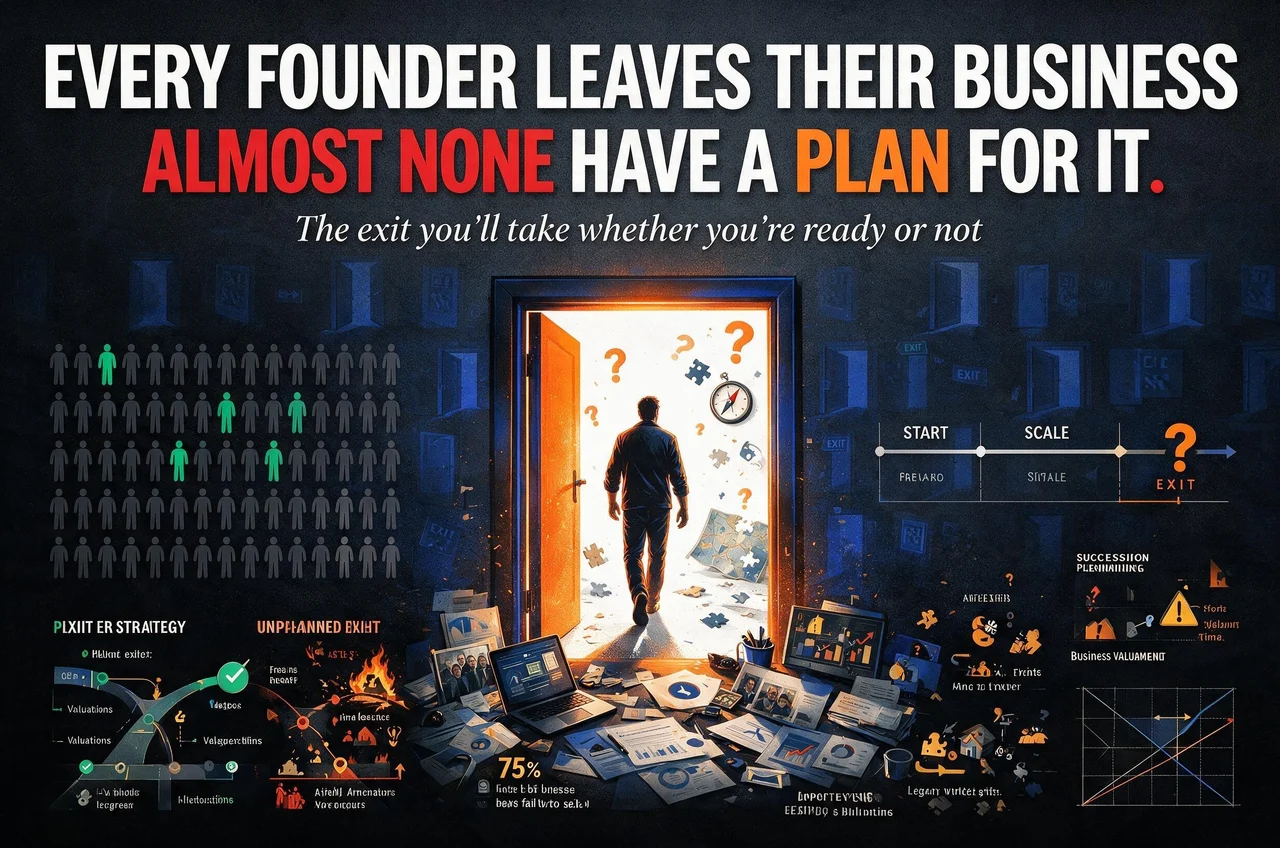
Every Founder Leaves Their Business. Almost None Have a Plan For It.
You can’t afford to risk your business without a Sidekick at your side.
You will exit your business one day — by choice or by force. Yet roughly half of owners have no succession or exit plan, nearly half of all exits are involuntary, and 70% of businesses fail within a decade of the founder’s death. Here’s the data, and the plan that protects everything you built.
Quick answer: There’s a dangerous “Exit Trap” facing founders — the gap between the certainty that you’ll leave your business someday and the near-total absence of a plan for it. New 2026 data shows only about half of retiring owners have a formal succession plan (U.S. Bank / Forbes), and among all owners a third have no plan or are unsure while another ~22% simply plan to close the doors (Gallup 2026, n=1,264). Meanwhile a “Silver Tsunami” of 2.3–3 million baby-boomer-owned businesses is hitting the market at once, and the Exit Planning Institute finds nearly 50% of exits are involuntary — driven by the “five D’s”: death, disability, divorce, disagreement, and distress. The fix isn’t waiting until retirement; it’s making your business survivable without you, starting now.
- Everyone exits: retirement, sale, or the “five D’s” — the only question is whether it’s planned or forced.
- Almost no one’s ready: only ~half of retiring owners have a formal succession plan; a third of all owners have no plan at all.
- Half of exits are involuntary: ~50% happen via death, disability, divorce, disagreement, or economic distress — reactive, not chosen.
- The wave is here: 2.3–3M boomer-owned businesses will change hands this decade — a buyer’s market that punishes the unprepared.
- The play: reduce owner-dependence, get a real valuation, put a buy-sell + emergency plan in place, and start ~2 years early.
There’s one fact about your business you cannot negotiate: you will leave it. Maybe you’ll sell it at the top, hand it to your kids, and sail off. Or maybe you’ll leave the way nearly half of founders actually do — suddenly, involuntarily, on the worst day of your life. The Exit Planning Institute found that nearly 50% of business owners exit involuntarily, pushed out by what advisors grimly call the “five D’s”: death, disability, divorce, disagreement, and economic distress. And yet, per 2026 Forbes and U.S. Bank data, only about half of even retirement-age owners have a formal plan for any of it.
That’s the gap this report is about — the chasm between the certainty that you’ll exit and the near-total absence of preparation for it. We call it the Exit Trap. It’s the most consequential of all the founder traps because it’s the one with no second chance: get the cash flow wrong and you recover; get the exit wrong and decades of work can evaporate in weeks. This is precisely the kind of decision Michael Dermer built The Lonely Entrepreneur to stop founders from facing alone and unprepared.
The question isn’t whether you’ll leave your business. It’s whether the day you leave, it takes care of everyone who depends on it — or collapses without you.
What founders actually plan for “someday”
Gallup’s 2026 Pathways to Wealth data (n=1,264) asked owners their long-term plans for the business once they step away. The answers reveal how few have built anything transferable. Among all owners, a third have no plan or are unsure, and another 22% simply plan to close the doors — meaning the future of roughly half of U.S. businesses is either a shutdown or a shrug. The picture is worse for solo, non-employer businesses, where the owner is the business.
Source: Gallup Pathways to Wealth Survey, 2026 (n=1,264; long-term plans, all owners).
Here’s the split that should stop every solo founder cold: among non-employer businesses, only 35% plan to sell or transfer, 27% plan to simply close, and 40% are uncertain. When the business runs entirely on you, there’s often nothing left to sell — the asset walks out the door the day you do. Building a business that can outlive your daily involvement is the whole game.
The “five D’s”: how founders actually leave
We imagine our exit as a choice — a clean sale at a number we like. The data says otherwise. Nearly half of all exits are involuntary, triggered by life events no one schedules. The chart below shows the reactive exits that catch founders unprepared. Every one of them is survivable with a plan, and catastrophic without one.
Source: Exit Planning Institute — the “five D’s” account for ~50% of business exits.
The five D’s — death, disability, divorce, disagreement, and distress — don’t wait for you to be ready. A disability is uniquely cruel here: unlike death, the owner may recover and want to return, so the business has to survive and hold their seat. Without documented processes, signing authority, and a buy-sell agreement, a single hospital stay can freeze a healthy company solid.
The Silver Tsunami: a wave of sellers, a shortage of buyers
Timing makes this urgent. Just over half of U.S. employer businesses — 3 million firms — are owned by people 55 or older, and 2.3 to 3 million boomer-owned businesses are expected to change hands this decade. That’s one of the largest ownership transfers in history hitting the market at once. When supply floods and buyers are scarce, the unprepared don’t get a premium — they get a fire sale, or no sale at all.
Sources: Gallup 2026 (52.3% of employer firms owned by 55+); Forbes / Project Equity 2026 (2.3–3M businesses transitioning); Teamshares (~30% of listed small businesses successfully sell).
There’s opportunity in this too — for prepared sellers and for buyers, it’s a genuine market with creative deal structures like seller financing and earnouts. But the leverage goes entirely to whoever did the work: the owner who reduced dependence, cleaned up the books, and got a real valuation two years early captures the value. The one who waited until burnout or a health scare sells into a glut at a discount.
The one number that decides your exit: owner-dependence
Every advisor in the Silver Tsunami coverage said the same thing in different words: the businesses that transfer well are the ones that don’t depend on the owner. Buyers aren’t paying for you — they’re paying for a machine that runs without you. The gauge below shows the share of small businesses that are still so owner-dependent they’d be hard or impossible to sell as-is. Lowering that number is exit planning.
of small businesses are so tied to the owner that they’d be hard to sell — or would collapse — without them.
Derived from Gallup 2026 & Forbes/Hello Alice 2026 commentary: most SMBs are “deeply tied to the owner,” lacking documented processes or transition structure — the #1 barrier to a successful sale.
The most valuable thing you can build isn’t a business that needs you. It’s a business that doesn’t.
The Exit Trap, in three numbers
Strip it all down and three numbers should sit on every founder’s desk — not to create fear, but to trigger the one project most owners keep postponing until it’s too late to do well.
Compiled from Gallup 2026, Exit Planning Institute, and Forbes / U.S. Bank Silver Tsunami coverage 2026.
The four moves — starting now, not “someday”
Closing your Exit Trap doesn’t require selling tomorrow — it takes four deliberate moves you can start this quarter. Make the business survivable without you: document core processes, name a second-in-command with real authority, and ensure someone can access accounts and sign in an emergency — this protects you against the five D’s and raises your sale value at the same time. Get an objective valuation early: a real number reveals the value-suppressing gaps (owner-dependence, messy financials, customer concentration) while you still have years to fix them. Put the legal scaffolding in place: a buy-sell agreement, funded where appropriate by insurance, plus updated estate and continuity documents, turns a catastrophe into a procedure. And don’t build the plan in isolation: valuation, deal structure, and successor choice are exactly the high-stakes calls founders get wrong alone and right with advisors and peers who’ve already navigated an exit.
You spent years building something worth protecting. Don’t let the one day you leave undo all of it.
Frequently Asked Questions
What is the Exit Trap for entrepreneurs?
The gap between the certainty that you'll leave your business someday and the near-total lack of a plan for it. In 2026, only about half of retiring owners have a formal succession plan, and a third of all owners have no plan or are unsure.
How many business exits are involuntary?
Nearly 50%, per the Exit Planning Institute, driven by the five D's: death, disability, divorce, disagreement, and economic distress. About 70% of businesses fail within a decade of the owner's death.
What is the Silver Tsunami?
The wave of 2.3–3 million baby-boomer-owned U.S. businesses expected to change hands this decade. So many sellers at once creates a buyer's market; only about 30% of listed small businesses successfully sell, so preparation determines who captures value.
What happens to my business if I die or become disabled without a plan?
Without documented processes, emergency signing authority, and a buy-sell agreement, even a healthy business can freeze and lose value fast. Disability is especially tricky since you may recover and want to return. An emergency continuity plan turns a crisis into a procedure.
When should I start exit planning?
At least two years before an intended exit, with emergency continuity protections in place immediately since involuntary exits don't wait. Early planning lets you reduce owner-dependence and fix value-suppressing issues. This is general education, not legal or financial advice.
Published by The Lonely Entrepreneur — the community and coaching platform for entrepreneurs who are building alone. lonelyentrepreneur.com
This article is for educational purposes and is not a substitute for professional financial or legal advice.