

 Founder Data Report
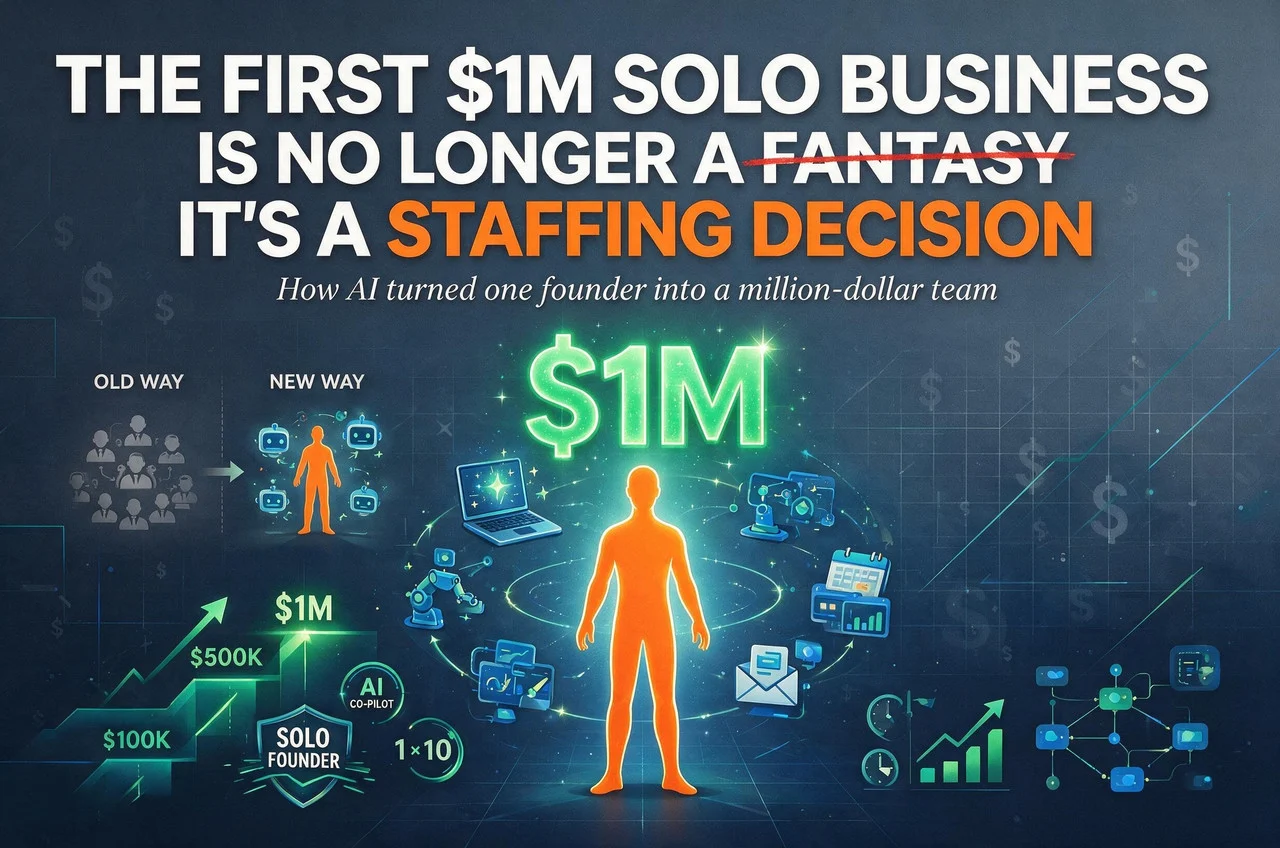
The First $1M Solo Business Is No Longer a Fantasy. It’s a Staffing Decision.
You can’t afford to risk your business without a Sidekick at your side.
AI didn’t come for the solo founder’s job. It came for the excuse that you needed a team of ten to build something serious. The question in 2026 isn’t “can I compete alone?” — it’s “which of me does the machine now cover?”
Quick answer: The “one-person million-dollar business” — a company generating seven figures with a single human owner and a stack of AI tools — has shifted from novelty to a documented, fast-growing category. For a solo founder, AI now credibly covers the four roles that used to force a first hire: a junior marketer, a customer-support rep, an operations coordinator, and a research/analyst assistant. Founders who deploy AI across these functions commonly report reclaiming 10–20+ hours a week and pushing their revenue-per-employee dramatically higher. The opportunity isn’t “replace yourself with AI.” It’s the opposite: use AI to remove the busywork that was crowding out the one thing only you can do — the vision, taste, and relationships that make the business yours. That’s exactly the shift Michael Dermer maps in Entrepreneur Survival Guide: Will You Survive in an AI World?
- The category is real: “one-person, seven-figure” businesses have gone from anecdote to a tracked, growing cohort — built on AI leverage, not headcount.
- AI fills four roles: the junior marketer, the support rep, the ops coordinator, and the research analyst — the exact hires that used to eat a solo founder’s first $200K.
- The metric that matters is revenue-per-person: a solo founder with an AI stack can reach a revenue-per-head number a 10-person firm would envy.
- The trap: founders use AI to do more low-value work faster, instead of using it to stop doing that work at all. Leverage, not busyness.
- The human moat widens: as AI commoditizes execution, trust, taste, and relationship become the scarce, defensible things — and those are yours alone.
- The play: audit your week, hand each recurring low-judgment task to an AI “role,” and reinvest the reclaimed hours into the work only a human founder can do.
For most of business history, growth had a headcount tax. Want to do more? Hire more. The founder who wanted to build something real faced a brutal early fork: stay small and do everything yourself, or take on the cost, risk, and management burden of a team before the revenue justified it. That fork is where a huge number of promising solo businesses quietly stalled — not for lack of demand, but for lack of hands. The lonely entrepreneur was lonely precisely because the alternative to loneliness was so expensive.
In 2026, that fork looks different. The headcount tax hasn’t been abolished, but for the first time it’s been dramatically discounted for a specific kind of work: the repeatable, judgment-light tasks that used to justify a founder’s first three or four hires. AI now does a credible version of the junior marketer drafting the emails, the support rep answering the routine tickets, the ops coordinator chasing the calendar, and the analyst pulling the numbers together. Not perfectly. Not without supervision. But well enough that “I need to hire someone to do this” is no longer automatically true.
AI didn’t replace the solo founder. It replaced the moment a solo founder used to have to stop being solo.
The category that shouldn’t exist — but does
The clearest signal that something has changed is the rise of a business type that classical economics said was nearly impossible: the company doing seven figures in revenue with exactly one full-time human. A decade ago these were freak outliers — a lone software developer, a viral creator. Today they span e-commerce, consulting, content, software, and productized services, and the common thread isn’t genius. It’s leverage: one person orchestrating a stack of tools that each do the work of a role.
TLE framework based on common AI-adoption patterns among solo founders. Figures directional.
Read that last bar carefully, because it’s the whole argument. Four roles that used to force expensive early hires are now largely coverable by tools. But the fifth — the judgment, the taste, the trust you build with a customer, the decision about what to build at all — barely moved. That’s not a coincidence. That’s the map of where a human founder’s value is migrating.
The number that actually tells the story
Revenue is a vanity number for a solo founder; the metric that reveals the AI shift is revenue per person. A traditional ten-person small business might do $2M — that’s $200K per head. The AI-leveraged solo founder is chasing a per-head number that would have been unthinkable, because the denominator is one. Watch how the same $600K business looks under the old model versus the new one.
Illustrative model, $600K revenue business. Directional.
The solo founder’s revenue-per-person isn’t 3x the team’s — it can be 7x or more, because there’s no payroll splitting the pie and no management overhead eating the hours. That’s the mechanical reason the one-person million is suddenly viable: AI collapsed the cost of the roles without adding heads to divide the revenue.
The old flex was headcount. The new flex is how much you can run without it.
The trap: doing more busywork, faster
Here’s where most founders get AI exactly wrong, and I want to be direct because it’s the difference between leverage and a hamster wheel. The instinct is to use AI to do more of your low-value work in less time — draft forty emails instead of ten, generate a hundred social posts, churn out more of the stuff that was already crowding your calendar. That’s not leverage. That’s the same trap with a faster engine. You end up busier, not freer, and the one thing only you can do gets squeezed even harder.
Real leverage is subtractive. It asks: which recurring, judgment-light task can I hand off entirely so it stops touching my week at all? The founders building one-person millions aren’t producing more noise — they’re removing whole categories of work from their own plate and pouring the reclaimed hours into the irreplaceable stuff: the product decision, the key customer relationship, the strategic bet. AI is the junior employee; you are still the founder. Confusing those two is how people get busier and call it progress.
Illustrative contrast. Directional example, not survey data.
Fourteen hours a week is most of a full day-and-a-half handed back to you — not to fill with more email, but to spend on the work that compounds. That reclaimed time is the real product of an AI stack, and it’s the single most direct antidote to the burnout we documented in the Survival Gap report.
Climb the leverage ladder deliberately
Not all AI adoption is equal, and rushing to the top rung usually backfires. The founders who win treat it like a staircase: automate the safest, most repetitive work first, prove the tool, then extend trust upward toward tasks with more judgment. Here’s the ladder, bottom to top.
End-to-end tasks with light review. Highest leverage — only after lower rungs are trusted.
First drafts of emails, proposals, posts, replies. You edit and ship — big time savings, low risk.
Research, analysis, summarizing, brainstorming. You stay fully in control of the output.
Transcribe, format, tidy, categorize. Zero judgment — the safest place to build the habit.
TLE framework. Start at the bottom rung and earn your way up — don’t skip to the top.
The mistake is jumping straight to Rung 4 — handing an agent the keys before you’ve learned where it’s reliable and where it hallucinates. The founders who trust AI too fast get burned and swear it off; the ones who trust it too slowly stay stuck doing everything by hand. The winners climb one rung at a time, expanding the tool’s territory only as it earns their confidence.
The human moat gets wider, not narrower
Here’s the counterintuitive part, and it’s the heart of why this is good news for the lonely entrepreneur rather than a threat. As AI commoditizes execution — as everyone can suddenly generate decent copy, decent analysis, decent code — the things that can’t be commoditized become disproportionately valuable. Trust. Taste. Judgment about what’s worth doing. The relationship a customer has with a real human who genuinely understands their problem. When execution is cheap, discernment is expensive.
That’s the opening for the solo founder. You were never going to out-execute a hundred-person company on raw output. But you can absolutely out-care, out-taste, and out-trust them — and AI now handles enough of the execution that you finally have the hours to compete on exactly those human dimensions. Customer distrust of faceless, AI-generated everything is rising, which means a real founder who shows up with genuine judgment is worth more than ever. The machine didn’t shrink your advantage. It cleared away the busywork that was hiding it.
TLE framework on where solo-founder value concentrates as execution commoditizes. Directional.
What to do Monday morning
You don’t need a technical background or a big budget to start closing your own leverage gap — you need one deliberate audit. Spend an hour writing down every recurring task that ate your last work-week, and mark each one with a simple label: “only I can do this” or “a capable junior could do this.” Everything in the second pile is a candidate to hand to an AI role. Start with the safest, most repetitive item — Rung 1 or 2 work — and give it to a tool for two weeks. Don’t try to automate your whole business at once; prove one handoff, feel the hours come back, and let that build your trust for the next rung.
Then — and this is the part that separates leverage from busywork — take the reclaimed hours and protect them. Don’t let them silently refill with more email. Spend them on the founder-only work: the customer conversations, the product bets, the strategic thinking you never had time for. The one-person million isn’t built by the founder who does the most tasks. It’s built by the founder who ruthlessly hands off everything a machine can do, so they can pour themselves entirely into the handful of things a machine never will. That’s not a threat to the lonely entrepreneur. It’s the first time in history that going it alone doesn’t have to mean doing it all.
The future doesn’t belong to founders who fear AI, or to those who worship it. It belongs to the ones who know exactly which of their jobs to keep.
Frequently Asked Questions
Is a one-person million-dollar business really achievable?
It's no longer a rare fluke. Seven-figure businesses run by a single human owner with an AI-and-tools stack now exist across e-commerce, consulting, content, software, and productized services. The driver is leverage: one founder orchestrating tools that each cover the work of a role that used to require a hire.
Which jobs can AI cover for a solo founder?
The four roles that historically forced early hires: a junior marketer, a customer-support rep for routine tickets, an operations coordinator, and a research or analyst assistant. AI does not replace the founder's vision, taste, judgment, or customer relationships.
Won't AI just make me busier?
It will if used wrong. The trap is producing more low-value output faster. Real leverage is subtractive: hand whole recurring tasks to AI so they stop touching your week, then protect the reclaimed hours for founder-only work.
Where should I start with AI as a solo founder?
Climb the leverage ladder from the bottom: judgment-light cleanup first, then research and drafting you approve, then more autonomous workflows. Automate one safe repetitive task for two weeks, prove it, and expand — don't automate everything at once.
Does AI make solo founders more replaceable?
The opposite. As AI commoditizes execution, scarce human things — trust, taste, judgment, relationships — become more valuable. Those are what a solo founder owns, and AI frees the time to compete on them.
How does this connect to surviving in an AI world?
It's the core reframe of Michael Dermer's Entrepreneur Survival Guide: Will You Survive in an AI World? Survival isn't out-computing the machine; it's using AI to remove what drowns you so you can double down on irreplaceably human work.
Published by The Lonely Entrepreneur — the community and coaching platform for entrepreneurs who are building alone. lonelyentrepreneur.com
This article is for educational purposes and is not a substitute for professional financial or legal advice.