

 Founder Data Report
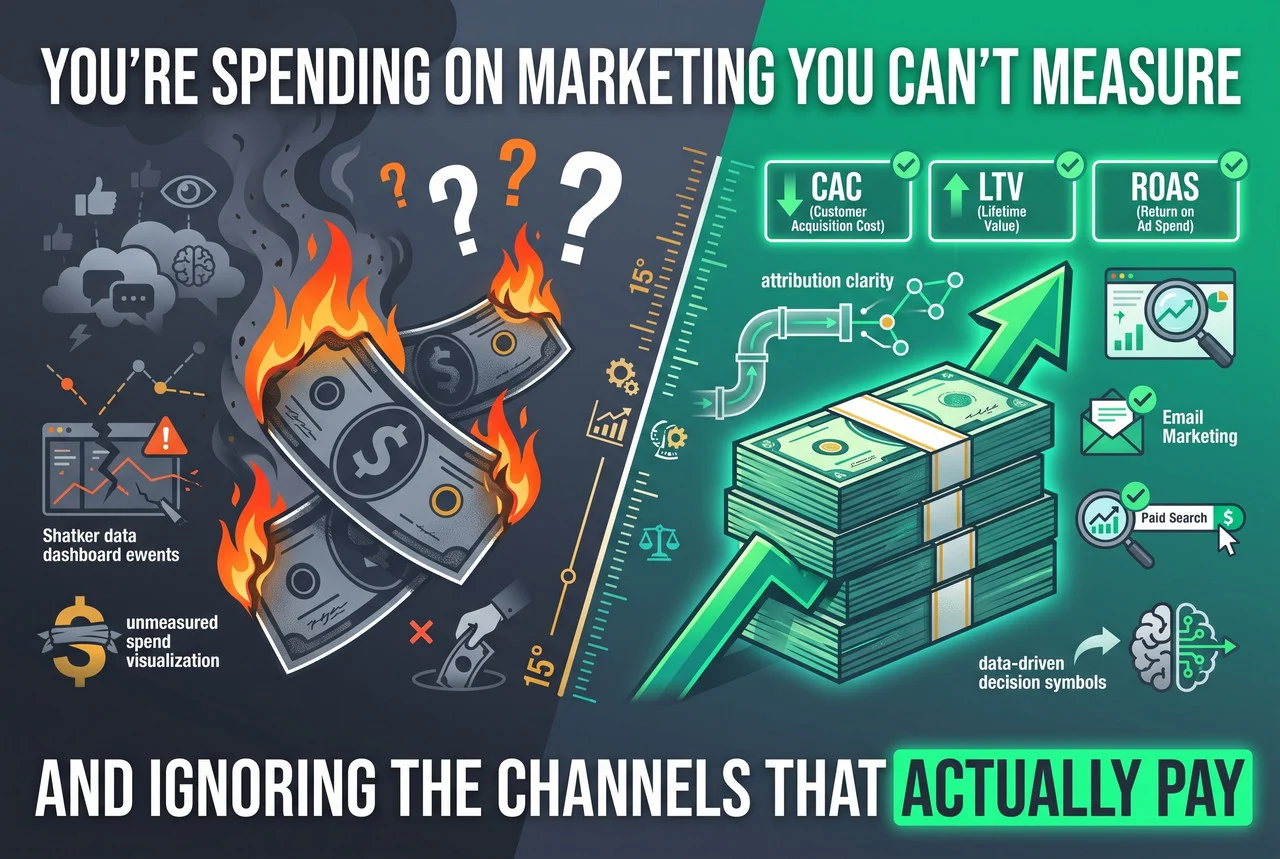
You’re Spending on Marketing You Can’t Measure — and Ignoring the Channels That Actually Pay.
Get clarity — download the free Entrepreneur Survival Guide Summary.
Most founders spend blindly: 44% have no way to measure marketing impact, 73% doubt their own strategy, and 47% do all of it themselves — while the cheapest channels quietly return $22 to $36 for every $1. Here’s where the money actually goes, and how to move it.
Quick answer: The “Marketing Waste Trap” is the gap between what founders spend on marketing and what they can actually prove it earns. In 2026, 44% of businesses have no quantitative measure of marketing impact and 73% lack confidence in their strategy — yet the highest-ROI channels are also the cheapest: email returns about $36 per $1, SEO about $22 per $1, and content marketing costs 62% less than outbound while producing 3× the leads. Meanwhile 66.3% of owners spend under $1,000/year total, and nearly half do all the marketing themselves. The fix isn’t spending more — it’s measuring what you spend and shifting it toward channels with proven returns.
- You can’t see the leak: 44% of businesses have no quantitative measure of marketing impact — so waste is invisible.
- Confidence is low: 73% of SMBs don’t trust their own marketing strategy, and 47% run all of it solo.
- The cheap channels win: email (~$36/$1) and SEO (~$22/$1) beat almost everything — yet get a fraction of the budget.
- A plan multiplies results: owners with a marketing plan are 6.7× more likely to report success.
- The play: track every dollar, kill what you can’t measure, and reallocate toward owned, compounding channels.
Ask a founder how much they spent on marketing last year and most can give you a number. Ask them what that money earned, and the room goes quiet. That silence is the whole problem. According to 2026 small-business marketing data, 44% of businesses have no quantitative measure of marketing impact at all — meaning nearly half are spending into a black box, unable to tell a winning campaign from a money pit.
We call it the Marketing Waste Trap: the gap between what you spend and what you can prove. It’s especially cruel for solo and small founders because they feel every wasted dollar personally, yet 47% of small business owners handle all their marketing themselves — squeezing it into the 1–10 hours a week most can spare. The result is spending driven by guilt and guesswork instead of returns. This is exactly the kind of lonely, high-stakes call Michael Dermer built The Lonely Entrepreneur to help founders stop making in the dark.
Marketing you can’t measure isn’t an investment. It’s a donation to a platform’s ad revenue.
The confidence gap: spending without a compass
Before the money question, there’s a trust question — and the answer is bleak. Nearly three-quarters of small businesses don’t believe in their own marketing strategy, most can’t measure what it does, and half do the work entirely alone. These aren’t independent problems; they compound. You can’t build confidence in something you can’t measure, and you can’t measure well when you’re the only person doing it at 11pm.
Source: Revenue Memo, Small Business Marketing Budget Statistics, 2026.
The trap tightens with size: businesses with 10 or fewer employees are 31% more likely to have a marketing budget under $500 a month. When every dollar is scarce and unmeasured, the smallest businesses — the ones who can least afford waste — end up wasting the highest share of their spend.
The return ladder: where a dollar actually goes furthest
Here’s the part that should reorganize your budget tomorrow. Not all marketing dollars are equal — they’re not even close. The channels founders under-fund tend to be the ones with the highest documented return, while the flashy paid channels sit near the bottom. The ladder below ranks return per dollar spent. Read it as: for every $1 you put in, this is what comes back.
Sources: Revenue Memo 2026 (email ~$36:$1, SEO ~$22:$1, content 3× leads at 62% lower cost, PPC ~$2:$1). Figures are industry-average ROI benchmarks.
Look at the shape of that. Email — the channel founders treat as an afterthought — returns roughly $36 for every $1, and it’s almost 40× more effective than Facebook and Twitter combined at acquiring customers. Yet only a sliver of budget goes there. The reason is psychological, not economic: paid ads feel like marketing because money visibly leaves your account. Owned channels feel like “free,” so they get no time, no budget, and no measurement — which is exactly why they’re underused and undervalued.
Where the money actually goes vs. where it should
If the return ladder shows what works, this shows what founders actually fund. The stacked bar below breaks down a typical small-business digital marketing budget. Notice how little flows to the two highest-ROI channels — email gets roughly 8%, and the largest slices go to paid and social, the channels with the lowest measured returns per dollar.
Source: Revenue Memo 2026 (paid media ~30%, martech ~28%, social ~15%, email ~8%; remainder across content, SEO, other).
The mismatch is the whole story: ~30% of budget flows to paid media (about $2 back per $1) while ~8% goes to email (about $36 back per $1). Move even a few points of budget from the bottom of the return ladder to the top, and the math changes dramatically — without spending an extra dollar.
The scale of the gap, in perspective
Numbers on a page can hide how lopsided this really is. The dot plot below puts return-per-dollar on a single scale so you can see the distance. The bigger the dot, the more each dollar returns. This is why “spend more” is the wrong question — spend smarter is where the leverage lives.
Sources: Revenue Memo 2026 email/SEO/PPC ROI benchmarks. Dot size and position scaled to dollars returned per $1 spent.
A plan is the multiplier that ties it together. Businesses with a documented marketing plan are 6.7× more likely to report marketing success, and those that pair in-house effort with outside help see 2.5× more success than going it fully alone. The single biggest predictor of whether marketing works isn’t budget size — it’s whether anyone wrote down what they were trying to do and then checked if it happened.
The Marketing Waste Trap, in three numbers
Strip it down and three numbers belong on every founder’s wall — not to shame the spending, but to trigger the audit most owners keep postponing.
Compiled from Revenue Memo 2026 and Socioapt Social Media Statistics 2026.
The four moves — starting this quarter
Closing your Marketing Waste Trap doesn’t require a bigger budget — it takes four moves you can start this week. Instrument everything first: before spending another dollar, set up basic tracking (a unique link, a “how did you hear about us?” field, simple analytics) so every channel can prove its worth — you can’t fix what you can’t see. Kill what you can’t measure: any spend that’s run for 90 days with no traceable return gets paused, not renewed out of habit; that reclaimed budget funds the winners. Reallocate toward owned, compounding channels: shift budget and time toward email and SEO — the channels that keep paying long after the spend, and that you own rather than rent. And don’t build the plan alone: a written marketing plan makes you 6.7× more likely to succeed, and founders who blend their own effort with outside expertise or peers outperform the ones grinding solo.
Stop asking “how much should I spend?” Start asking “what did my last dollar earn?” — the second question is where the money is.
Frequently Asked Questions
What is the Marketing Waste Trap?
The gap between what a founder spends on marketing and what they can prove it earns. In 2026, 44% of businesses have no quantitative measure of marketing impact and 73% lack confidence in their strategy.
Which marketing channel has the best ROI for small businesses?
Email marketing returns roughly $36 per $1 spent and is nearly 40x more effective than Facebook and Twitter combined at acquiring customers. SEO follows at about $22 per $1, and content marketing produces about 3x the leads at 62% lower cost than outbound. Paid search returns about $2 per $1.
Why do founders overspend on paid ads?
Psychology: paid ads feel like real marketing because money visibly leaves your account, while owned channels like email and SEO feel free and get less time, budget, and measurement, which is why the highest-ROI channels are the most under-funded.
How do I know if my marketing is being wasted?
If you can't trace where new customers come from or say what a channel earned, you can't rule out waste. Instrument everything with unique links, a how-did-you-hear field, and basic analytics, then pause any channel that has run 90 days with no traceable return.
Does having a marketing plan actually matter?
Yes. Businesses with a documented marketing plan are 6.7x more likely to report success, and those blending in-house work with outside help see about 2.5x more success than going fully solo. This is general education, not professional advice.
Published by The Lonely Entrepreneur — the community and coaching platform for entrepreneurs who are building alone. lonelyentrepreneur.com
This article is for educational purposes and is not a substitute for professional financial or legal advice.