

 Founder Data Report
You’re Pouring Money Into New Customers While the Old Ones Quietly Leak Out.
Join us Fridays at 12 PM ET to ask TLE CEO Michael Dermer your questions live.
Winning a new customer costs roughly 5× more than keeping one — yet most founders spend nearly everything on acquisition. A 5% lift in retention can raise profit 25–95%. Here’s the math nobody shows you.
Quick answer: The “Leaky Bucket Trap” is spending heavily to pour new customers into a business that’s quietly leaking existing ones out the bottom. Acquiring a new customer costs about 5× more than retaining one, the probability of selling to an existing customer is 60–70% versus 5–20% for a new prospect, and increasing retention by just 5% can lift profit 25–95%. Yet most small businesses pour their budget into acquisition. The fix isn’t more spend — it’s plugging the leak first.
- The leak is invisible: acquisition feels like growth, so churn gets ignored — even as it drains the bucket.
- The cost gap is huge: a new customer costs ~5× more to win than an existing one costs to keep.
- Existing customers convert: 60–70% close rate vs. 5–20% for cold prospects.
- Retention compounds: a 5% retention bump can raise profit 25–95%.
- The play: measure churn, fix the leak, then pour — not the other way around.
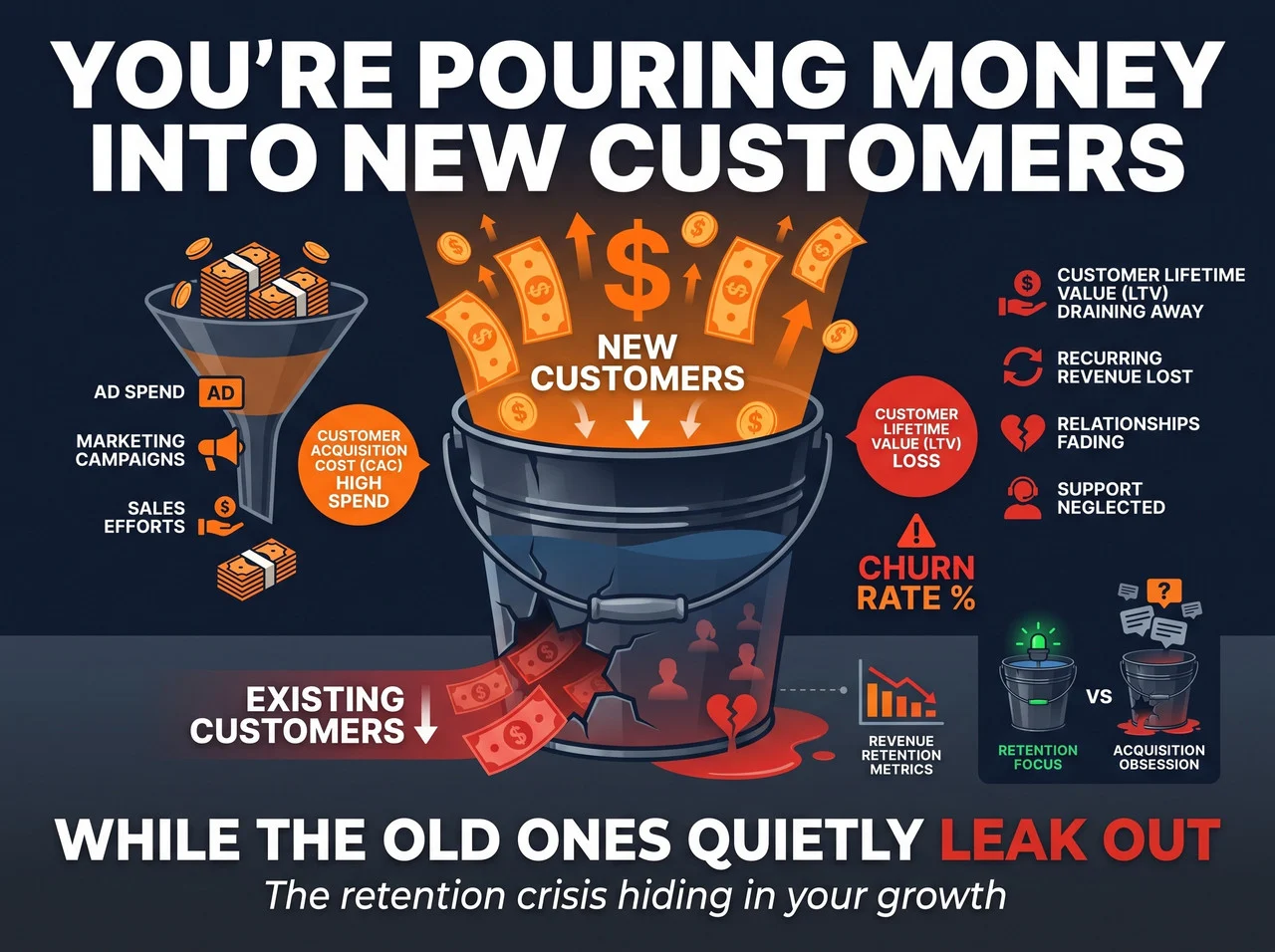
Picture your business as a bucket. Every new customer you win is water poured in the top. Every customer who quietly drifts away — stops reordering, doesn’t renew, forgets you exist — is water leaking out the bottom. Now here’s what most founders do: they respond to a draining bucket by pouring faster. More ads, more outreach, more discounts to strangers. The bucket keeps emptying anyway, and the water gets more expensive every year.
We call it the Leaky Bucket Trap, and it’s one of the most expensive blind spots in small business. Acquisition is visible and exciting — a new logo, a new sale, a dopamine hit. Retention is quiet and unglamorous, so it goes unmeasured and unfunded. But the economics are lopsided in the opposite direction of where the attention goes. This is exactly the kind of counterintuitive, lonely call that Michael Dermer built The Lonely Entrepreneur to help founders get right.
You can’t out-pour a leak. You can only out-spend yourself trying.
The cost gap: winning vs. keeping
Start with the single number that should reframe your whole budget. It costs dramatically more to acquire a new customer than to retain an existing one — the widely-cited benchmark is roughly 5×, and in some industries far higher. The seesaw below shows the imbalance: acquisition is heavy and expensive; retention is light and cheap. Yet the budget usually points the wrong way.
Source: established customer-economics research (Bain & Company / F. Reichheld). Relative cost shown; verify current figures.
And it’s not just cost — it’s conversion. The probability of selling to an existing customer is 60–70%, while for a new prospect it’s just 5–20%. You’re spending 5× more to chase a sale you’re up to 14× less likely to close.
Retention compounds — the profit step
Here’s where it stops being about cost and starts being about compounding. Small improvements in retention don’t add to profit — they multiply it. The classic finding is that increasing customer retention by just 5% can increase profits anywhere from 25% to 95%. The step chart below shows why founders under-rate this: the payoff isn’t linear, it climbs.
Source: Bain & Company / Reichheld retention–profit research. Range shown.
Why does 5% do so much? Because loyal customers do three things at once: they buy again (no reacquisition cost), they spend more over time, and they refer others (free acquisition). Existing customers are also more likely to try new products and less price-sensitive. Retention isn’t a cost center you’re trimming — it’s a compounding asset you’re neglecting.
The leaky bucket, visualized
This is the picture to keep in your head. You pour 100 new customers in the top. But if you’re losing a chunk out the bottom every year, your real growth is only what’s left after the leak. The rows below narrow as customers drain away — and every gap is money you already paid to acquire, gone.
Illustrative model. Actual retention curves vary by business; measure your own.
Every point of churn you plug is worth more than a point of new acquisition — because you already paid the acquisition cost once. Roughly 65% of a company’s business comes from existing customers, and it’s far cheaper to keep them than to keep replacing them.
The Leaky Bucket Trap, in three numbers
Three numbers belong on the wall next to your acquisition dashboard — not to stop you growing, but to make sure the water stays in.
Established customer-economics benchmarks (Bain / Reichheld / Marketing Metrics).
The four moves — plug before you pour
Closing your Leaky Bucket Trap doesn’t mean stopping acquisition — it means fixing the drain first so every new dollar sticks. Measure the leak: most founders can’t state their churn or repeat-purchase rate; calculate it this month, because you can’t plug a hole you can’t see. Talk to the ones who left: a handful of honest “why did you stop?” conversations reveal more than any acquisition campaign, and the fixes are usually cheap. Build one retention habit: a simple onboarding sequence, a check-in cadence, or a loyalty reason-to-return — one system that keeps customers engaged after the first sale. And rebalance the budget: shift even 10–20% of acquisition spend toward retention and watch the compounding math work in your favor. Don’t do it alone — founders who pressure-test these decisions with peers make the shift faster than those grinding solo.
Stop asking “how do I get more customers?” Start asking “why am I losing the ones I have?”
Frequently Asked Questions
What is the Leaky Bucket Trap?
Spending heavily to acquire new customers while quietly losing existing ones to churn. Because acquisition is visible and retention is quiet, founders over-fund the expensive side and neglect the cheaper, more profitable one.
Is it cheaper to keep a customer than win one?
Yes. The widely-cited benchmark is that acquiring a new customer costs roughly 5x more than retaining one, and you are 60-70% likely to sell to an existing customer versus 5-20% for a new prospect.
How much does retention affect profit?
The classic Bain and Company / Reichheld finding is that increasing retention by 5% can raise profits between 25% and 95%, because loyal customers repurchase, spend more, and refer others.
How do I know if I have a leak?
Calculate your churn or repeat-purchase rate. Most founders cannot state theirs. If you do not know how many customers returned this year versus last, you cannot see the leak.
Should I stop spending on acquisition?
No. Plug the leak before you pour rather than stop growing. Fix retention first so acquired customers stick, then keep acquiring. Shifting 10-20% of acquisition budget toward retention often produces outsized returns.
Published by The Lonely Entrepreneur — the community and coaching platform for entrepreneurs who are building alone. lonelyentrepreneur.com
This article is for educational purposes and is not a substitute for professional financial or legal advice.