

 Founder Data Report
One Client Is 30% of Your Revenue. Here’s What That Costs You at Sale.
You can’t afford to risk your business without a Sidekick at your side.
Your biggest customer feels like your greatest asset right up until the moment a buyer looks at your business. Then it becomes the most predictable discount in the deal.
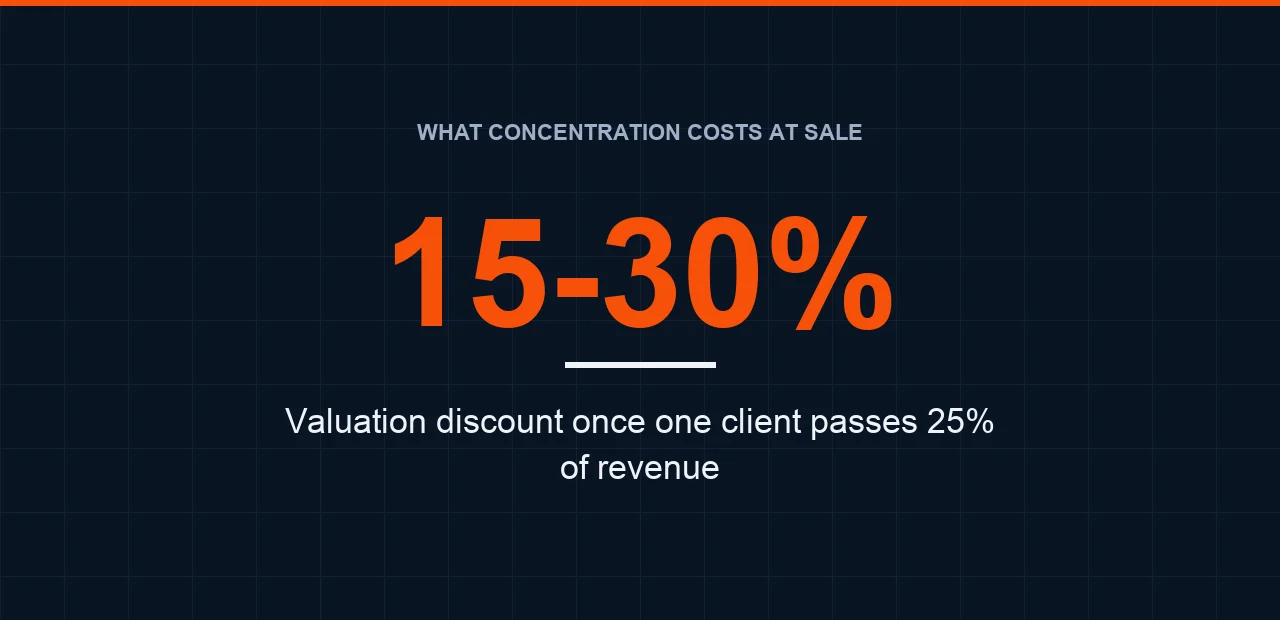
Quick answer: Buyers want no single customer above 10-15% of revenue and the top five under 40%. Cross 20% and the discount is the most predictable one in M&A — commonly one to two turns of EBITDA. Cross 25% and deals see 15-30% valuation discounts. Cross 30% and the structure itself changes: earnouts, escrow holdbacks, money you only collect if the client stays. The revenue is real. The price you get for it is not the same.
- Buyers want the largest client under 10-15%, and the top five under 40%.
- Above 20% of revenue from one client: typically 1-2 turns of EBITDA off the price.
- Above 25%: valuation discounts of 15-30%, restructured terms, or buyers walking.
- Above 30%: earnouts and holdbacks — you get paid only if the client stays.
- A 3-5 year contract cuts the concentration discount by 30-50%.
- This is the rare risk you can fix years ahead of needing to.
The client that feels like security
There is a particular kind of comfort in a large client. The revenue is predictable, the relationship is warm, and the invoices clear. You stop chasing quite so hard. You build the team around their work. Somewhere in there the percentage creeps from fifteen to twenty-five to a third of everything you bill, and because nothing bad has happened, it does not register as a risk at all.
It registers the first time someone tries to buy your business. A buyer is not purchasing last year’s revenue — they are purchasing the probability of next year’s. And every dollar that depends on one relationship, one procurement manager, one contract renewal, gets priced for what happens if that relationship ends the week after closing.
Earnouts and escrow holdbacks tied to that client staying. A meaningful share of the price moves out of cash at close and becomes conditional.
Discounts of this size, restructured terms, or the buyer withdrawing outright. This is where deals start dying quietly.
The single most predictable discount buyers apply. On a business at 5x, losing a turn is a fifth of the price.
What institutional buyers actually want to see, with the top five customers under 40% combined.
Sources: CT Acquisitions, Customer Concentration Risk in a Business Sale (2026); Mid Market Advisors; Livmo buyer-pricing analysis.
The same business, two different prices
The clearest way to see the cost is two companies with comparable revenue and different customer distribution. The gap is not a rounding error — it is the difference between selling a business and selling most of one.
Source: Livmo, buyer-pricing analysis of SaaS exits (2026).
Read the second line carefully. It is not only a lower multiple. Forty percent of the money is contingent on a customer relationship continuing after the founder who built it has left. That is the part founders underestimate: concentration does not just lower the number, it moves your money to the far side of a risk you no longer control.
Concentration does not only cut the price. It moves your money to the far side of a risk you can no longer control.
Why this one is worth fixing early
Most valuation problems cannot be solved quickly. You cannot manufacture three years of margin history in a quarter. Concentration is the exception — it is arithmetic, and arithmetic responds to deliberate action. Every new client of consequence lowers the ratio. So does growing the rest of the book faster than the anchor account.
And where you genuinely cannot diversify, you can contract. A multi-year agreement with real notice provisions changes how the risk reads: buyers assign a materially smaller discount to revenue that is contracted rather than assumed.
Sources: CT Acquisitions, Customer Concentration Risk in a Business Sale (2026); Mid Market Advisors; Livmo buyer-pricing analysis. Contracted-revenue effect reported for 3-5 year agreements with auto-renewal and notice provisions.
The question to ask this quarter
Pull your revenue by customer for the last twelve months and calculate two numbers: what percentage comes from your largest client, and what percentage comes from your top five. If the first is over twenty and the second is over forty, you have found the most expensive item on your balance sheet — and it is not on your balance sheet.
You do not have to be selling for this to matter. The same concentration that discounts a sale also limits what a bank will lend you and weakens every negotiation you have with that client, because they can feel their own leverage. Fixing it is not exit preparation. It is just running a business somebody else could survive owning.
Sources: CT Acquisitions, Customer Concentration Risk in a Business Sale (2026); Mid Market Advisors; Livmo buyer-pricing analysis.
Frequently Asked Questions
How much revenue from one client is too much?
Institutional buyers want no single customer above 10-15% of revenue, with the top five under 40% combined. Above 20% is treated as elevated risk and above 30% typically changes the structure of a deal.
How much does customer concentration reduce business value?
Above 20% of revenue from one client, buyers commonly take one to two turns of EBITDA off the price. Above 25%, reported valuation discounts run 15-30%, and some buyers withdraw entirely.
What is an earnout and why does concentration trigger one?
An earnout holds back part of the purchase price until agreed conditions are met. With concentration above about 30%, buyers tie that holdback to the key client staying — so you are paid only if the relationship survives your exit.
Can a long-term contract fix customer concentration?
It helps materially. Buyers assign a 30-50% lower concentration discount to revenue under a 3-5 year contract with auto-renewal and reasonable notice provisions. Diversifying the customer base is still the stronger fix.
Does concentration matter if I am not selling?
Yes. The same ratio limits what lenders will extend and weakens your negotiating position with that client, because they can see their own leverage as clearly as you can.
Published by The Lonely Entrepreneur — the community and coaching platform for entrepreneurs who are building alone. lonelyentrepreneur.com
This article is for educational purposes and is not a substitute for professional financial or legal advice.