

 Founder Data Report
What Is Your Business Actually Worth? The Multiple Depends on Your Size.
Get clarity — download the free Entrepreneur Survival Guide Summary.
Two businesses with identical profit can sell for very different money. Most of the difference is not performance — it is which side of a size threshold you are standing on.
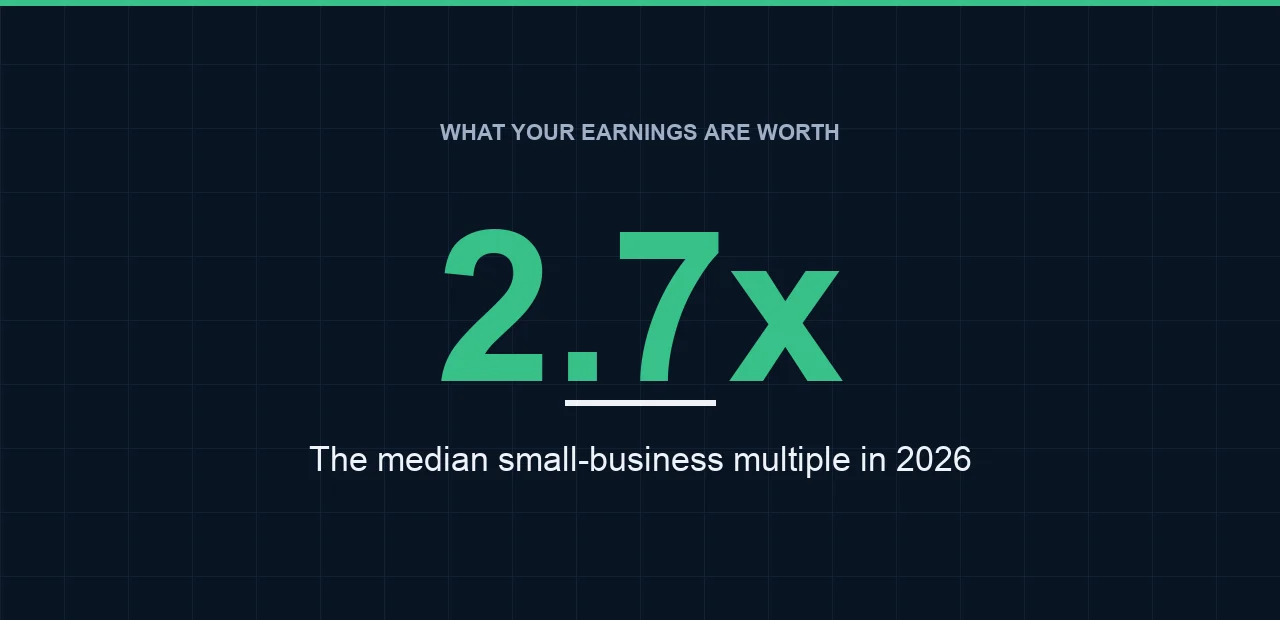
Quick answer: The typical small business sold for $350,000 in Q1 2026 at a 2.7x multiple of seller’s discretionary earnings, on median cash flow of $165,256 (BizBuySell). Multiples climb with size: roughly 2.0x under $500K of earnings, 3.3x at $1-2M, then 4.0x for $2-5M and 5.3x from $5-50M once you are valued on EBITDA rather than SDE. Same profit, different multiple — because size changes who is allowed to buy you.
- Median small-business sale in Q1 2026: $350,000 at 2.7x SDE on $165,256 cash flow.
- SDE multiples run about 2.0x under $500K of earnings and 3.3x at $1-2M.
- Cross into EBITDA territory and it is roughly 4.0x at $2-5M, 5.3x at $5-50M.
- SDE is for owner-operated businesses; EBITDA is for manager-run ones.
- Revenue multiples run 0.42x to 1.2x, averaging 0.67x — a weak guide on its own.
- Growing earnings past a threshold can raise the multiple and the base at once.
The question every founder asks eventually
Usually it arrives quietly. A competitor sells, or a broker calls, or you turn fifty-five and realise the largest asset you own is the thing you go to every morning. And you find you genuinely do not know what it is worth — not roughly, not within a range.
The honest answer is that your business is worth a multiple of its earnings, and the multiple is set less by how good the business is than by how big it is and who is therefore allowed to buy it. That is not a comfortable answer for people who have spent a decade making something excellent. It is, however, the one the market uses.
Private equity and strategic acquirers compete here. Professional buyers, real processes, and the highest multiples in the small-business market.
The lower middle market. You are institutionally buyable, which is what moves the multiple.
Strong Main Street. Individual buyers and search funds, often with SBA financing behind them.
Owner-operator territory. The buyer is purchasing a job as much as an asset, and the multiple reflects it.
Sources: BizBuySell Q2 2026 Insight Report; Regalis Capital 2026 SDE/EBITDA multiple guide. SDE applies to owner-operated businesses; EBITDA to larger manager-run ones.
Why the same profit gets two different prices
A business earning four hundred thousand and one earning three million are not simply different in scale — they are sold to different people. The first is bought by an individual who will run it themselves, financing it personally, and who is buying their own employment along with the cash flow. The second is bought by an institution with capital, a thesis and a management bench.
That is the real mechanism behind the multiple. Institutional buyers pay more because they can — and because a business that runs without its founder is a genuinely different asset from one that does not. Which is also why the single most valuable thing you can do to your own multiple has nothing to do with revenue.
Source: BizBuySell Insight Report, Q1-Q2 2026 (aggregated broker-reported transactions).
Your multiple is not a grade on how well you run the business. It is a statement about who is able to buy it without you.
Two ways to be worth more, and only one is obvious
The obvious route is earning more. Move from eight hundred thousand of SDE to two million and the base grows — but you also cross into a band that prices on EBITDA at a higher multiple. That is the compounding a lot of owners never see coming: the same dollar of profit is simply worth more once you are large enough to be bought by someone different.
The less obvious route is removing yourself. The gap between SDE and EBITDA is essentially a measure of how much of the business is you. SDE adds your compensation back because the buyer is stepping into your role. EBITDA does not, because a manager already does the work. Building the business so it runs without you is what moves you across that line.
Source: Regalis Capital, 2026 valuation guide. Threshold is approximate and set by earnings, not revenue.
What to do with this number
Take your last twelve months of earnings, find your band, and apply the multiple. That figure is not an appraisal — real valuations turn on customer mix, margin trend, contracts, and how much of the operation lives in your head. But it is close enough to make decisions with, and infinitely better than the number you have been carrying around in your head.
Then look at the band above yours and calculate what closing that distance is worth. For most owners the answer is startling, and it reframes the next three years from a grind into something with a price attached. That is not an exit plan. It is just knowing what your work is building.
Source: BizBuySell Insight Report, Q1-Q2 2026 (aggregated broker-reported transactions). Range across all reported transactions.
That spread is why revenue multiples are close to useless on their own. A business can sell for a third of revenue or well over it depending on margin, concentration and whether it runs without the owner. Earnings multiples are what the market actually transacts on. Use revenue as a sanity check, never as the answer.
Frequently Asked Questions
What multiple do small businesses sell for in 2026?
The typical small business sold at 2.7x seller's discretionary earnings in Q1 2026, at a median price of $350,000 on $165,256 of cash flow (BizBuySell). Multiples rise with size, from about 2.0x under $500K of earnings to 5.3x in the $5-50M band.
What is the difference between SDE and EBITDA?
SDE adds the owner's compensation back to earnings, because the buyer is stepping into the owner's role — it suits owner-operated businesses under roughly $2M of earnings. EBITDA leaves management cost in and applies to larger, manager-run businesses, which are valued at higher multiples.
Why do bigger businesses get higher multiples?
Because a different class of buyer can purchase them. Private equity and strategic acquirers have capital and management capacity that individual buyers do not, and they pay more for a business that already runs without its founder.
Can I value my business on revenue?
Only as a rough sanity check. Reported revenue multiples span 0.42x to 1.2x and average 0.67x — a range far too wide to make decisions on. The market transacts on earnings multiples.
How do I increase my valuation multiple?
Grow earnings into a higher band, and reduce how much of the business depends on you personally. The second is what moves you from an SDE valuation to an EBITDA one, and that shift alone can be worth more than a year of growth.
Published by The Lonely Entrepreneur — the community and coaching platform for entrepreneurs who are building alone. lonelyentrepreneur.com
This article is for educational purposes and is not a substitute for professional financial or legal advice.